VAN GOGH’S MOMENT OF CLARITY

Olivia Weinberg in More Intelligent Life:

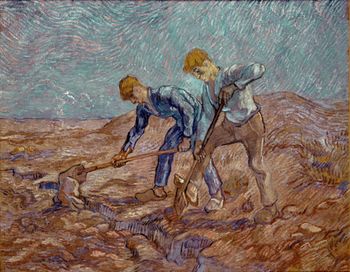
VanMons is a city steeped in history. Located in the east of the Borinage, an area in the Walloon province of Hainaut in Belgium, it was a military camp for the Romans, a thriving hub during the Industrial Revolution and the site of the first major battle fought by the British and the Germans in 1914. Now, 101 years later, it is back in the firing line—as the European Capital of Culture. Mons won the title on its own merits, and then someone realised that 2015 marks the 125th anniversary of the death of Vincent van Gogh. So he kicks off the programme for the year—but don’t expect an explosive blockbuster. “Van Gogh in the Borinage” homes in on the roots of his art, tracing the back-story behind the narrative we know. In 1878, aged 25, Van Gogh moved to Cuesmes, a coal-mining village in the Borinage blackened by a blanket of soot and a smoky haze. He was an evangelical preacher, desperate to become a respected clergyman, but he struggled to connect with the world around him and empathised instead with peasants and miners, some of whom he befriended and began to draw.

To train himself, he copied two artists whose style and subject he admired, Jules Breton and Jean-François Millet. “The Diggers” (above) and “The Sower”, both after Millet, show early signs of raw talent and deep emotional intelligence. Throughout his career, Van Gogh would return to simple, rustic scenes and the daily lives of working people, only with thicker impasto and brighter, more intense colour.

More here.

Friday Poem

A Soft, Bright Absence
Oddly enough, relief rises when he opens the door.
The steady thud of his steps, a falling night stick.
He holds me & my heart thumps like the pulse
of red & blue lights. The helicopter whir of anxiety
slows its chopping in my chest. When he’s late,
my searchlight does not go black. I breathe deeper
knowing that his rights have not been read.
His wrists cuffed only by crisp shirt & his father’s
bracelet, shiny as a revolver just cleaned.
When he says hey baby, hey honey, it is
a soft, bright absence of siren and megaphone.
.

by Tara Betts
from Alehouse Press, 2011

How Long Has It Been Since You Smelled a Flower?

Richard Shelton in Orion Magazine:

PrisonFOR FORTY YEARS I have worked at the nexus where language intersects with the lives of prison inmates, and it has proven to be one of the most exciting intersections imaginable. Much of it involves unlearning. Unlearning the language of excuses and the refusal to accept responsibility for one’s acts. Unlearning outmoded and no longer effective literary devices and attitudes. Unlearning, in short, by means of the honest and creative use of language, one’s orientation toward oneself and the world. Then building—building a renewed awareness of the natural world—a kind of wonder, a kind of hope that one is not entirely alone, not entirely lost as long as the swallows come back each spring and can be seen even from the narrow slot called a window in a prison cell.

There seems to be no limit to the evil we are capable of doing to one another. This includes both the assailant waiting for his victim and the state treating an inmate with deprivation so severe it amounts to torture, including the ultimate version of it—sensory deprivation. Early American prisons were designed so that an inmate would have no contact with anyone else, not even his keeper. Each man (and there were no prison facilities for women then) was given work to do in a totally private cell, a cell designed in such a way that he could neither see nor hear any other humans. He could not, as well, have any contact with the natural world. He was deprived of rain, snow, birds, plants, sunsets, animals, insects—everything. The shadow of this early practice hangs over today’s prisons like a cloud, producing policies by prison administrators who are often completely unaware of the history of those policies.

More here.

Thursday, January 22, 2015

Michel Houellebecq’s Francophobic satire

150126_r26055-320Adam Gopnik at The New Yorker:

The French writer Michel Houellebecq has become a literary “case” to be reprimanded as much as an author to be read, and his new novel, “Soumission,” or “Submission,” shows why. The book, which will be published in English by Farrar, Straus & Giroux, is shaped by a simple idea. In France in the very near future, the respectable republican parties fragment the vote in a multiparty election, and the two top vote-getters are Marine Le Pen, of the extreme right, and one Mohammed Ben Abbes, the fictive leader of a French Muslim Brotherhood. In the runoff, the French left backs the Muslim, preferring the devil it doesn’t know to the one it does. Ben Abbes’s government soon imposes a kind of relaxed Sharia law throughout France and—this is the book’s central joke and point—the French élite are cravenly eager to collaborate with the new regime, delighted not only to convert but to submit to a bracing and self-assured authoritarianism. Like the oversophisticated Hellenists in Cavafy’s poem, they have been secretly waiting for the barbarians all their lives.

Houellebecq is one of those writers who cause critics to panic, since placing him is tricky. He is probably the most famous French novelist of his generation. An immediately recognizable caricature of Houellebecq as a wannabe Nostradamus was the image on the last issue of Charlie Hebdo before the attack on its staff. But he is not a particularly graceful stylist, and it exasperates French writers who are to see him made so much of outside France, not to mention within it.

more here.

Is ‘Jesus’ Son’ a ‘Red Cavalry’ Rip-Off?

RedjesusNathan Scott McNamara at The Millions:

New Yorker Fiction Editor Deborah Treisman tells Donald Antrim about how she recently interviewed Denis Johnson at the Brooklyn Academy of Music. She says, “I asked him about this book, about Jesus’ Son…he’s quite dismissive of it when he talks about it now, and he said it’s just a rip-off of Isaac Babel’s Red Cavalry…” Antrim says that he’s never read Red Cavalry, and the discussion ofJesus’ Son, on its own terms, continues on.

But what does Denis Johnson mean by calling his most iconic book a “rip-off” ofRed Cavalry — a classic of early 20th-century Russian literature? Johnson’s book features a ragtag cast of addicts in rural America, engaged in efforts of drug procurement and petty crime that almost always go wrong. Red Cavalry, on the other hand, features the title army during the Russian-Polish campaign, the Soviets’ first military effort toward spreading Communism to the rest of Europe. In terms of locations and circumstances, the books are radically different. But, on closer look, they actually do share a lot in common.

“The orange sun is rolling across the sky like a severed head,” Babel writes in the opening story ofRed Cavalry (as translated by Peter Constantine). “The stench of yesterday’s blood and slaughtered horses drips into the evening chill.”

more here.

Low-Hanging Fruit

Francis FitzGibbon in London Review of Books:

HLFZakat, the Quranic obligation on Muslims to give alms for the relief of poverty, is one of the five pillars of Islam. The Holy Land Foundation (HLF), founded in 1988 by American citizens of Palestinian heritage, raised money for distribution by zakat charitable committees in Gaza and the West Bank. Most of it went to buy food, clothes and education for children. Between 1992 and 2001 the foundation raised at least $56 million. On 3 December 2001 the US Treasury Department decreed that the HLF was a ‘specially designated global terrorist’ (SDGT), and the next day, without informing the foundation of this decision, the FBI closed down its offices. Five staff members and the HLF itself were charged in 2004 with a variety of terrorism offences, on the basis that the money the organisation raised was ultimately going to fund Hamas.

The first trial, in 2007, resulted in a hung jury. The defendants were convicted in a retrial the next year. The leaders of the HLF, Shukri Abu Baker and Ghassan Elashi, are serving 65-year sentences and will die in jail. Three others were given prison sentences of 15 or 20 years. They lost their appeals, and the Supreme Court refused to hear the case, despite patent failings and abuses in the legal process. The 9/11 attacks precipitated much hasty and panicked action by the US authorities: hence the Patriot Act and the other instruments of at best dubious legality that the Bush administration used to advance the war on terror. But as a tale of legal chicanery by a government, of moral panic and of complicity on the part of the judiciary, what happened to the HLF is hard to beat.

Read the rest here.

Alice Munro’s Magic

Lee_1-020515_jpg_250x1097_q85Hermione Lee at the New York Review of Books:

Writers who get away from, or are in savage dispute with, “home,” yet spend most of their lives writing about it, are not uncommon, especially in North America: think of Shillington, Pennsylvania; Newark, New Jersey; Milledgeville, Georgia; Jackson, Mississippi; Red Cloud, Nebraska; or Great Village, Nova Scotia. What is special about Munro’s lifelong use and reuse of “family furnishings” and “unremarkable” local landscape?

Partly it is her exceptionally thorough and dedicated mining of the same ingredients, which endlessly come up rich and fresh, seem never to be used up, and however artfully shaped, feel “real.” Lives of Girls and Women (1971) was going to be calledReal Life. Munro’s “real life” ingredients become enormously familiar to us: the childhood in the fox farm on the edge of town, the mother with incurable Parkinson’s, the studious girl reading her way out of the country into university, the expectations for young women in 1940s and 1950s provincial, conservative, colonial Canada; the early marriage and motherhood in Vancouver, the condescending young husband, the adultery, the divorce, the deaths of her parents, the returns home.

In her stories about her mother’s past, “My Mother’s Dream” and “Dear Life,” she nudges us to remember that this is “real life,” even though she didn’t witness it herself: “It is early morning when this happens in the real world. The world of July 1945.” “He does not have any further part in what I’m writing now…because this is not a story, only life.”

more here.

Thursday Poem

Another Island

The old man sleeps on the little lawn
of the Korean Rosicrucian Church.
He positions himself like a cardboard cutout
all over Echo Park, sometimes by the curb
at Safeway, sometimes staring there
into the traffic as if it were a stream.
He always wears the same trimmed beard
and eyes like cloudy mornings.

Wherever he went in his youth
he didn't come home.
He hunkers down on his heels and sings,
brown bottle neck the instrument of his song.
He sits on the curb
and waves cover his ankles.

Even if I should catch his eye,
I couldn't find him.
I have a different island
to attend to and don't try to stop
the spinning door between the worlds.
I remember very carefully
how to come back.

by Eloise Klein Healy
from Artemis in Echo Park
Firebrand Books, 1991

Frankenstein Can’t Come Out And Play Today

Carl Zimmer in his excellent blog, The Loom:

ScreenHunter_956 Jan. 22 14.00In the standard Frankenstein story, a scientist creates an unnatural monster that breaks out of the lab and runs amok. But why should unnatural make something unstoppable? The contrary is possible, too. Imagine a different story: Frankenstein’s monster escapes, realizes that it can’t survive in the outside world, and retreats back to the lab. This story line may not make for a satisfying movie, but it might be a good goal for real life.

The fear of the unstoppable unnatural has been with us ever since scientists began moving genes between species in the 1970s. In a 1973 experiment, researchers transferred a gene from a frog into Escherichia coli. The gut microbe used the frog gene to make a frog protein.

It wasn’t long before researchers figured out how to use genetic engineering to turn microbes into factories. When scientists inserted the gene for human insulin into E. coli, the bacteria were able to manufacture a drug that had previously been harvested from cow pancreases. E. coli became the workhorse of biotechnology, spewing out drugs, vitamins, and industrial materials. (For more on E. coli’s strange yet significant history, see my bookMicrocosm.)

At first, the prospect of foreign genes in E. coli was terrifying. Some critics warned that insulin-producing bacteria would escape from fermenting tanks, get into people’s bodies, and cause an epidemic of diabetic comas. That never happened, probably because insulin does E. coli no good at all. The human gene is a burden to the microbe, draining off energy and resources it could use to grow.

More here.

What, To the Black American, Is Martin Luther King Jr. Day?

Chris Lebron in the New York Times:

ScreenHunter_955 Jan. 22 13.44I am very honored to be addressing you here today, though it is not without some trepidation.

You see, the distance between where I grew up, where I come from in the world, and where many of you sit is significant. That I am where I am in the world sometimes surprises me. So I consider it an especially pressing duty to be mindful of my journey; and, when possible, to remind others that such a journey is just that for some of us — a setting out without a clear sense that we will get where we intend to go.

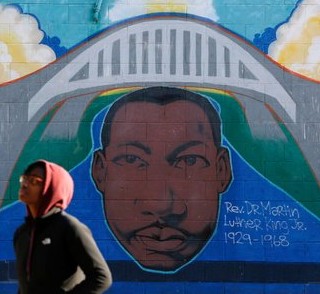
Representing the point of view that I do — as a brown American from a lower-class background, with the good fortune today to walk the halls of one of America’s most elite institutions as a teacher of philosophy — Martin Luther King Jr. Day is taken to represent a triumph. But here is an uncomfortable truth: It is a triumph of acceptable minimums rather than full respect for those who continue to wait for Dr. King’s dream to become reality.

My purpose is to challenge the common belief that honoring of Martin Luther King Jr. means the same thing to all Americans. Recalling the sense of disconnect expressed by Frederick Douglass in his speech “What, to the Slave, Is the Fourth of July?” — between himself as a former slave and his white audience — I want to say there is also some distance between black and white Americans today, between “you” and “I,” as it were, and that this day has increasingly become “yours,” not mine.

More here.

Two, Not Together

Nurjahan Akhlaq in ArtAsiaPacific:

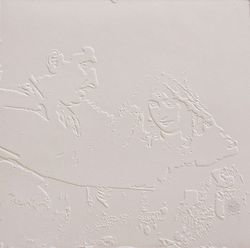
Two-not-together-series_-relief-print-on-somerset-paper-9_5x9___346Aisha Abid Hussain’s exhibition of recent works, entitled “Two Not Together,” was exhibited at Hanmi Gallery, in London, from August to September in 2014. In this body of work, consisting of photography, video, collage and prints, Abid Hussain delicately rips apart the institution of marriage. A recent graduate of the MFA program at London’s Goldsmiths College, as well as an alumni of the National College of Arts in Lahore (where the artist is based), Abid Hussain gained international recognition for her inclusion in the 2013 Bloomberg New Contemporaries—an annual touring exhibition of recent art graduates in the United Kingdom. A glance at her resume also reveals that she has shown at museum exhibits in New York, Vienna and Delhi, just to name a few.

“Two Not Together” is an exploration of Abid Hussain’s interest in gender and power relations, which are recurring themes within her oeuvre. For the works in the exhibition, however, inspiration came from her family photo archive. The artist claims: “My keen interest in human relationships with one another and to one’s surroundings inspires me hugely. The series is a satire, an attempt to start a debate regarding the institution of marriage. It is an effort to investigate the idea of marriage—is it not becoming a utopian concept in the present time and age?” Making use of a text by Urdu writer Bano Qudsia that frames the Hanmi Gallery show, Abid Hussain quotes the author’s reasons for which a marital contract should be valid in today’s world. For reasons other than having children, Qudsia suggests that a marriage contract should be renewed every two or three years. The artist herself adds that a paper contract for two individuals sealing their romantic commitment to one another is itself an archaic concept. The work in this exhibit uses a variety of media that parody, spurn and scrutinize the conventions of marriage that are specific to cultural context. The relief prints entitled “Two Not Together” (2014) are a remarkable set of works. The original photos that Abid Hussain’s prints are derived from are of her parents’ wedding. Five images, which originally captured moments of festive spectacle and ceremonial splendor, have been stripped of their photographic gloss and saturation and reduced to relief prints. The resulting images are rife with symbolism.

More here.

Wednesday, January 21, 2015

Why Can’t the World’s Greatest Minds Solve the Mystery of Consciousness?

4bf512b3-672c-4309-8900-a0039bcd86db-680x1020

Oliver Burkeman in The Guardian (Illustration by Peter Gamelen):

The consciousness debates have provoked more mudslinging and fury than most in modern philosophy, perhaps because of how baffling the problem is: opposing combatants tend not merely to disagree, but to find each other’s positions manifestly preposterous. An admittedly extreme example concerns the Canadian-born philosopher Ted Honderich, whose book On Consciousness was described, in an article by his fellow philosopher Colin McGinn in 2007, as “banal and pointless”, “excruciating”, “absurd”, running “the full gamut from the mediocre to the ludicrous to the merely bad”. McGinn added, in a footnote: “The review that appears here is not as I originally wrote it. The editors asked me to ‘soften the tone’ of the original [and] I have done so.” (The attack may have been partly motivated by a passage in Honderich’s autobiography, in which he mentions “my small colleague Colin McGinn”; at the time, Honderich told this newspaper he’d enraged McGinn by referring to a girlfriend of his as “not as plain as the old one”.)

McGinn, to be fair, has made a career from such hatchet jobs. But strong feelings only slightly more politely expressed are commonplace. Not everybody agrees there is a Hard Problem to begin with – making the whole debate kickstarted by Chalmers an exercise in pointlessness. Daniel Dennett, the high-profile atheist and professor at Tufts University outside Boston, argues that consciousness, as we think of it, is an illusion: there just isn’t anything in addition to the spongy stuff of the brain, and that spongy stuff doesn’t actually give rise to something called consciousness. Common sense may tell us there’s a subjective world of inner experience – but then common sense told us that the sun orbits the Earth, and that the world was flat. Consciousness, according to Dennett’s theory, is like a conjuring trick: the normal functioning of the brain just makes it look as if there is something non-physical going on. To look for a real, substantive thing called consciousness, Dennett argues, is as silly as insisting that characters in novels, such as Sherlock Holmes or Harry Potter, must be made up of a peculiar substance named “fictoplasm”; the idea is absurd and unnecessary, since the characters do not exist to begin with. This is the point at which the debate tends to collapse into incredulous laughter and head-shaking: neither camp can quite believe what the other is saying. To Dennett’s opponents, he is simply denying the existence of something everyone knows for certain: their inner experience of sights, smells, emotions and the rest. (Chalmers has speculated, largely in jest, that Dennett himself might be a zombie.) It’s like asserting that cancer doesn’t exist, then claiming you’ve cured cancer; more than one critic of Dennett’s most famous book, Consciousness Explained, has joked that its title ought to be Consciousness Explained Away. Dennett’s reply is characteristically breezy: explaining things away, he insists, is exactly what scientists do. When physicists first concluded that the only difference between gold and silver was the number of subatomic particles in their atoms, he writes, people could have felt cheated, complaining that their special “goldness” and “silveriness” had been explained away. But everybody now accepts that goldness and silveriness are really just differences in atoms. However hard it feels to accept, we should concede that consciousness is just the physical brain, doing what brains do.

More here.

The Argumentative Jew

WieseltierLeon Wieseltier at the Jewish Review of Books:

Learning to live with disagreement, moreover, is a way of learning to live with each other. Etymologically, the term machloket refers to separation and division, but the culture ofmachloket is not in itself separatist and divisive. This is in part because all the parties to any particular disagreement share certain metaphysical and historical assumptions about the foundations of their identity. But beyond those general axioms, the really remarkable feature of the Jewish tradition of machloket is that it is itself a basis for community. The community of contention, the contentious community, is not as paradoxical as it may seem. The parties to a disagreement are members of the disagreement; they belong to the group that wrestles together with the same perplexity, and they wrestle together for the sake of the larger community to which they all belong, the community that needs to know how Jews should behave and live. A quarrel is evidence of coexistence. The rabbinical tradition is full of rival authorities and rival schools—it owes a lot of its excitement to those grand and even bitter altercations—but the rivalries play themselves out within the unified framework of the shared search. There is dissent without dissension, and yet things change. Intellectual discord, if it is practiced with methodological integrity, is compatible with social peace.

The absence of the God’s-eye view of an issue, and the consequent recognition of the limitations of all individual perspectives, has a humbling effect. A universe of controversy is a universe of tolerance. Machloket is not schism, and the difference is crucial.

more here.

The radical art of the nineteen-thirties

150126_r26047-690Peter Schjeldahl at The New Yorker:

l artists want to change the world, usually just by making it take special notice of them, but now and then they do so out of a devotion to larger hopes. “The Left Front: Radical Art in the ‘Red Decade,’ 1929-1940,” a fascinating scholarly show at New York University’s Grey Art Gallery, on Washington Square, illustrates the most sustained convergence of art and political activism in American history. Some one hundred works by forty artists, along with photographs and publications, tell a story that tends to figure in art history only as a background to the emergence of the Abstract Expressionist generation; Arshile Gorky, Jackson Pollock, Willem de Kooning, et al., shared poverty but not zeal with their marching contemporaries. (Gorky revered Stalin and joined demonstrations near his loft on Union Square, but he scorned proletarian art, pronouncing it “Poor art for poor people.”) The show makes visible a twisty saga that the critic Clement Greenberg, who started his career in the late nineteen-thirties at the initially Communist-sponsored Partisan Review, mentioned in passing in a 1961 book, “Art and Culture.” He wrote, “Some day it will have to be told how ‘anti-Stalinism,’ which started out more or less as ‘Trotskyism,’ turned into art for art’s sake, and thereby cleared the way, heroically, for what was to come.”

The show originated at Northwestern University, where it was curated by John Murphy and Jill Bugajski, and it focussed on the movement’s legacy in Chicago. (“Left Front” was the name of an activist magazine published in that city in the early thirties.) It has now been expanded with material from New York, where the era’s leading organizations of radical artists began: the John Reed Club, in 1929, and its Popular Front successor, the American Artists’ Congress, in 1936.

more here.

Damián Szifron’s ‘Wild Tales’ is a carnival of the polymorphously perverse

Klawans_lowerdepths_ba_img_0Stuart Klawans at The Nation:

Although it was shot in Argentina, partially bankrolled in Spain (by Pedro Almodóvar’s company), given its premiere at Cannes and then shortlisted for the Oscars, the true mark of the internationalism of Damián Szifron’s Wild Tales is that it bears the artistic stamp of Quentin Tarantino. Many other films destined for US art houses display comparably global credentials, but Wild Tales is exceptional for the brio with which it imitates a style that is already proudly imitative—and as accepted worldwide as the American Express card.

You will immediately recognize the genre-movie settings (a cheap roadside diner in the rain, a lonely stretch of mountain highway), the pop-archivist musical choices (Giorgio Moroder’sFlashdance soundtrack, Bobby Womack’s cover of “Fly Me to the Moon”), the frequent pauses to let you admire a graphic effect (an off-kilter close-up, a character framed by a window), and the teasing, discontinuous narrative (which gives you six stories for the price of your ticket).

Above all, note the ratio of laughter to mayhem, which remains high in Wild Tales despite the continually mounting pile of corpses. The body count is already incalculable by the end of the first story, which comes to a boomingly funny climax before Szifron even rolls the opening credits, with their spaghetti-western theme music.

more here.

A window on Chaucer’s cramped, scary, smelly world

Paul Strohm in The Spectator:

ScreenHunter_953 Jan. 21 19.20Proust had his cork-lined bedroom; Emily Dickinson her Amherst hidey-hole; Mark Twain a gazebo with magnificent views of New York City. Where, then, did the father of English poetry do his work? From 1374 till 1386, while employed supervising the collection of wool-duties, Chaucer was billeted in a grace-and-favour bachelor pad in the tower directly above Aldgate, the main eastern point of entry to the walled city of London.

‘Grace and favour’ makes it sound grander than it was. With the help of a wonderfully ingenious pattern of inferences — in particular an architectural drawing from 200 years later which happened to include a sketch of Aldgate’s north tower at its margins — Paul Strohm is able to reconstruct the room in which, after a long day weighing bags of wool and writing down columns of figures, Geoffrey Chaucer retired to scratch away at his verse.

Chaucer occupied a single bare room of about 16’ x 14’. The only natural light would come from ‘two (or at most four) arrow slits’ tapering through the five-foot thickness of these walls (the towers were a defensive feature) to an external aperture of four or five inches. ‘Light, even at midday, would have been extremely feeble. Arrangement for a small fire might have been possible. Waste would be hand-carried down to the ditch that lapped against the tower and dumped there.’

You can imagine how cosy it was in winter. And the noise! Chaucer slept directly over the main London thoroughfare. Every morning at first light the portcullis would go rattling up, and thereafter ‘the creak of iron-wheeled carts in and out of the city, drovers’ calls, and the hubbub of merchants and travellers pressing for advantage on a wide but still one-laned road, probably made sleep impossible, five-foot walls or no five-foot walls’. That’s if he could hear anything over the incessant bong-bonging of bells from each of the three churches within a couple of hundred feet of his front door.

More here.

Understanding (Artificial) Intelligence

Ali Minai in Barbarikon:

IMG_1396This piece in the Atlantic from a few months ago is a wonderful profile of Douglas Hofstadter and a timely exposition of an issue at the core of the artificial intelligence enterprise today.

I read Doug Hofstadter's great book, Goedel, Escher, Bach (or GEB, as everyone calls it) in 1988 as a graduate student working in artificial intelligence – and, as with most people who read that book, it was a transformative experience. Without doubt, Hofstadter is one of the most profound thinkers of our time, even if he chooses to express himself in unconventional ways. This piece captures both the depth and tragedy of his work. It is the tragedy of the epicurean in a fast food world, of a philosopher among philistines. At a time when most people working in artificial intelligence have moved on to the “practical and possible” (i.e., where the money is), Hofstadter doggedly sticks with the “practically impossible”, in the belief that his ideas and his approach will eventually recalibrate the calculus of possibility. The reference to Einstein at the end of the piece it truly telling.

My main concern, however, is the deeper point made in the Atlantic article: The degree to which the field of artificial intelligence (AI) has abandoned its original mission of replicating human intelligence and swerved towards more “practical” applications based on “Big Data”. This point was raised vociferously by Fredrik deBoer in a recent piece, and much of this post is a response to his critique of the current state of AI.

deBoer begins with a simplistic dichotomy between what he terms the “cognitive” and the “probabilistic” models of intelligence. The former, studied by neuroscientists and psychologists – grouped together under the term “cognitive scientists” – was the original concern of AI, which sought to first understand and then replicate human intelligence. Instead, what dominates today is the latter approach which seeks to achieve practical capabilities such as machine translation, text analysis, recommendation, etc., through the application of statistics to large amounts of data without any attempt to “understand” the processes in cognitive terms. deBoer sees this as a retreat for AI from its original lofty goals to mere praxis driven, in his opinion, by the utter failure of cognitive science to elucidate how real intelligence works.

More here.

The People’s Protest: Sudan from the margins

Zachariah Mampilly in n + 1:

ScreenHunter_952 Jan. 21 19.02Sudan was the site of the first major anti-colonial revolt in African history, when the followers of Muhammad Ahmad, known as the Mahdi (or Redeemer), overthrew the Anglo-Egyptian regime in 1885. Yet the Mahdist revolt is not the only or even most consequential of Sudan’s historic uprisings. In 1964, countless Sudanese took to the streets to overthrow the military regime of Ibrahim Abboud. At the forefront of the revolt was the country’s emerging civil society—students, trade unions, and members of the vibrant Sudanese Communist Party. But the protest wave quickly swelled beyond civil society, drawing in ordinary people as it flowed towards the presidential palace. Most demonstrations were peaceful, but some engendered bouts of rioting. The regime opened fire, killing twenty-eight and scattering protesters. Its victory was short lived, however: the next day, facing pressure from junior military officers unhappy with the violent crackdown, Abboud dissolved the military government and stepped aside. The triumph of the protesters, now remembered as Sudan’s “October Revolution,” represented the first time in post-colonial African history that a popular movement overthrew a military regime, preceding the Arab Spring by nearly half a century.

But few other post-colonial nations have struggled as much to remain a viable national community. Just two years ago, the southern region was cleaved off, following a civil war that had stretched on for decades. As with an amputated limb, many Sudanese cannot shake the sensation of its phantom presence.

More here.