Stomach-acid-powered micromotors

From KurzweilAI:

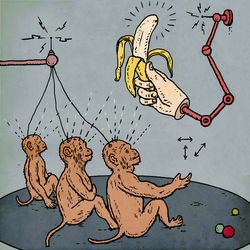
Zinc-micromotorsImagine a micromotor fueled by stomach acid that can take a bubble-powered ride inside a mouse — and that could one day be a safer, more efficient way to deliver drugs or diagnose tumors for humans. That’s the goal of a team of researchers at the University of California, San Diego. The experiment is the first to show that these micromotors can operate safely in a living animal, said Professors Joseph Wang and Liangfang Zhang of the NanoEngineering Department at the UC San Diego Jacobs School of Engineering. Wang, Zhang and others have experimented with different designs and fuel systems for micromotors that can travel in water, blood and other body fluids in the lab. “But this is the first example of loading and releasing a cargo in vivo,” said Wang. “We thought it was the logical extension of the work we have done, to see if these motors might be able to swim in stomach acid.”

In the experiment, the mice ingested tiny drops of solution containing hundreds of the micromotors, which are 20 micrometers long. The motors become active as soon as they hit the stomach acid and zoom toward the stomach lining at a speed of 60 micrometers per second. They can self-propel like this for up to 10 minutes. This propulsive burst improved how well the cone-shaped motors were able to penetrate and stick in the mucous layer covering the stomach wall, explained Zhang. “It’s the motor that can punch into this viscous layer and stay there, which is an advantage over more passive delivery systems,” he said. The researchers found that nearly four times as many zinc micromotors found their way into the stomach lining compared with platinum-based micromotors, which don’t react with and can’t be fueled by stomach acid. Wang said it may be possible to add navigation capabilities and other functions to the motors, to increase their targeting potential. Now that his team has demonstrated that the motors work in living animals, he noted, similar nanomachines soon may find a variety of applications including drug delivery, diagnostics, nanosurgery and biopsies of hard-to-reach tumors.

More here.

Wednesday, January 28, 2015

Armand Marie Leroi’s rewarding study of Aristotle’s science

Adam Rutherford in The Guardian:

DownloadIn this lush, epic and hugely enjoyable book, biologist Armand Marie Leroi explores the idea that it was another ancient Greek giant whose shoulders we may all stand upon. In his mid 30s, around 346 BCE, Aristotle exiled himself from Athens to islands in the Aegean, where he spent time thinking and writing about nature, possibly near a lagoon on Lesbos. We primarily know him as a philosopher, but here, Aristotle's biological output was titanic: he dissected dozens of species and compiled the first biology textbook, Historia Animalium. It is this body of work that Leroi argues continues to percolate through scientific thought today.

There's great temptation in analysing historical scholars to suggest that their insights were in some way vatic, or to use that horrid phrase, they were “anticipating” things to come. Leroi does a splendid job of avoiding hagiography of his hero, and never springs that inviting trap. Aristotle's contention that seals are mutated quadrupeds is true in a purely Darwinian sense: they are mammals, evolved from terrestrial four-legged mammals. But Leroi points out that this is not Aristotle's thinking. The idea that mutation from common ancestors was the cause of species is not present in any of Aristotle's work. He was not predicting evolution, nor did he once consider that Darwinian truth.

More here.

A Graphene Discoverer Speculates on the Future of Computing

Katia Moskvitch in Scientific American:

ScreenHunter_965 Jan. 28 20.57What does graphene mean for the future of computing?
It is certain that silicon will be used for transistors—semiconductor devices that are the building blocks of modern computers—for at least the next five to 10 years. But people are already thinking about possible alternative materials and technologies to replace silicon when it will fail to deliver for increasingly smaller and smaller transistors. A graphene transistor is one of the alternatives.

I’m also looking into other one-atom-thick 2-D materials that were obtained soon after graphene and at heterostructures based on those 2-D crystals. Potentially they can provide an alternative to silicon technologies, but here we’re talking about completely new architecture rather than just introducing a new material into the system. It’s hard to predict how it will develop because when you introduce one new material into a process, it’s already quite a complicated step, and if you want to change the whole architecture, it requires years of research. That’s why research should start now if we want to achieve something like that in 10 years’ time.

What do you think computers of the future could look like?
Computers are much more than just a display, interface and software: they are mainly about computing power and microprocessors—also known as the central processing unit [CPU], or the “brain” of a computer. In the future, we’ll probably expand the parallel computations, utilizing microprocessors with larger number of cores, when several CPUs will be working together on the same chip, enabling the computer to perform many more tasks with a much greater overall system performance. At the same time more specialized computers will start to appear because the cost won’t be so prohibitive anymore.

More here.

The Blog Comment That Achieved an Internet Miracle

Conor Friedersdorf in The Atlantic:

LeadLast month, an improbable Internet exchange inspired many who noticed it to reconsider what's possible when debating politics online. It began when MIT professor Scott Aaronson published a blog post on a sexual harassment controversy. A predictably heated argument ensued in the comments section. Then, 171 comments into the thread, Aaronson achieved a breakthrough: He posted a reply so personal, vulnerable and powerful that it transformed the character of the conversation. And all sides emerged better able to see one another's humanity.

The comment that begat this small Internet miracle wasn't perfect. Neither were the responses to it–as ever online, some needless cruelty and lack of charity followed.

But Aaronson and his interlocutors did transform an obscure, not-particularly-edifying debate into a broad, widely read conversation that encompassed more earnest, productive, revelatory perspectives than I'd have thought possible. The conversation has already captivated a corner of the Internet, but deserves wider attention, both as a model of public discourse and a window into the human experience. It began with the most personal thing that the professor had ever publicly shared.

More here.

A Review of Herbrechter’s “Critical Posthumanism”

EX-MACHINA2John Bruni at berfrois:

If posthumanism signals the end of a certain way of describing—or, more precisely, orienting—selfhood, then we might ask, as Ralph Waldo Emerson did at the start of his famous essay, “Experience” (that addressed, among other crucial issues, slavery), “Where do we find ourselves?” (266). [1]

To be sure, technology has already expanded ideas about seeing the human as created through evolution. Marvin Minsky argues that robots will be the next evolutionary phase; they will be our “children.”[2] Ray Kurzweil anticipates the ethical issues of posthumanism will be worked out by machines gaining consciousness and then guiding themselves (and, presumably, us) through deeper realms of spiritual experience and insight. [3]

But, it must be asked, where does all this talk about spiritual transcendentalism leave the crucial subject of our bodies? N. Katherine Hayles cautions that privileging the disembodiment of information is a return to Cartesian dualism that supports the liberal humanist subject: what posthumanism seeks to challenge.[4] Cary Wolfe, moreover, reminds us that we have to take into account how posthumanism is shaped by our relationships with other embodied forms of life constituted by non-human animals.[5]

more here.

Conversation as Performance: On ‘BOMB: The Author Interviews’

1616953799.01.LZZZZZZZNick Ripatrazone at The Millions:

The art of literary conversation, by whatever name, is certainly not new.Hannah Rosefield opened her review of John Freeman’s How to Read a Novelist to a larger discussion of our cultural obsession with the interview as a way to look behind the authorial mask. Rosefield is dismissive of Freeman’s collection of 55 profiles of novelists, calling them “weirdly artificial…as if the writer is sitting alone in a restaurant or, sometimes, in her glamorous apartment, addressing occasional comments to the atmosphere.” Literary hero worship.

Rosefield isn’t enthralled with interviews as a whole, but her discussion is insightful. Many contemporary writers are known for their disinterest in the form — ranging from the prolific and visible Joyce Carol Oates to the prolific and invisible Thomas Pynchon — but she traces the displeasure back to Henry James, who gave his first interview in 1904, nearly 30 years after he published his first novel.

The magazine that has become synonymous with interviews is The Paris Review, which, as Rosefield notes, published a long interview with E.M. Forster in their first issue, Spring 1953. John Rodden, author of Performing the Literary Interview: How Writers Craft Their Public Selves, the first book-length examination of the literary interview genre, thinks George Plimpton “virtually invented” the literary interview as a genre for the “little magazine.”

more here.

Pope Francis, Radical Leftist?

Pope-FrancisElizabeth Stoker Breunig at The New Republic:

In any analysis of a public figure, partisan interests will influence one’s opinion, and there isn’t anything particularly productive about pointing out that conservatives tend to forgive in conservative leaders what they don’t in liberals. A more helpful question is this: Why has Pope Francis addressed political issues, such as climate change, inequality, poverty, and overpopulation? Is it evidence of abject partisan interest, or a covert dedication to communism, Marxism, or some other insidious ideology?

Or is it just that we now presume that “politics” belongs outside the Church’s purview—despite the Church’s historical record of considering and intervening in political affairs? To me, this appears to be the distortion at hand.

This is partly because the notion that “politics” can be neatly separated from daily life is a new one. For earlier political theorists, like Aristotle and Augustine, politics was just a natural extension of community life. But over time, a fantasy of “politics” wholly divorced from everyday life and experience has emerged in certain corners of liberal thought, producing with it the expectation that politics is a matter for professional politicians and their colleagues, while those in religious offices should simply avoid addressing politics altogether.

more here.

21 + 21 = 42

Carley Moore in TNB:

Carley-21-2-e1422065147403Last summer I turned 42 years old. On the morning of my birthday, my then-boyfriend asked me what I was doing when I was 21, half that age. I said, “Baking quiches, dropping acid, and chasing boys.” I imagined this retort as a tweet—short and to the point. I’d managed to get my life at that time down to 39 characters, and it was mostly accurate.

At 21 years old, I was obsessed with Molly Katzen’s Moosewood cookbook, The Enchanted Broccoli Forest. I was going to a state school in upstate New York, not far from the home of the Moosewood restaurant in Ithaca, which had always seemed to me a cultural mecca in a vast state of industrial depression and blight. Ithaca was the home of my favorite thrift shop, Zoo Zoos, and a lot of cute hippie musicians I dreamed of fucking. The cookbook was steeped in that same sexy, vintage, hippie musician lore. I imagined myself cooking for one of those musicians. I could be his “old lady” for a recipe or two. Many of my activities then were overlaid with a fantasy plot line, worthy of an episode of Laverne and Shirley or Three’s Company. I was rarely just doing something; I was doing that thing while imagining I was in the TV sitcom version of it. As a child, I’d made it through my sometimes chore of washing the dishes by pretending I was in a Dawn dish soap ad.

More here.

Unconscious thought not so smart after all

Alison Abbott in Nature:

MindIf you have to make a complex decision, will you do a better job if you absorb yourself in, say, a crossword puzzle instead of ruminating about your options? The idea that unconscious thought is sometimes more powerful than conscious thought is attractive, and echoes ideas popularized by books such as writer Malcolm Gladwell’s best-selling Blink. But within the scientific community, ‘unconscious-thought advantage’ (UTA) has been controversial. Now Dutch psychologists have carried out the most rigorous study yet of UTA — and find no evidence for it.

…A typical study probing UTA asks subjects to make a complex decision, such as choosing a car or a computer, after either mulling over a list of the object’s attributes or viewing the list quickly and then engaging in a distracting activity such as a word puzzle. However, such studies have drawn different conclusions, with about half of those published so far reporting a UTA effect and the other half finding none. Proponents of the theory claim that the effect is exquisitely sensitive to experimental variations, and often attribute the negative results to the fact that many research groups varied elements of the set-up, such as the choice of puzzle used for the distraction3. Critics say that the positive results came from having too few participants in the experiments. Psychologists Mark Nieuwenstein and Hedderik van Rijn at the University of Groningen in the Netherlands set out with their colleagues to determine which explanation was correct. They asked 399 participants — around ten times more than the typical (median) sample sizes in other studies — to choose between either 4 cars or 4 apartments on the basis of 12 desirable or undesirable features. They incorporated the full list of conditions that UTA proponents had reported as yielding the strongest effect, such as the exact type of puzzle used as a distraction. They found that the distracted group was no more likely than the deliberating group to choose the most desirable item.

More here.

Why free speech is fundamental

Steven Pinker in the Boston Review:

ScreenHunter_965 Jan. 28 12.54More than two centuries after freedom of speech was enshrined in the First Amendment to the Constitution, that right is very much in the news. Campus speech codes, disinvited commencement speakers, jailed performance artists, exiled leakers, a blogger condemned to a thousand lashes by one of our closest allies, and the massacre of French cartoonists have forced the democratic world to examine the roots of its commitment to free speech.

Is free speech merely a symbolic talisman, like a national flag or motto? Is it just one of many values that we trade off against each other? Was Pope Francis right when he said that “you cannot make fun of the faith of others”? May universities muzzle some students to protect the sensibilities of others? Did the Charlie Hebdo cartoonists “cross a line that separates free speech from toxic talk,” as the dean of a school of journalism recently opined? Or is free speech fundamental — a right which, if not absolute, should be abrogated only in carefully circumscribed cases?

The answer is that free speech is indeed fundamental. It’s important to remind ourselves why, and to have the reasons at our fingertips when that right is called into question.

More here.

Tuesday, January 27, 2015

Larry Sultan’s photos capture, tenderly, the paradise of Southern California – and the tensions and desires that complicate it

Morgan Meis in The Smart Set:

IC_MEIS_SULTAN_AP_000When I look at photographs by Larry Sultan I smell eucalyptus and lavender. Those are the plants I can name. I also smell the gnarled bushes and brown weeds, the nameless desert flowers that grew in the nooks and crannies of Laurel Canyon, in the places that hadn’t been watered and replanted by homeowners. Running around in the behind-spaces of the Hollywood Hills as a youth, I smelled all those smells, got them on my fingers. It is strange that a photograph, something that cannot be smelled or touched or tasted, could recall those sensations. But those dirt-dusted plant smells are in every frame of Sultan’s photographic series Pictures from Home (1982-92), The Valley (1998-2003), and Homeland (2006-9).

Larry Sultan died of cancer in 2009; the Homeland series constitutes his final testimony. The smelliest of the Homeland pictures is, for me, Creek, Santa Rosa (2007). Santa Rosa is actually up in Northern California, but Sultan shot it to look more or less the same as L.A.’s Valley. The picture shows a half-dried creek behind a housing development. A youngish Latino man crouches down with a bucket. Presumably, he is gathering water. Another man is heading up the hill behind, his bucket already full. In terms of content, the picture is not unlike something you might see in a 17th century painting. European villagers drawing water from a nearby river. Something painted, maybe, by Claude Lorrain.

But in a picture by Claude Lorrain, the villagers drawing the water are fully integrated into the landscape. With Claude, people belong to place and place belongs to people. The paintings work because everything holds together in a neo-classical pictorial oneness. It doesn’t work that way in a picture by Larry Sultan. The two men in Creek, Santa Rosa are drawing water from the creek because they don’t have access to the taps in the modern homes just behind them.

More here.

Raising Elvis

Allison Gehlhaus in Brain, Child:

SymbolsIt’s been an eye-opening twelve years. A time to examine some preconceived—literally—notions regarding the raising of boys and girls. Especially my own. I had been stunned and hurt by the comments I heard after the birth of our daughters. The nurses at the hospital told me that they hear a lot of women apologize to their husbands after giving birth to girls. Seriously. Right in the labor room. One nurse said, “Don’t they realize that it is the man who determines the sex of the baby?” Another quipped, “So maybe the men should apologize.”

So I shouldn’t have been surprised when visitors would say, “Maybe next time,” with a dismissive wave at our little pink bundles of joy. Or, “How soon are you going to try again?”

My brother-in-law actually said, “Three girls. That’s the pits.”

He’s lucky to be alive.

“Another girl? Is Hank mad at you?” a neighbor asked.

And when I answered, “Yeah, my husband’s furious, he’s kicking me out next week,” she didn’t even flinch.

Read the rest here.

Claude McKay Walks in Ferguson

David X. Noval in The Critical Flame:

ScreenHunter_964 Jan. 27 19.53Claude McKay, born in Jamaica in 1890, is the first modern master of the sonnet form. Yeats of course had turned out a few—one a classic—as had Pound. Cummings wrote plenty of sonnets, but, because of their idiosyncrasies, they are more complications than masterworks. Wilfred Owen, if he had lived, might have rivaled McKay, as he was disposed to the sonnet and masterful in its usage. The only other serious contender, to my mind, would be Edna St. Vincent Millay, and perhaps later, Berryman. In the Selected Poems, first published in 1953, several years after his death, Max Eastman writes (with what McKay’s biographer, Wayne Cooper, generously describes as an “unconscious condescension”):

Claude McKay was most widely known perhaps as a novelist, author of Home to Harlem, a national best-seller in 1928. But he will live in history as the first great lyric genius that his race produced.

Why then has McKay’s work languished in relative obscurity? Eastman writes in 1953 that his “place in the world’s literature is unique and is assured.” Yet in his fifties, after a decade of illness, McKay sought to end his financial difficulties by taking on employment as a riveter—something he was not physically equipped to handle, and which surely contributed to a stroke at age fifty-three. He had turned down a “sizeable” book advance, explaining, “I haven’t been able to concentrate on a plot. It’s quite impossible when one’s mind is distracted. People can’t realize the state of one’s mind under such conditions, and the few I meet make me angry by telling me how happy I look.”

More here.

Remembering Robert Stone

RobertstoneStephen Goodwin at The American Scholar:

Robert Stone, who died on January 10, was a member of the all-but-vanished tribe of hard-living, two-fisted, wildly ambitious American novelists who grew up in Hemingway’s slipstream. In the 1960s, when Bob was writing his first novel, Hall of Mirrors, the elders were guys like Norman Mailer, William Styron, Saul Bellow, and Nelson Algren. They punched like heavyweights. They swung for the fences. They all stalked that shaggy beast, the Great American Novel.

Or so it seemed to an impressionable younger writer like me; I felt just enough younger to have missed out on something. Perhaps I romanticized the generation of writers ahead of me, but from the safety of the academy—I was on path of the writer-teacher—they did seem larger-than-life: more adventurous, more daring, more glamorous that the rest of us would ever be.

By the time I met Bob, he had already won the 1975 National Book Award for his second novel, Dog Soldiers, a thriller that linked the disastrous war in Vietnam with the drug culture that was epidemic on the home front. That book is richly populated with the kinds of characters who would become familiar to his readers: the druggies, the drunks, the psychopaths, the world-weary, the desperate, and the deluded, some of them so violent, cruel, or just plain loony that they could strike fear in your heart.

more here.

THE CREATOR, By Mynona

ImagesMichael Dirda at The Washington Post:

When I first picked up this eerie-looking paperback, attracted by the half-spider, half-human figure on the cover, its author was completely unknown to me. That doesn’t happen a lot (he said immodestly). I could see that Mynona was the German word for “anonymous” spelled backward, but that only fed my curiosity. So I turned to the dust jacket flap of “The Creator” and read the following:

“Mentioned in his day in the same breath as Kafka, Mynona, aka Salomo Friedlaender (1871-1946), was a perfectly functioning split personality: a serious philosopher by day (author of ‘Friedrich Nietzsche: An Intellectual Biography’ and ‘Kant for Kids’) and a literary absurdist by night, who composed black-humored tales he called ‘Groteske.’ His friends and fans included Martin Buber, Walter Benjamin, and Karl Kraus.”

I think it was “Kant for Kids”— the mind reels — even more than the mention of Kafka or literary absurdism that made me look further into this odd novella, originally published in 1920.

more here.

Michel Houellebecq Defends His Controversial New Book

M.-houellebecq-2010�sylvain-bourmeau-e1420217389165Michel Houellebecq interviewed at Paris Review:

Where did you get the idea for a presidential election, in 2022, that came down to Marine Le Pen and the leader of a Muslim party?

Well, Marine Le Pen strikes me as a realistic candidate for 2022—even for 2017 … The Muslim party is more … That’s the heart of the matter, really. I tried to put myself in the place of a Muslim, and I realized that, in reality, they are in a totally schizophrenic situation. Because overall Muslims aren’t interested in economic issues, their big issues are what we nowadays call societal issues. On these issues, obviously, they are very far from the left and even further from the Green Party. Just think of gay marriage and you’ll see what I mean, but the same is true across the board. And one doesn’t really see why they’d vote for the right, much less for the extreme right, which utterly rejects them. So if a Muslim wants to vote, what’s he supposed to do? The truth is, he’s in an impossible situation. He has no representation whatsoever. It would be wrong to say that this religion has no political consequences—it does. So does Catholicism, for that matter, even if the Catholics have been more or less marginalized. For those reasons, it seems to me, a Muslim party makes a lot of sense.

But to imagine that such a party might find itself poised to win a presidential election seven years from now

I agree, it’s not very realistic. For two reasons, actually. First—and this is the most difficult thing to imagine—the Muslims would have to succeed in getting along with each other. That would take someone extremely intelligent and with an extraordinary political talent, qualities that I give to my character Ben Abbes. But an extreme talent is, by definition, an unusual occurrence. But supposing he existed, the party could take off, but it would take longer than seven years.

more here.

Man Down: why men are ridiculous

Amanda Marcotte in Slate:

BookMen: Notes From an Ongoing Investigation may be the most provocative title in a long list of provocative book titles from essayist Laura Kipnis—a remarkable feat for a woman whose previous works include Against Love and Bound and Gagged.

…Repeatedly, she zeroes in on how keenly men are rankled by their revoked entitlement to female flattery, and it’s always hilarious. Christopher Hitchens’ fantasy that men and not women evolved humor for reproductive purposes, she writes, has “the slightly musty air of the 1960-ish Kingsley Amis, wrapped in nostalgia for the merry days when sexual conquest required an arsenal of tactics deployed by bon-vivantish cads on girdled, girlish sexual holdouts.” And in a particularly hilarious piece looking at right-wing male reactions to Hillary Clinton, she muses, “You’d think they were talking about their first wives.” Kipnis paints all this male anxiety in the face of women’s growing power as both humorous and poignant. Thankfully though, despite the residual chill girl tendencies, she never suggests that women should abandon feminism to calm men down.

More here.

Can This Treatment Help Me?

Austin Frakt and Aaron E. Carroll in The New York Times:

Health-articleLargeConsider aspirin for heart attack prevention. Based upon both modifiable risk factors like cholesterol level and smoking, and factors that are beyond one’s control, like family history and age, it is possible to calculate the chance that a person will have a first heart attack in the next 10 years. The American Heart Association recommends that people who have more than a 10 percent chance take a daily aspirin to avoid that heart attack. How effective is aspirin for that aim? According to clinical trials, if about 2,000 people follow these guidelines over a two-year period, one additional first heart attack will be prevented. That doesn’t mean the 1,999 other people have heart attacks. The fact is, on average about 3.6 of them would have a first heart attack regardless of whether they took the aspirin. Even more important, 1,995.4 people would never have a heart attack whether or not they took aspirin. Only one person is actually affected by aspirin. If he takes it, the number of people who remain heart attack-free rises to 1996.4. If he doesn’t, the number remains 1995.4. But for 1,999 of the 2,000 people, aspirin doesn’t make any difference at all.

…The Mediterranean diet, which is heavy in vegetables, fruits, nuts and olive oil; moderate in fish and poultry; and light in dairy, meat and sweets; has long been advocated as a means to avoid heart disease. In people who have never had a heart attack, but who are at risk, the N.N.T. is 61 to avoid a heart attack, stroke or death. And that is for people who adhere to the diet for about five years. For those at higher risk, who have already had a heart attack, to avoid one additional death, the N.N.T. is about 30. That’s the number of people who would have to adhere to the diet for four years so that one extra person survived. About 1.4 people out of 30 such people will die no matter what they eat; 27.6 will not die no matter what they eat. Only one will benefit from sticking to the diet.

More here.