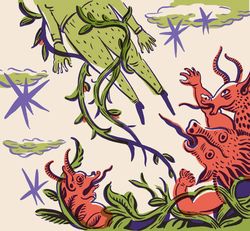
Throughout evolutionary history, we never saw anything like a montage. So why do we hardly notice the cuts in movies?

Jeffrey M. Zacks in Aeon:

ScreenHunter_1142 Apr. 17 17.00Suppose you were sitting at home, relaxing on a sofa with your dog, when suddenly your visual image of the dog gave way to that of a steaming bowl of noodles. You might find that odd, no? Now suppose that not just the dog changed, but the sofa too. Suppose everything in your visual field changed instantaneously in front of your eyes.

Imagine further that you were in a crowd and exactly the same thing was happening to everyone around you, at exactly the same time. Wouldn’t that be disturbing? Kafkaesque? In 1895 in Paris, exactly this started happening – first to a few dozen people, then to hundreds and then thousands. Like many fin-de-siècle trends, it jumped quickly from Europe to the United States. By 1903, it was happening to millions of people all over the world. What was going on? An epidemic of an obscure neurological disorder? Poisoning? Witchcraft?

Not quite, though it was definitely something unnatural. Movies are, for the most part, made up of short runs of continuous action, calledshots, spliced together with cuts. With a cut, a filmmaker can instantaneously replace most of what is available in your visual field with completely different stuff. This is something that never happened in the 3.5 billion years or so that it took our visual systems to develop. You might think, then, that cutting might cause something of a disturbance when it first appeared. And yet nothing in contemporary reports suggests that it did.

More here.

on Wilfred Owen’s “Insensibility”

Wilfred_Owen_plate_from_Poems_(1920)Austin Allen at Poetry Magazine:

The poem plays out over six sections, each brief but densely woven. The first five describe soldiers at war, with the fifth also turning inward to address the speaker and his fellow writers and intellectuals. The sixth shifts to a denunciation of civilians who turn a blind eye to war’s devastation.

The poem’s structure is also founded, with caustic irony, on a biblical model. From the first lines onward, Owen imitates the Beatitudes of the Gospel of Matthew, as well as their equivalent in the Gospel of Luke: “Happy are men who yet before they are killed / Can let their veins run cold.” The Greek word that is traditionally translated as “Blessed” (as in the biblical phrase “Blessed are the meek”) can also be rendered as “Happy.” The eight “blessed” groups in Matthew are “the poor in spirit,” “they that mourn,” “the meek,” “they which do hunger and thirst after righteousness,” “the merciful,” “the pure in heart,” “the peacemakers,” and “they which are persecuted for righteousness’ sake” (King James Version). Within this allusive framework the poem spins a dense web of parallels and contrasts.

more here.

thinking about knausgaard

MyStruggle_cvrforwebBruce Bawer at Hudson Review:

Yet while these very traits may distinguish Knausgaard from your standard Norwegian-literary-elite type, they make him seem very familiar—and endearing—to rank-and-file Norwegians. Like most of his countrymen, Knausgaard is a matter-of-fact and unpretentious soul; although My Struggle does include a number of essayistic musings on life, death, and other grand abstractions, some of which go on at length (the last and longest one, in the final volume, fills over 400 pages), they read not like highfalutin poetry but, in good Norwegian fashion, like frank, intensely engaged, down-to-earth conversation of the sort you could imag­ine taking place over a few beers at some down-at-heels watering hole. For obvious reasons, Knausgaard has been compared to Proust (Time magazine even entitled its review “Norway’s Proust”), but he’s every bit as Norwegian as Proust was French, which is to say that while it came naturally to Proust to perpetrate elaborate, poetic, and witty prose, it comes just as naturally to Knausgaard to be blunt, straightforward, and prosaic—to spin out sentences so artless that they can read like excerpts from a hurriedly dashed-off letter. Knausgaard himself has said that he reveres Proust but has laughingly dismissed descriptions of himself as a Norwegian Proust, stating in an interview, quite sensibly, that the very concept is “a contradiction in terms.”

So Norwegian is he, indeed, that at one point, in what amounts to a summing-up of the so-called Jante Law—formulated in 1933 by Norwegian novelist Aksel Sandemose, by way of representing the manner in which almost all Norwegians are (or, at least until the last couple of decades, were) trained from infancy to think about themselves—Knausgaard tells himself:

Don’t believe you are anybody.

Do not fucking believe you are somebody.

Because you are not. You’re just a smug, mediocre little shit.

more here.

the middlemen—an underground network of recruitment agents in South Asia

1428327147Kamatcrabapplecrowd666Anjali Kamat at Dissent:

Over the past decade, contractors and subcontractors have earned billions of dollars providing half a million Asian migrant workers, primarily from India, Nepal, and the Philippines, to perform the menial tasks in American war zones that soldiers will no longer do: cooking, cleaning, laundry, construction, and base security. Employing these workers—an invisible support army with no domestic political constituency—has allowed Washington to keep troop numbers and casualty figures artificially low. Over the years, prompted by worker unrest and some media attention, conditions for workers have somewhat improved on the bases. But the very first phase of their exploitation—the manner in which they were recruited—has not changed, and they continue to be hired through the same extortionary system that supplies labor to the Gulf countries.

On a U.S. military base I visited in northern Afghanistan in December 2013, most of the workers were rural migrants from India and Nepal. The cooks spent twelve hours a day preparing and serving meals to hungry American soldiers: roast beef, turkey, mashed potatoes, meatloaf, and pasta. As they put up Christmas decorations in the dining hall under the watchful gaze of a U.S. commander, they spoke in hushed tones of fees paid to agents, threats made by loan sharks, and the pressures of working in a war zone. Everyone was deep in debt.

more here.

The new thought police

Joan W. Scott in The Nation:

ImageSince Wise's letter, a number of university leaders have echoed her invocation of civility. In September, Nicholas Dirks—once a postcolonial historian and anthropologist who wrote critically of British rule in India, and now chancellor of the University of California, Berkeley—released a statement to his campus community. Reminding his constituents that 2014 was the 50th anniversary of the Free Speech Movement, he called for civility in terms that should surprise anyone who has studied the First Amendment or the long history of academic freedom: “We can only exercise our right to free speech insofar as we feel safe and respected in doing so, and this in turn requires that people treat each other with civility. Simply put, courteousness and respect in words and deeds are basic preconditions to any meaningful exchange of ideas. In this sense, free speech and civility are two sides of a single coin—the coin of open, democratic society.” Dirks seems to have forgotten that the Free Speech Movement was not an event characterized by civility either in its expression or in its suppression.

Within days of Dirks's statement, Eric Barron, the president of Penn State, released a video message to his own community deploring the erosion of civility in university discourse. The video was provoked by the controversy over a child-sexual-abuse scandal involving coaches of the school's fabled football team. “Respect is a core value at Penn State,” Barron said in a statement. And so “we ask you to consciously choose civility and to support those whose words and actions serve to promote respectful disagreement and thereby strengthen our community.”

* * *

“Civility” has become a watch word for academic administrators. Earlier this year, Inside Higher Ed released a survey of college and university chief academic officers, which found that “a majority of provosts are concerned about declining faculty civility in American higher education.” Most of these provosts also “believe that civility is a legitimate criterion in hiring and evaluating faculty members,” and most think that faculty incivility is directed primarily at administrators. The survey brought into the open what has perhaps long been an unarticulated requirement for promotion and tenure: a certain kind of deference to those in power.

Read the rest here.

Friday Poem

The Unthinkable

It wants the grandest place
– the heavenly –
albeit not on the horizon,
neither between here and there
nor before, nor beside, nor behind
the borders of space.

Remain neutral
– this is the outline –
supple shell,
neither root nor egg,
moveable therefore, adaptable,
in the anonymous,
what is without reference,
mass in the department store,
at the railway station,
at the aerospace installation,
in the trail of automobiles
along the highway,
(anthropology of supermodernism)
in the bustle,
in haste,
globalising,
in motionless speed,
now, yonder, elsewhere,
circling information
everywhere and simultaneously, worldwide,
without coercion,
without necessity,
without a destination,
eroded knowledge,
fractured power,
indifferent,
free.

by Albert Bontridder
from Wonen in de vloed
publisher: Poëziecentrum, Gent, 2012
translation: 2012, Willem Groenewegen

Fruits and Vegetables Are Trying to Kill You

Moises Velasquez-Manoff in Nautilus:

3706_4764f37856fc727f70b666b8d0c4ab7aYou probably try to exercise regularly and eat right. Perhaps you steer toward “superfoods,” fruits, nuts, and vegetables advertised as “antioxidant,” which combat the nasty effects of oxidation in our bodies. Maybe you take vitamins to protect against “free radicals,” destructive molecules that arise normally as our cells burn fuel for energy, but which may damage DNA and contribute to cancer, dementia, and the gradual meltdown we call aging.

Warding off the diseases of aging is certainly a worthwhile pursuit. But evidence has mounted to suggest that antioxidant vitamin supplements, long assumed to improve health, are ineffectual. Fruits and vegetables are indeed healthful but not necessarily because they shield you from oxidative stress. In fact, they may improve health for quite the opposite reason: They stress you.

That stress comes courtesy of trace amounts of naturally occurring pesticides and anti-grazing compounds. You already know these substances as the hot flavors in spices, the mouth-puckering tannins in wines, or the stink of Brussels sprouts. They are the antibacterials, antifungals, and grazing deterrents of the plant world. In the right amount, these slightly noxious substances, which help plants survive, may leave you stronger.

Parallel studies, meanwhile, have undercut decades-old assumptions about the dangers of free radicals. Rather than killing us, these volatile molecules, in the right amount, may improve our health. Our quest to neutralize them with antioxidant supplements may be doing more harm than good.

More here.

THE MAGIC OF THE GRAVITY ASSIST

Oliver Morton in More Intelligent Life:

GravityIt will be the most far-flung rendezvous in historyand the end of the most taxing uphill trip ever made. On Bastille Day 2015, NASA’s New Horizons spaceprobe will reach Pluto after a slog of more than 5 billion kilometres, with the sun’s gravity pulling against it every step of the way. That such a trip is possible at all is remarkable. That it could be managed in less than a decade is a tribute both to the most brute force and the most subtle calculation. First the force. As interplanetary missions go, this is a small one, weighing half a tonne. But when it was launched in January 2006, it was sitting on top of one of America’s largest rockets, an Atlas V. The launcher burned more than a tonne of rocket fuel and oxygen for every kilo of the craft’s mass. As a result New Horizons headed off to Pluto faster than any previous space mission: 45km a second. Puck boasted that he could put a girdle round the Earth in 40 minutes. At that rate New Horizons could have done it in 14. The need for speed was simple; as the probe headed to the solar system’s outer edge, the centring sun pulled it back. Its gravity was not so strong as to bring the spacecraft to a haltNew Horizons will be the fifth human spacecraft to leave the system entirelybut it was enough to slow it down, draining away the kinetic energy the mighty Atlas had given it at lift-off day by day. By the time it reached Jupiter, about a year later, New Horizons had lost more than half its initial speed.

This is where the cleverness came in. Jupiter did not just provide a target on which New Horizons could test its cameras and other instruments. It also sped it back up. This pick-me-up, known as a gravity-assist manoeuvre, knocked five years off the time taken to get to Pluto. And unlike the Earth-shaking, sky-splitting $200m-or-more expense of an Atlas launch, it needed no fuel and no money. Gravity assists are a beautiful example of the conservation of momentum, one of the most fundamental ideas of Newtonian mechanics: for every action, there is an equal and opposite reaction. When a spacecraft swings past a planet, the pull of the planet’s gravity changes its momentum so that it ends up moving not just in a different direction, but also faster than before.

More here.

Make precision medicine work for cancer care

Mark A. Rubin in Nature:

Cnacer1Ten months ago, the physicians of a feisty 76-year-old sales clerk from New Jersey who had an advanced carcinoma in her urinary tract decided to try an unconventional therapy. A few weeks earlier, they had sent a sample of her tumour to my team at the Institute of Precision Medicine at Weill Cornell Medical College and NewYork-Presbyterian Hospital in New York City. Genetic sequencing had revealed that she had more copies than usual of the HER2 gene (also known as ERBB2). After years of failure with the usual arsenal of surgery, chemotherapy and radiation, the physicians included the drug Herceptin (trastuzumab) in the woman's treatment. Herceptin is more commonly used for breast cancer, but it targets the HER2 mutation. Since taking the drug, she has been free of disease.

Advances in sequencing have dramatically increased the likelihood of discovering mutations that drive tumour growth in certain people and in certain tumours — even in specific cells within tumours. Yet mountains of genomic data are accumulating that are of little use because they are not tied to clinical information, such as family medical history. What is more, genomic data are generally confined to documents that cannot easily be searched, shared or even understood by most physicians. To achieve the level of success in precision medicine for cancer care that US President Barack Obama and others are anticipating, sequence data needs to be linked, in real time, to the patient sitting in front of his or her doctor. Integrated genomic and clinical data will also need to be available, in a searchable way, to a broad community of practitioners and researchers. Prototypes for centralized data banks are showing promise, but serious and sustained investment is needed to scale them up. Clinicians are used to appraising 20–50 measurements from routine laboratory tests, such as for blood-sugar levels. Such data can be easily entered into patients' electronic health records. Genomic data introduces a whole new level of complexity. To give an idea of the scale, it would take more than 25 days to transfer from one computer server to another the 2.5 petabytes (a petabyte is 1,000 terabytes) of data generated by The Cancer Genome Atlas — a US project started in 2005 to catalogue the mutations that drive cancer. This is according to my colleague Toby Bloom, deputy director for informatics at the New York Genome Center, a consortium that specializes in large-scale human genome sequencing.

More here.

Thursday, April 16, 2015

The world’s first hologram protest held in Spain

Alexis C. Madrigal in Fusion:

ScreenHunter_1141 Apr. 17 12.03A protest group pulled off an undeniably futuristic stunt this weekend in Spain: they sent thousands of holograms parading past the lower house of the country’s parliament.

The augmented reality protest was just the latest in activist groups’ campaign against a series of “citizen security” bills, which received final passage in March. The new laws criminalize some forms of protest, such as gathering in front of Parliament. And among highly restrictive digital provisions, the law makes taking or distributing “unauthorized” photographs of police a crime punishable with a 30,000 euro fine. All in, the laws would create 45 new infractions, mostly centered on cracking down on dissent.

The new measures will go into effect July 1, if they survive national and European legal challenges.

No Somos Delito, which translates as We Are Not Crime, has been protesting what they call the country’s “gag law,” and in that context, the hologram protest is more than the stunt it might first appear. Under conditions in which people cannot put their bodies into the streets, the ghostly virtual projections serve both as protest and as a reminder of the protests that cannot occur.

More here.

on ‘how to be both’ by ali smith

F158e712-00d3-4b1f-8a71-9ab5937d8e94Nathaniel Popkin at Public Books:

How to Be Both, the sixth novel by the Scottish writer Ali Smith, is an astounding work of art, so exquisite in its composition that reading it feels like staring into a Decadent painting, bound and endless all at once. This feeling is both the product of the book’s composition and simultaneously its silky essence. Depending on the version the reader has in her hands, she will start, either as I did, with the chatty ghost of Renaissance painter Francesco del Cossa (1435/6–1477/8), landed back on earth in the winter of 2014 in a room with 16-year-old George, whose mother has just died, or with George a few months previous, driving in Ferrara, Italy, with her mother and brother to see del Cossa’s greatest work. The book is about the duality of sexuality and of existence in general, a theme reinforced by the publisher’s decision to print two versions, reversing the order of the two interrelated but distinct parts. Most profoundly, How to Be Both depicts the power of art to produce within art maker and art observer alike capacities we don’t always realize are already there.

“Is there spring in purgatorium?,” purrs del Cossa’s ghost while standing in the place he has landed, room 55 of the National Gallery in London, where his painting Saint Vincent Ferrer hangs. A boy stands before the painting; Francesco can tell that the boy, really the girl George, “faces a door he can’t pass through.”

more here.

The novel that Malcolm Lowry thought burnt to a crisp

P19_Hofmann_1143061hMichael Hofmann at the Times Literary Supplement:

Who ever thought they would one day be able to read Malcolm Lowry’s fabled novel of the 1930s and 40s, In Ballast to the White Sea? Lord knows, I didn’t. The manuscript was the principal casualty of a fire on June 7, 1944 that destroyed the Lowrys’ beach shack outside Vancouver (from which the endlessly revised and near-perfect Under the Volcano was mercifully retrieved), and it was long supposed that all that was left of it were a few perfectly round pieces of charred typescript – like paper portholes – some of them oddly, but inescapably for the accident- and coincidence-obsessed Lowry (“The Element Follows You Around, Sir”), on the subject of fire. That, and the title.

It turns out, however, that in an access of prudence, Lowry had deposited the carbon of an early version of In Ballast in New York City in 1936 (where it had already done the rounds of publishers), with the mother of Jan Gabrial, his first wife, before setting off with Gabrial for Mexico. Mexico did for the marriage, and very nearly for Lowry as well, but it gave him the germ of Under the Volcano (originally a highly technical short story, about a Consul and his daughter witnessing a murder on a Mexican bus); in the end, after twenty months, he retreated to Los Angeles, met and married his second wife, Margerie Bonner, and struck north for Canada, where the couple lived on next to no money in conditions of extreme simplicity. There he continued to work on Under the Volcano and In Ballast pretty much in tandem.

more here.

‘As I Knew Him: My Dad Rod Serling’ by Anne Serling

Rod_Serling_with_daughters_19592An excerpt from Anne Serling's book at berfrois:

Shortly after Julie and Rhoda leave, my dad drives back to his hometown in Binghamton, New York—a small, once bucolic city in upstate New York where down a tree-lined street there stands a white, two-story house with dark shutters. It isn’t difficult to find; head down Front Street, straight onto Riverside Drive, right on Beethoven Street, then two blocks and you’re there.

This is a pilgrimage my father takes every summer until his death. It is 1965. He is forty years old. In ten years he will be gone.

He starts the car and waits as we call, “Good-bye.” He is going back, he says, “just for a few hours,” and leaning out of the car window, waves. His paratrooper bracelet glints in the sun. I listen as the car’s tires crunch through the gravel road of our cottage. I watch him go.

I imagine him driving slowly down Bennett Avenue, his old street, and passing by his house, now slightly in need of painting, a little worse for wear. I wonder if, stopping briefly, he pictures his mother still there, opening the front door, seeing him suddenly, a vision she cannot quite be certain of, holding up her hand to block the afternoon sun. Or maybe it is his father he sees out in the driveway, washing the old Ford, suddenly dropping the hose, which snakes through the air, spraying memories my dad can almost touch as he imagines both his parents running toward him in a kind of dreamlike, slow-motion reverie that only this level of recall can recreate.

more here.

How powerful was the Kaiser?

KAISER_WILHELMChristopher Clark at the London Review of Books:

In January 1904, King Leopold II of Belgium was invited to Berlin to attend a birthday dinner for Kaiser Wilhelm II. The two monarchs were seated next to each other and everything was going nicely until the Kaiser suddenly brought up the question of a possible future French attack on Germany. In the event of a war between Germany and France, Wilhelm explained, he would expect the Belgians to side with Germany. So long as they agreed, he would see to it personally that Belgium was rewarded after the conclusion of hostilities with territories annexed from northern France. Leopold himself, he added, warming to his theme, could expect to be rewarded with ‘the Crown of Old Burgundy’. When the king of the Belgians, unsettled by these speculations, countered that the ministers and parliament of his country were hardly likely to approve of such far-flung plans, Wilhelm became flustered. He couldn’t respect a king, he said, who felt himself answerable to ministers and parliament rather than to God alone. ‘I will not be trifled with!’ he snapped. ‘As a soldier, I belong to the school of Frederick the Great, to the school of Napoleon. If Belgium does not go with me, I will be guided solely by strategic considerations.’ Leopold is reported to have been so upset by the exchange that, on rising from the table, he put his helmet on backwards.

The career of the last German Kaiser is littered with effusions of this kind. They range from the gross and offensive to the bizarre or merely foolish. Wilhelm II spent most of his waking hours talking, arguing, shouting, speechifying, preaching, threatening and generally unbosoming himself of his latest preoccupations to whoever happened to be within earshot. He was like a Tourette’s tic at the heart of the German state executive. Even when he made the utmost effort to restrain himself, the indiscretions kept slipping out.

more here.

Science and serendipity: famous accidental discoveries

Samira Shackle in New Hummanist:

Penicillin

CupPerhaps the most famous accidental discovery of all is penicillin, a group of antibiotics used to combat bacterial infections. In 1928, Scottish biologist Alexander Fleming took a break from his lab work investigating staphylococci and went on holiday. When he returned, he found that one Petri dish had been left open, and a blue-green mould had formed. This fungus had killed off all surrounding bacteria in the culture. The mould contained a powerful antibiotic, penicillin, that could kill harmful bacteria without having a toxic effect on the human body. At the time, Fleming’s findings didn’t garner much scientific attention. In fact, it took another decade before this drug was available for use in humans. Retrospectively, Fleming’s chance discovery has been credited as the moment when modern medicine was born.

Pulsars

In 1967, astronomy graduate student Jocelyn Bell noticed a strange “bit of scruff” coming from her radio telescope. It was a regular signal coming from the same patch of sky, of a type that no known natural sources would produce. Bell and her supervisor, Anthony Hewish, ruled out sources of human interference – other researchers, television signals, satellites. None explained the signal, and the scientists wondered if they had detected a sign from aliens. This was ruled out when another was located in a different part of the sky: it seemed unlikely that two sets of aliens would simultaneously be trying to communicate with Earth. In fact, it was the first discovery of a pulsar (pulsating radio star), a highly magnetised, rotating neutron star that emits a beam of electromagnetic radiation. Pulsars, which had been predicted three decades earlier but had never been actually observed, indirectly confirm the existence of gravitational radiation.

More here.

How the Computer Got Its Revenge on the Soviet Union

Slava Gerovitch in Nautilus:

5828_48000647b315f6f00f913caa757a70b3Here was a target that checked the ideological boxes. In May of 1950 Boris Agapov, the science editor of the Soviet Literary Gazette, penned a scornful critique of the American public’s fascination with “thinking machines.” He scoffed at the capitalist’s “sweet dream” of replacing class-conscious workers and human soldiers—who could choose not to fight for the bourgeoisie—with obedient robots. He mocked the idea of using computers for processing economic information and lampooned American businessmen who “love information [like] American patients love patented pills.” He poured contempt on the Western prophets of the information age, especially the most prominent of them—cybernetics creator Norbert Wiener, a mathematics professor at the Massachusetts Institute of Technology. Cybernetics, which was then just a couple of years old, declared that control and communication mechanisms in biology, technology, and society were fundamentally the same.

Philosophers chimed in, bashing cybernetics for “clinging to the decrepit remnants of idealistic philosophy,” as well as for being “mechanistic” in reducing the activity of the human brain to “mechanical connection and signaling.” Cybernetics, they claimed, was doubly guilty. It deviated from dialectical materialism, the official Soviet philosophy of science, in two opposite directions—toward idealism and toward mechanicism—at the same time. The media portrayed it as both “idealistic” and “mechanistic,” “utopian” and “dystopian,” “technocratic” and “pessimistic,” a “pseudo-science” and a dangerous weapon of Western military aggression. Soviet critics ignored, or possibly were unaware of, Wiener’s openly pacifist stand, which he had taken after Hiroshima, and his refusal to participate in military research.

…The trouble with these public attacks against the use of computers was, of course, that the country desperately needed computers. The military, in particular, recognized the value of the nascent technology, and the risks of being left behind.

So, in a classic example of “doublespeak,” the Soviet Union began to secretly pursue military computing while condemning the West for doing the same. While the press ridiculed American “fantasies” of robots giving military orders, Sergei Sobolev, the chief mathematician of the Soviet nuclear weapons program, tirelessly promoted the development of new computers. These included the Soviet Union’s first computer, the MESM, and its first small computer, the M-1.

Read the full article here.

Things I’ve Learned About Heterosexual Female Desire From Decades Of Reading

Mallory Ortberg in The Toast:

  • ScreenHunter_1140 Apr. 16 13.45A woman can forgive a man for anything, except for having freckles or a weak chin
  • 100% of women want to have sex with a man who embodies the fox version of Robin Hood from the cartoon Robin Hood, but most do not actually want to have sex with a fox or a man dressed as one
  • It’s not enough to have a lot of hair falling in your eyes; men must be constantly tugging at their own hair in exasperation or at the very least running their hands through it as they think carefully about art or something
  • Men should have a TON of money but not care about it for even a SECOND, he should literally forget he even has money, he should whisk you away on a helicopter and then when you try to tip the pilot in cash he’s like “what are those weird little flat green dudes in your wallet?” because he doesn’t care about money at all even though he has so much of it

More here.

Short probabilistic programming machine-learning code replaces complex programs for computer-vision tasks

From KurzweilAI:

Probabilistic programming does in 50 lines of code what used to take thousands

Probabilistic-progOn some standard computer-vision tasks, short programs — less than 50 lines long — written in a probabilistic programming language are competitive with conventional systems with thousands of lines of code, MIT researchers have found. Most recent advances in artificial intelligence — such as mobile apps that convert speech to text — are the result of machine learning, in which computers are turned loose on huge data sets to look for patterns. To make machine-learning applications easier to build, computer scientists have begun developing so-called probabilistic programming languages, which let researchers mix and match machine-learning techniques that have worked well in other contexts. In 2013, the U.S. Defense Advanced Research Projects Agency launched a four-year program to fund probabilistic-programming research. “This is the first time that we’re introducing probabilistic programming in the vision area,” says Tejas Kulkarni, an MIT graduate student in brain and cognitive sciences and first author on the new paper. “The whole hope is to write very flexible models, both generative and discriminative models, as short probabilistic code, and then not do anything else. General-purpose inference schemes solve the problems.”

By the standards of conventional computer programs, those “models” can seem absurdly vague. One of the tasks that the researchers investigate, for instance, is constructing a 3-D model of a human face from 2-D images. Their program describes the principal features of the face as being two symmetrically distributed objects (eyes) with two more centrally positioned objects beneath them (the nose and mouth). It requires a little work to translate that description into the syntax of the probabilistic programming language, but at that point, the model is complete. Feed the program enough examples of 2D images and their corresponding 3D models, and it will figure out the rest for itself. “When you think about probabilistic programs, you think very intuitively when you’re modeling,” Kulkarni says. “You don’t think mathematically. It’s a very different style of modeling.”

More here.

For Persi Diaconis’ Next Magic Trick …

PersiDiaconis

Erica Klarreich in Quanta [h/t: Jennifer Ouellette] (image Skip Sterling):

Diaconis’ career as a professional magician began more than five decades ago, when he ran away from home at age 14 to go on the road with the sleight-of-hand virtuoso Dai Vernon. But unlike most magicians, Diaconis eventually found his way into academia, lured by an even more powerful siren song: mathematics. At 24, he started taking college classes to try to learn how to calculate the probabilities behind various gambling games. A few years later he was admitted to Harvard University’s graduate statistics program on the strength of a recommendation letter from the famed mathematics writer Martin Gardner that said, more or less, “This kid invented two of the best ten card tricks in the last decade, so you should give him a chance.”

Now a professor of mathematics and statistics at Stanford University, Diaconis has employed his intuition about cards, which he calls “the poetry of magic,” in a wide range of settings. Once, for example, he helped decode messages passed between inmates at a California state prison by using small random “shuffles” to gradually improve a decryption key. He has also analyzed Bose-Einstein condensation — in which a collection of ultra-cold atoms coalesces into a single “superatom” — by envisioning the atoms as rows of cards moving around. This makes them “friendly,” said Diaconis, whose speech still carries the inflections of his native New York City. “We all have our own basic images that we translate things into, and for me cards were where I started.”

In 1992, Diaconis famously proved — along with the mathematician Dave Bayer of Columbia University — that it takes about seven ordinary riffle shuffles to randomize a deck. Over the years, Diaconis and his students and colleagues have successfully analyzed the effectiveness of almost every type of shuffle people use in ordinary life.

All except one: “smooshing.”

This toddler-level technique involves spreading the cards out on a table, swishing them around with your hands, and then gathering them up. Smooshing is used in poker tournaments and in baccarat games in Monte Carlo, but no one actually knows how long you need to smoosh a deck to randomize it. “Smooshing is a completely different mechanism from the other shuffles, and my usual techniques don’t fit into that,” Diaconis said. The problem has tantalized him for decades.

More here.