
Enjoying the content on 3QD? Help keep us going by donating now.
Category: Recommended Reading
Thursday, January 1, 2026
Carrie Courogen remembers the cross-genre brilliance of Rob Reiner’s filmmaking
Carrie Courogen in the Los Angeles Review of Books:
 “I don’t have a clear-cut film identity,” Rob Reiner told London’s Sunday Telegraph in 1989.
The late actor, writer, and director was on a promotional tour for When Harry Met Sally…, the fifth feature nestled in what would become an eight-year run of all-timers, including This Is Spinal Tap (1984), The Sure Thing (1985), Stand by Me (1986), The Princess Bride (1987), Misery (1990), and A Few Good Men (1992). With a quick, passing glance at his list of credits, it’s easy to take him at his word. Reiner’s films spanned the genre spectrum, from mockumentary to rom-com to thriller to courtroom drama, and his work as a filmmaker was often described as “versatile,” that of a journeyman: reliable, occasionally great, but never executed with the distinct stylistic flair of a true auteur.
Yet in spite of flash, what Reiner’s vastly differing films all share is the generous and empathetic heart of their director, a deep sense of humanity, and a relentless curiosity about and love of people, in all their imperfections and quirks. It seems a cliché to call a filmmaker’s work personal—what creative work isn’t?—but in Reiner’s case, filmmaking was deeply personal, taking the form not of statements but of questions. Taken all together, they shape the lifelong quest of a man searching for enlightenment on subjects both simple and profound.
More here.
Enjoying the content on 3QD? Help keep us going by donating now.
High-achieving adults rarely began as child prodigies
Christa Lesté-Lasserre at New Scientist:
 International chess masters, Olympic gold medallists and Nobel prize-winning scientists were rarely child prodigies, a review reveals. Likewise, early childhood successes and intense training programmes have rarely led to top achievement at a global level in the adult world.
The analysis – based on 19 studies involving nearly 35,000 high-performing people – shows that the vast majority of adults who lead worldwide rankings in their field of expertise grew up participating in a broad range of activities, only gradually developing their most proficient skill.
The findings contradict popular beliefs that achieving top international performance levels requires intensive, highly focused training during childhood, says Arne Güllich at RPTU Kaiserslautern in Germany.
More here.
Enjoying the content on 3QD? Help keep us going by donating now.
Fields Medalist Terence Tao on Math and AI, and more
Enjoying the content on 3QD? Help keep us going by donating now.
Flying Taxis? China Has Them
Keith Bradsher in the New York Times:
 As an American reporter living in Beijing, I’ve watched both China and the rest of the world flirt with cutting-edge technologies involving robots, drones and self-driving vehicles.
But China has now raced far beyond the flirtation stage. It’s rolling out fleets of autonomous delivery trucks, experimenting with flying cars and installing parking lot robots that can swap out your E.V.’s dying battery in just minutes. There are drones that deliver lunch by lowering it from the sky on a cable.
If all that sounds futuristic and perhaps bizarre, it also shows China’s ambition to dominate clean energy technologies of all kinds, not just solar panels or battery-powered cars, then sell them to the rest of the world. China has incurred huge debts to put trillions of dollars into efforts like these, along with the full force of its state-planned economy.
More here.
Enjoying the content on 3QD? Help keep us going by donating now.
Infinity, Paradoxes, Gödel Incompleteness & the Mathematical Multiverse
Enjoying the content on 3QD? Help keep us going by donating now.
Googoosh!
Dina Nayeri at The Guardian:
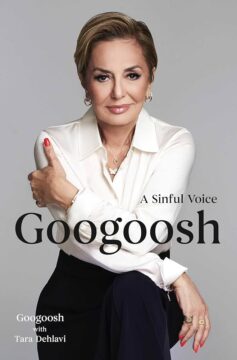 If you ask any Iranian to name the most important female pop star in our country’s history, they’ll say Googoosh. Nobody else comes close. Over six decades of revolution, suppression and exile, Googoosh has gone from singer to cultural icon, a symbol of a country’s grief for its murdered, imprisoned, and muzzled artists, and a living link between pre-revolutionary Iran and the diaspora.
Googoosh was just three years old when she started singing in small halls and cabaret venues where her father worked. By her teens she was a film actor and a fashion icon. In the 60s and 70s, when my mother was a teenager, Googoosh was everywhere: on television, in films, magazines, on the radio. She kept recreating herself – her style, her moves, her hair. (My mother and many of her university classmates copied Googosh’s famous wispy haircut.) For a while, this bold, creative young woman shaped how westerners saw Iran, and how a generation of Iranian women understood modernity, femininity and public life.
more here.
Enjoying the content on 3QD? Help keep us going by donating now.
Thursday Poem
“On Turning Ten”
The whole idea of it makes me feel
like I’m coming down with something,
something worse than any stomach ache
or the headaches I get from reading in bad light
a kind of measles of the spirit,
a mumps of the psyche,
a disfiguring chicken pox of the soul.
You tell me it is too early to be looking back,
but that is because you have forgotten
the perfect simplicity of being one
and the beautiful complexity introduced by two.
But I can lie on my bed and remember every digit.
At four I was an Arabian wizard.
I could make myself invisible
by drinking a glass of milk a certain way.
At seven I was a soldier, at nine a prince.
But now I am mostly at the window
watching the late afternoon light.
Back then it never fell so solemnly
against the side of my tree house,
and my bicycle never leaned against the garage
as it does today,
all the dark blue speed drained out of it.
This is the beginning of sadness, I say to myself,
as I walk through the universe in my sneakers.
It is time to say good-bye to my imaginary friends,
time to turn the first big number.
It seems only yesterday I used to believe
there was nothing under my skin but light.
If you cut me I would shine.
But now if I fall upon the sidewalks of life,
I skin my knees. I bleed.
by Billy Collins
from The Art of Drowning © 1995
Enjoying the content on 3QD? Help keep us going by donating now.
A Moving Fable Of Table Tennis
Nawal Arjini at the NYRB:
 The Hungarian poet Géza Röhrig, the Shark Tank shark Kevin O’Leary, and Timothée Chalamet walk into a bar. The bar is the restaurant of the London Ritz, and it’s 1952. Gwyneth Paltrow is also there, at another table. O’Leary, playing the part of the ink tycoon Milton Rockwell in Josh Safdie’s Marty Supreme, notices the tattoo on the arm of Röhrig’s character, Béla Kletzki. “He used to defuse bombs for the Nazis,” says Timothée, as the ping-pong ingenue Marty Mauser. “Tell ’em the story you told me.” “My guests are waiting,” Rockwell replies. “Wait,” says Marty, “you’re gonna love this.”
Kletzki tells him that, out of respect for his table tennis talent, guards at Auschwitz used to give him unexploded ordnance to defuse, a job that allowed him to leave the camp for a few hours. One day he noticed a beehive, smoked the bees out, and covered himself in honey to bring back to his fellow prisoners under his uniform: cut to a poundingly soundtracked shot of starving men licking honey off Kletzki’s bare chest. While he’s telling this story the unibrowed, mustachioed Marty has been making grotesque faces over his shoulder to the fading actress Kay Strong (Paltrow), Rockwell’s wife; later that night she shows up at his room.
more here.
Enjoying the content on 3QD? Help keep us going by donating now.
NYC has a new Mayor

Our guide to the (literally) biggest novels of the season
From The Washington Post:
 Traditionally, autumn is when publishers bring out their most ambitious novels: the buzziest debuts, the most hotly anticipated returns, the heaviest hitters. This year, many of them were also physically heavy, with page counts that climbed, dizzyingly, into the high hundreds and even four digits. (One independent press told us that producing these books broke their printer.)
What’s a reader to do? Even with the promise of holiday downtime ahead, there’s only so much room on your nightstand. And it can only hold so much weight. The author of one hulking title quipped that while his book had been compared to “a brick,” that wasn’t quite right, because bricks start around four pounds and his tome came in at less than that. Only slightly, it turned out.
More here.
Enjoying the content on 3QD? Help keep us going by donating now.
Wednesday, December 31, 2026
10 Fitness Tips to Help You Get Moving in 2026
Erik Vance in the New York Times:
 On the Well desk, we see a lot of exercise fads. And while all movement is good, plenty of trending workouts aren’t worth your time. “Japanese walking,” a form of interval walking that took over social media this summer, was a rare exception.
The idea is simple: Walk fast for three minutes, then walk slow for three minutes, alternating back and forth for at least 30 minutes. Some research suggests that varying your walking intensity in this way may improve blood pressure, cardiovascular health and leg strength more than keeping the same pace.
If you feel comfortable walking fast for a few intervals, consider increasing the challenge by mixing in some running. Or, if you are a runner looking to go even longer distances, the run-walk method can help you get there.
More here.
Enjoying the content on 3QD? Help keep us going by donating now.
2025 LLM Year in Review
Andrej Karpathy at his own blog:
2025 has been a strong and eventful year of progress in LLMs. The following is a list of personally notable and mildly surprising “paradigm changes” – things that altered the landscape and stood out to me conceptually.
1. Reinforcement Learning from Verifiable Rewards (RLVR)
At the start of 2025, the LLM production stack in all labs looked something like this:
- Pretraining (GPT-2/3 of ~2020)
- Supervised Finetuning (InstructGPT ~2022) and
- Reinforcement Learning from Human Feedback (RLHF ~2022)
This was the stable and proven recipe for training a production-grade LLM for a while. In 2025, Reinforcement Learning from Verifiable Rewards (RLVR) emerged as the de facto new major stage to add to this mix. By training LLMs against automatically verifiable rewards across a number of environments (e.g. think math/code puzzles), the LLMs spontaneously develop strategies that look like “reasoning” to humans – they learn to break down problem solving into intermediate calculations and they learn a number of problem solving strategies for going back and forth to figure things out (see DeepSeek R1 paper for examples). These strategies would have been very difficult to achieve in the previous paradigms because it’s not clear what the optimal reasoning traces and recoveries look like for the LLM – it has to find what works for it, via the optimization against rewards.
More here.
Enjoying the content on 3QD? Help keep us going by donating now.
How Far Back in History Can You Start to Understand English?
Enjoying the content on 3QD? Help keep us going by donating now.
Susan Sontag: A Critic at the Crossroads of Culture
Hal Foster at The MIT Press Reader:
 Austere like her prose and engaged like her subjects, Sontag was my first inkling of avant-garde culture, my initial point of access to an edgy alternative to the Anglophonic modernism — Yeats, Eliot, Pound, Joyce — that represented high literature. Her European protagonists — Lukács, Sartre, Camus, Leiris, Artaud, Weil, Sarraute, Pavese, Cioran, Ionesco, Godard, Bresson, Resnais, Bergman — were exotic to me, and the notion that philosophers, writers, and filmmakers could be political was even more so. I didn’t understand the many differences among these figures, but I sensed a shared posture, one that pointed to a way around the given terms of American culture, mass versus elite, and American politics, liberal versus conservative. I, too, wanted to be against. If Sontag could cross over to my living room, maybe I could cross over to her New York downtown (which even then I took to be the name of an elective affinity as much as an actual place), and I was hardly alone in wanting to do so.
It was her combination of lucidity and ambition that made Sontag so attractive; hers was a “style of radical will,” and we didn’t understand then that her emphasis on style might also be her limitation. Certainly, it prepared her critical success, which left Sontag, like other prominent women of her generation, somewhat unmoved by feminist critiques: smart and “serious” (her preferred term of approval) knew no gender for her.
more here.
Enjoying the content on 3QD? Help keep us going by donating now.
How the internet changed news, according to The Onion
Stephen Johnson at Big Think:
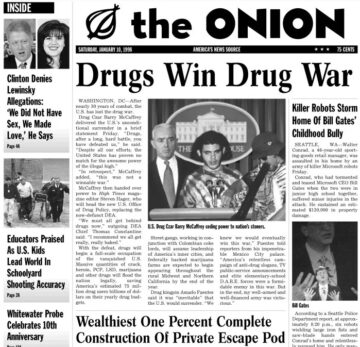 When amateur writers pitch headlines to The Onion, their jokes often flop. One reason may surprise you: They use too many funny words that wink at the reader, “wacky” elements that sabotage any chance at good parody, former Onion editor Joe Randazzo told our sister site Big Think in 2012.
“It’s counterintuitive, but it’s that dry tone and that straight tone of the newspaper article — of the kind of AP style of writing, or New York Times style of writing — is what we strive to achieve,” Randazzo said. “Sometimes just deleting an extra little funny word makes the joke that much better because it’s really emulating that style.”
Parody requires verisimilitude: the act of mirroring the style, tone, and conventions of your target as closely as possible — “down to every syllable and punctuation mark,” Scott Dikkers, a cofounding editor of The Onion, explains in his book How To Write Funny.
More here.
Enjoying the content on 3QD? Help keep us going by donating now.
Saints of the Middlebrow
Jon Repetti at the LARB:
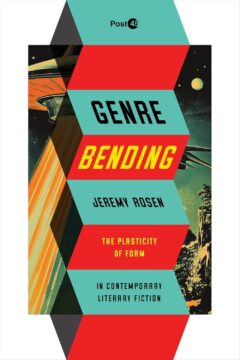 IT’S 2025, and the turn to genre is old news. Since at least the 1980s, writers of “literary fiction” have been adopting the forms and techniques of popular “genre fiction”—a huge category that includes detective novels, sci-fi, spy thrillers, fantasy, horror, Westerns, and all varieties of romance. By 2012, China Miéville could tell the Edinburgh World Writers’ Conference that it had already become “a cliché to point out that generic tropes are infecting the mainstream.” As ever, it seems that the academics are the last to know. Thirteen years after Miéville’s much-cited remark, Jeremy Rosen’s Genre Bending: The Plasticity of Form in Contemporary Literary Fiction can still advertise itself as “the first monograph to address this phenomenon.” (We’ll take the author at his word, while noting that the institutional history of this turn has been told and retold, with the usual variations and hair-splitting, by a number of Rosen’s colleagues: Mark McGurl, Dan Sinykin, and Sarah Brouillette, among others.)
The basic story goes something like this. With the rise of mass culture in the late 19th century, certain prose writers sought to distinguish themselves as makers of “serious art,” cordoning off their work from the crowd of potboilers, bodice rippers, and other products of Grub Street. Building on the example of a few forebears (Gustave Flaubert and Henry James chief among them), the modernists systematized this great divide as a collective project of resistance to market logics in the realm of art.
more here.
Enjoying the content on 3QD? Help keep us going by donating now.
Peruvian Psychedelic Cumbia, Salsa, Boogaloo And Beyond
Enjoying the content on 3QD? Help keep us going by donating now.
Wednesday Poem
Stay
Before you came
I knew my world
Things were in place
The sky steady to the end of sight
The street its familiar self
The glass of wine just a glass of wine
And now
They circle and cavort
Blur so fast
I cannot tell
What is which
And which is what
Stay
If you may
So that again
Time and space
Slip back in place
The sky steady to the end of sight
The street its familiar self
The glass of wine just a glass of wine
by Anjum Altaf
from More Transgressions
Poems inspired by Faiz Ahmed Faiz
LG Publishers, Delhi, 2021
Enjoying the content on 3QD? Help keep us going by donating now.
One Hundred Years of Gossip
Chris Zimmerman in Plough:
 Penned in August 1925, Eberhard Arnold’s “First Law of Sannerz” is the oldest written rule of the community now known as the Bruderhof, and members have been attempting to practice it ever since. It is no exaggeration to say that without it, the community probably would have succumbed by now to one of the many crises it has weathered over the last one hundred years. Here it is:
There is no law but that of love. Love is joy in others. What, then, is anger at them? If we have joy in the presence of others, we will convey it with words of love. It follows that words of irritation or annoyance about members of the community are unacceptable. This is why we can never allow talk against brothers or sisters or their character traits, whether openly or by insinuation – under no circumstances behind their backs. Gossiping within one’s own family is no exception.
Without the commandment of silence, there is no loyalty and therefore no community. The only possibility, when someone’s weakness has caused something in us to rise up against them, is to speak to them directly, in the sense of performing a service of love.
An open word, directly addressed, deepens friendship and will not be taken amiss. Only when two people cannot find one another in this manner will it be necessary to draw in a third person whom both parties trust; and this will lead to a mutual understanding at the highest and deepest levels.
Members of our household should hang this admonition at their places of work, where they always have it before their eyes.
In writing the “First Law,” Arnold, a founder of the Bruderhof, drew inspiration from a passage in the Gospel of Matthew where Jesus advises his followers to solve quarrels “just between the two of you” (Matt. 18:15) and to forgive someone who angers you not just once, nor even seven times, but “seventy times seven” (Matt. 18:21).
More here.
Enjoying the content on 3QD? Help keep us going by donating now.