
Hal Foster at The MIT Press Reader:
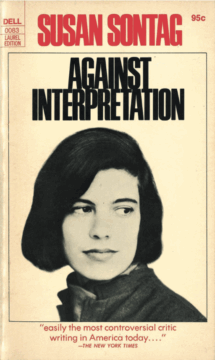 Austere like her prose and engaged like her subjects, Sontag was my first inkling of avant-garde culture, my initial point of access to an edgy alternative to the Anglophonic modernism — Yeats, Eliot, Pound, Joyce — that represented high literature. Her European protagonists — Lukács, Sartre, Camus, Leiris, Artaud, Weil, Sarraute, Pavese, Cioran, Ionesco, Godard, Bresson, Resnais, Bergman — were exotic to me, and the notion that philosophers, writers, and filmmakers could be political was even more so. I didn’t understand the many differences among these figures, but I sensed a shared posture, one that pointed to a way around the given terms of American culture, mass versus elite, and American politics, liberal versus conservative. I, too, wanted to be against. If Sontag could cross over to my living room, maybe I could cross over to her New York downtown (which even then I took to be the name of an elective affinity as much as an actual place), and I was hardly alone in wanting to do so.
It was her combination of lucidity and ambition that made Sontag so attractive; hers was a “style of radical will,” and we didn’t understand then that her emphasis on style might also be her limitation. Certainly, it prepared her critical success, which left Sontag, like other prominent women of her generation, somewhat unmoved by feminist critiques: smart and “serious” (her preferred term of approval) knew no gender for her.
more here.
Enjoying the content on 3QD? Help keep us going by donating now.