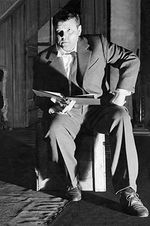
During the 18 years examined here, Welles starred in The Third Man (1949), directedOthello (1952) and Touch of Evil (1958), acted in stage productions in New York, Belfast, Dublin and London, incorporated Shakespeare into his successful Las Vegas magic show, became a reporter on British television and even directed a ballet in London. He also fell abjectly in love with an Italian actress, Lea Padovani, who threw him over (“it was the most intense amatory relationship of his life to date — the first time he had met serious resistance, the first time he had been deeply wounded”).
In Welles, gargantuan intellectual self-confidence and charisma coexisted with a profound sense of inadequacy. He was insecure about his appearance, in particular hating his nose, which he sought to cover up with prosthetic make-up whenever possible. He was an exuberant role-player in everyday situations, able to breeze out of restaurants without paying, but he suffered acutely from stage fright. Joseph Cotten, who acted opposite him in Kane and during the days of the Mercury Theatre in the 1930s, said Welles lacked confidence in himself as a performer, adding: “And he knows that I know that.”
more here.


 and
and  respectively. Write
  for the distance between the two objects. Then Newton’s law says that the gravitational force
  between them is
![[ F=G_ Nfrac{m_1 m_2}{r^2}, ]](https://plus.maths.org/MI/2a3605452ac3c0b078db80069082a51d/images/img-0005.png)
 is a fixed number, known as
  the smaller
  ) and that the gravitational force is stronger between more massive objects (the larger either of
  and
and  the larger
  that acts between two charged particles with charges
  and
and  :
:![[ F = frac{1}{4 pi epsilon _0} frac{Q_1 Q_2}{r^2}. ]](https://plus.maths.org/MI/53dfd7da8e6d4a6ac337a461dce1cd3c/images/img-0001.png)
 stands for the distance between the two particles and
  is a constant which determines the strength of electromagnetism. (It has the fancy name permittivity of free space.)