The Anti-Packaging Movement

Aimee Lee Ball in The New York Times:

Precycling-slide-7Z2B-blog427THE SHOPPERS AT Original Unverpackt, a food market in the gentrifying but still gritty Berlin neighborhood of Kreuzberg, arrive largely by bicycle, carrying mesh totes and burlap sacks. Along one impeccably organized wall, they lift the spouts of gravity bins to let grains, nuts or legumes tumble into the tins and jars they’ve brought along. At the bulbous stainless steel fusti, they dispense olive oil, balsamic vinegar or soy sauce into glass vessels. A customer samples a Medjool date, but looks confused about what to do with the pit — there are no napkins, no trash cans — and ends up stashing it in her pocket. She is, after all, shopping at a store committed to zero waste. Designed by the Los Angles-based architect Michael J. Brown, a disciple of Daniel Libeskind, the shop is a particularly sleek and modern manifestation of precycling, the concept of eliminating trash before it is created. If you don’t use new plastic, paper or metal to begin with, you won’t have to dispose of it.

It’s been 20 years since the Environmental Protection Agency began a media campaign to introduce precycling, but it’s yet to catch on in any substantial way with Americans. Now, a new breed of mostly European store owners, who are as aesthetically sophisticated as they are ethically minded, are trying to change how we shop by presenting the market as a curated space. In an age in which we simultaneously expect and are overwhelmed by the sheer amount of choice at the grocery — this brand of whole-grain pasta or that one? — these stores offer something defiantly old-fashioned: one or two alternatives, selected by a member of a righteous cognoscenti. ‘‘There’s one kind of rice in my store,’’ said Andrea Lunzer of her eponymous Viennese shop. ‘‘I don’t have rices fighting with each other. I’ve chosen for you — that’s why it’s called Lunzers.’’

More here.

Monday, March 14, 2016

China’s Forbidden History, Forbidden Subjects, Forbidden Ideas

by Gail Pellett

ScreenHunter_1767 Mar. 11 11.22Along with the jaw-dropping economic and technological transformation in China over the past two decades, has come an Orwellian load of forbidden history, subjects and ideas. Aided by a Party-censored and self-censored traditional and social media these forbiddens are maintained today—as in the past—by threats and fear.

Forbidden is a passionate word compared to censored. Forbidden commands and threatens while censored seems…well, bureaucratic. Forbidden is the term the Chinese government uses to sustain ideological control.

When I began writing a book about my time in Beijing thirty-five yeas ago, friends often asked. “China is so different now, how could a book about 1980 Beijing have any relevance?” Yet daily I marvel at how the speeches and policies of President Xi Jinping reflect the tough political and ideological policies of the Deng Xiaoping era. Deng was just consolidating his power in 1980.

I was the first professional broadcast journalist hired in the forty-year history of Radio Beijing—China's equivalent to Voice of America—invited to teach courses in Western journalism and edit scripts in the English Language Department. Despite my expertise, I couldn't be trusted with a private conversation with my colleagues about the news, the world, or their ideas or our journalistic mission. Associating with me was forbidden. As one brave comrade told me privately, “Although the Cultural Revolution is over, if people are seen getting close to you they risk losing their housing, a pay raise, access to university or school for their kids. “During the Cultural Revolution,” she said, “People lost everything.” So while that fear of relationships with foreigners—especially foreign journalists—harked back to the Cultural Revolution it was reinforced by a threatening speech made by Deng Xiaoping in December 1980 when he warned those who didn't resist foreign ideas or bourgeois individualism. Those who grew chummy with foreigners. After that speech icy winds blew through the hallways of Radio Beijing.

Read more »

Sunday, March 13, 2016

The blindness of EU migration policy

Kenan Malik in Padaemonium:

ScreenHunter_1772 Mar. 14 08.42How do you solve a crisis? By brushing it far enough away from your gaze so you can pretend that it is no longer there. That, at least, appears to be the European Union’s approach. For more than a year, the migration crisis has torn at the heart of the EU, creating deep tensions between members, and raising questions about the future of freedom of movement within the union, and indeed about the future of the union itself.

Europe’s leaders have been desperately trying to figure out a solution. This week, after months of negotiation, they stitched together a deal with Turkey. Its main aim is to allow the EU to push the problem far enough away to pretend that it is not there.

Under the deal, the details of which are still being hammered out, all irregular migrants crossing from Turkey to Greece will be sent back. A ‘one for one’ agreement will allow one Syrian from a Turkish refugee camp to be resettled in the EU, for every Syrian refugee returned to Turkey from Greece. For non-Syrians, the route to Europe is entirely cut off.

In return, the EU has promised to speed up plans for Turks to travel without visas inside the EU and to actually pay Ankara some of the €3 bn that was promised in October for Turkish help in closing its borders to migrants. Turkey has reportedly asked for an extra €3 bn, which is still being negotiated. Turkey has also demanded that concrete steps be taken to resume its accession negotiations with the EU.

Donald Tusk, the President of the EU Council, has described the deal as a ‘breakthrough’ and ‘historic’. It is, in fact, immoral and unworkable.

More here.

Did LIGO Detect Dark Matter?

Sean Carroll in Preposterous Universe:

Ligo-bh-768x539It has often been said, including by me, that one of the most intriguing aspects of dark matter is that provides us with the best current evidence for physics beyond the Core Theory (general relativity plus the Standard Model of particle physics). The basis of that claim is that we have good evidence from at least two fronts — Big Bang nucleosynthesis, and perturbations in the cosmic microwave background — that the total density of matter in the universe is much greater than the density of “ordinary” matter like we find in the Standard Model.

There is one important loophole to this idea. The Core Theory includes not only the Standard Model, but also gravity. Gravitons themselves can’t be the dark matter — they’re massless particles, moving at the speed of light, while we know from its effects on galaxies that dark matter is “cold” (moving slowly compared to light). But there are massive, slowly-moving objects that are made of “pure gravity,” namely black holes. Could black holes be the dark matter?

It depends. The constraints from nucleosynthesis, for example, imply that the dark matter was not made of ordinary particles by the time the universe was a minute old. So you can’t have a universe with just regular matter and then form black-hole-dark-matter in the conventional ways (like collapsing stars) at late times. What you can do is imagine that the black holes were there from almost the start — that they’re primordial. Having primordial black holes isn’t the most natural thing in the world, but there are ways to make it happen, such as having very strong density perturbations at relatively small length scales (as opposed to the very weak density perturbations we see at universe-sized scales).

Recently, of course, black holes were in the news, when LIGO detected gravitational waves from the inspiral of two black holes of approximately 30 solar masses each. This raises an interesting question, at least if you’re clever enough to put the pieces together: could the dark matter be made of primordial black holes of around 30 solar masses, and could two of them have come together to produce the LIGO signal?

More here.

On migrant narratives and imagined future citizenship

Arjun Appadurai in Eurozine:

Appadurai_468w (1)Forced exits can be created by traumas of environment, economy or national civil war. They produce refugees who are invariably traumatized. Their claims on the hospitality of the nations in which they land are always in a grey zone between hospitality, sanctuary and incarceration, because they are usually in a categorical grey zone that combines features of the stranger, the victim, the criminal and the undocumented visitor.

The trauma of the forced refugee provokes the deepest anxieties of the modern nation-state, which relies on boundaries, censuses, taxes and documentation. The heart of the new traumas that the forced refugee experiences in the new country is that he or she has a plot (a narrative, a story) but no character, identity or name. The challenge of evolving a new form of legal and ethical hospitality is to create a name to fit the plot, an identity to fit the narrative. The challenge of the modern nation-state is that, whereas its key narratives of identity rely on fixed starting points (blood, language, religion, territory), the forced exit is usually produced precisely by originary traumas of blood, language, religion or location. This raises the question of how to build a new relationship between plot and character in modern nation-states and a world of forced exits, where there is as yet no ethical foundation for seeing traumatic movement as the pivot of a serious identity for some citizens.

More here.

Slow Thinking: An Unnatural Pursuit

Anna Badkhen in Guernica:

Slow_thinking_TOPScientists say busy minds make us sad and less alert. This holds true for me. What causes my cognitive overload is probably what causes yours: deadlines, ambitions, chores, parenting worries, and how all of these often seem impossible to juggle. When my mind is crowded in this way I fail to notice the beauty that nurtures it. A cardinal’s enchanted scarlet flight on a monochrome winter run in Philadelphia. The hollow flutter of a moth wrestling out of a cage of agave. The unfathomable embrace of the universe that accommodates tigerfish teeth and the electromagnetic song of the comet 67P both. A friend’s kindness. I grow too hard-pressed to be astonished by the ineffable in the world, my well-being withers, and I become terribly blue, sometimes for days, for weeks.

Mental health scholars and practitioners in industrialized countries have come to identify overachieving work ethics, the 24-hour news cycle, our pandemic connectedness, our desire for instant gratification, and our growing practice of multitasking as the main sources of cognitive pressure. They say it is a side effect of modernity and link it to an array of emotional and somatic disorders: ulcers, migraines, hypertension, heart disease, anxiety, clinical depression. The Centers for Disease Control and Prevention advise that “the nature of work is changing at whirlwind speed,” and that “now more than ever before, job stress poses a threat to the health of workers.” The extent to which fast-paced lives jeopardize our mental hygiene has become a kind of present-day platitude, a Gospel of Rushed Living. Carl Honoré’s book In Praise of Slowness: Challenging the Cult of Speed is an international bestseller. We live, according to Honoré, in a world that is “time-sick.”

More here.

Sunday Poem

Muchas Gracias por Todo

This plane has landed thanks to God and his mercy.
That’s what they say in Jordan when the plane sets down.

What do they say in our country? Don’t stand up till we tell you.
Stay in your seats. Things may have shifted.

This river has not disappeared thanks to that one big storm
when the water was almost finished.

We used to say thanks to the springs
but the springs dried up so we changed it.

This rumor tells no truth thanks to people.
This river walk used to be better when no one came.

What about the grapes? Thanks to the grapes
we have more than one story to tell.

Thanks to a soft place in the middle of the evening.
Thanks to three secret hours before dawn.

These deer are seldom seen because of their shyness.
If you see one you count yourselves among the lucky on the earth.

Your eyes get quieter.
These deer have nothing to say to us.

Thanks to the fan, we are still breathing.
Thanks to the small toad that lives in cool mud at the base of the zinnias.
.

by Naomi Shihab Nye

How the Mormons Conquered America: a study in social adaptation

Michael Fitzgerald in Nautilus:

MormonAt the end of the smash Broadway musical, The Book of Mormon, the protagonist, Elder Price, a zealous young Mormon missionary in Uganda, triumphantly sings, “We are still Latter day Saints, all of us / Even if we change some things, or we break the rules.” The ribald musical, written by South Park creators Trey Parker and Matt Stone, mocks the Mormon religion and its visionary founder Joseph Smith. At one point Smith has sex with a frog to rid himself of AIDS. The musical gleefully incorporates how the real church will react to it, having an outraged Mormon leader, Mission President, declare, “You have all brought ridicule down onto the Latter Day Saints!” If the real Mormons feel like Mission President, they aren’t showing it. Instead the church has consistently bought ad space in cities where the musical has appeared to promote the Church of Jesus Christ of Latter-day Saints and the real Book of Mormon, its sacred foundation. The ads have appeared on a Times Square billboard, around London, and in The Book of Mormon playbills for touring companies, featuring the taglines, “You’ve seen the play… now read the book,” and “The book is always better.” Clearly the Church of Jesus Christ of Latter-day Saints can take a joke—especially if it gets people talking about the faith. That the Mormon church appears to be good-natured about a scatological musical might surprise those who associate the church with the squeaky clean image of the Osmond family and Mitt Romney.

The truth is that the Mormon church has always changed with the times. Religions have to mutate “if they’re going to survive,” says J. Gordon Melton, a religious scholar who founded the Institute for the Study of American Religion. They survive by setting what the anthropologist Roy Rappaport has called “ultimate sacred postulates,” ultimate truths, and then re-interpreting them over time. Scholars say the Church of Jesus Christ of Latter-day Saints provides a casebook study of how a religion has thrived by folding its postulates into a social institution that adapts to changing environments. The analogy, they say, can be stretched to science. Religions don’t have literal DNA, of course, but they can parallel how species mutate. There are key properties of successful genetic mutations that religions must have to succeed, says Lucas Mix, a researcher at the Haig Lab at Harvard University, who is both an evolutionary biologist and an Episcopalian priest. The properties are inheritance, variation, and selection.

More here.

Eqbal Ahmad: Critical Outsider in a Turbulent Age

&NCS_modified=20160310131625&MaxW=640&imageVersion=default&AR-160319931

Muhammad Idrees Ahmad in The National:

Shortly after the collapse of the Berlin Wall, the Balkans were plunged into a ruthless war that put the western left in a quandary.

Rhetorically it had always been committed to “people’s” struggles, but in practice “anti-imperialism” trumped other concerns.

The extreme nationalism of Slobodan Milosevic’s ethnic cleansers did not lend itself to easy identification so the left went to war against its opponents. Bosnians were painted as pawns of western imperialism, their shortcomings were amplified and any action to end their suffering was resisted. Humanitarian concerns were laid by the wayside.

There were few deviations from the party line. Notable among these was the influential Pakistani intellectual Eqbal Ahmad.

With decades of anti-imperialist activism and prolific dissents on western policy behind him, Ahmad’s credibility could not be gainsaid. But he discovered to his dismay that beyond introspective individuals like the late Edward Said, few were willing to deviate enough from dogma to demand timely action.

It would take three years and more than 200,000 deaths before the world would act to bring the slaughter to an end.

This humanist universalism, analytical acuity and resistance to orthodoxy were Ahmad’s distinguishing attributes. These are the features of his personality that radiate through the pages of Stuart Schaar’s essential new biography Eqbal Ahmad: Critical Outsider in a Turbulent Age. From the vantage point of personal acquaintance, and following years of research, Schaar has composed a compelling portrait of the dissident as a man of sense, sensibility and principle.

Ahmad lived an extraordinary life that brought him into contact with figures ranging from Gandhi and Rabindranath Tagore to Yasser Arafat and Osama bin Laden. United States president Richard Nixon’s justice department would charge him with planning to kidnap Henry Kissinger; Tunisian president Habib Bourguiba would try to persuade him to write his official biography; Pakistani dictator Ayub Khan would try to recruit him as the country’s foreign minister. Ahmad would build notable institutions in several countries. He accurately predicted the consequences of western recklessness in Afghanistan, and his warnings on US intervention in Iraq would prove prophetic.

More here.

Saturday, March 12, 2016

The great variety show

Lewens_variability_468w

Tim Lewens in Eurozine:

“What”, asked the distinguished evolutionist Michael Ghiselin in 1997, “does evolution teach us about human nature?” The answer he gave will surprise those who suppose that the evolutionary sciences describe the deepest and most ubiquitous aspects of our psychological makeup. Ghiselin informed his readers that evolution “teaches us that human nature is a superstition”. Why would anyone say such a thing? Doesn't talk about human nature amount to talk about the ways we are all the same? What could be objectionable about that? We can begin to understand the problems if we look back 180 years.

On 2 October 1836, HMS Beagle landed at Falmouth. She had finally returned to England, after a five-year circumnavigation of the globe. One of the Beagle's passengers was a 27-year-old Charles Darwin. After disembarking he first went to stay at his father's house in Shrewsbury, but by March of 1837 he had moved to London. It was here that Darwin began to speculate in a series of notebooks on a wide range of topics in natural history and beyond. He formulated his “transmutationist” view of how species had come into existence, he pointed to intense struggle as the primary agent of change in the natural world, and he reflected openly on the impact this image of life's history might have for human psychology, morality and aesthetic sensibilities. Many of these notebook jottings were transformed, in 1842, into a short “sketch” of Darwin's theory. By 1844 that short sketch had expanded into a 230-page statement of the evolutionary view. But it was not until 1859 – 15 years later – that the Origin of Species was published. What had Darwin been doing in the meantime?

The answer is that he spent the eight years between 1846 and 1854 working on a gigantic study of barnacles. This period – sometimes referred to as a “delay”, as though Darwin was ready to publish the Origin in the mid-1840s, but somehow lost his nerve – was a puzzle to historians for some time. But it now seems clear how Darwin used his barnacle work as a detailed empirical testing ground for many of his earlier theoretical speculations. One of the most important lessons Darwin took from his meticulous study of barnacle anatomy concerned the ubiquity of variation: “Not only does every external character vary greatly in most of the species”, he wrote, “but the internal parts very often vary to a surprising degree”. He went so far as to assert that it is “hopeless” to find any part or organ “absolutely invariable in form or structure”.

More here.

Lunch with Mr Hobbes

Sacred-mysteries_2250010b

Michael McManus in 3:AM Magazine:

Who from history would you like to invite to lunch? A question we’ve all pondered
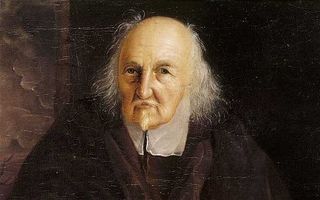
in an idle moment, and for me it’s Thomas Hobbes author of Leviathan, 1651. Having just joined Labour as a 70th birthday treat for myself the appointment has become urgent. Hobbes was a rottweiler, but I’m finding the party more like a goldfish. Why are we not proposing to nationalise some of our egregious companies – at least one bank and one power firm – to show what can be done without prima donna management and astronomical salaries? What is to be done about the vile pay inequalities. Where does it say we are going to break the spines of the people who have plundered and wrecked our economy?

Nasty, brutish and short was how Hobbes described life without the rule of law and it’s possible that lunch might share some of those aspects too. For a start it will be at 11am: we’ll be having fish, probably whiting, but absolutely no wine as on the rare occasions when he drank he made sure he took in enough ‘to have the benefit of vomiting by which neither his wit was disturbed nor his stomach oppressed’. So reported the garrulous and meandering John Aubrey who also holds out the unpleasing prospect of Mr Hobbes’ ‘greatest trouble’, which was ‘to keep off the flies from pitching on the baldness’ of his head.

Hobbes was accused of being an atheistical cynic with a falsely pessimistic view of humanity as irredeemably selfish, distrustful and violent. Then as now, we all like to think we’re not like that – Don’t we help others? Are we not basically altruistic? Do we not trust one another?

Hobbes had a ready response:

‘Let him therefore consider with himselfe … when going to sleep he locks his dores; when even in his house he locks his chests; and this when he knows there bee lawes and publicke officers, armed, to revenge all injuries shall bee done to him; what opinion he has of his fellow citizens when he locks his dores; and of his children and servants when he locks his chests. Does he not there as much accuse mankind, by his actions, as I do by my words?’

More here.

on ‘apostle’ by Tom Bissell

9780375424663Christian Wiman at The New York Times:

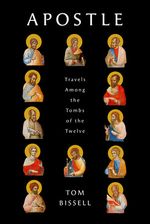
Nietzsche believed that if only a Dostoyevsky had been among the apostles who followed Jesus, someone who understood the environment in which “the scum of society, nervous maladies and ‘childish’ idiocy keep a tryst,” we might have been spared centuries of ovine idiocy. One genius could have given us a work of ennobling art. Instead, we got 12 bleating sheep and one filthy religion.

Nietzsche is hardly alone in his contempt for the disciples. Many a preacher, whether for castigation or consolation, has pointed out their all-too-human foibles. There’s Thomas and his infamous doubt, Peter’s craven denials as Jesus is being tried and crucified. There are all the parables the disciples are too boneheaded to understand, kiddie squabbles about who is going to get the best seat in heaven. Even at Jesus’ most agonizing moment in the Garden of Gethsemane, the disciples, like exhausted teenagers, fall sound asleep. It almost seems as if the Gospel writers wanted to emphasize these inadequacies, wanted to root an entire religion in the very human weakness that so appalled Nietzsche.

Given the mediocrity of those to whom Jesus’ message was entrusted, it seems surpassing strange that the message should have taken hold with such force. Somehow those hapless men rose out of their stupor to become paragons of Christian virtues.

more here.

A new collection examines a decade of New York Times war photography

Cover00Jesse Barron at Bookforum:

A generation gap divides readers of the New YorkTimes. On one side, it’s the publisher of the Pentagon Papers, the first draft of history, the indispensable source. On the other side, the Pentagon Papers do not define the Times at all; failure to publish the Edward Snowden papers does. If you were a teenager on 9/11, the Times introduced itself to you with news of WMDs. A couple years later, it confirmed your ill impression by dousing the fuse on its own domestic-wiretapping story—ready to publish in the fall of 2004—until after Election Day, removing a major obstacle to George W. Bush’s second victory. Bill Keller, then the Times’s executive editor, later told 60 Minutes that the National Security Agency said he’d “have blood on [his] hands” if he published. It sounds credulous in retrospect, as though he let himself be flattered.

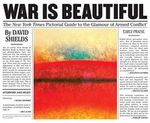
The Times, in short, has made itself an easy target for teardowns by the young and media-critical. But there is another kind of teardown that is not so much angry as sorrowful, tinged with betrayal and aggrievement, written by those who once loved and trusted the paper. David Shields’s War Is Beautiful is in this category. Putatively the story of why Shields “no longer reads The New York Times,” it is a coffee-table book containing color reproductions of front-page war photos taken between 2001 and 2014, mostly in Afghanistan and Iraq. In an introduction, Shields explains that though he read the paper “for decades,” the war photography from this period disgusted him. It obscured the reality of “death, destruction, and displacement.” It was too pretty and therefore false.

The pretty-false equivalence has long preoccupied Shields, who mistrusts the beauty of artifice. He reads, he has said, for “existential knowledge” and to access writers’ minds, and he’s impatient with ornaments like character and setting; The Great Gatsby, in his opinion, should be twenty pages long. Like an old-fashioned modernist, he rejects the old-fashioned.

more here.

the city v the country in literature

Citycountry-02Tristram Hunt at The Guardian:

“Policy, polity, politeness, urbanity, civility, derive their names as well as their nature from city life, while the terms rustic, savage, heathen, pagan, indicate the rougher and more backward tendencies of the herdsmen and cultivators of the ground,” was the considered view of the Liverpool architect and Victorian city booster Sir James Picton. By contrast, in his lurid 1844 pamphlet, “On the Need of Christianity to Cities”, the Paddington curate James Shergold Boone struck a different tone: “Cities are the centres and theatres of human ambition, human cupidity and human pleasure … the appetites, the passions, the carnal corruptions of man are forced, as in a hotbed, into a rank and foul luxuriance.”

Raymond Williams’s 1973 book The Country and the City is an ambitious attempt to unpick the historical, cultural and imaginative context behind such sentiments, as expressed through centuries of English literature. In its remarkable range of literary sources and historical sweep, this deeply confident work reveals Williams’s powers as fiction critic, cultural theorist, Marxist ideologue and urban thinker. Above all, it is a beautifully written account of one of the abiding themes of European culture: the construction of the virtue of the rural and the vice of the urban. Rural idiocy versus urban civility. Or as the poetJuvenal put it: “What can I do in Rome? I never learned how to lie.”

Central to Williams’s intellectual project – evident in Culture and Society (1958), The Long Revolution (1961) and Keywords: A Vocabulary of Culture and Society (1976) – was a sustained attempt to overturn a conservative cultural consensus, handed down by what he regarded as a hegemonic ruling class. “My primary motivation in writing [Culture and Society] was oppositional,” he explained, “to counter the appropriation of a long line of thinking about culture to what were by now decisively reactionary positions … It allowed me to refute the increasing contemporary use of the concept of culture against democracy, socialism, the working class or popular education, in terms of the tradition itself.”

more here.