
Enjoying the content on 3QD? Help keep us going by donating now.
Category: Recommended Reading
Why EY Treats Loneliness as an Inclusion Issue
Michelle Peng in Time Magazine:
 Engagement scores for US workers fell to a 10-year low in January, a dip that coincides with workers’ falling confidence that someone at work cares about them as a person or supports their development at work, according to Gallup. For Karyn Twaronite, global vice chair of diversity, equity, and inclusiveness at EY, this rising level of isolation and loneliness is fundamentally an inclusion issue.
“My job is to make sure that more of our people feel more included all the time,” she says, pointing out that the work also has a clear business case: “The lonelier people are at work, the less committed and less engaged they are.” Increase belonging and inclusion, on the other hand, and employers can also see productivity, engagement, and commitment rise.
More here.
Enjoying the content on 3QD? Help keep us going by donating now.
Friday, March 7, 2025
Modern Life Is Ruining Storytelling
Heather Parry at Persuasion:

Over the last few years, for various reasons (mentoring early career writers, being in a workshop group, chairing events, running a magazine, being asked to blurb books), I’ve had cause to read a lot of fiction—some of it by new writers, some of it by established writers.
When you get to the point of mentoring and editing emerging talent, you see a clear pattern of issues shared by most people’s early work. Mistakes like overwriting, being so desperate to make pretty sentences that you don’t actually describe what’s going on, failing to give basic information clearly. Writers are often so keen to be good at something, to be artistic, that we forget the basics. We forget that writing is a method of communication, and unless you’re being unclear for a very specific reason that will eventually reveal itself, in communication, clarity is key.
When it comes to first attempts at literary fiction, though, there’s often a different issue. That issue is that nothing fucking happens in it. When I started writing short stories I had excellent free mentoring from much-lauded Glasgow writer Kirsty Logan. The most irritating but insightful thing she would say to me, when I presented her with my stories, was this: “What is this story about?” And more often than not, I didn’t know.
More here.
Enjoying the content on 3QD? Help keep us going by donating now.
Read an unpublished excerpt from Carl Zimmer’s new book “Air-Borne”
Carl Zimmer in Sequencer Magazine:
 Some of the microbes that rose from the ocean fell on land instead of water. Lying on the bare continents, they no longer had sea water to shield them from direct sunlight. Many likely died as the ultraviolet radiation ravaged their genes and proteins. Meanwhile, the atmosphere was sucking out the water from their interiors, causing their molecules to stick together and collapse into toxic shapes.
Over time, however, life adapted to land. The earliest signs of its spread are 3.2-billion-year-old fossils from South Africa. They preserve microbial mats that grew in a braidplain of streams woven across an arid landscape. The water in the streams would have periodically dried up, exposing the mats to dry air. Mutations that helped the microbes survive longer out of water would have allowed them to reproduce more, shaping future generations. Instead of relying on water to shield them, these microbes grew pigments that could absorb the deadly ultraviolet rays. They also relied on cooperation to survive in the air. Terrestrial microbes worked together to build rubbery films around themselves. These biofilms soaked up rain and water vapor from the air and held onto it during dry weather.
Three billion years later, these living films still exist. Known as biological soil crusts, they can be as thin as butter on toast, or as thick as the toast itself. Biological soil crusts today cover about 12 percent of dry land—roughly equivalent to the area of South America.
More here.
Enjoying the content on 3QD? Help keep us going by donating now.
Something Strange Happens When You Trust Quantum Mechanics
Enjoying the content on 3QD? Help keep us going by donating now.
Destroying Americans’ livelihoods and wealth to satisfy the whims of a crazy ideology
Noah Smith at Noahpinion:
Despite steady GDP growth, low inflation, low unemployment, and record high stock prices, Americans told pollsters in 2024 that they were deeply unhappy with how Joe Biden had handled the U.S. economy. So they elected Donald Trump, who promised to lower costs for average Americans, create a new era of U.S. manufacturing and domestic investment, and so on.
How is that working out? Well, the Atlanta Fed now projects that the U.S. economy will shrink at an annualized rate of 2.8% in the first quarter of Trump’s presidency:
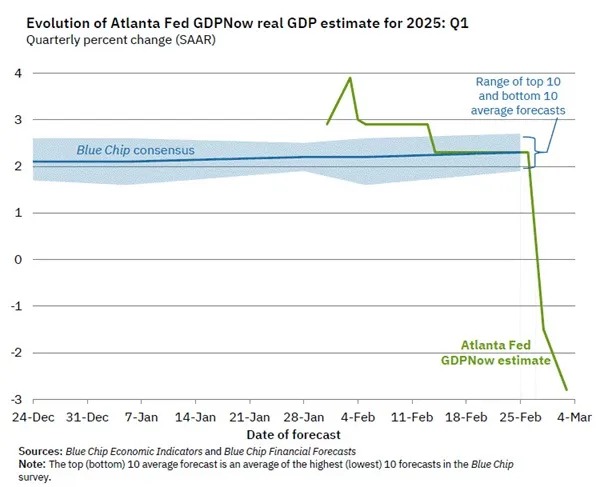
The forecast was fine until it became clear a few days ago that Trump’s tariffs on Canada and Mexico would actually go into effect.
Now, this is just one forecast; the real number might be less dramatically bad. The Federal Reserve’s Beige Book, a survey of current economic indicators, suggests that growth will stall out but not go negative. But it’s very clear that tariffs are the driving force behind the slowdown.
More here.
Enjoying the content on 3QD? Help keep us going by donating now.
Julian of Norwich and Heidegger with Hannah Lucas
Enjoying the content on 3QD? Help keep us going by donating now.
Can Painting Alter Politics?
John Banville at the New Statesman:
 In his introduction, Clark poses a more immediate question: “Shouldn’t we judge political art by its effects, not its beauty or truth?” Leaving aside the second clause, we find two questionable assertions implicit in the first: namely, that art can be political and that it can have an effect. In this context, he imagines the reader wondering why his book “makes room for Matisse and Jackson Pollock,” two artists who “reached the conclusion, in practice, that opinions had to be what art annihilated if it was to survive”. Their stance is one that Clark accepts: “The blankness was essential. It was reality as they lived it.”
And is not that blankness –“inutility” was the word Vladimir Nabokov favoured – the very essence of art? Surely we go to Velázquez’s Las Meninas, to Piero della Francesca’s Sansepolcro Resurrection, to Bonnard’s baigneuses series, not to be told things, not to be persuaded of this or that political solution to life’s problems, but to have an intensified sense of what it is to be alive in this exquisite and appalling world into which we have been thrown, and from which after a little interval we shall be summarily ejected.
more here.
Enjoying the content on 3QD? Help keep us going by donating now.
Joan Didion And The Manson Murders
Alissa Wilkinson at the NYT:
Somehow, this case keeps surprising us. But one person who regarded it without shock — as if it was the inevitable conclusion of a panicked era — was Joan Didion, who was living and working in Hollywood when the murders occurred. In her 1978 essay “The White Album,” regarded as a seminal account of the era, she writes about the ripples of terror the murders provoked. “These early reports were garbled and contradictory,” with different numbers of victims and explanations of what happened, Didion writes. “I remember all of the day’s misinformation very clearly, and I also remember this, and wish I did not: I remember that no one was surprised.”
Reality was barely tangible in the summer of 1969, with its highs and lows, its muddled impressions and half-understood headlines. Cause and effect seemed to be breaking apart. In some respects this was simply the inevitable result of a country becoming saturated in images because they had a screen at home. A movie theater was a place to go if you wanted to see a whole story, beginning to end. But a TV you could turn on and off, and you never knew what would be there when you turned it on again.
more here.
Enjoying the content on 3QD? Help keep us going by donating now.
Inside the scientific quest to reverse human aging
Gretchen Reynolds in The Washington Post:
 For those hoping to cure death, and they are legion, a 2016 experiment at the Salk Institute for Biological Studies in San Diego has become liminal — the moment that changed everything. The experiment involved mice born to live fast and die young, bred with a rodent version of progeria, a condition that causes premature aging. Left alone, the animals grow gray and frail and then die about seven months later, compared to a lifespan of about two years for typical lab mice.
But the Salk scientists had a plan to change the aging animals’ fate. They injected them with a virus carrying four genes that can reshape DNA and, in effect, make every cell in the rodents’ bodies young again. The scientists could even control the genes from outside the mice, turning them on and off to manage the safety and potency of the genetic changes.
More here.
Enjoying the content on 3QD? Help keep us going by donating now.
The great American classic we’ve been misreading for 100 years
Constance Grady in Vox:
 The Great Gatsby is 100 years old this year, which feels right in a way. After all those years as a perennial mainstay of the American high school English curriculum, all those Gatsby-themed flapper parties, all those valiant but ham-fisted attempts to adapt it, we know the beats of it well: the parties, the glamour, the green lights, and the beautiful clothes. It might as well be a hundred.
On the other hand, there are parts of Gatsby that feel so fresh and modern that they could have been written yesterday. In our own moment, as the world’s richest man takes a hatchet to the federal government for sport, one of Gatsby’s most celebrated lines about the very wealthy feels resoundingly true: “They were careless people … They smashed up things and creatures and then retreated back into their money or their vast carelessness, or whatever it was that kept them together, and let other people clean up the mess they had made.”
More here.
Enjoying the content on 3QD? Help keep us going by donating now.
Friday Poem
Loose on Earth
A tiny spark, or
the slow-moving glow on the fuse
creeping toward where
ergs held close
in petrol, saltpeter, mine gas,
buzzing minerals in the ground,
are waiting.
Held tight in a few hard words
in a dark mood,
in an old shame.
Humanity,
……….. said Jeffers, is like quick
explosion on the planet
we’re loose on earth
half a million years
our weird blast spreading—
and after,
rubble—millennia to weather,
soften, fragment,
sprout, and green again.
by Gary Snyder
from Danger on Peaks
Shoemaker Hoard, 2004
Enjoying the content on 3QD? Help keep us going by donating now.
Thursday, March 6, 2025
Alvin Ailey American Dance Theater: Revelations
Enjoying the content on 3QD? Help keep us going by donating now.
English Is French
John Gallagher at the LRB:
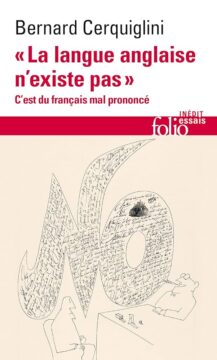 It’s no secret that modern English is saturated with French. Insults and derogatory terms owe much to the French example – bastard, brute, coward, rascal, idiot. French oozes from the language of food and drink: chowder echoes the old French chaudière, meaning a cooking pot, while crayfish started out as escrevise before the English chopped off its initial vowel (something they also did with scarf, stew, slice and a host of others) and decided that the last syllable sounding like ‘fish’ was just too good to pass up. From arson to evidence, jury to slander, French runs through the language of the English law (and the ‘Oyez! Oyez! Oyez!’ of the US Supreme Court), such that the philologist Mildred Pope could write that the only truly English legal institution, at least from a linguistic perspective, was the gallows. With contemporary English including more than eighty thousand terms of French origin, Georges Clemenceau might have had a point when he argued that ‘the English language doesn’t exist – it’s just badly pronounced French.’ In this engaging and sometimes infuriating essay, Bernard Cerquiglini – linguist, medievalist, member of Oulipo, advisor to successive French governments on linguistic affairs – pushes Clemenceau’s statement further, arguing that ‘the global success of English is a homage to Francophonie.’ Anyone speaking English today, Cerquiglini argues, is mostly speaking French.
more here.
Enjoying the content on 3QD? Help keep us going by donating now.
Werner Herzog on the OED: ‘the book of books’
Stan Carey at Sentence First:
That the OED is for Herzog ‘the book of books’ does not surprise me, given his love of learning and literature and his admiration for diligence and excellence. But he brings it up unexpectedly, in a medley passage in which he muses on his habits and nature:
I avoid contact with fans. Occasionally, I watch trash TV because I think the poet shouldn’t avert his eyes. I want to know what others aspire to. I’m a good but limited cook. My steaks are excellent, but they’ll never touch what you can get on any street corner in Argentina. Tree huggers are suspicious to me. Yoga classes for five-year-olds—which in California are a thing—are suspicious to me. I don’t use social media. If you see my profile anywhere there, you can be sure it’s a fake. I don’t use a smartphone. I never quite trust the media, so I get a truer picture of the political situation by going to multiple sources—the Western media, Al Jazeera, Russian TV, and occasionally by downloading the whole of a politician’s speech. I trust the Oxford English Dictionary, which is one of mankind’s greatest cultural achievements. I mean the one in twenty massive volumes with six hundred thousand entries and more than three million quotations culled from all over the English-speaking world and over a thousand years. I reckon thousands of researchers and amateur helpers spent 150 years combing through everything recorded. For me, it is the book of books, the one I would take to a desert island. It is inexhaustible, a miracle. The first time I visited Oliver Sacks on Wards Island north of Manhattan, I had mislaid the house number but knew the name of the little street. It was evening, winter-time; the slightly sloping street was icy. I parked and tiptoed along the icy pavement looking into every lit-up home. None of the windows had curtains. Through one window I saw a man sprawled on a sofa with one of the hefty volumes of the OED propped on his chest. I knew that had to be him, and so it was. Our first subject was the dictionary; for him as well, it was the book of books.
(The translation from the German is by Michael Hofmann.)
I am utterly won over by the image of Herzog tiptoeing along an icy street in search of Oliver Sacks, peering into windows until he recognises him thanks to the dictionary they both adored.
More here.
Enjoying the content on 3QD? Help keep us going by donating now.
How to Save the NIH
Eric Reinhart & Craig Spencer at the Boston Review:
 On Saturday Francis Collins resigned from the National Institutes of Health (NIH) after directing it for over a decade. His departure, coming on the heels of the expected confirmation of Stanford’s Jay Bhattacharya as his replacement, represents more than the loss of an influential physician-scientist who once led the Human Genome Project and played a central role in the United States’ COVID-19 response. It marks the culmination of a decades-long missed opportunity: despite being the world’s largest funder of biomedical research, the NIH has not built a broad public constituency to protect it from partisan destruction.
In his resignation letter, Collins notes that the institute “is the main piston of a biomedical discovery engine that is the envy of the globe. Yet it is not a household name. It should be.” He singles out two notable discoveries. “When you hear about patients surviving stage 4 cancer because of immunotherapy,” he writes, “that was based on NIH research over many decades.” And “when you hear about sickle-cell disease being cured because of CRISPR gene editing, that was built on many years of research supported by NIH.”
Collins is right, but he fails to mention the fundamental reason many Americans don’t credit the government for these achievements: they only ever learn of NIH’s work from intermediaries—deeply unpopular pharmaceutical or medical device companies—that take credit for NIH science while leveraging it to extract as much money as possible from desperate patients and families.
More here.
Enjoying the content on 3QD? Help keep us going by donating now.
Love Letters
Lamorna Ash at Amulet:
 Whenever I read The Letters of Abelard and Héloïse I have in mind another, more contemporary couple, whose collaborative work I have come to think of as sacred, too. As soon as the performance artists Marina Abramović and Ulay met in the 1970s, they fell hard in love and began making performance art together. They called this work a “third energy,” their souls combined, a kind of artistic procreation (we don’t know what happened to Héloïse and Abelard’s child—only that she called him Astrolabe, after the astronomical instrument for reckoning with time and observing the stars. Astrolabe as the one instrument that could point up to the star-crossed lovers who made him and prove that their love had been real). The idea for “The Lovers” came to Abramović as a vision in a dream. They would walk from either end of the Great Wall of China to finally meet in the middle where they would marry, documenting the whole expedition on film—the kind of exaggeratedly cinematic, romantic scheme that is destined to go wrong. In the time it took to secure their visas—several years—the relationship had already begun to fall apart. Five years later, they set out at last to make “The Lovers.” After almost 90 days of walking, each covering over two thousand kilometres alone, they reunited on the wall, not to marry, but to break up. Watching the footage of “The Lovers,” I imagine they are actually Héloïse and Abelard, setting out on their private pilgrimages through life in the wake of their painful estrangement, then meeting in the middle again through the form of letters.
more here.
Enjoying the content on 3QD? Help keep us going by donating now.
Nick Bostrom: Focus on These AI-Proof Areas
Enjoying the content on 3QD? Help keep us going by donating now.
The United States is joining the ranks of patrimonial states
Stephen E. Hanson & Jeffrey S. Kopstein at Persuasion:
 To understand Trump’s political order, then, we need to familiarize ourselves with the standard operating procedures of patrimonialism. While this regime type may be novel for the United States, it is quite common in human history. In the 21st century, patrimonial regimes have been consolidated in countries as diverse as Vladimir Putin’s Russia, Viktor Orbán’s Hungary, Narendra Modi’s India, and Benjamin Netanyahu’s Israel. Drawing lessons from regimes of this type, we can help get our bearings in what, for most Americans, is an unfamiliar new political environment.
First, in patrimonial regimes there is simply no way to distinguish between the parts of the leader’s speeches that matter politically from empty rhetoric not meant to be taken seriously. The cumulative effect of the daily storm of Trump’s announcements, social media posts, news conferences, and executive orders can be exhausting…
More here. And more by Francis Fukuyama on the same subject here.
Enjoying the content on 3QD? Help keep us going by donating now.
Thursday Poem
A Rapture on Spring
Night rain
but morning wakes him
with a rush of bird sound.
The world
is made for love they cheep.
They croon
the world is made for me.
In the coniferous branches
outside his window a hummingbird
lights for a moment,
then off again
going to work
to feed its body
which burns up
calories so fast, so fast –
no time to lie in a nest in the comfort
of hummingbird thought.
Where is food?
Next where are the babes?
But the man in bed wonders
what is his own whistling all about?
Is it for himself? he imagines
that girl back in college somehow reading it
and sending him a smile – maybe a letter even.
But spring songs,
though pretending
to be about bright eyes
or the swirl of a shapely hip,
sing of that great love affair –
you and the world.
Maybe
that’s all there is,
you and the world.
Nothing else to sing about,
in the fine light of spring?
by Nils Peterson
Enjoying the content on 3QD? Help keep us going by donating now.