Computer Algorithm Turns Videos into Living Van Goghs

Carl Engelking in Discover Magazine:
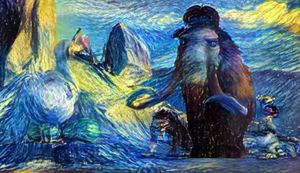
Ice-ageComputers are becoming rather versatile copycats, thanks to deep-learning algorithms.

Just last year, researchers “trained” machines to transfer the brushstrokes of iconic artists onto any still image. Now, Manuel Ruder and a team of computer scientists from the University of Freiburg in Germany have taken the technology a step further: They’re altering videos. The team’s style transfer algorithm makes clips from Ice Age or the television show Miss Marple appear as living paintings crafted by the likes of Van Gogh, Picasso or any other artist. And the results speak for themselves.

Deep-learning algorithms rely on artificial neural networks that operate similarly to the connections in our brain. They allow computers to identify complex patterns and relationships in data by parsing it layer by layer. More fine-grained information is extracted the deeper the layers go. Last year, researchers at the University of Tubingen demonstrated that it was possible to separate the content of an image from its artistic style using these deep-learning algorithms. Basically, they could use an artist’s “style” like an image filter, regardless of the image’s content — you can now add a Starry Night twist to your own images. Ruder and his team built upon this work, and applied it frame-by-frame in videos.

More here.
Building Stability for Indian Growth

Rajan-full

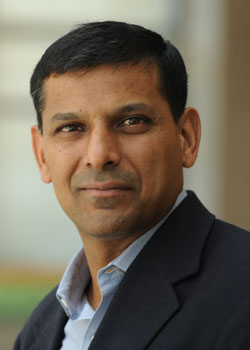
Raghuram Rajan in Project Syndicate:

In their efforts to stimulate demand by pursuing increasingly aggressive monetary policies, advanced economies have been imposing risks on emerging-market countries such as India. Indeed, one day we face surging capital inflows, as investors go into “risk-on” mode, and outflows the next as they switch risk off.

India has responded to this external volatility by trying to create a domestic platform of macroeconomic stability on which to build growth. India’s latest central budget emphasizes fiscal prudence, adheres to past commitments, and aims at structural reforms, especially in agriculture. Fiscal consolidation has also helped to keep the current-account deficit under 1% of GDP. Moreover, inflation has been brought within the official target range. And parliament has created a monetary-policy committee for the Reserve Bank of India (RBI), which should ensure that multiple views are embedded in policy and improve continuity.

We must also address banks’ non-performing loans so that their balance sheets have room for new lending. Unlike more developed countries, India does not have an effective bankruptcy system (though a bill to create one has just cleared the lower house of Parliament). But, using some “out-of-court resolution” mechanisms devised by the RBI, and with capital support from the government, banks should have well-provisioned balance sheets by March 2017.

Perhaps the hardest challenge has been to persuade the public, impatient for rapid growth, of the need to ensure stability first. Growth, it is argued, is always more important, regardless of the looming economic risks. Yet, despite the focus on stability, inhospitable global growth conditions, and two successive droughts (any of which would have thrown the economy into a tailspin in the past), growth is above 7%.

The task is to build on this base. For the first time in decades, global trade has grown more slowly than global output.

More here.

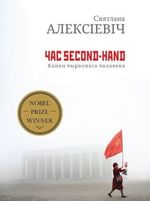
an excerpt from Svetlana Alexievich’s ‘Second-Hand Time’

Image-20151009-9146-q1w8lcSvetlana Alexievich at the Times Literary Supplement:

Why does this book have so many stories of suicides instead of more typical Soviets with typically Soviet life stories? When it comes down to it, people end their lives for love, from fear of old age, or just out of curiosity, from a desire to come face to face with the mystery of death. I sought out people who had been permanently bound to the Soviet idea, letting it penetrate them so deeply, there was no separating them: the state had become their entire cosmos, blocking out everything else, even their own lives. They couldn’t just walk away from History, leaving it all behind and learning to live without it – diving head first into the new way of life and dissolving into private existence, like so many others who now allowed what used to be minor details to become their big picture. Today, people just want to live their lives, they don’t need some great idea. This is entirely new for Russia; it’s unprecedented in Russian literature. At heart, we’re built for war. We were always either fighting or preparing to fight. We’ve never known anything else – hence our wartime psychology. Even in civilian life, everything was always militarized. The drums were beating, the banners flying, our hearts leaping out of our chests. People didn’t recognize their own slavery – they even liked being slaves. I remember it well: after we finished school, we’d volunteer to go on class trips to the Virgin Lands4 and we’d look down on the students who didn’t want to come. We were bitterly disappointed that the Revolution and Civil War had all happened before our time. Now you wonder: was that really us? Was that me? I reminisced alongside my protagonists. One of them said, ‘Only a Soviet can understand another Soviet.’ We share a communist collective memory. We’re neighbours in memory. […]

more here.

Thomas Bernhard makes intricate fiction from the grit and putty of life

Thier_bernhard_otu_imgAaron Thier at The Nation:

Goethe Dies, translated from the German by James Reidel (Seagull; $21), is a brief and headlong collection—just four stories in 76 pages—but any reader susceptible to Thomas Bernhard’s charm will be transfixed by it in a few sentences. Bernhard, who died in 1989 at the age of 58, is one of the great stylists of the 20th century, and his writing is an irreducible essence, an ungovernable torrent of lunacy and glee, impossible to paraphrase but immediately recognizable.

In the title story, Goethe dies as advertised. Before he does, however, he conceives a desire to summon Wittgenstein to his bedside (the two men are contemporaries in this reality). But Wittgenstein dies before the meeting can be arranged—and this is essentially all that happens. The story consists of the remarks, or an elaborate description of the remarks, that Goethe’s secretary and various associates make about his desire that the meeting should take place. This is a desire they aim to gratify or frustrate, according to obscure whims of their own. The narrator, who may be present for some of this and may be a fanciful version of Bernhard himself, is painstaking in his attribution of the most irrelevant statements, which produces wonderfully tortured formulations like “Riemer underscored that Goethe allegedly said…,” or, even better, this: “the idea of inviting Wittgenstein to Weimar occurred to Goethe at the end of February, thus said Riemer presently, and not at the beginning of March, as Kräuter maintained, and it was Kräuter who learned from Eckermann that Eckermann would prevent Wittgenstein from travelling to Weimar to see Goethe at all costs.”

more here.

teffi: From Odessa to Paris

Static1.squarespaceCatherine Brown at Literary Review:

Fans of Teffi in this country have had to wait only two years since the publication of Subtly Worded, her remarkable collection of short stories, for two further volumes to appear. Memories, her memoir of the Civil War, and Rasputin and Other Ironies, a collection of shorter reminiscences, are both, like Subtly Worded, published by Pushkin Press and translated by the excellent Robert Chandler and colleagues.

From these books we gain a much better sense of Nadezhda Lokhvitskaya (as Teffi was born) as a person. No longer do I think of her as the female Chekhov or the Russian Saki, but simply as Teffi – or rather unsimply, since she is both robust and vulnerable, sensible and absurd, compassionate and satirical. I wish that the portrait of her by Ilya Repin, described in her essay on the painter, had survived (perhaps even to feature in the ‘Russia and the Arts’ exhibition now on at the National Portrait Gallery in London). It would have been fascinating to see which of these qualities Repin managed to capture.

The wry perceptiveness that was apparent in Subtly Worded is evident again in several pieces here: in ‘The Merezhkovskys’; in ‘Liza’, a portrait of a quixotically mendacious friend; and in ‘How I Live and Work’, which paints a picture of her messy Montparnasse desk.

more here.

How to hack the hackers

M. Mitchell Waldrop in Nature:

Cybersecurity_illoSay what you will about cybercriminals, says Angela Sasse, “their victims rave about the customer service”. Sasse is talking about ransomware: an extortion scheme in which hackers encrypt the data on a user's computer, then demand money for the digital key to unlock them. Victims get detailed, easy-to-follow instructions for the payment process (all major credit cards accepted), and how to use the key. If they run into technical difficulties, there are 24/7 call centres. “It's better support than they get from their own Internet service providers,” says Sasse, a psychologist and computer scientist at University College London who heads the Research Institute in Science of Cyber Security. That, she adds, is today's cybersecurity challenge in a nutshell: “The attackers are so far ahead of the defenders, it worries me quite a lot.”

Long gone are the days when computer hacking was the domain of thrill-seeking teenagers and college students: since the mid-2000s, cyberattacks have become dramatically more sophisticated. Today, shadowy, state-sponsored groups launch exploits such as the 2014 hack of Sony Pictures Entertainment and the 2015 theft of millions of records from the US Office of Personnel Management, allegedly sponsored by North Korea and China, respectively. 'Hacktivist' groups such as Anonymous carry out ideologically driven attacks on high-profile terrorists and celebrities. And a vast criminal underground traffics in everything from counterfeit Viagra to corporate espionage. By one estimate, cybercrime costs the global economy between US$375 billion and $575 billion each year1. Increasingly, researchers and security experts are realizing that they cannot meet this challenge just by building higher and stronger digital walls around everything. They have to look inside the walls, where human errors, such as choosing a weak password or clicking on a dodgy e-mail, are implicated in nearly one-quarter of all cybersecurity failures2. They also have to look outwards, tracing the underground economy that supports the hackers and finding weak points that are vulnerable to counterattack.

More here.

Thursday Poem

Advice

You think it ugly: drawing lines with a knife
Down the backs of those writers we exist to dislike. But it’s life.

One is disadvantaged by illustrious company
Left somehow undivided. Divide it with animosity.

Don’t be proud –
Viciousness in poetry isn’t frowned on, it’s allowed.

Big fish in a big sea shrink proportionately.
Stake out your territory

With stone walls, steamrollers, venomous spit
From the throat of a luminous nightflower. Gerrymander it.
.

by Sinead Morrissey
from The State of the Prisons
Publisher: Carcanet, Manchester, 2005

Wednesday, May 11, 2016

THE GREATEST WRITERS’ GROUP IN THE HISTORY OF IOWA

Ben Miller in Literary Hub:

Iowa-1One Thursday night in 1980—that interminable presidential election year now melted into the slippery coin of Reagan’s Shangri-La moment—a Clinton, Iowa, public school teacher drove 41 miles south to the larger river city of Davenport to attend a meeting of Writers’ Studio, the local club for aspiring (and expiring) literary practitioners. He knew nobody seated at the folding table that spanned the jump-ball circle in the rented gym of a defunct Catholic school. Technically he was not late: we regular attendees were criminally early. I, spinsterish 16-year-old male in a Hawaiian shirt, quivered along with my peer group of genuine elders. The stranger wore a V-neck sweater, slacks and loafers, a meditative gaze and thin laconic grin. It always startled us to be found.

Most first-timers suffered under the weight of an aesthetic. Either they had been evicted from another group—Wordsmith’s, Pen Women—or swept out of the bungalow of a fed-up aunt. To us these exiles lugged their trilogy concepts, claims to inborn talent, their influences. Rimbaud! Fletcher Knebel! They careened toward a too-little place at the pad-strewn table, exchanging glances with the uncurling tentacles of our trepidation.

Not this one. This writer specimen paused a respectful distance from our tight circle. Upright, no apparent literary leanings, he stated: “I’m Beenk.”

“Blink!?” yelped cigarette-flicking Blanche Redman, hard of hearing. “Gene B-E-E-N-K. I saw the meeting notice in the paper.”

More here. [Thanks to J. M. Tyree.]

A Filmmaker in Palestine: A Q&A with Hany Abu-Assad

Tony Phillips in Signature:

ScreenHunter_1942 May. 11 17.11I've been tracking Palestinian filmmaker Hany Abu-Assad since his harrowing film about childhood friends turned suicide bombers, “Paradise Now,” played the 2005 New York Film Festival, then went on to garner an Academy Award nomination for best foreign film and win a Golden Globe for the same. In 2012, his English language debut, “The Courier,” starring Mickey Rourke went direct to video, but he gained his footing again in 2013 scoring his second Oscar nomination with “Omar.”

In 2014, he was invited to join The Academy of Motion Picture Arts and Sciences and follows up with his most personal film to date, “The Idol.” The film tracks the true story of Mohammed Assaf following a bold escape from Gaza as he scrabbles to the top of the Arab Idol television competition in Cairo as Egypt basks in the Arab Spring. Another English language foray for Abu-Assad awaits: his “Charlie Hunnam out, Idris Elba in” studio adaptation of Charles Martin’s 2010 bestseller, The Mountain Between Us.

When we meet in the lobby of a boutique hotel in Tribeca, his broad, open face welcomes me and I listen to his outspoken views on Israel, thinking, How do I keep this feature balanced? Tell the reader to pick up a fashion magazine with Natalie Portman on the cover as a chaser? But in the end, I decide it’s best to keep the fifty-four-year-old writer, director, and former airplane engineer in his own words, as sparkling as the Pellegrino sitting in front of him.

More here.

LA BELLE RIVIÈRE

E1a325047b148c9441be2b14c42dc196_XLC. E. Morgan at The Oxford American:

La belle rivière: the Great, the Sparkling, the White; coursing along the path of the ancient Teays, the child of Pleistocene glaciers and a thousand forgotten creeks run dry, formed in perpetuity by the confluence of two prattling streams, ancient predecessors of the Kentucky and Licking—maternal and paternal themes in the long tale of how the river became dream, conduit, divide, pawn, baptismal font, gate, graveyard, and snake slithering under a shelf of limestone and shale, where just now a boy is held aloft by his beautiful father, who points and says, “Look!” and the boy looks, and what he will remember later is not just the river like a snake but also the city crowding it, and what a city! A queen rising on seven hills over her Tiber, ringed hills forming the circlet of a crown. A jagged cityscape of limestone and brick and glass with a bright nightless burn. The buildings never shut their brilliant eyes to the river where not so long ago, a teeming white mass came floating down to topple trees between the Great and Little Miamis and garrison pike-forts and sling tart, poison arrows at the wegiwas, those brown beehives up in flames. What freedom to rename the named! Losantiville, or Rome, or Cincinnatus after that noble man who would not stay in Rome, but returned home to his plow on the grange. In his stead, they crowned themselves and an American queen was born, one free of Continental dreams, the first to climb off the king’s cock. Visionaries and confidence men alike launched down la belle rivière in droves. Lawyers and stevedores and sawyers and preachers and masons and Methodists, Lutherans, Baptists, and all the rest; the pious came with the venal, the wealthy with aspiring merchants, and the poor came by the thousands as well, passing women lap to lap on flatboats crammed with china, bedsteads, chests, and hogs to the gunnels that dipped and threatened to tip as they rounded broad bends in the river, curving down through the Territory to the Miami Purchase with its terraced bottoms and towering heights. More green than will ever be seen again, and the chance—now forgotten—to peer straight down through the pellucid Ohio, so sunshot and numinous and strange, it was like peering into bright time itself, right into the eyes of an engorged staring catfish not of this age but of millennia before, darting momentarily through a dream no Boston or Philadelphia could offer.

more here.

the “macbeth” riots in New York City

117Andrew Dickson at Literary Hub:

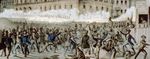
The saga began several years earlier, in 1845, when the volatile Philadelphia-born star Edwin Forrest—the American in question—was on tour to the UK. Stung by a poor reviews in London (the Spectator yawned that his Othello was “affected” and said his “killing of Desdemona was a cold-blooded butchery”), Forrest became paranoid that his great rival, the eminent English actor William Charles Macready, was orchestrating a campaign against him. The following March, Forrest bought a ticket for Macready’sHamlet in Edinburgh; just as the play-within-the-play scene began, Forrest hissed, loudly and publicly. The affair became a scandal, particularly when Forrest sent a letter to the London Times pouring scorn on Macready’s “fancy dance” of a Dane. Back in the US, Forrest—narcissistic even by the standards of most actors—exulted that he had struck a blow against anti-American prejudice.

Macready, an altogether quieter and more uptight character, was shocked, but had little sense how things would escalate. On his own return tour to the US in the fall of 1848, he was astonished to discover that many American reviewers—who had praised him to the rafters on previous visits—had mysteriously turned against him. When he reached Forrest’s hometown of Philadelphia, he was dismayed to find that his enemy had arranged to perform many of the same dates in direct opposition. One night, Macready’sMacbeth was interrupted when the audience began fighting amongst itself. As the curtain came down, Macready protested, only to find when he opened the paper the next day that Forrest had printed a furious take-down of his “narrow, envious” rival. The dispute simmered: in Cincinnati a few months later, half a sheep was thrown at Macready’s feet.

more here.

Seriously Funny: A Nicole Eisenman retrospective

160516_r28143-690Peter Schjeldahl at The New Yorker:

A succinct Nicole Eisenman retrospective of twenty-two paintings and three sculptures, at the New Museum, is accidentally well timed to the recent news that the MacArthur Foundation has awarded a “genius” grant to the spectacularly talented, darkly hilarious New York artist. That’s good. Any attention drawn to Eisenman benefits conversation about contemporary art. At fifty-one—tall and stovepipe slim, with a strikingly long face beneath close-cropped black hair—Eisenman has mellowed only slightly from the raucous wunderkind who burst onto the scene in the 1995 Whitney Biennial. Since then, she has led a kind of one-woman insurgency, bidding to reshape the field, with figurative works that collapse the political into the personal and the personal into an erudite devotion to painting. She paints narrative fantasies that look bumptiously jokey at first, but reveal worlds of nuanced thought and feeling. They must be judged in person; in reproduction they lose the masterly touch that is Eisenman’s signature. The MacArthur Foundation cited her for restoring “to the representation of the human form a cultural significance that had waned during the ascendancy of abstraction in the 20th century.” I’d like it to be true. Eisenman’s resourceful Expressionism hints at the power of narrative painting to re-situate the art world in the world at large.

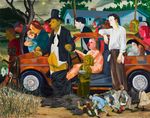
Eisenman is an artist of overlapping sincerities. One of them suggests that of a bohemian community organizer. In “Biergarten at Night” (2007), dozens of characters—some realist, including a self-portrait; others fanciful, such as an androgynous figure passionately kissing a death’s-head—hoist brews in velvety shadow and glimmering light. Each face is painted a bit differently, in a range from filmy to impastoed, and each feels individually known: liked, not liked, loved, perhaps feared. The longer you look the more meaningful the picture becomes. It does indeed recast bohemia in a convincingly up-to-date guise—in Brooklyn, of course, where thousands of the art world’s threadbare strivers reside. Similarly compelling are two big, populous paintings that signal Eisenman’s response to the Great Recession. In “Coping” (2008), poignant citizens of a strange village meander waist-deep in a caramel-colored flood. In “The Triumph of Poverty” (2009), a crowd treks past a beat-up car in a rural scene; one of them is a dishevelled rich man whose dropped pants reveal that he is ass-backward.

more here.

Why So Many Smart People Aren’t Happy

Joe Pinsker in The Atlantic:

ScreenHunter_1941 May. 11 14.58There are three things, once one’s basic needs are satisfied, that academic literature points to as the ingredients for happiness: having meaningful social relationships, being good at whatever it is one spends one’s days doing, and having the freedom to make life decisions independently.

But research into happiness has also yielded something a little less obvious: Being better educated, richer, or more accomplished doesn’t do much to predict whether someone will be happy. In fact, it might mean someone is less likely to be satisfied with life.

That second finding is the puzzle that Raj Raghunathan, a professor of marketing at The University of Texas at Austin’s McCombs School of Business, tries to make sense of in his recent book, If You’re So Smart, Why Aren’t You Happy? Raghunathan’s writing does fall under the category of self-help (with all of the pep talks and progress worksheets that that entails), but his commitment to scientific research serves as ballast for the genre’s more glib tendencies.

More here.

Wednesday Poem

Vanishing Point

April morning and out beyond the city,
the hills are strung with vineyards,
church towers and rows of cypress trees.
A patch of olive in thick strokes of silvery green.
No wilderness of laundrettes or builders’ yards
leech from the suburb’s ragged edge.
Just a stone farmhouse nestling beneath
red-scalloped tiles in bold perspective.
It might be a Renaissance painting,
where down in the valley a shoeless
shepherd sits minding his flock,
as a soldier in colourful hose goes riding by.
It’s not difficult to believe it’s 1553
and you’re looking out at the world through
a window; straight down the road
as far as the eye can see, where parallel lines
converge towards a single vanishing point, as if it is the future.

by Sue Hubbard

‘Second Skin’ May Reduce Wrinkles, Eyebags

Gina Kolata in The New York Times:

SkinThe idea sounds like fantasy: an invisible film that can be painted on your skin and give it the elasticity of youth. Bags under the eyes vanish in seconds. Wrinkles disappear. Scientists at Harvard and M.I.T. have discovered that it is not fantasy at all. Reporting on Monday in the journal Nature Materials on pilot studies with 170 subjects, the researchers said a “second skin” composed of commonly used chemicals deemed safe by the Food and Drug Administration can accomplish that — and in small studies of it, so far no one has reported irritation or allergic reactions.

Undereye bags are just the start. You can soak the film with sunscreen and protect yourself without worrying about sweat or water washing it away, researchers said. They expect it can be used to treat eczema, psoriasis and other skin conditions by covering dry itchy patches with a film that moistens and soothes. The chemicals are siloxanes — their basic form is one atom of oxygen linked to two atoms of silicon — which form polymers, long chains of repeating units. The researchers made a large collection of them by modifying molecular features such as the chain length to get the ones with the properties they wanted. Then they devised a two-step process. First, a polymer, a clear liquid, is applied. Its chains are not very strong, though, so the next step is applying a product that links them together. By modifying the chemistry of the chains, the researchers can alter the properties of the second skin, depending on how it will be used, making it more or less permeable, for example. A more permeable second skin might be used for undereye bags while a less permeable one might hold a medication in place. It can be removed with a solution that dissolves the polymer.

More here.

the lahore literary festival comes to new york

Mehr Khan Williams in Youlin Magazine:

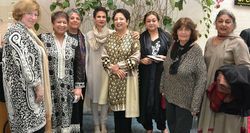
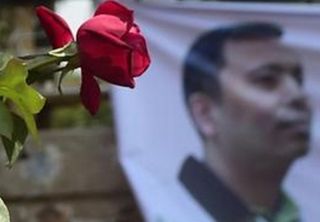
Lahore-literary-festival-llf-in-new-york-4The vibrancy, color and cultural diversity of Lahore came to New York for two days over this Spring weekend at the Asia Society, the premier American institution which promotes a deeper cultural understanding and partnership between the United States and Asia. In a burst of dance, music, literary and policy discussions, the Lahore Literary Festival event in New York sought to showcase an image of Pakistan as a complex society with pluralistic values and an ancient and rich literary and intellectual tradition. A tradition that is alive and thriving in Pakistan today. An image which reflects the very real aspirations and lives of Pakistanis but one which is seldom reflected in news coverage in the United States, where Pakistan is often associated with terrorism and Islamic fundamentalism. Amidst all of the stimulating discussions and the joy of listening to great poetry and stirring music, both modern and devotional, there was also a moment of silence to honor the Pakistani human rights activist Khurram Zaki who was killed in Karachi on Sunday, when four men on two motorbikes sprayed Zaki with bullets as he was lunching with a friend at a road side cafe.

…The festival opened with a dance performance by Ammr Vandal against a backdrop of street life on a screen and followed by innovative songs by Zeb Bangash, and her creative band from Brooklyn. The music was Pakistani rendered in many languages and the band played on diverse instruments including the harpsichord. It concluded with the Qav'vali performance by the Saami brothers. Before the start of the sessions on Day 2, Azra Raza accepted the Lifetime Achievement award on behalf of Sara Suleri who could not travel to the conference. One of the most interesting sessions was on “Urdu Literature— Binding South Asia” with Tahira Naqvi, who spoke of the ground-breaking work of Ismat Chughtai, Frances Pritchett who spoke of Ghalib and his poetry and Arfa Sayeda Zehra who spoke in Urdu and reminded the audience of the relevance today of the work of Saadat Hasan Manto. The session was moderated by Dr. Azra Raza, who urged the audience to re-acquaint themselves with some of the best literature in the world produced in Urdu and now also available in English. In this session, Arfa Sayeda Zehra’s contribution received a standing ovation.

More here.

Tuesday, May 10, 2016

Theoretical physicist who loves philosophy — and a good story

From the Boston Globe:

SeanCarroll2Sean Carroll, a theoretical physicist at California Institute of Technology, has made a career of making cosmology and physics understandable for those of us who just barely passed high school algebra. Carroll discusses his new book, “The Big Picture: On the Origins of Life, Meaning and the Universe Itself,” at 7 p.m. Wednesday at Harvard Book Store.

BOOKS: What are you currently reading?

CARROLL: I just finished Helen Wecker’s fantastic “The Golem and the Jinni.” It’s the kind of thing I like reading these days, really good literary fiction with some fantastical element to it. When I was a kid in high school, I read science fiction. When I got to grad school and afterward I discovered the rest of the world and read everything from Jane Austen to Julian Barnes and Thomas Pynchon. I have settled in between with people who are really good writers but who are not purely into realism.

BOOKS: Is that a hard combination to find?

CARROLL: I don’t think it is. Pynchon does that. Barnes too. It’s a gamut from people who get identified as science fiction writers like Ursula K. Le Guin and Kurt Vonnegut to mainstream literary novelists like Michael Chabon. My favorite example is Iain Banks who after publishing his first novel, “The Wasp Factory,” alternated between writing science fiction and literary novels.

More here.

Bangladesh’s slow capitulation to Islamism

Ikhtisad Ahmed in Scroll.in:

ScreenHunter_1939 May. 10 20.56On April 25, Islamists butchered LGBTQ activists Xulhaz Mannan and Tonoy Mahbub in the presence of Xulhaz’s mother at Mannan's home in Dhaka, for being “the pioneers of practicing and promoting homosexuality in Bangladesh (sic)”. Two days before that, extremists hacked to deathRezaul Karim Siddique, a Muslim professor of English at Rajshahi University in northwest Bangladesh. His killers accused him of “calling to atheism”.

At the time of writing this piece, news of the hacking of a Hindu tailoraccused of insulting the prophet has just come in – reportedly the doing of the Islamic State or its local agents. Along with the murder of the bloggerNazimuddin Samad earlier this month, the red hues greeting the Bengali New Year have been painted with blood.

The most recent killings mark the widening range of targets of the unconscionable machete-wielding Islamists in Bangladesh. A total of 35 such fatal attacks have taken place since 2004, and counted Hindus, Christians, moderate Muslim preachers, secular intellectuals and activists, and foreigners as their victims. By turns, Al Qaeda in the Indian subcontinent and the Islamic State laid tenuous claims on these heinous killings – including ones that preceded their appearance in this region.

Attacks on progressive intellectuals in Bangladesh date back to the country’s birth in 1971. They resumed again in the early 2000s, with the attacks on celebrated poets Shamsur Rahman and Humayun Azad. While Rahman survived with minor injuries, Azad died of his injuries months later. Jamaat-e-Islami, the country’s biggest Islamist party, and its proxies played a crucial role in the war crimes of ’71, including listing and rounding up leading intellectuals for revenge killings in the final three days of the war. Ziaur Rahman, the founder of the Bangladesh Nationalist Party and the country’s president from 1977 to 1981, rehabilitated the Jamaat in politics after the assassination of the nation’s founder, Sheikh Mujibur Rahman, in 1975.

More here.