Is this the end of sex?

41zzO16vpZL._SX327_BO1,204,203,200_Philip Ball at The New Statesman:

Is it time to give up sex? Oh, it has plenty to recommend it; but as a way of making babies it leaves an awful lot to chance. I mean, you might have some pretty good genes, but – let’s face it – some of them aren’t so great. Male pattern baldness, phenylketonuria, enhanced risk of breast cancer: I’m not sure you really want those genetic conditions passed on in the haphazard shuffling of chromosomes after sperm meets egg.

It is already possible to avoid more than 250 grave genetic conditions by genetic screening of few-days-old embryos during in vitro fertilisation (IVF), so that embryos free from the genetic mutation responsible can be identified for implantation. But that usually works solely for diseases stemming from a single gene – of which there are many, though most are rare. The procedure is called pre-implantation genetic diagnosis (PGD), and it is generally used only by couples at risk of passing on a particularly nasty genetic disease. Otherwise, why go to all that discomfort, and possibly that expense, when the old-fashioned way of making babies is so simple and (on the whole) fun?

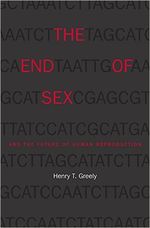
In The End of Sex, Henry Greely, a law professor and bioethicist at Stanford University, argues that this will change. Thanks to advances in reproductive and genetic technologies, he predicts that PGD will become the standard method of conception in a matter of several decades. (Recreational sex might nonetheless persist.)

more here.

The spectrum of sex development: Eric Vilain and the intersex controversy

Sara Reardon in Nature:

Sex1As a medical student in Paris in the 1980s, Eric Vilain found himself pondering the differences between men and women. What causes them to develop differently, and what happens when the process goes awry? At the time, he was encountering babies that defied simple classification as a boy or girl. Born with disorders of sex development (DSDs), many had intermediate genitalia — an overlarge clitoris, an undersized penis or features of both sexes. Then, as now, the usual practice was to operate. And the decision of whether a child would be left with male or female genitalia was often made not on scientific evidence, says Vilain, but on practicality: an oft-repeated, if insensitive, line has it that “it's easier to dig a hole than build a pole”. Vilain found the approach disturbing. “I was fascinated and shocked by how the medical team was making decisions.”

Vilain has spent the better part of his career studying the ambiguities of sex. Now a paediatrician and geneticist at the University of California, Los Angeles (UCLA), he is one of the world's foremost experts on the genetic determinants of DSDs. He has worked closely with intersex advocacy groups that campaign for recognition and better medical treatment — a movement that has recently gained momentum. And in 2011, he established a major longitudinal study to track the psychological and medical well-being of hundreds of children with DSDs. Vilain says that he doesn't seek out controversy, but his research seems to attract it. His studies on the genetics of sexual orientation — an area that few others will touch — have attracted criticism from scientists, gay-rights activists and conservative groups alike. He is also a medical adviser for the International Olympic Committee, which about five years ago set controversial rules by which intersex individuals are allowed to compete in women's categories.

More here.

Wednesday Poem

Strange Fruit

Where the plows can’t reach
snow crusts brick tenements in
a black-and-white photograph.
Outside the apartments
streetlamps glow like twin moons,
as if belonging to another solar system,
one where Billie Holiday didn’t die.
Still, the thin blade of her voice
keeps slicing, fragile and honeyed,
transporting me to a closet-sized
chamber redolent with beeswax,
illuminated by a single bare bulb
swinging from its cord.

Rebecca Hart Olander
originally published in Brilliant Corners
Find more about: Rebecca Hart Olander

Tuesday, May 17, 2016

Designing Time: The Idea of Plot in the Lyric Essay

Tyler Mills in Agni:

ScreenHunter_1944 May. 17 19.53What is “plot” in a lyric essay? As I worked on “Home” (AGNI issue 83), I kept thinking about this question. Why? My process involves piecework. I handwrote scenes in a notebook, typed them up, and moved them around.

A half hour here. An hour there. Forty-five minutes in the dark early light of October.

Primarily a poet, I’ve always been tentative about plot. But I’ve always kept a notebook. Words, phrases, scraps of description—these are the things that the plot of the lyric essay must transform. In “On Keeping a Notebook,” Joan Didion writes,

“our notebooks give us away, for however dutifully we record what we see around us, the common denominator of all we see is always, transparently, shamelessly, the implacable ‘I.’… we are talking about something private, about bits of the mind’s string too short to use, an indiscriminate and erratic assemblage with meaning only for its maker.”

The lyric essay must transform our “erratic assemblage,” moving them into meaning like the night sky that turns toward morning. The constellations change positions, and we pick out their patterns from the chaos of darkness. The crisis that spins everything toward the main thing is realization. Realization is what the mind does with these observations. Realization is what the mind does with the world. Realization is the heart of the lyric essay—what makes it move, what makes all of its light-riddled parts hold together.

More here.

This Man Memorized a 60,000-Word Poem Using Deep Encoding

Lois Parshley in Nautilus:

ScreenHunter_1943 May. 17 19.42Of man’s first disobedience, and the fruit of that forbidden tree,” John Basinger said aloud to himself, as he walked on a treadmill. “Of man’s first disobedience…” In 1992, at the age of 58, Basinger decided to memorize Paradise Lost, John Milton’s epic poem, as a form of mental activity while he was working out at the gym. An actor, he’d memorized shorter poems before, and he wanted to see how much of the epic he could remember. “As I finished each book,” he wrote, “I began to perform it and keep it alive in repertory while committing the next to memory.”

The twelve books of Paradise Lost contain over 60,000 words; it took Basinger about 3,000 hours to learn them by rote. He did so by reciting the piece, line-by-line out loud, for about an hour a day for nine years. When he memorized all 12 books, in 2001, Basinger performed the masterpiece in a live recital that lasted three days. Since then, he’s performed smaller sections for various audiences, eventually attracting the attention of John Seamon, a psychologist at Wesleyan University, in Connecticut. In 2008, “He recited for an hour in the Wesleyan library,” says Seamon. “He’d given out copies of Milton’s book so we could follow along. At the end of the talk I introduced myself and said ‘I’d love to study your memory.’” Basinger agreed, and so Seamon devised a test.

Then 74, Basinger came into the lab to perform a series of cued recall tests. Scientists read two successive lines from each of the poem’s 12 books and then asked Basinger to recall the next 10 lines. The results, published in Memory in 2010, were surprising: Despite the amount of elapsed time since his memorization process, Basinger’s recall was, overall, word-perfect 88 percent of the time. When he was prompted with lines that opened one of the 12 books, his accuracy increased to 98 percent.

More here.

The grotesque criminalization of poverty in America

Ryan Cooper in The Week:

If you are arrested for a serious crime, you're supposed to be taken to jail and booked. Then there's some sort of hearing, and if the judge doesn't think you will skip town or commit more crimes, you are either released on your own recognizance, or you post bail, and you are free until a pre-trial hearing. After that, you either go to trial, or plead guilty and accept punishment.

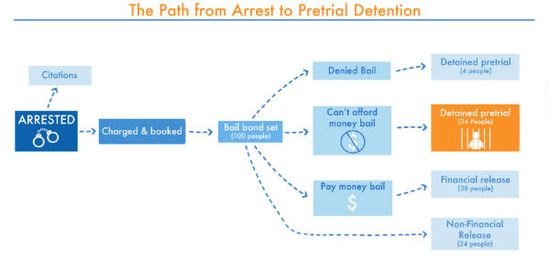
But for a great many people, this is not how it works. As a new report from the Prison Policy Initiative demonstrates, over one-third of people who go through the booking process end up staying in jail simply because they can't raise enough cash to post bail. For millions of Americans in 2016, poverty is effectively a crime.

This flowchart lays out the basic reality for people who get booked. A very small minority (4 percent) are denied bail, while about a quarter are released without bail. Thirty-eight percent manage to make bail, while 34 percent can't scrape together the cash:

Arrest_pretrialdetention

People who can't make bail (let's call them “bailed-in”) make little money, with a median pre-jail income of $15,109 — less than half the median income for the general population.

More here.

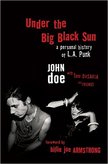
a personal history of L.A. Punk by John Doe with Tom DeSavia

Cover00Camden Joy at Bookforum:

In Los Angeles in the middle of the 1970s several hundred diverse misfits came together and began to collaborate. Some were high school glam-rock enthusiasts, like Belinda Carlisle, Jane Wiedlin, or the boys who became Pat Smear and Darby Crash. Others were older, having traveled farther. From Baltimore came John Doe, from Florida came Exene Cervenka; in California they met and fell in love. Together, and against the world, these few hundred sparked an experiment called LA punk rock—an impulse, some might say, a happening, an underground movement, a rebellion, a cultural revolution. Mention of it now usually stirs memories of mohican haircuts and hardcore music, stage-diving and slam-dancing, but those didn’t come until later. There was an initial punk endeavor in the city that was far different. The charismatic Tomata du Plenty at the front of The Screamers. The wonderfully harebrained choreography of Devo, newly arrived from Ohio. Photographers, cartoonists, poets, painters, and performance artists participated fully, supporting and contributing to a movement that was all about risk, immediacy, rule-breaking, and anti-materialism. Despite how that sounds, the scene was a welcoming one, more Brando and Bettie Page than what was going on in New York and London at the time. This is the moment with which John Doe’s new book Under the Big Black Sun concerns itself, shining a light on a legendary but largely unexamined corner of the West Coast counterculture.

This LA moment ran from 1976 through 1981, and Doe, a founder of the band X, saw much of it firsthand. Under the Big Black Sun—which Doe wrote with Tom DeSavia and includes contributions by a number of others musicians—gathers together a few of the musical and critical celebrities, allotting them each a chapter or, in the case of John Doe, several chapters. Here nostalgic fans of LA punk will learn amazing things: how The Go-Gos and The Germs grew out of the same rehearsal space, how the stories of Charles Bukowski inspired not only the lyrics but the lifestyle of X (the cigarettes, tattoos, and booze), how friends became bandmates, parties went on for weeks, everyone was high and no one had any money, and some people died, and some became famous, how the scene was pansexual, gay-friendly.

more here.

michael fried on clement greenberg

Clement_greenbergMichael Fried at nonsite:

But, again, my aim in these remarks is not to critique Greenberg’s ideas. Instead I want to seize upon the thought of density or intensity or weight of intuited decision and to associate that thought with a body of work to which, on theoretical grounds, it might seem to have nothing in common—the photographic oeuvre of Robert Adams. Very briefly: Adams was born in New Jersey in 1937; his family subsequently moved to Madison, Wis­consin and a few years later to the suburbs of Denver. Adams got his B.A. from the University of Redlands in California, and went on to do a Ph.D. at the University of Southern California. In 1962 he began teaching English at Colorado College but around that time became interested in taking and making photographs; by 1967 he was doing so seri­­ously, and in 1970 he stopped teaching in order to photo­graph full time. An important photobook, The New West: Landscapes along the Colorado Front Range, appeared in 1974 and a year later his work was shown in the impor­tant exhibition (in retrospect a mile­stone in American photographic history), New Topographics: Photographs of a Man-Altered Landscape (1975). Since that time superb photobooks have appeared with some regularity (Denver: A Photographic Survey of the Metropolitan Area [1977]; Los Angeles Spring [1986]; What We Bought: The New World, Scenes from the Denver Metropolitan Area, 1970-74 [1995 and 2009]; and Turning Back: A Photographic Journal of Re-exploration [2005] among them), and of course for a long time now Adams has been widely recognized as one of the most distinguished photographers at work anywhere. My personal familiarity with his art is quite recent, dating as it does from the major retro­spective exhibition, a selection of nearly 300 works, organized by Joshua Chuang for the Yale University Art Gallery, which opened in Vancouver in the fall of 2010 and over the next few years traveled to a number of venues in this country and Europe.8 (I saw it in New Haven in the fall of 2012 after having caught it some months before at LACMA. Let me also say that I had the privilege of going through the exhibition at LACMA with Jim Welling and at Yale with Josh Chuang; I’m grateful to them both for count­less insights.) Simply put, I was swept away by what I saw. Naturally I had admired individual photographs and even small shows of Adams’s work in the past. But Josh Chuang’s exhibition established Adams’s sta­ture as a major artist beyond the possibility of dispute, by virtue both of the taste, intel­ligence, and amplitude of the selection and, in both museums but espe­cially in New Haven, the effectiveness of the installation.

more here.

Survivor guilt in the Anthropocene

1280px-Lonesome_George_-Pinta_giant_tortoise_-Santa_CruzJennifer Jacquet at Lapham's Quarterly:

The current array of species disappearances is comparable in rate and size to the five other mass extinctions in earth’s 4.5-billion-year history. But only since the second half of the twentieth century—with the creation of international scientific bodies, and databases that tally likely extinct species (to date, nine pages of very small font)—have we come to understand the magnitude. This havoc we have wreaked on earth’s biological system feels fundamentally different than that which we have wreaked on its physical system. We feel bad for warming glaciers and making the oceans more acidic, but we feel particularly bad about annihilating wild animals that managed to struggle for their survival alongside us year after year. They struggled against all odds but one.

Dealing with the disaster we have created means finding a way to reckon with our guilt for causing it. “Why stick around to see the last beautiful wild places getting ruined, and to hate my own species, and to feel that I, too, in my small way, was one of the guilty ruiners?” asked Jonathan Franzen in 2006. “The guilt of knowing what human beings have done” is how conservation biologist George Schaller described the feeling he gets when he looks at the Serengeti. In 2008 Schaller made one of the most definitive statements of Anthropocene-inspired self-reproach. “Obviously,” he said, “humans are evolution’s greatest mistake.” And in 2015 Pope Francis joined the chorus of mourners. “Because of us,” he wrote in his encyclicalLaudato Si’, “thousands of species will no longer give glory to God by their very existence, nor convey their message to us. We have no such right.”

In 1961 psychoanalyst William Niederland coined the term survivor syndrome after conducting a study of those who survived Nazi concentration camps as well as survivors of natural disasters and car accidents. Niederland noted that among their symptoms were chronic depression and anxiety. Many camp survivors whom the SS had “selected” to live found it difficult to relate to ordinary people and have ordinary feelings. Sigmund Freud , page 44] had intimated the idea in an 1896 letter in which he discussed his father’s death, describing a “tendency toward self-reproach which death invariably leaves.”

more here.

The myth of human nature

Tim Lewens in New Humanist:

Nature-cover-cutout-copy“What,” asked the distinguished evolutionist Michael Ghiselin in 1997, “does evolution teach us about human nature?” The answer he gave will surprise those who suppose that the evolutionary sciences describe the deepest and most ubiquitous aspects of our psychological makeup. Ghiselin informed his readers that evolution “teaches us that human nature is a superstition.” Why would anyone say such a thing? Doesn’t talk about human nature amount to talk about the ways we are all the same? What could be objectionable about that? We can begin to understand the problems if we look back 180 years. On 2 October 1836, HMS Beagle landed at Falmouth. She had finally returned to England, after a five-year circumnavigation of the globe. One of the Beagle’s passengers was a 27-year-old Charles Darwin. After disembarking he first went to stay at his father’s house in Shrewsbury, but by March of 1837 he had moved to London. It was here that Darwin began to speculate in a series of notebooks on a wide range of topics in natural history and beyond. He formulated his “transmutationist” view of how species had come into existence, he pointed to intense struggle as the primary agent of change in the natural world, and he reflected openly on the impact this image of life’s history might have for human psychology, morality and aesthetic sensibilities. Many of these notebook jottings were transformed, in 1842, into a short “sketch” of Darwin’s theory. By 1844 that short sketch had expanded into a 230-page statement of the evolutionary view. But it was not until 1859 – 15 years later – that the Origin of Species was published. What had Darwin been doing in the meantime?

The answer is that he spent the eight years between 1846 and 1854 working on a gigantic study of barnacles. This period – sometimes referred to as a “delay”, as though Darwin was ready to publish the Origin in the mid-1840s, but somehow lost his nerve – was a puzzle to historians for some time. But it now seems clear how Darwin used his barnacle work as a detailed empirical testing ground for many of his earlier theoretical speculations. One of the most important lessons Darwin took from his meticulous study of barnacle anatomy concerned the ubiquity of variation: “Not only does every external character vary greatly in most of the species,” he wrote, “but the internal parts very often vary to a surprising degree.” He went so far as to assert that it is “hopeless” to find any part or organ “absolutely invariable in form or structure”. Variability in all parts of all species is a primary fact of nature, says Darwin, and this ubiquitous variation is the fuel that powers natural selection. It is the conviction, inherited from Darwin, that species vary in all respects at any moment in time, and that natural selection causes those species to change in profound ways over time, that has made the likes of Ghiselin so sceptical of the thought that species have “natures”.

Evolutionists are not, however, united in their rejection of “human nature”. The eminent evolutionary psychologists Leda Cosmides and John Tooby announced back in 1990 their intention to defend “the concept of a universal human nature”, and Stephen Pinker’s 2002 book The Blank Slate: The Modern Denial of Human Nature implies through its title that the deniers of human nature are misguided.

More here.

An old idea revived: Starve Cancer to Death

Sam Apple in The New York Times:

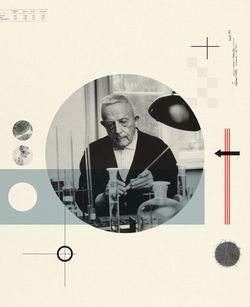
WarburgThe story of modern cancer research begins, somewhat improbably, with the sea urchin. In the first decade of the 20th century, the German biologist Theodor Boveri discovered that if he fertilized sea-urchin eggs with two sperm rather than one, some of the cells would end up with the wrong number of chromosomes and fail to develop properly. It was the era before modern genetics, but Boveri was aware that cancer cells, like the deformed sea urchin cells, had abnormal chromosomes; whatever caused cancer, he surmised, had something to do with chromosomes. Today Boveri is celebrated for discovering the origins of cancer, but another German scientist, Otto Warburg, was studying sea-urchin eggs around the same time as Boveri. His research, too, was hailed as a major breakthrough in our understanding of cancer. But in the following decades, Warburg’s discovery would largely disappear from the cancer narrative, his contributions considered so negligible that they were left out of textbooks altogether. Unlike Boveri, Warburg wasn’t interested in the chromosomes of sea-urchin eggs. Rather, Warburg was focused on energy, specifically on how the eggs fueled their growth. By the time Warburg turned his attention from sea-urchin cells to the cells of a rat tumor, in 1923, he knew that sea-urchin eggs increased their oxygen consumption significantly as they grew, so he expected to see a similar need for extra oxygen in the rat tumor. Instead, the cancer cells fueled their growth by swallowing up enormous amounts of glucose (blood sugar) and breaking it down without oxygen. The result made no sense. Oxygen-fueled reactions are a much more efficient way of turning food into energy, and there was plenty of oxygen available for the cancer cells to use. But when Warburg tested additional tumors, including ones from humans, he saw the same effect every time. The cancer cells were ravenous for glucose.

Warburg’s discovery, later named the Warburg effect, is estimated to occur in up to 80 percent of cancers. It is so fundamental to most cancers that a positron emission tomography (PET) scan, which has emerged as an important tool in the staging and diagnosis of cancer, works simply by revealing the places in the body where cells are consuming extra glucose. In many cases, the more glucose a tumor consumes, the worse a patient’s prognosis.

More here.

Tuesday Poem

The Last Time

The last time we had dinner together in a restaurant
with white tablecloths, he leaned forward

and took my two hands in his hands and said,
I’m going to die soon. I want you to know that.

And I said, I think I do know.
And he said, What surprises me is that you don’t.

And I said, I do. And he said, What?
And I said, Know that you’re going to die.

And he said, No, I mean know that you are.

by Marie Howe
from What Living We Do
W.W. Norton, 1998

Monday, May 16, 2016

Perceptions: Art in Nature

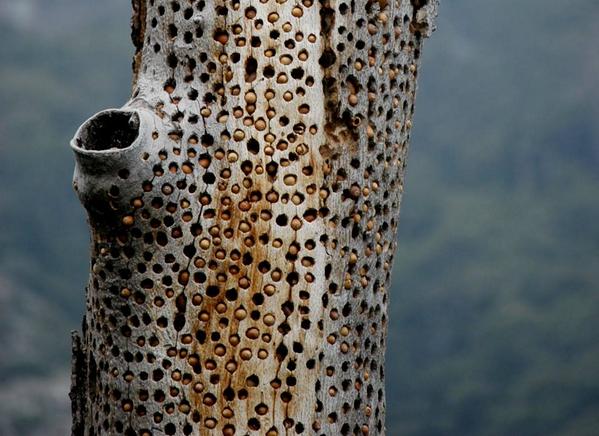
Acorn woodpecker tree
Acorn Woodpecker. Granary Tree.

Acorn woodpeckers drill into trees not in order to find acorns, but in order to make holes in which they can store acorns for later use, especially during the winter.

As the acorn dries out, it decreases in size, and the woodpecker moves it to a smaller hole. The birds spend an awful lot of time tending to their granaries in this way, transferring acorns from hole to hole as if engaged in some complicated game of solitaire.

Multiple acorn woodpeckers work together to maintain a single granary, which may be located in a man-made structure – a fence or a wooden building – as well as in a tree trunk. And whereas most woodpecker species are monogamous, acorn woodpeckers take a communal approach to family life. In the bird world, this is called cooperative breeding. Acorn woodpeckers live in groups of up to seven breeding males and three breeding females, plus as many as ten non-breeding helpers. Helpers are young birds who stick around to help their parents raise future broods; only about five per cent of bird species operate in this way.”

More here, here and here.

Sunday, May 15, 2016

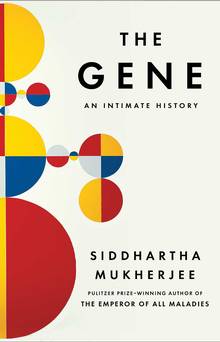
Siddhartha Mukherjee’s “The Gene” is a terrifically engaging book

Ivan Semeniuk in The Globe and Mail:

The+GeneEarlier this year, Jennifer Doudna, a molecular biologist at UC Berkeley who is known for her role in developing the revolutionary gene-editing technique called CRISPR, got a surprising e-mail from her neighbour. It was a link to a do-it-yourself CRISPR kit on sale for $140 US.

The site included an enticement that until recently would be taken as droll science fiction. “Note to BioHackers: Each Kit comes with all sequence and cloning detail so you can perform your own custom genome engineering.”

Even Doudna, a recent winner of a Canada Gairdner International Award, expresses amazement at the pace, scope and accessibility of the new genetics. In the few short years since she and others got CRISPR to work, the manipulation of genes has become something we can play with at home in our spare time. It’s this newfound capacity, with all its ethical ramifications, that makes Siddhartha Mukherjee’s latest book especially timely.

Mukherjee is a physician and assistant professor at Columbia University whose history of cancer,The Emperor of All Maladies, won him a Pulitzer Prize in 2011. A gifted writer with knack for storytelling, Mukherjee managed to translate his insider’s view of cancer medicine into a memorable read.

With The Gene: An Intimate History, Mukherjee is attempting to capture something far larger. Genetics is not just a field of research, it is the overarching framework that spans the life sciences and the key to heredity and identity. Where cancer provides a rich world of material for narrative treatment, genetics throws in the entire biological universe.

More here.

Should Prostitution Be a Crime?

Emily Bazelon in the New York Times:

ScreenHunter_1940 May. 15 21.21Last November, Meg Muñoz went to Los Angeles to speak at the annual West Coast conference of Amnesty International. She was nervous. Three months earlier, at a meeting attended by about 500 delegates from 80 countries, Amnesty voted to adopt a proposal in favor of the “full decriminalization of consensual sex work,” sparking a storm of controversy. Members of the human rights group in Norway and Sweden resigned en masse, saying the organization’s goal should be to end demand for prostitution, not condone it. Around the world, on social media and in the press, opponents blasted Amnesty. In Los Angeles, protesters ringed the lobby of the Sheraton where the conference was being held, and as Muñoz tried to enter, a woman confronted her and became upset as Muñoz explained that, as a former sex worker, she supported Amnesty’s position. “She agreed to respect my time at the microphone,” Muñoz told me. “That didn’t exactly happen” — the woman and other critics yelled out during her panel — “but I understand why it was so hard for her.”

Muñoz was in the middle of a pitched battle over the terms, and even the meaning, of sex work. In the United States and around the globe, many sex workers (the term activists prefer to “prostitute”) are trying to change how they are perceived and policed. They are fighting the legal status quo, social mores and also mainstream feminism, which has typically focused on saving women from the sex trade rather than supporting sex workers who demand greater rights. But in the last decade, sex-worker activists have gained new allies. If Amnesty’s international board approves a final policy in favor of decriminalization in the next month, it will join forces with public-health organizations that have successfully worked for years with groups of sex workers to halt the spread of H.I.V. and AIDS, especially in developing countries. “The urgency of the H.I.V. epidemic really exploded a lot of taboos,” says Catherine Murphy, an Amnesty policy adviser.

More here.

Glenn Greenwald Interviews BDS Co-Founder Omar Barghouti

Glenn Greenwald in The Intercept:

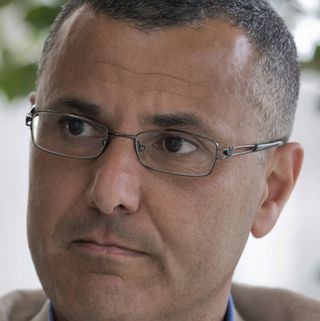
AP_16131491139182-article-headerDespite having lived in Israel for 22 years with no criminal record of any kind, Omar Barghouti (above) was this week denied the right to traveloutside the country. As one of the pioneers of the increasingly powerful movement to impose boycotts, sanctions and divestment measures (BDS) on Israel, Barghouti, an articulate, English-speaking activist, has frequently traveled around the world advocating his position. The Israeli government’s refusal to allow him to travel is obviously intended to suppress his speech and activism. Prime Minister Benjamin Netanyahu was one of the world leaders who traveled last year to Paris to participate in that city’s “free speech rally.”

As the husband of a Palestinian citizen of Israel, Barghouti holds a visa of permanent residency in the country, but nonetheless needs official permission to travel outside of Israel, a travel document which – until last week – had been renewed every two years. Haaretz this week reported that beyond the travel ban, Barghouti’s “residency rights in Israel are currently being reconsidered.”

The travel denial came after months of disturbing public threats directed at him by an Israeli government that has grown both more extreme and more fearful of BDS’s growing international popularity.

More here.

Five Known Unknowns about the Next Generation Global Political Economy

Image_Drezner_Daniel

Dan Drezner over at the Brookings Institution:

2. Are there hard constraints on the ability of the developing world to converge to developed-country living standards?

One of the common predictions made for the next generation economy is that China will displace the United States as the world’s biggest economy. This is a synecdoche of the deeper forecast that per capita incomes in developing countries will slowly converge towards the living standards of the advance industrialized democracies. The OECD’s Looking to 2060 report is based on “a tendency of GDP per capita to converge across countries” even if that convergence is slow-moving. The EIU’s long-term macroeconomic forecast predicts that China’s per capita income will approximate Japan’s by 2050. The Carnegie Endowment’s World Order in 2050 report presumes that total factor productivity gains in the developing world will be significantly higher than countries on the technological frontier. Looking at the previous twenty years of economic growth, Kemal Dervis posited that by 2030, “The rather stark division of the world into ‘advanced’ and ‘poor’ economies that began with the industrial revolution will end, ceding to a much more differentiated and multipolar world economy.”

Intuitively, this seems rational. The theory is that developing countries have lower incomes primarily because they are capital-deficient and because their economies operate further away from technological frontier. The gains from physical and human capital investment in the developing world should be greater than in the developed world. From Alexander Gerschenkron forward, development economists have presumed that there are some growth advantages to “economic backwardness”

This intuitive logic, however, is somewhat contradicted by the “middle income trap.” Barry Eichengreen, Donghyun Park, and Kwanho Shin have argued in a series of papers that as an economy’s GDP per capita hits close to $10,000, and then again at $16,000, growth slowdowns commence. This makes it very difficult for these economies to converge towards the per capita income levels of the advanced industrialized states. History bears this out. There is a powerful correlation between a country’s GDP per capita in 1960 and that country’s per capita income in 2008. In fact, more countries that were middle income in 1960 had become relatively poorer than had joined the ranks of the rich economies. To be sure, there have been success stories, such as South Korea, Singapore, and Israel. But other success stories, such as Greece, look increasingly fragile. Lant Prichett and Lawrence Summers conclude that “past performance is no guarantee of future performance. Regression to the mean is the single most robust and empirical relevant fact about cross-national growth rates.”

More here.