Democrats Need to Wake Up

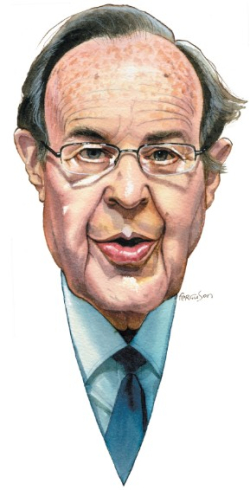
Bernie Sanders in The New York Times:

SandersDuring my campaign for the Democratic presidential nomination, I’ve visited 46 states. What I saw and heard on too many occasions were painful realities that the political and media establishment fail even to recognize. In the last 15 years, nearly 60,000 factories in this country have closed, and more than 4.8 million well-paid manufacturing jobs have disappeared. Much of this is related to disastrous trade agreements that encourage corporations to move to low-wage countries. Despite major increases in productivity, the median male worker in America today is making $726 dollars less than he did in 1973, while the median female worker is making $1,154 less than she did in 2007, after adjusting for inflation.

Nearly 47 million Americans live in poverty. An estimated 28 million have no health insurance, while many others are underinsured. Millions of people are struggling with outrageous levels of student debt. For perhaps the first time in modern history, our younger generation will probably have a lower standard of living than their parents. Frighteningly, millions of poorly educated Americans will have a shorter life span than the previous generation as they succumb to despair, drugs and alcohol. Meanwhile, in our country the top one-tenth of 1 percent now owns almost as much wealth as the bottom 90 percent. Fifty-eight percent of all new income is going to the top 1 percent. Wall Street and billionaires, through their “super PACs,” are able to buy elections. On my campaign, I’ve talked to workers unable to make it on $8 or $9 an hour; retirees struggling to purchase the medicine they need on $9,000 a year of Social Security; young people unable to afford college. I also visited the American citizens of Puerto Rico, where some 58 percent of the children live in poverty and only a little more than 40 percent of the adult population has a job or is seeking one.

Let’s be clear. The global economy is not working for the majority of people in our country and the world. This is an economic model developed by the economic elite to benefit the economic elite. We need real change. But we do not need change based on the demagogy, bigotry and anti-immigrant sentiment that punctuated so much of the Leave campaign’s rhetoric — and is central to Donald J. Trump’s message.

More here.
Wednesday Poem

Deer Walk Upon Our Mountains
.

When they see me said the old woman

they stop where they are

and gaze into my eyes for as long

as I am willing to stand there

in the wind

at the edge of the forest

You are speaking of my mortal enemy

said the dark red tulip

they have eaten many of my family

they do not spare children

they are pests

beauty excuses nothing

Oh cried the dog

the very thought of them

thrills me to the bone

the chase as much as the capture

the scent weaving ahead of me like a flag

saliva spinning from my teeth
.

by Alicia Ostriker
from The Old Woman, and The Dog
University of Pittsburgh Press, 2014

.

Tuesday, June 28, 2016

Michael Sandel: “The energy of the Brexiteers and Trump is born of the failure of elites”

Jason Cowley in The New Statesman:

JC One of the key slogans of the Brexiteers is to regain control. Why does this resonate with so many? And are you somewhat sympathetic to that line of argument?

ScreenHunter_2064 Jun. 28 18.48MS Well, I do think it resonates deeply. And I see this not only in Britain, I see this in the American political campaign, and I see it looking at the rise of anti-establishment parties throughout Europe. A theme running through these various political movements is taking back control, restoring control over the forces that govern our lives and giving people a voice. As to whether I have some sympathy for this sentiment, I do. I don’t have sympathy for many of the actual political forms that it takes.

One of the biggest failures of the last generation of mainstream parties has been the failure to take seriously and to speak directly to people’s aspiration to feel that they have some meaningful say in shaping the forces that govern their lives. And this is partly a question of democracy: what does democracy actually mean in practice? It’s also closely related to a question of culture and identity. Because a sense of disempowerment is partly a sense that the project of self-government has failed. When it’s connected to borders, the desire to reassert control over borders, it also shows the close connection between a sense of disempowerment and a sense that people’s identities are under siege.

A large constituency of working-class voters feel that not only has the economy left them behind, but so has the culture, that the sources of their dignity, the dignity of labour, have been eroded and mocked by developments with globalisation, the rise of finance, the attention that is lavished by parties across the political spectrum on economic and financial elites, the technocratic emphasis of the established political parties. I think we’ve seen this tendency unfold over the last generation. Much of the energy animating the Brexit sentiment is born of this failure of elites, this failure of established political parties.

More here.

Chivalry Isn’t Dead, But Men Are

Jesse Marczyk in Psychology Today:

InjuredIn the somewhat-recent past, there was a vote in the Senate held on the matter of whether women in the US should be required to sign up for the selective service – the military draft – when they turn 18. Already accepted, of course, was the idea that men should be required to sign up; what appears to be a relatively less controversial idea. This represents yet another erosion of male privilege in modern society; in this case, the privilege of being expected to fight and die in armed combat, should the need arise. Now whether any conscription is likely to happen in the foreseeable future (hopefully not) is a somewhat different matter than whether women would be among the first drafted if that happened (probably not), but the question remains as to how to explain this state of affairs. The issue, it seems, is not simply one of whether men or women are better able to shoulder the physical demands of combat, however; it extends beyond military service into intuitions about real and hypothetical harm befalling men and women in everyday life. When it comes to harm, people seem to generally care less about it happening to men.

More here.

The 4 Big Takeaways of Brexit That the Media and Pundits Missed

Robert Kuttner in AlterNet:

ScreenHunter_2063 Jun. 28 18.29What was the narrow British vote to leave the European Union really about?

In recent days, you have read commentaries with variations on the following themes, ad nauseam. All of them contain pieces of the truth, but all miss the basic point:

Irrational Racism. This vote was a mostly racist reaction on the part of Brits who resented dark skinned foreigners in their midst, and mistakenly blamed the E.U.

Britain actually has more control over its borders than most E.U. members, since London never signed the 1985 Schengen Agreement, which got rid of border controls for travelers throughout most of the Union. Before entering Britain, Europeans must still go through passport control, just like Syrians or Americans.

Scapegoating the E.U. for Economic Frustrations. Britain actually has a better deal than most E.U. nations. For starters, it retained its own currency, and controls its own monetary and fiscal policy. But as a member of the E.U., Britain does get to send tariff-free exports to the continent and London operates as a major European financial center. All of this now at risk.

More here. [Thanks to Sarah Ives.]

Jerry Saltz’s Breath has Been Taken Away

16-the-knockdown.w529.h352Jerry Saltz at New York Magazine:

I don't think I've ever had my breath taken away in New York the way I did when I first set eyes on the artist-run operation in Queens known as Knockdown Center. Not only did I not feel like I was in New York, I remembered the jealousy I always feel when I'm in Berlin or Los Angeles, walking in off some street through an unassuming doorway to a hidden huge courtyard and a magical vast building for art. I was staggered at what I saw, and then starting seeing, as possible art-world futures. New York must have a lot of derelict industrial spaces like this, in Maspeth and elsewhere, I thought. It was the most hopeful real-estate moment I've had in New York since the days of the East Village in the early 1980s (or maybe since galleries settled Chelsea in the 1990s). Somehow the man who saved Knockdown Center from developers coveting the site found a way to transform this magnificent 50,000-square-foot former door factory into a “radically cross-disciplinary” space devoted to “diverse formats, nourishing experimental impulses, questioning traditional notions of authorship, cultural production, and reception.” The space also “accepts proposals” for shows. You can propose something. I met an artist who did and the show is there now.

more here.

Colors / Army Green

Elvis-600Alexander Keefe at Cabinet Magazine:

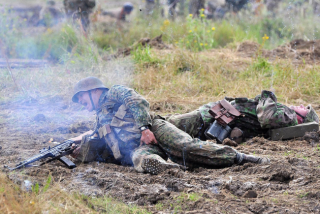
Late Motörhead front man and Nazi-memorabilia collector Lemmy Kilmister once said of his preference for the German side’s kit that he would have collected and worn British uniforms from the same period had their khaki color not made whoever put them on look “like a fucking swamp frog.” Much the same could have been said of the US Army’s World War II uniforms, characterized by an ochreous, greenish, khaki-like color known as olive drab. And Lemmy was not alone in his disdain for the dusty greens and taupes favored by the Allies; indeed, he was late to the game. Almost as soon as the war was over, mutters of dissatisfaction with olive drab in the United States turned into explicit concern. Army brass began to feel a pressing need for an appealing, ennobling color that could distinguish the army from its rivals—the other (generally blue-toned) branches of the US armed services. Committees were formed, reports drawn up, and after much debate it was decided that olive drab had to go, no matter the cost; the all-too-familiar sight of plumbers, garbagemen, and service station attendants working in battered, shit-brown Ike jackets across small-town America had finally put an end to whatever glimmer of romantic, colonial swagger had once attached to khaki and its confreres. And anyway, the colonial age was over, at least for the Brits—the war had put paid to that set of fantasies—and something new was beginning: call it the Cold War, call it the space age, call it the age of advertising. Call it Pax Americana or the beginning of America’s long half-century.

Whatever it was, it cried out for a new color, something plastic, identifying, unifying, and good. Reluctantly, the army also concluded that it would have to be some shade of green, an unfortunate color that, as historian Michel Pastoureau has pointed out, carries a profound ambivalence in the Western tradition—“a symbol of life, luck, and hope on the one hand, an attribute of disorder, poison, the devil and all his creatures on the other.”

more here.

this referendum has unleashed the worst in us

27661060226_1598768344_o-1Jon Day at n+1:

It began as an internal matter of party discipline. The offer of a referendum was a strategic decision made by the Conservative Party in the run up to last year’s general election. It was offered both as Prime Minister David Cameron’s concession to the eurosceptic wing of his own party—which had been hammering him on the issue of EU membership from the shires of middle England for years—and as a way of shoring up his nationalist credentials against the upstart band of blazer-wearing, spittle-spewing paranoiacs who call themselves the UK Independence Party.

Though they have one MP in the Commons (their leader Nigel Farage sits prettily in the European Parliament even as he rails against it) UKIP are more of a single-issue pressure group than a real political party. Nevertheless they have proved depressingly effective at whipping up anti-outsider sentiment: against Romanians and Bulgarians, against Turkey joining the EU, against Syrian refugees. It seemed as though they might well dilute the vote for the Tories—as well as for Labour, in some constituencies—during the 2015 election, so that giving way on the question of an EU referendum made some sense for the Conservatives. Both major parties felt comfortable, if not compelled, to make immigration a campaigning issue.

more here.

The Challenges of Male Friendships

Jane Brody in The New York Times:

BrodyChristopher Beemer, a 75-year-old Brooklynite, is impressed with how well his wife, Carol, maintains friendships with other women and wonders why this valuable benefit to health and longevity “doesn’t come so easily to men.” Among various studies linking friendships to well-being in one’s later years, the 2005 Australian Longitudinal Study of Aging found that family relationships had little if any impact on longevity, but friendships increased life expectancy by as much as 22 percent.

…From childhood on, Dr. Olds said, “men’s friendships are more often based on mutual activities like sports and work rather than what’s happening to them psychologically. Women are taught to draw one another out; men are not.” Consciously or otherwise, many men believe that talking about personal matters with other men is not manly. The result is often less intimate, more casual friendships between men, making the connections more tenuous and harder to sustain. Dr. Olds said, “I have a number of men in my practice who feel bad about having lost touch with old friends. Yet it turns out men are delighted when an old friend reaches out to revive the relationship. Men might need a stronger signal than women do to reconnect. It may not be enough to send an email to an old friend. It may be better to invite him to visit.” Some married men consider their wives to be their best friend, and many depend on their wives to establish and maintain the couple’s social connections, which can all but disappear when a couple divorces or the wife dies. Differences between male and female friendships start at an early age. Observing how his four young granddaughters interact socially, Mr. Beemer said, “They have way more of that kind of activity than boys have. It may explain why as adults they continue to do a much better job of it.” In defense of his gender, he observed, “Men have a harder time reaching their emotions and are less likely than women to reveal their emotional side. But when you have a real friendship, it’s because you’ve done just that.” He has found that “it’s important to expose yourself and be honest about what’s going on. If you reveal yourself in the right way to the right person, it will be just fine. There are risks, you can’t force it. Sometimes it doesn’t work — you get a don’t-burden-me-with-that kind of response and you know to back off. But more often men will respond in kind.” Mr. Beemer has worked hard to establish and maintain valuable relationships with other men of a similar vintage. He joined a men’s book group that meets monthly, and after about two years, he said, “it became a group where the members really mean something to one another.”

More here.

Tuesday Poem

Touch

We made our own laws.
I want to be a Hawk,
A Dolphin, a Lion, we’d say

In stores where team logos hung
Like animal skins.

By moonlight,
We chased each other
Around the big field

Beneath branches sagging
As if their leaves were full of blood.

We didn’t notice when policemen
Came lighting tree bark
& our skin with flashlights.

They saw our game
For what it was:

Fingers clutching torso,
Shoulder, wrist—a brawl.
Some of the boys escaped,

Their brown legs cut by thorns
As they ran through the brush.

It’s true, we could have been mistaken
For animals in the dark,
But of all our possible crimes,

Blackness was the first.
So they tackled me,

And read me my rights without saying:
You Down or Dead Ball.
We had a language

They did not use, a name
For collision. We called it Touch.
.

by Terrance Hayes
from Hip Logic
Penguin, 2002
.

Monday, June 27, 2016

perceptions

Tumblr_mnt4vxX2kg1rouua1o7_1280

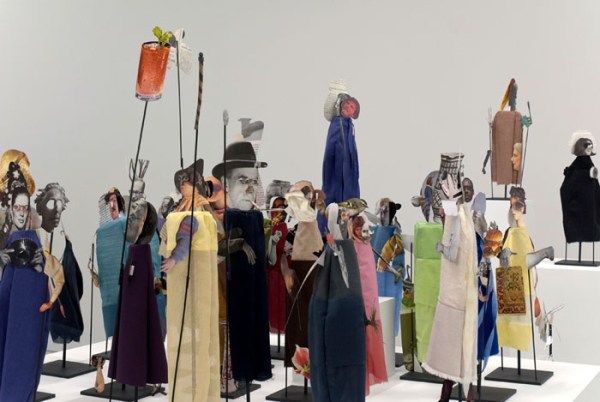
Geoffrey Farmer. The Surgeon and The Photographer. From Stage Presence, SFMOMA 2012.

Installation: paper, textiles, wood, & metal.

“… Farmer collaged photographic reproductions from books into 365 puppet-like sculptures, each approximately the size of a hand, thirty of which are included in this exhibition. The puppets bristle with multiple identities; each angle presents a new figuration as disproportionate and layered appendages cohere into forms. They are totemic but not possessed of any spirit. Rather, they are waiting for occupation and activation.

More here, and here.

Sunday, June 26, 2016

A history of masturbation

Barry Reay in Aeon:

ScreenHunter_2062 Jun. 26 23.10The anonymous author of the pamphlet Onania (1716) was very worried about masturbation. The ‘shameful vice’, the ‘solitary act of pleasure’, was something too terrible to even be described. The writer agreed with those ‘who are of the opinion, that… it never ought to be spoken of, or hinted at, because the bare mentioning of it may be dangerous to some’. There was, however, little reticence in cataloguing ‘the frightful consequences of self-pollution’. Gonorrhoea, fits, epilepsy, consumption, impotence, headaches, weakness of intellect, backache, pimples, blisters, glandular swelling, trembling, dizziness, heart palpitations, urinary discharge, ‘wandering pains’, and incontinence – were all attributed to the scourge of onanism.

The fear was not confined to men. The full title of the pamphlet wasOnania: Or the Heinous Sin of Self-Pollution, and all its Frightful Consequences (in Both Sexes). Its author was aware that the sin of Onan referred to the spilling of male seed (and divine retribution for the act) but reiterated that he treated ‘of this crime in relation to women as well as men’. ‘[W]hilst the offence is Self-Pollution in both, I could not think of any other word which would so well put the reader in mind both of the sin and its punishment’. Women who indulged could expect disease of the womb, hysteria, infertility and deflowering (the loss of ‘that valuable badge of their chastity and innocence’).

Another bestselling pamphlet was published later in the century:L’onanisme (1760) by Samuel Auguste Tissot. He was critical of Onania, ‘a real chaos … all the author’s reflections are nothing but theological and moral puerilities’, but nevertheless listed ‘the ills of which the English patients complain’.

More here.

In Indonesia, Non-Binary Gender is a Centuries-Old Idea

Modern Western culture is slowly acknowledging gender fluidity, but “third genders” and other classifications have existed throughout history.

Jessie Guy-Ryan in Atlas Obscura:

ScreenHunter_2061 Jun. 26 23.03This week, an Oregon judge ruled to allow Jamie Shupe, a 52-year-old former Army mechanic, to list themselves as non-binary—that is, neither male nor female on their driver’s license. The ruling is likely the first time that an individual has been allowed to legally identify as non-binary in the United States, and represents part of a growing effort around the world to extend legal recognition to those whose identities fall outside the masculine/feminine gender binary.

Some might assume that the shift towards viewing gender as fluid or encompassing identities beyond the binary is a novel cultural change; in fact, several non-Western cultures—both historically and today—have non-binary understandings of gender. In Indonesia, one ethnic group shows us that the idea that gender identity is expressed in more ways than two is actually hundreds of years old.

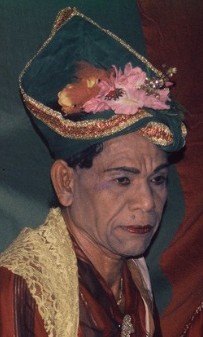
The Bugis are the largest ethnic group in South Sulawesi, Indonesia, and are unique in their conception of five distinct gender identities. Aside from the cisgender masculinity and femininity that Westerners are broadly familiar with, the Bugis interpretation of gender includes calabai (feminine men), calalai (masculine women) and bissu, which anthropologist Sharyn Graham describes as a “meta-gender” considered to be “a combination of all genders.”

More here.

Across the Universe

Steven Wheeler in Inference:

As the 1960s drew to a close, Rainer Weiss was working as an associate professor at MIT’s Department of Physics.1 Asked to teach an undergraduate course on general relativity by the department chairman, Weiss found himself in the unenviable position of teaching an unfamiliar subject. “I had a terrible time with the mathematics,” Weiss recalled, “[a]nd I tried to do everything by making aGedankenexperiment out of it.”2

Weiss’s students were curious about the work of physicist Joseph Weber and, in particular, his attempts to detect gravitational waves. Predicted by Albert Einstein’s theory of general relativity, gravitational waves were a much-debated phenomenon for which no experimental evidence had been found. Weber’s efforts were centered on resonant mass detectors of his own design: suspended aluminum cylinders two meters in length and a meter in diameter fitted with a ring of piezoelectric crystals.3 Weber believed that the cylinders would, in effect, act like giant tuning forks; a passing gravitational wave would ring the cylinders at their resonant frequency. In a 1969 paper published by the Physical Review, Weber claimed to have found evidence for gravitational waves.

More here.

How the New Science of Computational History Is Changing the Study of the Past

From the MIT Technology Review:

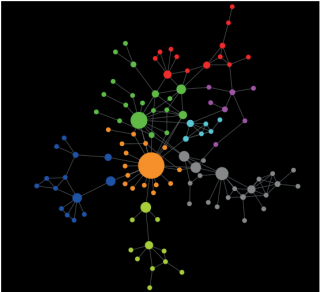
Computational-historyOne of the curious features of network science is that the same networks underlie entirely different phenomena. As a result, these phenomena have deep similarities that are far from obvious at first glance. Good examples include the spread of disease, the size of forest fires, and even the distribution of earthquake magnitude, which all follow a similar pattern. This is a direct result of their sharing the same network structure.

So it’s usually no surprise that the same “laws” emerge when physicists find the same networks underlying other phenomena. Exactly this has happened repeatedly in the social sciences. Network science now allows social scientists to model societies, to study the way ideas, gossip, fashions, and so on flow through society—and even to study how this influences opinion.

To do this they’ve used the tools developed to study other disciplines. That’s why the new field of computational social science has become so powerful so quickly.

But there’s another field of endeavor that also stands to benefit: the study of history. Throughout history, humans have formed networks that have played a profound role in the way events have unfolded. Historians have recently begun to reconstruct these networks using historical sources such as correspondence and contemporary records.

More here.

A Stark Nuclear Warning

Jerry Brown in the New York Review of Books:

ScreenHunter_2060 Jun. 26 22.48I know of no person who understands the science and politics of modern weaponry better than William J. Perry, the US Secretary of Defense from 1994 to 1997. When a man of such unquestioned experience and intelligence issues the stark nuclear warning that is central to his recent memoir, we should take heed. Perry is forthright when he says: “Today, the danger of some sort of a nuclear catastrophe is greater than it was during the Cold War and most people are blissfully unaware of this danger.”1 He also tells us that the nuclear danger is “growing greater every year” and that even a single nuclear detonation “could destroy our way of life.”

In clear, detailed but powerful prose, Perry’s new book, My Journey at the Nuclear Brink, tells the story of his seventy-year experience of the nuclear age. Beginning with his firsthand encounter with survivors living amid “vast wastes of fused rubble” in the aftermath of World War II, his account takes us up to today when Perry is on an urgent mission to alert us to the dangerous nuclear road we are traveling.

Reflecting upon the atomic bombing of Hiroshima and Nagasaki, Perry says it was then that he first understood that the end of all of civilization was now possible, not merely the ruin of cities.

More here.