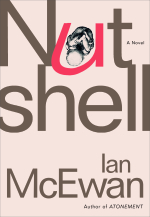
‘Nutshell’ by Ian McEwan

Nutshell_creamKate Clanchy at The Guardian:

This is a short novel narrated by a foetus who is also Hamlet. “Bounded in the nutshell” of (Ger-) Trudy’s womb he listens, with a cervix for an arras, to her planning to murder his father, John Cairncross, in partnership with her lover, John’s brother Claude (-ius). The state of Denmark is being played by a decaying, but entire, Georgian town house in central London, based surely on the legendarily unimproved Islington home of the poet Hugo Williams. It has been inherited by hopeless poetry publisher John, is coveted by property developer Claude and is worth a cool £8m. Though the narrator at one point has a gorgeous and explicitly Elizabethan dream – “A cold mist on the day of my desertion, a three-day journey on horseback, long rows of the English poor in the rutted lanes” – the year is mostly 2015.

This may not sound like an entirely promising read: a talking foetus could be an unconvincing or at least tiresomely limited narrator, and updatings of Shakespeare often strain at their own seams. From the start, though, McEwan manages to establish both the groggy, gripping parameters of the uterus – “My limbs are folded hard across my chest, my head is wedged into my only exit. I wear my mother like a tight-fitting cap” – and that this foetus, Hamlet-style, is “king of infinite space”. He sounds rather like Humbert Humbert in Nabokov’sLolita; the same grand, elegiac tone; the same infinite knowledge of history and English poetry, the same covetous, obsessively physical eye.

more here.
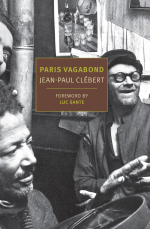
‘Paris Vagabond’ by Jean-Paul Clébert

Paris-vagabondHal Hlavinka at The Quarterly Conversation:

We meet many people across Clébert’s wanderings, and his characters (for that’s what they become) parade past the reader, page by page, each pausing only for a brief second before plunging back into the seedy tableau. While out measuring rooms for an architect, our hero is “struck by the odor of soil and dead leaves” and encounters a mushroom farm inside of an apartment. “I would have had to clamber in damp darkness,” he writes, “over little mounds of earth on which white spots were breaking out.” On the Buttes-Chaumont he discovers an artist’s workshop filled with uncaged birds, “an immense glassed-in space that stunned you with cries and colors.” A page later, on assignment in the Saint-Pierre neighborhood, we’re in an apartment-turned-serpentarium, with snakes nestled in every nook: “They were everywhere, slithering under tables and around the feet of chairs. . . . I left with my tail between my legs, ignoring the gentleman’s polite and soothing explanations.” Friends and acquaintances are equally mad. There’s Jérôme, the grave robber, “the world’s expert on the topography and benefits of Paris’s cemeteries,” who engages in the business of “headhunting.” Inside a crypt, a motivated headhunter need only avoid the caretaker, hold his breath, “grasp hold of a head by thrusting a finger and thumb into the eye sockets, twist sharply so as to snap the uppermost vertebra, and toss each skull into [a] sack.” The heads, for their part, become curios to sell to discerning bidders. And Monsieur Claude, aka Mr. Numb, “who sticks needles, pins or nails into a part of his anatomy chosen by any enthusiast who pays a round.” Only for those paying a premium does Mr. Numb reserve his best: “[He] will adorn the knob of his penis with a tight sheaf of tiny needles, a spectacle prone to make young tourists blanch and choke.” The case of Marceau and his two wives is particularly emblematic of the carefree vagabond cast. After Marceau goes missing during a multi-day bender, the police discover a corpse, which wife number one (the one and only, at the time) identifies as her husband’s. The woman grieves over free drinks from anyone who will pay their respects, until one morning when Marceau returns from the dead with wife number two in hand, “this to the outrage of the other one, who bombarded him with curses.” The polygamist remains officially deceased: “[The police] struck Marceau off the roster of the living and registered his death as accidental. End of story.”

more here.

When Exercise Becomes Too Much of a Good Thing

Carrie Arnold in Nautilus:

ExerciseIn their 2015 book The Truth About Exercise Addiction: Understanding the Dark Side of Thinspiration, author Katherine Schreiber and Jacksonville University professor of kinesiology Heather Hausenblas write, “Exercise addicts experience physical activity as both a coping mechanism and a compulsion without which they feel they cannot survive.” People generally feel better both physically and mentally after working out. But for exercise addicts, that positive surge—similar to the ones gambling- and sex-addicts feel—is substantially higher: It can give athletes and non-athletes alike a powerful buzz of pleasure that can leave them coming back for more, ultimately leading to a life tethered to the treadmill, so to speak, and serious medical consequences, including fatigue, overuse injuries (stress fractures, pulled muscles, tendonitis), infections that won’t go away, electrolyte imbalances, cardiac issues, and, perhaps paradoxically, listlessness. To see this play out, we may need to look no further than the Olympics. Exercise addiction seems to increase, at least among athletes, the more elite they become, according to a study, published last month, in Journal of Behavioral Addictions. Tim Brewerton, a physician at the Medical University of South Carolina, agrees. “We venerate Olympic athletes almost like gods. We give them lots of praise and attention, but if we knew anything of what their lives were like…” he says, trailing off. “I think many of them likely experience some type of exercise addiction—they are training constantly for years.”

What makes exercise addiction a thorny phenomenon to study, though, is its complicated relationship with eating disorders. In the 1800s, for example, physicians treating young women with anorexia nervosa, an eating disorder characterized by self-starvation and persistent weight loss, often noted their extreme restlessness and need to constantly move about. And in a 1984 study, a group of physicians had noted in the Journal of the American Medical Association that considerably dedicated male runners, or “obligatory runners,” shared many of the same psychological traits as young women with anorexia, such as perfectionism and depression, although to a lesser degree.

More here.

Overselling A.D.H.D.: A New Book Exposes Big Pharma’s Role

Steve Silberman in The New York Times:

PharmaIn the late 1930s, Charles Bradley, the director of a home for “troublesome” children in Rhode Island, had a problem. The field of neuroscience was still in its infancy, and one of the few techniques available to allow psychiatrists like Bradley to ponder the role of the brain in emotional disorders was a procedure that required replacing a volume of cerebrospinal fluid in the patient’s skull with air. This painstaking process allowed any irregularities to stand out clearly in X-ray images, but many patients suffered excruciating headaches that lasted for weeks afterward. Meanwhile, a pharmaceutical company called Smith, Kline & French was facing a different sort of problem. The firm had recently acquired the rights to sell a powerful stimulant then called “benzedrine sulfate” and was trying to create a market for it. Toward that end, the company made quantities of the drug available at no cost to doctors who volunteered to run studies on it. Bradley was a firm believer that struggling children needed more than a handful of pills to get better; they also needed psychosocial therapy and the calming and supportive environment that he provided at the home. But he took up the company’s offer, hoping that the drug might eliminate his patients’ headaches.

It did not. But the Benzedrine did have an effect that was right in line with Smith, Kline & French’s aspirations for its new product: The drug seemed to boost the children’s eagerness to learn in the classroom while making them more amenable to following the rules. The drug seemed to calm the children’s mood swings, allowing them to become, in the words of their therapists, more “attentive” and “serious,” able to complete their schoolwork and behave. Bradley was amazed that Benzedrine, a forerunner of Ritalin and Adderall, was such a great normalizer, turning typically hard-to-manage kids into models of complicity and decorum. But even after marveling at the effects of the drug, he maintained that medication should be considered for children only in addition to other forms of therapy. Bradley’s research was ignored for a couple of decades as psychoanalysis became dominant in the United States.But his discoveries laid the foundation for one of the most aggressive marketing campaigns in history, which succeeded not only in helping to transform the nascent drug industry into the multinational juggernaut known as Big Pharma, but in convincing parents, physicians and ­public health officials that 15 percent of American schoolchildren are sick enough that they would require powerful medication just to get through the day.

More here.

Saturday Poem

Work

my son, who's seventeen years old,
rides his bicycle to work in the heat and rain, and his
legs and arms are bony and muscled

old men love to send them into the smoke
and trenches, into the knowledge of how easily bodies and
courtesies come apart — we did it by jesus we did it,
now you'll see

and for eight hours scrubs the burnt paint
off what he describes as iron grapefruit halves, assisting
in the trickling together of parts from the continent's
corners, some race of machines assembling itself in
Karnac, Ohio, or Oshawa, my son labouring obscurely at
the birth

handsome as never again, just getting his beard

comes home black with grease, proud and marvelling;
the other men, he says, don't talk about sports or politics,
they talk about Ed's wife who's having her first baby,
Ed says the baby's already dropped,

growing up in the country of my past, he'd often
had the shrines pointed out to him, the jobs from grade six
on (35 cents an hour to start), heaving crates of
rotten fruit, green bales of alfalfa, planks into the
planer, planks into the planer

the rubber gloves they give him are like artificial
hands

working the wire brush, water spills
into his steel shoes, and the men who pass say that looks
like fun

saving

lies in bed in the dark
smiling, sensing his growing invisible shape, his stories
building

by John Steffler
from Canadian Poetry Online

.

Friday, August 26, 2016

The Two-faced Politics of Indian-Americans

3QD's own Namit Arora in Shunya's Notes:

ScreenHunter_2170 Aug. 26 20.15Indian-Americans, a group that includes me, are one of the most visible and successful global diasporas. With the highest per capita income of any ethnic group in the US, we’re often called a ‘model minority’ in America. But what can be said about our politics as a group?

Historically, we Indian-Americans—and here I’m speaking primarily of Indians who’re naturalized US citizens or permanent residents—have overwhelmingly supported the Democrats, more so than any other large Asian group in the US. Over 80 percent of us voted for Barack Obama in 2008, second only to black Americans. This year, less than ten percent might vote for the Republican Donald Trump. Curiously, contrary to what one might expect, success and wealth haven’t driven most of us to vote for Republicans, who’re seen as friendlier to the rich. What can explain this? Is it because we are remarkably liberal as a group?

Consider some more facts. We Indian-Americans overwhelmingly support Narendra Modi too, at a rate much higher than among Indians in India. We host rockstar receptions for him in arenas like Madison Square Garden in NY and SAP Center in Silicon Valley. This despite Trump and Modi being similar in so many ways. They’re both authoritarian and anti-democratic; anti-Muslim; anti-LGBT; steeped in nationalism (white/Hindu); allied with far-right groups (KKK/RSS); economically conservative; anti-labor union; thuggish (think Amit Shah); big on defense spending; and so on. Even if we concede that Trump is worse than Modi—though some will disagree—their proximities are undeniable. So why do we Indian-Americans despise Trump yet love Modi? What’s behind this apparent paradox?

More here.

How Designers and Scientists Are Using Bees to Map NYC’s Microbes

Liz Stinson in Wired:

ScreenHunter_2169 Aug. 26 20.05You share more than a zip code with your neighbors. You also share bugs—microscopic organisms (think bacteria, fungi, and viruses). These microbial communities are called microbiomes, and they seem to have an impact on everything from digestion to allergies. They also happen to be everywhere—from your intestines to your phone’s screen to the sidewalk beneath your feet.

But those bugs are tough to understand, because you can’t see them. “There’s like this whole other invisible planet,” says Kevin Slavin, head of the Playful Systems group at the MIT Media Lab. In a new project called Holobiont Urbanism, Slavin’s team is working to sample, sequence, and visualize the microbial makeup of New York City. Some of the team members are designers, engineers, and biologists.

Some of them are bees.

Bees typically forage no more than a mile and a half from their hives, but in their expeditions they come into contact with the microbes in their range, and those microbes stick. Slavin’s group worked with apiarists to build beehives with removable trays at the bottom that collect detritus from the bees, like a crumb-catcher in a toaster.

More here.

Ralph Wedgwood on the nature of normativity

Richard Marshall in 3:AM Magazine:

MarkSchroeder_square-200x200Ralph Wedgwood is a philosopher who asks questions related to ethics and epistemology. His great-great-great-great uncle was Charles Darwin. Here he discusses the nature of metaethics and why the best-known approaches dissatisfy him, how normativity is to be fitted into a naturalistic framework, his ‘moderate naturalism’, why normativity raises issues of semantics, metaphysics and epistemology, what makes ‘ought’ statements true or false, how we know the real normative components of actuality, how to defend Normative Judgment Internalism, the normativity of rationality, degrees of rational thinking, how he defends his view from various objections, why ‘reasons’ talk is more complicated than many philosophers have assumed, whether rationality is a kind of value and the point of being guided by internal norms. As late summer brings us heatwaves, freshen up on this cool distillation …

3:AM: What made you become a philosopher?

Ralph Wedgwood: I didn’t study philosophy as an undergraduate: I studied Classics and Modern Language (German and Greek) instead. At school, I particularly enjoyed learning foreign languages, including Latin and ancient Greek, and I loved learning about history, literature and culture. However, while I was an undergraduate at Oxford, I had friends who were studying philosophy (for example, Alexander Bird, who is now a Professor of Philosophy at Bristol), and I spent a lot of time talking to them. I also encountered philosophy as part of my studies of German and Greek – in particular, Plato and the Presocratics on the Greek side, and Schiller, Kant, and Nietzsche on the German side. But fundamentally, I just got gripped by the central question of ethics, which Socrates poses so insistently: How should we live? While this is the central question of ethics, in my view answering this question also involves epistemology – since to know how we should live, we need to understand what we should believe, and how we should form and revise our beliefs in response to experience and reflection; and the question as I see it also involves the theory of rational choice or decision—since to know how we should live, we need to understand how we should make choices or decisions, and how we should revise our plans or intentions as we acquire new information over time.

There were many reasons why this question gripped me.

More here.

The Plastic Earth: Connecting climate change to the planet’s shifting crust

Jonathan Shaw in Harvard Magazine:

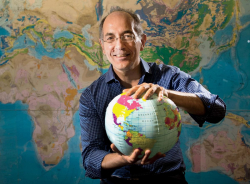
SO16_image_Page_060_Image_0001Jerry Mitrovica is a solid-earth geophysicist, but the description is inapt. He spends much of his time demonstrating that the earth is not firm at all—it moves. His lab in Cambridge, for example, oscillates up and down by nearly eight inches twice a day. Mitrovica is a pioneer of dynamic topography, the study of such vertical motions. For most people, these ebbs and flows are new ground. But for Mitrovica, who investigates changes large and small to the planet’s shape, on timescales ranging from hours to eons, using evidence that ranges from the history embedded in coral to eclipse records, it’s terra firma. His research, of fundamental importance to earth scientists, also has a public resonance, because his discoveries about the planet’s plasticity, and his explorations of its shape-changing past, bear directly on the problem of melting ice sheets and rising sea levels in an era of rapid climate change.

Fame of the academic variety came early to Mitrovica and mushroomed about a decade ago, when he reminded people what happens to local sea levels in the vicinity of a melting ice sheet, like those covering Greenland and Antarctica. The effect was first described a hundred years ago, but “people had forgotten how big it was,” he says. “It’s big.” If Greenland’s ice sheet melted entirely, sea level would fall 20 to 50 meters at the adjacent coast. That’s counterintuitive, but the ice sheets are so massive (Greenland’s ice, one-tenth the size of the Antarctic ice sheets, weighs on the order of 3,000 trillion tons) that two immediate effects come into play. First, all that ice exerts gravitational pull on the surrounding ocean. When an ice sheet melts, that gravitational influence diminishes, and water moves away from the ice sheet, causing sea levels to drop as far as 2,000 kilometers away. (The drop is most pronounced close to the glacier, because gravity’s effects dissipate with distance.) But because the sea level has fallen where the ice sheet melted, it rises everywhere else beyond that 2,000-kilometer boundary, and on distant shores this rise is far greater than the global average. The effect amplifies the rise in average global sea level attributable to the addition of the meltwater itself to the oceans. (Greenland alone contributed a trillion tons of melted ice from 2011 to 2014.) Second, the land beneath the now-vanished ice sheet slowly rebounds, rising as the weight of the mass above diminishes, a process that continues for thousands of years after the ice sheet is gone. Locally, this doubles the relative drop in sea level. But globally, the uplifting crust pushes water outward, further raising sea levels around the world.

More here.

On Raul Brandão’s ‘The Poor’

1564787648.01.LZZZZZZZMiguel Rosa at The Millions:

Raul Brandão debuted in English a month ago without a murmur. We should welcome him with the joyful thrill of discovering a late, great Portuguese novelist heretofore unknown to the Anglo-American world. However the recent publication of The Poor also exemplifies one accidental way of hampering a foreign writer. Although the usual method involves a bad translation, Karen Sotelinogets an A from me for navigating syntactically and lexically close to the original. But what can you do with inaccurate translation of context? According to Dalkey Archive Press, this is “a powerful tribute to the underclasses” and an exposé of the “economic situation in Portugal.”

How unexciting: Portugal’s first Modernist novelist downgraded to a turn-of-the-century social realist fiction pamphleteer. DAP could have found more suitable candidates among his contemporaries. Now, bad translations can’t be salvaged, only scraped and rewritten, but let’s see if we can correct Brandão’s haphazard labeling.

In the first chapter, the unnamed narrator introduces several people living in a derelict tenement building: a group of prostitutes and thieves; Senhor José, a pallbearer; the unemployed Gebo, his wife and daughter, Sofia; and Gabiru, “a solitary philosopher, slender, as sad as a funeral, and armed with the most formidable and strangest of wisdom in God’s creation.”

more here.

The Dream of Enlightenment

Alex Dean in Prospect Magazine:

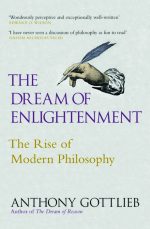
The-dream-of-enlightenment_v2-e1471349419184At two points in history philosophy has made a great leap forwards: in the time of Socrates, Plato and Aristotle from the mid-5th century to the late-4th century BC, and between 1640 and the French Revolution. That’s according to Anthony Gottlieb who, having written about the first 150 years in his acclaimed The Dream of Reason, now analyses the second in The Dream of Enlightenment. The century-and-a-half covered here is packed with important philosophical events. Many great thinkers (René Descartes, John Locke and Gottfried Wilhelm Leibniz to name but a few) were doing their finest work during this period—a period in which, along with the development of early modern philosophy, science was moving along apace and religion was undergoing an upheaval. Gottlieb therefore has a huge amount of ground to cover. He canters over it elegantly and with remarkable expertise. Gottlieb does not just present philosophers’ arguments; he engages with them and provides rebukes to common misconceptions. He provides some much-needed clarity when he comes to Descartes’s famous maxim “I think, therefore I am” (an argument that should be better understood given how widely-known it is) and when he reaches Locke’s frequently misunderstood view that the human mind resembles a blank slate.

The Dream of Enlightenment contains some fascinating biographical tales. By the book’s end you know not just what the philosophers said, but who they were. I did not know, for instance, that Thomas Hobbes was so obsessed with geometry that he used to draw triangles on his sheets and legs while in bed.

More here.

A MONUMENT TO OUTLAST HUMANITY

160829_r28571-1200x928-1471540396Dana Goodyear at The New Yorker:

“City” is a monumental architectonic work, with dimensions comparable to those of the National Mall, in Washington, D.C., and a layout informed by pre-Columbian ritual cities like Teotihuacan. Heizer started it in 1972, when he was in his late twenties and had already established himself as an instigator of the earthworks movement, a group of artists, including Robert Smithson and Walter De Maria, who made totemic outdoor sculptures, often in the majestic wastelands of the American West. “City” is made almost entirely from rocks, sand, and concrete that Heizer has mined and mixed on site. The use of valueless materials is strategic, a hedge against what he sees as inevitable future social unrest. “My good friend Richard Serra is building out of military-grade steel,” he says. “That stuff will all get melted down. Why do I think that? Incans, Olmecs, Aztecs—their finest works of art were all pillaged, razed, broken apart, and their gold was melted down. When they come out here to fuck my ‘City’ sculpture up, they’ll realize it takes more energy to wreck it than it’s worth.”

It is either perfect or perfectly bizarre that Heizer’s sculpture, a monument meant to outlast humanity, is flanked by an Air Force base and a bomb-test site; in recent years, the land surrounding “City” was under consideration for a railroad to convey nuclear waste to a proposed repository at Yucca Mountain. As it happened, Senator Harry Reid, a dedicated opponent of Yucca Mountain and an advocate for public lands, fell in love with Heizer’s crazily ambitious project and its quintessentially Nevadan setting. “I decided to go and look at it,” Reid told me. “Blew out two tires. I just became infatuated with the vision that he had.” Last summer, at Reid’s urging, President Obama declared seven hundred and four thousand acres of pristine wilderness surrounding “City” a national monument, meaning that it will be protected from development, including a nuclear rail line, for as long as the United States exists.
more here.

Radical Flâneuserie: the aimlessly wandering woman

Flaneuse-1024x868Lauren Elkin at The Paris Review:

There’s something so attractive about wandering aimlessly through the city, taking it all in (especially if we’re wearing Hermès while we do it). We all, deep down, want to detach from our lives. The flâneur, since everyone wants to be one, has a long history of being many different things to different people, to such an extent that the concept has become one of these things we point to without really knowing what we mean—a kind of shorthand for urban, intellectual, curious, cosmopolitan. This is what Hermès is counting on: that we will associate Hermès products with those values and come to believe that buying them will reinforce those aspects of ourselves.

The earliest mention of a flâneur is in the late sixteenth century, possibly borrowed from the Scandinavian flana, “a person who wanders.” It fell largely out of use until the nineteenth century, and then it caught on again. In 1806, an anonymous pamphleteer wrote of the flâneur as “M. Bonhomme,” a man-about-town who comes from sufficient wealth to be able to have the time to wander the city at will, taking in the urban spectacle. He hangs out in cafés and watches the various inhabitants of the city at work and at play. He is interested in gossip and fashion, but not particularly in women. In an 1829 dictionary, a flâneur is someone “who likes to do nothing,” someone who relishes idleness. Balzac’s flâneur took two main forms: the common flâneur, happy to aimlessly wander the streets, and the artist-flâneur, who poured his experiences in the city into his work.

more here.

Friday Poem

In Kashmir, it is the boys, [and everyone]
—Dedicated to the killed, maimed, blinded, imprisoned,
…. curfewed in Kashmir

It is the boys, says the government man

on the Indian TV

who the parents should ask to stay away

away from the streets and stones

and sit, in front of lifeless computers

in dark, Internet banned, phones shut,

smeared with blood of their mates

drinking milk-less tea, dry-eyed

and stay calm [a must]

pretend the chains they keel under

are the gossamer-threads of democracy

Read more »

Thursday, August 25, 2016

On Rainer Maria Rilke, William Gass, Stumbling Across My Younger Self, and the Pleasures and Perils of Translating Poetry

Kai Maristed in Agni:

ScreenHunter_2166 Aug. 25 21.48This past spring, at AGNI’s Issue 83 launch, I had the chance to chat with David Daniel, whose atmospheric, heart-moving poetry I had just discovered in the way you discover something you’ve missed before knowing it exists.

At some point I confided to David that, not being a published poet, I had recently experienced twinges of self-doubt, of feeling like a trespasser, while translating Ingeborg Bachmann, Paul Celan and others. At the same time, the doing itself was exhilarating, and seemed, well…if not exactly easy, to flow toward rightness and resolution. Or was I being grossly naive, to believe I could simply listen closely to the German words and verses, immerse myself in the worlds they made, twirl them through my ear and mind and have them emerge as lines of English, lucid and faithful to original meaning while carrying as much of the original music as possible?

Shouldn’t there be more hard labor involved, more agony and frustration? Isn’t that why so many modern poetry translations appear to have been composed by a duo of Established Poet and her/his trusty sidekick, the Native Speaker? Like high level military brass going into the battlefields guided by, well, local translators. Didn’t William Gass, in his 1999 book-length essay, Reading Rilke, Reflections on the Problems of Translation, assert that, compared to having fluency in both languages, “it is more important that the translator have native-like possession of the language into which he is trying to put his chosen poem”? (‘Native-like possession’ being in context a strikingly awkward euphemism for ‘should be a skilled poet or literary eminence, capable of wrestling with the intransigency of the task.’)

David listened patiently to my questions, then answered with a single one of his own: “Well, and aren’t Gass’s translations of the Duino Elegies really terrible?” Nothing like a baldly-stated truth to make you burst out laughing.

More here.

Adaptive Computation: The Multidisciplinary Legacy of John H. Holland

Stephanie Forrest and Melanie Mitchell in Communications of the ACM:

072116_CACMpg59_John-Holland.largeAs a descendant of the cybernetics era, he was influenced by the work of John von Neumann, Norbert Wiener, W. Ross Ashby, and Alan Turing, all of whom viewed computation as a broad, interdisciplinary enterprise. Holland thus became an early proponent of interdisciplinary approaches to computer science and an active evangelist of what is now called computational thinking, reaching out enthusiastically to psychologists, economists, physicists, linguists, philosophers, and pretty much anyone he came in contact with. As a result, even though he received what was arguably one of the world's first computer science Ph.D. degrees in 1959,23his contributions are sometimes better known outside computer science than within.

Holland is best known for his invention of genetic algorithms (GAs), a family of search and optimization methods inspired by biological evolution. Since their invention in the 1960s, GAs have inspired many related methods and led to the thriving field of evolutionary computation, with widespread scientific and commercial applications. Although the mechanisms and applications of GAs are well known, they were only one offshoot of Holland's broader motivation—to develop a general theory of adaptation in complex systems.

Here, we consider this larger framework, sketching the recurring themes that were central to Holland's theory of adaptive systems: discovery and dynamics in adaptive search; internal models and prediction; exploratory modeling; and universal properties of complex adaptive systems.

More here.

How Science Can Help Get Out the Vote

Supriya Syal and Dan Ariely in Scientific American:

4A11021A-054A-45DB-8ADD281A2E38A395Only about half of the people who could vote in the 2012 U.S. presidential election actually did so (53.6 percent of the voting-age population). This puts turnout in the U.S. among the worst in developed countries. By way of contrast, 87.2 percent of Belgians, 80.5 percent of Australians and 73.1 percent of Finns voted in their last elections. In a nation quick to defend democracy both within its borders and beyond, why are more Americans not exercising what is arguably their biggest democratic right?

Certainly there are political and mechanical obstacles within the American voting climate that make it difficult for people to even get to the polls, such as onerous voter ID laws or a shortage of polling stations in some locales. The absence of automatic voter registration (as in Finland) or mandatory registration (as in Australia) also limits turnout.

But beyond these structural hurdles, most theories that examine the mindset of those who do not vote speak to disengagement from electoral politics or disbelief in government's ability to affect progress. Solutions that aim to address these problems typically inform people about the importance of their vote in electing a government that works for them. Yet this tactic does not appear to sway many. Despite such efforts, turnout has consistently hovered around 50 percent for the past nine U.S. presidential elections—the highest being 56.9 percent in 2008.

More here.

The Chomsky Puzzle: Piecing together a celebrity scientist

Tom Bartlett in The Chronicle of Higher Education:

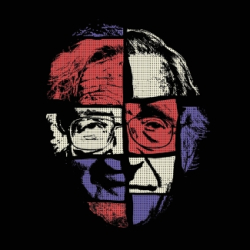
Photo_78141_square_325x325You can order Gnome Chomsky, the Garden Noam for $195, plus shipping. A “What Would Noam Do?” mug can be yours for $15. “Colorless green ideas sleep furiously,” an oft-repeated demonstration of how words can be simultaneously grammatical and nonsensical, is available both as a bumper sticker and an iPhone case. Noam Chomsky is souvenir-level famous.

That’s what happens when you are “arguably the most important intellectual alive today,” a line from a 1979 New York Times book review that’s been recycled ever since as shorthand for a hard-to-summarize man. The same book review, written by Paul Robinson, a Stanford historian, goes on to outline what he calls “the Chomsky problem,” that is, “the problem of an opinionated historian inhabiting the same skin as the brilliant and subtle linguist.” There is Noam Chomsky, father of modern linguistics, whose theory of Universal Grammar seeks to explain human language. And there is Noam Chomsky, the political activist and writer, who remains among the most unrelenting critics of American military action. In his new book, Tom Wolfe takes a crack at explaining that bifurcated persona. (Yes, that Tom Wolfe — the Bonfire of the Vanities, Electric Kool-Aid Acid Test guy.). He describes the divide with patented Wolfeian exuberance: “Chomsky’s politics enhanced his reputation as a great linguist, and his reputation as a great linguist enhanced his reputation as a political solon, and his reputation as a political solon inflated his reputation from great linguist to all-around genius, and the genius inflated the solon into a veritable Voltaire, and the veritable Voltaire inflated the genius of all geniuses into a philosophical giant … Noam Chomsky.”

Once fully inflated, Wolfe proceeds to stick a pin in him. The Kingdom of Speech (Little, Brown and Company) is one of two new books that offer sour portraits of the soft-spoken, if not always mild-mannered, emeritus professor of linguistics at the Massachusetts Institute of Technology. The other, Decoding Chomsky: Science and Revolutionary Politics (Yale University Press), by Chris Knight, was a decade in the making and may be the most in-depth meditation on “the Chomsky problem” ever published. Like Wolfe, Knight first consecrates Chomsky, noting that, by one measure, he is the eighth-most-cited thinker in the humanities — hot on the heels of fellow one-namers like Freud and Plato — before setting fire to the shrine.

Is this any way to treat arguably the most important intellectual alive?

More here.