Ketchup sandwiches and other things stupid poor people eat

Anastasia Basil in Think Progress:

ScreenHunter_2212 Sep. 13 21.56I met this woman named Mae. She’s a van driver for a production company. She works 14-hour days but says she doesn’t mind, says she keeps one eye on the road and the other on the prize — a paycheck that has to last through the dead months.

We’re driving through a poor stretch of Atlanta. Dirty streets. Old houses. Plastic toys upturned in front yards, no kids though. The neighborhood is quiet. I live in L.A., land of nannies and gardeners where the hills are alive with the sound of toddlers and leaf blowers. I prefer Atlanta. You can find parking at the grocery store in the middle of the day. In L.A. it doesn’t matter what time it is, the Trader Joe’s is packed with SAHs and WAHs (stay-at-homes and work-at-homes.)

We pass a decades-old Buick Skylark. I point it out.

“You into cars?” Mae asks.

I’m not into cars, but my dad and I once abandoned one of those Buicks on the side of a Florida highway when I was a teenager. That’s how my family did cars — we bought them on their last leg and left them where they died. I tell her how I’d come home from high school and there’d be nothing in the fridge but a bottle of red wine vinegar and a head of lettuce. On the counter, there’d be a bag of potatoes and a bottle of olive oil from the Dollar Store. That was dinner, potatoes and lettuce.

“I hear you,” she says. “We had ketchup sandwiches all the time growing up. We didn’t complain. We ate them.”

More here.
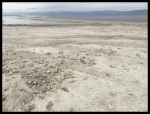
at the salton sea

SaltonSeaBLACK-TomMacherJenny Zhang at Harper's Magazine:

The Salton Sea began as an error. At the end of the nineteenth century, developers took interest in the fertile soil found in the Imperial Valley and constructed a series of canals around the ancient dry lakebed, then called the Salton Sink, to divert water for agricultural production. Favoring greed over quality, these shoddily built canals were ill equipped to handle the accumulation of silt. In 1905, the nearby Colorado River breached the canals and for eighteen months filled the thirty-five-mile-wide, ten-mile-long, 235-feet-below-sea-level lakebed with freshwater. The Southern Pacific Railroad company had several lines running through the Imperial Valley and, frustrated by the amount of labor and money lost to rerouting lines onto higher ground, dumped 2,500 cars of rolling stock filled with rock, dirt, and wood into the canals to stop the flooding. Despite being smack-dab in the blistering desert, the high rate of evaporation was offset by runoff from neighboring farmland in the Imperial Valley, and for the next few decades, the water level remained relatively stable.

In the Fifties and Sixties, developers set their sights on transforming the Salton Sea into a destination for urban dwellers from Los Angeles looking for an escape. Resort towns and retirement homes quickly popped up along the shore. Yacht clubs and glittering marinas attracted celebrities like Sonny Bono, Desi Arnaz, and Frank Sinatra, as well as more modest vacationers who came for the golfing, boating, and jet-skiing.

more here.

on strophic prose

Birth_of_the_poetAnthony Madrid at The Paris Review:

Before we begin, I need you to search your heart and evaluate soberly whether you have ever had the experience of sincerely enjoying metrical effects in poetry. If you find in your bosom any doubts regarding this matter, I'm going to ask you to please rise from your seat and locate your nearest exit, keeping in mind that it may be behind you, or opening right now at your feet. You may ignore the smoke. Best wishes. Thank you so much.

Now. The rest of you. We have a great deal to discuss, but I must be brief. I am going to advance a radical proposition.

It can seem, to those of us who teach poetry writing, that the only way to sell young poets on metrical effects is by contagion. One reads aloud some poems where the meter is key—“Easter 1916,” “The Ballad of Sir Patrick Spens”—and one points out, charismatically smacking one’s lips, that the meter is key. Reasons and analogies and explanations are not to the purpose. One points; one smacks one’s lips; dharma does the rest.

more here.

A biography of Diane Arbus

Cover00Prudence Peiffer at Bookforum:

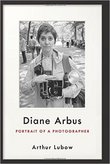
IF EVERY BIOGRAPHY PEDDLES the aura of the unknown with a promise of revelation, Diane Arbus: Portrait of a Photographeracknowledges a darker obfuscation from the start. As his book’s fitting epigraph, Arthur Lubow chooses the artist’s cryptic challenge to anyone attempting to uncover the meaning behind her work: “A photograph is a secret about a secret. The more it tells you the less you know.” Arbus wrings out the cliché that a photograph doesn’t lie and rehangs it as a riddle. What is the relationship between a secret and knowledge? How well can we understand someone, even with access to her confidences? And does this information help us see her art better, too? Or, in a Derridean twist, does knowing a secret reveal the very impossibility of its existence in the first place?

Lubow confronts an extreme instance of this problem within the first twenty pages of his seven-hundred-plus tome. He reveals, without fanfare, the ultimate secret of Arbus’s life: According to her psychiatrist, Arbus had a sexual relationship with her older brother, the onetime US poet laureate Howard Nemerov, beginning in childhood, and she last slept with him just a few weeks before her suicide. I was shocked to encounter this claim so early on (and that her therapist would have shared this still feels wrong). But in detonating the taboo at the beginning, Lubow defuses it, too. (No spoiler alert here.) It is not the climax of the book, but one more beveled pane of the window onto its subject.

more here.

Power to… the art of protest

Tim Adams in The Guardian:

Sarah Sze’s intricate installations were described by the New Yorker as “changing the potential for sculpture”. She has been awarded a MacArthur “genius” grant and represented the US at the 2013 Venice Biennale.

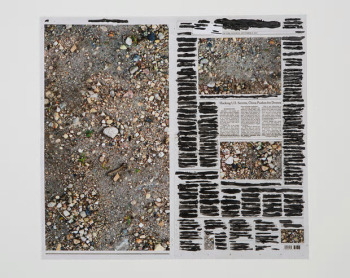
SzeWhat’s the history of the piece you have made for this Protest show? I originally made a version of the piece for a show in Philadelphia. Every day, I kept the front page of the New York Times and cut out the pictures and replaced them with pictures that were vast in terms of time and space – there could be an image of the ocean, an image from 500 years ago… I was interested in contrasting what was newsworthy with these timeless images. That piece was then accepted for a triennial in Guangzhou. When we were shipping it we were contacted by the Chinese authorities saying they wanted specific front pages to be removed.

What was the problem? It turned out that every front page I was being asked to remove said something about China; it could be just a phrase or something. So I made a new version for China. The piece was actually on the floor, like it was protecting the floor, spattered with paint and so on. So I took black paint and painted out the parts they wanted redacted and then mentioned the fact in the wall note. For this show, I have done the opposite. I left in all the pieces I had redacted and painted black all the rest of the text.

More here. (Note: Thanks to dear friend Gayil Nalls)

In the Bonobo World, Female Camaraderie Prevails

Natalie Angier in The New York Times:

BONOBOS1-master768The female bonobo apes of the Wamba forest in the Democratic Republic of Congo had just finished breakfast and were preparing for a brief nap in the treetops, bending and crisscrossing leafy branches into comfortable day beds. But one of the females was in estrus, her rump exceptionally pink and swollen, and four males in the group were too excited to sleep. They took turns wildly swinging and jumping around the fertile female and her bunkmates, shaking the branches, appearing to display their erections and perforating the air with high-pitched screams and hoots. Suddenly, three older, high-ranking female bonobos bolted up from below, a furious blur of black fur and swinging limbs and, together with the female in estrus, flew straight for the offending males. The males scattered. The females pursued them. Tree boughs bounced and cracked. Screams on all sides grew deafening. Three of the males escaped, but the females cornered and grabbed the fourth one — the resident alpha male. He was healthy, muscular and about 18 pounds heavier than any of his captors. But no matter.

The females bit into him as he howled and struggled to pull free. Finally, “he dropped from the tree and ran away, and he didn’t appear again for about three weeks,” said Nahoko Tokuyama, of the Primate Research Institute at Kyoto University in Japan, who witnessed the encounter. When the male returned, he kept to himself. Dr. Tokuyama noticed that the tip of one of his toes was gone. “Being hated by females,” she said in an email interview, “is a big matter for male bonobos.” The toe-trimming incident was extreme but not unique. Describing results from their long-term field work in the September issue of Animal Behaviour, Dr. Tokuyama and her colleague Takeshi Furuichi reported that the female bonobos of Wamba often banded together to fend off male aggression, and in patterns that defied the standard primate rule book.

More here.

Monday, September 12, 2016

perceptions

What my dad gave me 2008_Rockfeller Center_001

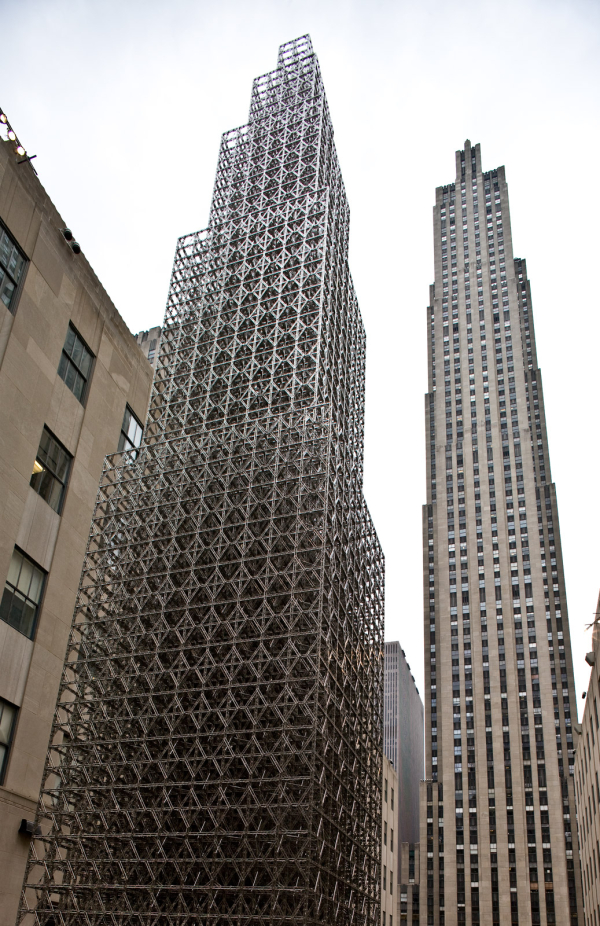
Chris Burden. What My Dad Gave Me, Rockefeller Center, NY. 2008.

Installation.

“I have always wanted to build a model skyscraper using Erector parts. The model skyscraper, built from a toy and 65 feet in height, takes on the dimensions of a full sized building. The circle of actual buildings inspiring a toy in 1909, which is then used to build a model skyscraper the size of an actual building…”

More here, here, and here.

Sunday, September 11, 2016

Disproving 9 of the Biggest 9/11 Conspiracy Theories

Jack Holmes in Esquire:

ScreenHunter_2205 Sep. 12 01.57An extraordinary event requires an extraordinary explanation. But for some, the idea that 19 men could commandeer four commercial airliners in a coordinated attack and use them as 400-ton missiles to destroy such massive buildings still doesn't make sense. Even 15 years after the fact, there are still plenty who cannot believe that these symbols of American power—military, economic, and, had they not been stopped, political—were so fundamentally vulnerable to destruction. People want more, and when the official accounts aren't satisfying, they begin to look elsewhere.

There are still plenty of 9/11 conspiracy theorists, and no matter what you tell them, they will tell you the attacks on September 11, 2001 did not happen the way our government or our media claim. Conspiracy theorists will tell you it was an inside job. They will tell you the government let it happen. They will tell you the buildings couldn't have fallen that way, or the Air Force could have stopped the whole thing if they wanted to.

There are an untold number of theories about what really happened that day. They are the subject of a well-known documentary film, and they have spawned countless websites. Most of them are weird, and some are almost comical. But exploring these theories involves venturing into the darkest corners of our imagination, where confusion and despair bleed into reactionary paranoia, and the enduring sacrifice of the innocent people who died that day is almost cheapened by slander and suspicion.

Below are nine of the most prominent theories, as well as the evidence explaining why they simply don't add up.

More here.

Mourning 9/11 Fifteen Years Later

Ingrid Norton in the Boston Review:

Norton-9-11_bodyIn late May 2002 the fifty-eight-ton steel column was shrouded with black cloth, covered in an enormous American flag, and lowered onto a specially made truck bed. Its journey was accompanied by a slow procession of emergency workers and officials, a dirge of bagpipes, and trumpeters playing “Taps.” The removal of the column marked the end of eight and a half months of recovery work, in which several billion pounds of debris and human remains were removed from the wreckage of the Twin Towers in Lower Manhattan. At the time, a coalition of victims’ families—WTC Families for a Proper Burial—was protesting the removal of the site’s ash, mud, and metal to the Fresh Kills landfill, where forensics experts poured over it to extricate the remains. Against this backdrop, the ceremony of the column’s removal served as a kind of proxy funeral.

May 2002 was the month that my parents and I moved from uptown Manhattan to a former bank building on Wall Street. We had been lured by the rent abatements that Michael Bloomberg, the new mayor, offered to spur development in Lower Manhattan in the wake of the September 11 attacks. My parents and I sometimes shared the subway with 9/11 clean-up workers, their clothes and boots stained with the ash and dust that would later be found to cause chronic respiratory illness as well as cancer. Our apartment was a block and a half away from the New York Stock Exchange, thought to be a likely future terrorism target. Police toting assault rifles and submachine guns patrolled our block; large metal barriers had been embedded in the street to stop truck bombs.

More here.

Consciousness and Downward Causation

Sean Carroll in Preposterous Universe:

For many people, the phenomenon of consciousness is the best evidence we have that there must be something important missing in our basic physical description of the world. According to this worry, a bunch of atoms and particles, mindlessly obeying the laws of physics, can’t actually experience the way a conscious creature does. There’s no such thing as “what it is to be like” a collection of purely physical atoms; it would lack qualia, the irreducibly subjective components of our experience of the world. One argument for this conclusion is that we can conceive of collections of atoms that behave physically in exactly the same way as ordinary humans, but don’t have those inner experiences — philosophical zombies. (If you think about it carefully, I would claim, you would realize that zombies are harder to conceive of than you might originally have guessed — but that’s an argument for another time.)

The folks who find this line of reasoning compelling are not necessarily traditional Cartesian dualists who think that there is an immaterial soul distinct from the body. On the contrary, they often appreciate the arguments against “substance dualism,” and have a high degree of respect for the laws of physics (which don’t seem to need or provide evidence for any non-physical influences on our atoms). But still, they insist, there’s no way to just throw a bunch of mindless physical matter together and expect it to experience true consciousness.

People who want to dance this tricky two-step — respect for the laws of physics, but an insistence that consciousness can’t reduce to the physical — are forced to face up to a certain problem, which we might call the causal box argument. It goes like this. (Feel free to replace “physical particles” with “quantum fields” if you want to be fastidious.)

  1. Consciousness cannot be accounted for by physical particles obeying mindless equations.
  2. Human beings seem to be made up — even if not exclusively — of physical particles.
  3. To the best of our knowledge, those particles obey mindless equations, without exception.
  4. Therefore, consciousness does not exist.

Nobody actually believes this argument, let us hasten to add — they typically just deny one of the premises.

But there is a tiny sliver of wiggle room that might allow us to salvage something special about consciousness without giving up on the laws of physics — the concept of downward causation.

More here.

Mark Thompson’s New Book on the Use and Misuse of Rhetoric

James Fallows in the New York Times:

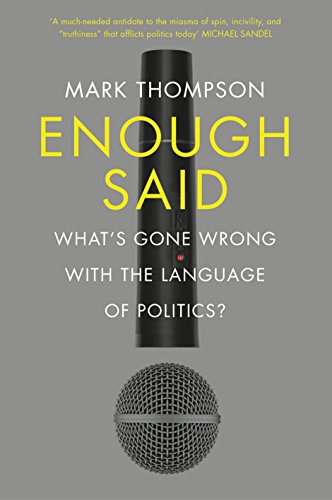
41qM4KSoTTLIn the “Afterthoughts” to his book about the decline of public language in politics, Mark Thompson mentions something that for me clarified the 12 chapters that went before. Thompson, who grew up in England and was director-general of the BBC before taking his current job as chief executive of The New York Times Company, was invited in 2012 to give a series of lectures on the “art of public persuasion” at Oxford, his alma mater. From those lectures and subsequent discussions, he writes, “Enough Said” arose.

Knowing the book’s genesis is useful in understanding the kind of value it has, and what it does not do. To oversimplify, the most influential nonfiction books usually exist either to tell a story, as with “Seabiscuit” and “All the President’s Men,” or to advance an argument, as with “Silent Spring” and “The Feminine Mystique.” Ideally they combine the two, as for example Michael Lewis did with his tale of the origins of the 2008 financial crisis, “The Big Short.”

Lecture series, and books derived from them, are different in that their assumed interest comes from watching a thinker engage with a set topic and seeing what insights emerge, rather than expecting a clear narrative or argument to ring through. That’s the case with “Enough Said.” Given Thompson’s standing as a past leader of one of the world’s dominant news organizations and the current head of another, what he thinks about the interactions among politicians, citizens and the press is by definition important. I don’t think this book will change the continuing debates about “bias” and “objectivity,” the separation of the public into distinct fact universes, the disappearing boundary between entertainment and civic life, the imperiled concept of “truth” or the other important topics it addresses. But it offers many instructive allusions, useful judgments and important refinements on these themes — and provides reassurance by its mere existence that someone in the author’s position is grappling so earnestly with such questions.

More here.

Joseph Stiglitz Says Standard Economics Is Wrong. Inequality and Unearned Income Kills the Economy

Joseph Stiglitz in Evonomics:

Joseph-E.-Stiglitz_avatar_1457763065-175x175In the middle of the twentieth century, it came to be believed that ‘a rising tide lifts all boats’: economic growth would bring increasing wealth and higher living standards to all sections of society. At the time, there was some evidence behind that claim. In industrialised countries in the 1950s and 1960s every group was advancing, and those with lower incomes were rising most rapidly.

In the ensuing economic and political debate, this ‘rising-tide hypothesis’ evolved into a much more specific idea, according to which regressive economic policies— policies that favour the richer classes— would end up benefiting everyone. Resources given to the rich would inevitably ‘trickle down’ to the rest. It is important to clarify that this version of old-fashioned ‘trickle-down economics’ did not follow from the postwar evidence. The ‘rising-tide hypothesis’ was equally consistent with a ‘trickle-up’ theory— give more money to those at the bottom and everyone will benefit; or with a ‘build-out from the middle’ theory— help those at the centre, and both those above and below will benefit.

Today the trend to greater equality of incomes which characterised the postwar period has been reversed. Inequality is now rising rapidly. Contrary to the rising-tide hypothesis, the rising tide has only lifted the large yachts, and many of the smaller boats have been left dashed on the rocks. This is partly because the extraordinary growth in top incomes has coincided with an economic slowdown.

More here.

The Unique Sound of the Cricket

Stephane Mallarme in The Paris Review:

Stéphane Mallarmé died 118 years ago today. He wrote the letter below to his friend Eugène Lefébure, in May 1867, at age twenty-five, when he was working as a teacher in the provinces. It was, apparently, stressful, and Mallarmé came to feel that he’d entered “the Void”—a liberating (albeit terrifying) abyss of constant, torturous renewal.

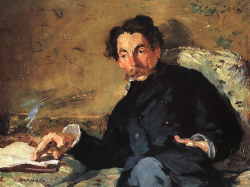
Portrait_of_stephane_mallarme_manetThis is what I heard my neighbor say this morning, as she pointed to the window on the opposite side of the street from her: “Gracious me! Madame Ramaniet ate asparagus yesterday.” “How can you tell?” “From the pot she’s put outside her window.” Isn’t that the provinces in a nutshell? Its curiosity, its preoccupations, and that ability to see clues in the most meaningless things—and such things, great gods! Fancy having to confess that mankind, by living one on top of the other, has reached such a pass!!—I’m not asking for the wild state, because we’d be obliged to make our own shoes and bread, while society permits us to entrust those tasks to slaves to whom we pay salaries, but I find intoxication in exceptional solitude … I’ll always reject all company so that I can carry my symbol wherever I go and, in a room full of beautiful furniture just as in the countryside, I can feel myself to be a diamond which reflects everything, but which has no existence in itself, something to which you are always forced to return when you welcome men, even if only to put yourself on the defensive …

I think that to be truly a man, to be nature capable of thought, one must think with one’s entire body, which creates a full, harmonious thought, like those violin strings vibrating directly with their hollow wooden box. As thoughts are produced by the brain alone (which I so abused last summer and part of this winter), they now appear to me like airs played on the high part of the E-string without being strengthened by the box,—which pass through and disappear without creating themselves, without leaving a trace of themselves. Indeed, I no longer remember any of those sudden ideas I had last year.

More here.