
Category: Recommended Reading
the moral questions around gene editing

The fears and the hopes of genetically engineering the human race have been haunting the modern mind for the better part of a century, although only in the last decade have techniques been developed that might give us the power to modify the genomes of human beings at the embryonic stage. Foremost among these has been the CRISPR-Cas9 system — a set of bacterial enzymes first identified in the late 1980s, and during just the last few years harnessed as a gene-editing tool. What sets CRISPR apart from earlier genetic modification techniques is its accuracy and versatility: the enzymes that cut the targeted DNA are guided by short sequences of RNA that can be custom-designed for any site in the genome. Earlier genetic engineering methods required different enzymes to target different locations in the genome, but by using RNA instead, CRISPR makes that targeting process much easier. (Although there are some differences in what the terms “genetic engineering,” “genetic modification,” and “gene editing” mean, they are for the most part interchangeable.)
This new gene-editing tool has rapidly become ubiquitous in molecular biology, with many applications beyond gene therapy. For instance, scientists have used CRISPR to remove retroviral sequences from the genomes of pig embryos in the hope of producing pigs with organs that can be transplanted more safely into humans. Because CRISPR is relatively easy to use, some journalists have even speculated that the technique might lead to the democratization of genetic engineering, with “home hobbyists” using it for who-knows-what. This claim seems overblown. While it is true that CRISPR makes the specific task of editing DNA much easier, there are other technically complicated steps and procedures involved in most forms of genetic engineering.
more here.
‘SOPHIA’ BY MICHAEL BIBLE

At this late date Southern literature is only slightly coherent as a marketing label, but if understood as a series of related, competing traditions, it’s vastly more interesting. And like the modern Republican Party, the umbrella of “Southern literature” shades a handful of not always easily alignable interests that often regard each other with suspicion.
For instance, there is the khaki-pants-and-seersucker strain, what you might call the Walker Percy tradition. There is the Faulkner strain, a fabricated country gentleman intent on creating a mythos of the South. (This fabricated gentleman also happens to be Ahab, unfortunately.) And then there is the evangelical degenerate strain, a ménage a trois of booze, Bible thumping, and Foghorn Leghorn. The patron saint of this strain is probably Barry Hannah, most famous for his early story collection Airships and one of the most legitimately weird postwar American writers, at least at the sentence level. Hannah taught writing at the University of Alabama and then at Ole Miss for a sizable chunk of his career, and he was famous for various apocryphal stories related to his drunken outlandishness, both in and out of the classroom. Hannah was himself a character, a presence of folk heroic proportions. (A beloved folk hero, it should be said.) Stories about Hannah were almost as important as stories by him. In his vapor trails he outlined the parameters of his own tradition, and we continue to read his disciples: the Hannahs. (Jim Harrison, who recently died, was, if not a direct disciple, a type of Hannah—a Hannah from Montana, if you will.)
Michael Bible is definitely one of the Hannahs, and this would be the case even if his latest book Sophia didn’t boast a promotional quote from Hannah himself, who’s been dead since 2010.
more here.
The Mind of Donald Trump: Narcissism, disagreeableness, grandiosity
Dan P. McAdams in The Atlantic:

“O.K., I guess I’m asking, do you consider yourself ideal company?”
“You really want to know what I consider ideal company?,” Trump replied. “A total piece of ass.”
I might have phrased Singer’s question this way: Who are you, Mr. Trump, when you are alone? Singer never got an answer, leaving him to conclude that the real-estate mogul who would become a reality-TV star and, after that, a leading candidate for president of the United States had managed to achieve something remarkable: “an existence unmolested by the rumbling of a soul.”
More here.
The Narcissist Next Door
Jane Brody in The New York Times:
Does this sound like anyone you know?

*Displays a grandiose sense of self, violating social norms, throwing tantrums, even breaking laws with minimal consequences; generally behaves as if entitled to do whatever he wants regardless of how it affects others.
*Shames or humiliates those who disagree with him, and goes on the attack when hurt or frustrated, often exploding with rage.
*Arrogant, vain and haughty and exaggerates his accomplishments; bullies others to get his own way.
*Lies or distorts the truth for personal gain, blames others or makes excuses for his mistakes, ignores or rewrites facts that challenge his self-image, and won’t listen to arguments based on truth.
These are common characteristics of extreme narcissists as described by Joseph Burgo, a clinical psychologist, in his book “The Narcissist You Know.” While we now live in a culture that some would call narcissistic, with millions of people constantly taking selfies, spewing out tweets and posting everything they do on YouTube and Facebook, the extreme narcissists Dr. Burgo describes are a breed unto themselves. They may be highly successful in their chosen fields but extremely difficult to live with and work with. Of course, nearly all of us possess one or more narcissistic trait without crossing the line of a diagnosable disorder. And it is certainly not narcissistic to have a strong sense of self-confidence based on one’s abilities.
More here.
Monday, July 18, 2016
perceptions
John Houck. Portrait Landscape (video still). 2015.

From: Public, Private, Secret – current exhibition at the International Center of Photography in New York.
“It’s unsettling, even before you enter. Stenciled on the ground, just outside the entrance to the International Center of Photography’s (ICP) new museum in Manhattan, are words informing visitors that once you enter, you “consent to being photographed, filmed and/or otherwise recorded” and “surrender the right to the use of such material throughout the universe in perpetuity.” …
Thanks to Ms. Gayil Nalls for telling me about this very interesting show.
CATSPEAK
by Brooks Riley

Sunday, July 17, 2016
ASTRONYMY
Justin E. H. Smith in Cabinet:

“I hope that some people see some connection between the two topics in the title,” is how, in 1970, Saul Kripke began the first of his lectures on “Naming and Necessity.”1 Plainly, though, it was not necessary that Justinsmith should come to bear my name. The asteroid was first observed in 1993, when I was twentyone years old and had yet to accomplish anything that would merit so much as an eponymous clod of dirt. According to the rules established by the International Astronomical Union’s Minor Planet Center, discoverers enjoy the exclusive right of naming for the first ten years, though they may still choose a name after that deadline, pending approval by the iau’s fifteenmember Committee for Small-Body Nomenclature, if no one else has gone through the complicated steps necessary to do so.2 In this case, the discoverer, Belgian astronomer Eric W. Elst, would not choose the name until the middle of 2015: it was, after all, only one of at least 3,600 asteroids he had discovered in his long and distinguished career.
More here.
Islamist extremism in Bangladesh may be countered, but not easily
K. Anis Ahmed in Time:

I am friends with the owners, and every other day I would meet friends and family for coffee on the cafe’s manicured lawns. My wife and I always spoke with pride of our apartment being “right around the corner” from Holey, which was an oasis, a sanctuary, in a city that has now changed forever. Things may never be the same again here, most grievously for the families who lost their loved ones, but for the country too. Indeed, it may mark a turning point so severe that years from now people will think of Bangladesh in terms of pre- and post-Holey.
After such a disfiguring calamity, the biggest question is always, Why? Yet looking for a reason based on the stated claims of terrorists is a mistake. There is no need for a reason when it comes to convincing young men to join groups promising violence in the name of a cause. Islam is not needed, religion is not needed; all that is needed is a sense of righteous injustice and unique victimhood.
The puppet masters, whoever they are, have a clear goal: to grab state power using an ideology that will turn recruits into terrorists while gaining credence with parts of the population. Already, I see comments on social media about Western hegemony, economic inequality and other factors that might have motivated the killers, as if those are legitimate grounds for such an outrage. Let us be clear — there are no legitimate grounds.
More here.
Whatever their limits, Murray Bookchin’s ideas should be studied by today’s left
Damian White in Jacobin:
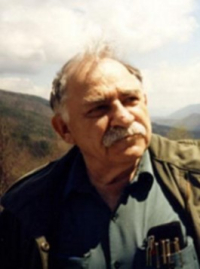
Here is a thinker, who in the early sixties, declared climate change as one of the defining problems of the age. Bookchin saw the environmental crisis as capitalism’s gravedigger.
But he also insisted we must be continually alert to the postcapitalist potentialities that may surface within capitalism. “Liberatory technologies” from renewables to developments in “minituration” and automation combined with broader forms of social and political reorganization, could open up unprecedented possibilities for self-management and sustainable abundance.
In the seventies and eighties, Bookchin suggested an environmentalism obsessed with scarcity, austerity, and the defense of “pure nature” would get nowhere. The future lay with an urban social ecology that addressed people’s concerns for a better life and could articulate this in the form of a new republican vision of politics and a new ecological vision of the city.
More here.
How A Danish Town Helped Young Muslims Turn Away From ISIS
Hanna Rosin at NPR:

The officers put together whatever clues they had about the missing person: He was a teenager who went to a local high school, and he lived in a largely Muslim immigrant neighborhood just outside town. But before they got any further with their investigation, they got another call, from another set of parents. Their son was missing too.
“Why is this going on?” asked Allan Aarslev, a police superintendent.
After talking to the parents and snooping around the neighborhood, the police figured it out: These young men and women had gone to Syria. They were among the exodus of thousands of European citizens who were drawn to the call put out by ISIS, the Islamist terrorist group, for Muslims worldwide to help build the new Islamic state.
Link and Aarslev are crime prevention officers. They usually deal with locals who are drawn to right-wing extremism, or gangs. The landscape of global terrorism was completely new to them. But they decided to take it on. And once they did, they wound up creating an unusual — and unusually successful — approach to combating radicalization.
More here.
Pokémon Go is barely a week old and Hillary Clinton is already using it to register voters
Dylan Matthews in Vox:
The game, which came out on July 6, encourages users to walk around and visit PokéStops where they can acquire items for the game like Poké Balls, and “gyms” where they can fight against other players. PokéStops and gyms are real locations in the real world. For instance, there’s a gym on a small traffic island by the Vox DC offices, and the Embassy of Iraq is a PokéStop and a reliable source of Poké Balls.
So campaign organizers for Clinton, like her Ohio organizing director Jennifer Friedmann, started showing up at PokéStops and gyms to register Pokémon Go players to vote…
The Cincinnati Enquirer's Mallorie Sullivan reports that Clinton's Ohio staff spent the past weekend going “from Cuyahoga to Athens to seek out players in their communities to register them to vote.”
There’s even an official Hillary event scheduled in Lakewood, Ohio, pegged to the game. “Join us as we go to the Pokestop in Madison Park and put up a lure module, get free pokemon, & battle each other while you register voters and learn more about Sec. Hillary Clinton!!!” the event description says. “Kids welcome!”
Lure modules, for context, are items in the game that attract a large number of Pokémon to a given area. You can acquire them for free, but to use them for any length of time usually requires shelling out for additional lures, meaning the Clinton campaign could be spending funds on attracting Pokémon (and players) to its events.
The ease with which Clinton’s campaign flocked to Pokémon Go is partially an indication of how perfect the app is as a campaign tool. Campaigns have invested considerable time and money into mastering social media platforms like Snapchat, Twitter, and Facebook, but the payoff is uncertain. If you send a funny tweet, that might win your campaign a good press cycle — but does it actually sway public opinion? Does it actually increase your odds of victory? The path to impact is so windy and indirect that evaluating whether your strategy is actually working is extraordinarily difficult.
That’s largely because those apps are not well-positioned to spur action outside their confines.
More here.
The History of India: Every Year
Sharia Does Not Mean What Newt Gingrich Thinks It Means
Jeffrey Goldberg in The Atlantic:

…There is much to critique in Gingrich’s approach, but I was struck in particular by his statement that “Sharia is incompatible with Western civilization.” One of the Middle East countries that officially endorses sharia as a legal system is one of Gingrich’s most favored countries, Israel, which is, by his lights—and mine—a crucial component of Western civilization. Israel’s sharia courts, which are supervised by the Ministry of Justice, allow the more than 15 percent of Israel’s population that is Muslim to seek religious recourse for their personal dilemmas. These courts have been in operation since Israel’s founding, and yet the country does not seem to have been fatally undermined by their existence. Israel’s sharia courts raise complicated mosque-state questions (and the power of the Israeli rabbinate raises complicated synagogue-state questions) but, so far, Western civilization, in its Israeli democratic manifestation, seems to be holding on. So, apart from the obviously unconstitutional quality of Gingrich’s demand—and its deeply counterproductive national security component—another question is worth raising: Does the Israeli government’s support for the existence of sharia courts—the government actually pays the salaries of sharia judges—cast doubt on the Jewish state’s commitment to Western values? Should Benjamin Netanyahu, the Israeli prime minister, be questioned by American authorities for advancing the cause of sharia? And what about Israel’s president, Reuven Rivlin, who, in a recent ceremony welcoming the appointment of seven new Muslim court judges, quoted the following passage from the Quran: “Indeed, did We send Our apostles with all evidence of truth, and through them We bestowed revelation from on high, and gave you a balance so that men might behave with equity.”
More here.
robin hardy (1929 – 2016)
abbas kiarostami (1940 – 2016)
michael cimino (1939 – 2016)
Saturday, July 16, 2016
ISIS: The Durability of Chaos
Scott Atran in the New York Review of Books:

Mass murder has again been visited upon France and shaken the world. Again ISIS has claimed credit, though this time the link to the group seems confusingly ambiguous, feeding new fears in the West about random violence by alienated or radicalized Muslims anywhere. It raises the urgent questions: What does the attack tell us about the changing face of jihadist violence today? And how might our own response, in turn, be contributing to it?
The local driver of the truck that mowed down at least eighty-four people, including ten children, and wounded more than two hundred, on the Nice waterfront Thursday was a Tunisian citizen residing in France. He had a police record for road rage and wife beating, but was not on a terrorism watch list and had no known jihadi affiliations. Yet supporters of the Islamic State immediately celebrated his actions on social media, and French President François Hollande directly linked the attack to France’s war against ISIS in Syria and Iraq.
And on Saturday, the ISIS media outlet Amaq formally claimed the Nice truck driver as “one of its soldiers” who answered the call to kill anyone from a country in the coalition against it. Such formal claims have, until now, never been merely opportunistic but refer to those who have either sworn allegiance to ISIS (like the Orlando shooter) or have actually been involved in an ISIS plot (like the Paris and Brussels attackers).
All of this suggests that trying to pin down a direct ISIS connection—while ramping up operations against ISIS in Syria and Iraq—may be missing the point.
More here.
French Artist Creates Mind Blowing Trompe-L’oeil Illusions

From Design You Trust, and more here.
Productivity Is Slowing and Inequality Is Growing. Here’s What’s Causing it.
Jason Furman in Evonomics:
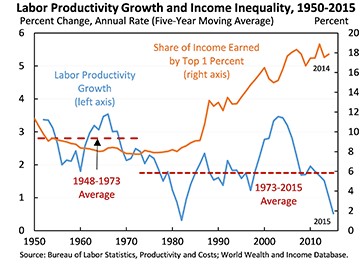
These dual trends—that is, the slowdown in productivity growth and the increase in inequality in recent decades—have many distinct sources, but insofar as they have some causes in common, there is the potential to address these causes in ways that simultaneously improve efficiency and equity. To this end, the evidence that a rise in rents is contributing to both phenomena is important.
More here.