BREAST-FEEDING THE MICROBIOME

Ed Yong in The New Yorker:

Yong-BreastMilk-1200The Foods for Health Institute, at the University of California, Davis, has the appearance of a Tuscan villa, its terra-cotta-walled buildings overlooking a large vineyard and a garden that bursts with summer vegetables. It is led by a chemist named Bruce German, and if there were a world title in extolling the virtues of milk he would surely hold it. At our first meeting, he spent half an hour monologuing on the subject, bouncing on an exercise ball and kneading a tattered shred of bubble wrap as he spoke. Milk, he said, is a perfect source of nutrition, a superfood that is actually worthy of the label. This isn’t a common view. The number of scientific publications about milk is tiny, compared with the number devoted to other bodily fluids—blood, saliva, even urine. The dairy industry has spent a fortune on extracting more and more milk from cows, but very little on understanding just what this white liquid is or how it works. Medical-funding agencies have generally dismissed it as irrelevant, German said, because “it doesn’t have anything to do with the diseases of middle-aged white men.” And nutritionists have looked at it as a simple cocktail of fats and sugars, one that can be easily duplicated and replaced by formulas. “People said it’s just a bag of chemicals,” German told me. “It’s anything but that.”

Milk is a mammalian innovation, common to platypuses and pangolins, humans and hippos, its ingredients varying according to what each species needs. Human milk is a particular marvel. Every mammal mother produces complex sugars called oligosaccharides, but human moth­ers, for some reason, churn out an exceptional variety: so far, scientists have identified more than two hundred human milk oligosaccharides, or H.M.O.s. They are the third-most plentiful ingredient in human milk, after lactose and fats, and their structure ought to make them a rich source of energy for growing babies—but babies cannot digest them. When German first learned this, he was gobsmacked. Why would a mother expend so much energy manufacturing these complicated chemicals if they were apparently useless to her child?

More here.

Trump Is an Agent of Putin

Justin E. H. Smith in his own blog:

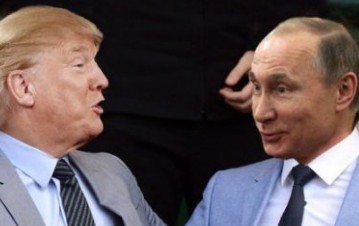
ScreenHunter_2122 Jul. 26 21.13The evidence has been accumulating for a long time now –the connection to Yanukovych's former advisor Paul Manafort, the apparent Russian hacking of the DNC, the flippancy about NATO's responsibilities in the Baltics, the general conspiratorial tenor that sounds so much like a typical invited loon on the RT network, the mutual public praise– that Trump is, at least unwittingly, an agent of Putin.

Whenever I try to bring this up as potentially damaging, Americans keep telling me that the Putin connection can't be made into a campaign issue, since “Trump's supporters don't really care about foreign policy.” But that can't really be true. Surely they care about possible future foreign policies that diminish US sovereignty, or that shift the balance of geopolitical power in the world towards an autocratic Eurasia. It seems to me that the real problem is just poor information in the US: Americans seem to believe that Russia ceased to exist in 1991, that Gorbachev just gave up and closed up shop. This perception only strengthened after 2001, when US triumphalism over the fall of communism in the 1990s fused with racism and 'civilisational' bigotry to convince Americans that the Arab and Muslim world was the principal geopolitical hotspot in the world.

Tellingly, Slavic-studies departments in US universities downsized, and enrolment in Arabic courses skyrocketed (studying Russian in the early 1990s, we still got to use military-issue textbooks with helpful phrases about nuclear summits and fallout shelters). But this indifference only goes one way: Putinite ideology, while also working when expedient to cultivate small autocrats such as Le Pen fille or Viktor Orban, is monomaniacally focused on the US, all the nuclear weapons are still there, and of course Putin is interested in helping to install a leader in the US who has given up on the post-war Atlanticist liberal-democratic order.

More here.

How Bollywood shuts its doors on the poor

The-Outcasts_Photo-by-Ritesh-Uttamchandani_The-Caravan-magazine_July-2016-01-652x435Tanul Thakur at Caravan:

BOLLYWOOD STARDOM, though, has a particular geography. Historically, the Hindi film industry has recognised only certain parts of Mumbai. It knows Yari Road and Lokhandwala in Andheri West, where aspiring actors, screenwriters, assistant directors and directors live; Aram Nagar, where production houses hold auditions for films, television serials and advertisements; Juhu and Bandra West, home to film stars; and south Mumbai, or Town, where many movies are shot. But it doesn’t know Dharavi, Bhiwandi, Naigaon or Nalasopara, or any of the city’s other slums and sprawling suburbs.

Still, if you visit any of those slums or suburbs, you find thousands of people who don’t know this, who don’t want to know this. They, like so many of their fellow Indians, are in thrall to Bollywood. They crowd theatres to see new releases, follow stars’ lives, and, in indulgent moments, imagine some twist of fate landing them on the silver screen. Some of them take such daydreams more seriously than others. Some, like Jadav, make that dream the centre of their lives.

So they go knocking on doors, trying to find a way in. They look for acting classes that promise them a leg-up, and approach casting agents who promise to get them auditions. And, repeatedly, they find all doors shut. Because the truth is that Mumbai’s geography of Bollywood corresponds pretty much exactly to Mumbai’s geography of wealth. The city Bollywood knows is that of the haves. The city it pays no mind to is that of the have-nots.

more here.

Nicole Eisenman’s Path to Genius

NEisenman_SundayNightDinner_2009_300-650x536Barry Schwabsky at The Nation:

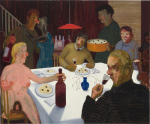
The will to dissolve or relax boundaries is part of what makes Eisenman’s work feel so of the moment right now. It’s the same acceptance of ambiguity that allows the artist, when asked why her single-figure paintings have been mostly of men, to remark: “Representing bodies is complex. What looks masculine in a painting could be a self-determined gender mutineer, or trans, or something completely off the spectrum. It seems that I present as masculine in the world, and I think I use my body as a baseline jumping-off point for representation, which I think goes a long way toward explaining the preponderance of masculine-looking bodies in this show.” What’s true of the painted figure also goes for the act of painting itself. When pressed with the observation that the painters who caught her eye in the 1980s—the likes of Julian Schnabel and the German Neo-Expressionists—were “very macho and conservative,” Eisenman explains: “To me, it’s radical, and it felt radical when I saw it for the first time…. My feeling about painting and gender is that whatever any dude feels entitled to, I feel like: ‘Fuck, I’m entitled to that too.’”

The title of the New Museum show, though, points to the ambivalence of Eisenman’s relation to the age-old traditions. At least some of her paintings are genuine allegories, with appropriately moralizing titles like The Work of Labor and Care (2004); Progress: Real and Imagined (2006), a diptych oddly represented in this show by just one of its panels; and The Triumph of Poverty (2009). At the same time, they are also send-ups of allegory, maybe even expressions of disgust with it. The didactic function of painting can only be sustained, Eisenman implies, if it is pursued with self-critical humor, if it tacitly acknowledges that it does not speak from a position of vested authority— allegorizing on behalf of church or state or any social consensus on values—but instead on the basis of its own cogency.

more here.

On Ben Lerner’s “The Hatred of Poetry”

HatredofpoetryBrandon Kreitler at the LA Review of Books:

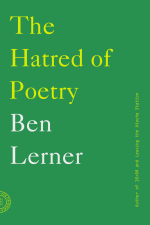
In his short new book The Hatred of Poetry, Ben Lerner glosses the problem like this: the poet wants to say more than can be said, wants language to do more than it does, wants to transcend. (The poet who merely wants to communicate would do better, in Richard Hugo’s advice, to use the phone.) The consolidation of this ambitious but diffuse impulse into a verbal act — the arrival at actual terms fixed on the page — is an unacceptable circumscription of the impulse, a failure. But the failure is unavoidable. It inheres in the activity of putting words on paper. Lerner writes: “Poetry isn’t hard, it’s impossible.”

“Poetry” here names that utterance which would somehow surpass the limits of speech: a conceptual category that, though by definition empty of examples, tempts the history of literary production like the ghost of some God or father we could have known or might know yet but can’t humanly grasp. The poet feels the dull memory of other knowledge of the tongue and can’t reproduce it. She has to use the words there are for such things as have names — language is the fallen medium, built of worn material — but what she wants from an act of reference exceeds what any amalgam of communicable content can actually do. She wants to make moonlight felt, not speak again the name of the moon.

more here.

Michelle Obama’s powerful speech demolishes Donald Trump without even mentioning his name

Julia Rampen in New Statesman:

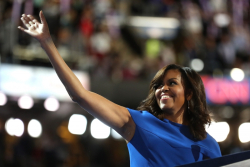
Gettyimages-580960326This is one speech he won't be able to steal. After her stirring speech at the Democratic Convention, Michelle Obama can be sure of one thing – Melania Trump won't be able to copy it. Obama, like her husband, is a fine orator, so much so that the wife of Republican nominee Donald Trump was widely suspected of borrowing from her speeches. But those who crowded into the audience on Monday night could be sure of the real deal. Obama did not mention Trump by name, but in an implicit criticism of him, she spoke passionately about the responsibilities of the Presidency, and how the United States had moved on since the days of slavery and oppression.

The Obamas knew their kids were watching them, she said: “We know that our words and actions matter.” And in a reference to Trump's Twitter obsession, she declared: The issues a President faces “cannot be boiled down to 140 characters”. Obama, whose husband fought a fierce campaign against Hillary Clinton to clinch the Democratic nomination in 2008, now heaped praise on his former rival. Clinton was a “true public servant” who “did not pack up and go home” after losing to Obama in 2008, she said. She had carried out “relentless, thankless work” to actually make a difference in children's lives.

More here.

Personality Change May Be Early Sign of Dementia

Pam Belluck in The New York Times:

Untitled“Has the person become agitated, aggressive, irritable, or temperamental?” the questionnaire asks. “Does she/he have unrealistic beliefs about her/his power, wealth or skills?” Or maybe another kind of personality change has happened: “Does she/he no longer care about anything?” If the answer is yes to one of these questions — or others on a new checklist — and the personality or behavior change has lasted for months, it could indicate a very early stage of dementia, according to a group of neuropsychiatrists and Alzheimer’s experts. They are proposing the creation of a new diagnosis: mild behavioral impairment. The idea is to recognize and measure something that some experts say is often overlooked: Sharp changes in mood and behavior may precede the memory and thinking problems of dementia.

…Dr. Zahinoor Ismail, a neuropsychiatrist at the University of Calgary and member of the group proposing the new diagnosis, said studies and anecdotes suggested that emotional and behavioral changes were “a stealth symptom,” part of the dementia disease process, not separate from it. Whatever is eroding memory and thinking skills in the dementia process may also affect the brain’s systems of emotional regulation and self-control, he said. If two people have mild cognitive impairment, the one with mood or behavior changes develops full-blown dementia faster, he said. Alzheimer’s patients with those symptoms “do much worse over time;” after death, autopsies have shown they had more brain damage. Of course, not everyone experiencing mood swings with age is suffering warning signs of dementia. Dr. Ismail emphasized that, to be considered M.B.I., a symptom should have lasted for at least six months and be “not just a blip in behavior, but a fundamental change.” Still, some experts worry that naming and screening for such an early-stage syndrome might end up categorizing large numbers of people, making some concerned they will develop Alzheimer’s when there are not yet effective treatments for the disease.

More here.

Monday, July 25, 2016

Perceptions

Hieronymus Bosch. The Pedlar or The Wayfarer, c.1500.

Museum Boijmans Van Beuningen, Rotterdam, the Netherlands.

“This vagabond or pedlar with mismatched shoes is symbolic of man on his path through life. He is a kind of 'Everyman' a popular late 15th century moral tale. He represents the 'homo viator', the pilgrim who goes through life weighed down by the baggage of his earthly existence. He suffers his lot along a path full of temptations.”

And from “Abandon All Hope” by Nat Segnit, Harper's Magazine, August 2016.

A naked man grabs me by the lapels and bares his teeth in frustration. I say naked, when I mean clad in a skintight nude suit that delineates his six-pack and decorously abstracts his genitals in the manner of a kids’ action figure. I have been assaulted by the personification of Anger. I’m probably being paranoid, but the unshakable sense of foreboding this gives me derives, as far as I can tell, from the suspicion that his little coup de théâtre is so effective because the guy playing Anger has actually taken against me, can discern in me something weak or sinful that he could exploit as grist for his performance. Earlier, a jester wearing a boat around his midriff had sniggered at the way I was holding my press folder. Maybe I’m not being paranoid, and the bad feeling I’ve had since I walked onstage at the Theater aan de Parade — which will increase over the course of my stay — is only an appropriate response.”

More here, here, and here.

Sunday, July 24, 2016

“DEAD PEOPLE” BY MORGAN MEIS AND STEFANY ANNE GOLDBERG

Nathaniel Popkin in The Rumpus:
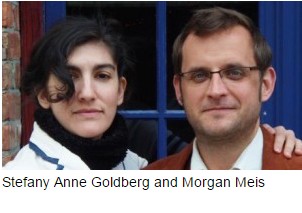
ScreenHunter_2118 Jul. 25 16.34Robert Rauschenberg, Mary Ellen Mark, Christopher Hitchens, Osama bin Laden, Václav Havel, Cy Twombly, Susan Sontag, Chinua Achebe, David Foster Wallace, Arthur Danto, and Thomas Kinkade: you are very dead. You, too, Günter Grass, Mikhail Kalashnikov, Roman Opalka, Tom Clancy, and the 13 other critics, painters, musicians, and inventors whose lives are the subjects of this alluring volume of eulogies by the writers Stefany Anne Goldberg and Morgan Meis.

Most of these 20th century people have died since 2008, around the time that Goldberg and Meis began writing the eulogies, which have appeared in The Smart Set, n+1, 3 Quarks Daily, and the New Yorker. The eulogies, to which the authors lend a homespun energy and quiet integrity, aren’t distant summations, but rather, they say, opportunities for intimacy. “It’s almost as if the person becomes more real by having so recently left us,” Goldberg and Meis write in the introduction. They suggest that “death gives us a chance truly to connect our own life with the life of the person who has died.”

Dead People is, then, a book of connections and interrogations, the object of which is the nature of reality itself and how we face it, if we can. Goldberg and Meis fix a gentle but inquisitive gaze on the lives of their dead as if they are modeling the form of their inquiry on its function. Some particularly monstrous realities of the 20th century—mass slaughter, failed ideologies, fast food, the dispossessed—demand courage to bear, but are also fertile ground for writers and artists. Those who faced them, the authors assert, directed the cultural flowering of their century.

More here.

Sunday Poem

Puerto Rican Obituary
.

They worked

They were always on time

They were never late

They never spoke back

when they were insulted

They worked

They never took days off

that were not on the calendar

They never went on strike

without permission

They worked

ten days a week

and were only paid for five

They worked

They worked

They worked

and they died

They died broke

They died owing

They died never knowing

what the front entrance

of the first national city bank looks like
.

Read more »

The Best Time I Pretended I Hadn’t Heard of Slavoj Žižek

Rosa Lyster in The Hairpin:

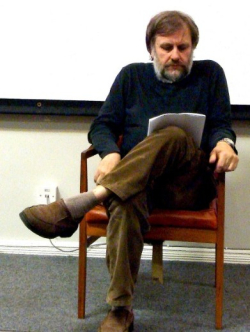
ScreenHunter_2117 Jul. 24 16.04The other night, I pretended I didn’t know who Slavoj Žižek, the Slovenian Hegelian Marxist and cultural critic, was. I’ve done this before, but never to such triumphant effect. This Marxist bro I was talking to made a reference to Žižek that he obviously assumed I would get, and my heart sank. He was a nice guy, actually, but I saw the conversation stretching out in front of us, and I saw myself having to say things about Žižek and listen to him say things about Žižek, and I saw that I really did not want this to happen. “This is a bar,” I wanted to say, the same way that my grandmother might have said “This is achurch.” A bar is not the appropriate venue for a loud, show-offy conversation about The Pervert’s Guide to Ideology.

At first, I thought I might be able to get away with ignoring the reference. Not so. He made another one, and then another one, and then said, sort of desperately, “Žižek argues that…” I saw the gap, and I took it. I asked him who that was, and he assumed I hadn’t heard him over the music. “ŽIŽEK” he shouted. “SLAVOJ ŽIŽEK.” I told him I’d never heard of such a person, and his eyes widened. His attempts to explain were met with the same denials. Celebrity philosopher? Nope. Lacan? Nope. Hegel? Nope. I stopped short of saying I had never heard of Karl Marx, but only just. This guy couldn’t believe it. How could I have never heard of Žižek?

More here.

Clean energy won’t save us – only a new economic system can Jason Hickel

Jason Hickel in The Guardian:

ScreenHunter_2116 Jul. 24 15.54Earlier this year media outlets around the world announced that February had broken global temperature records by a shocking amount. March broke all the records too. In June, our screens were covered with surreal images of flooding in Paris, the Seine bursting its banks and flowing into the streets. In London, floods sent water pouring into the tube system right in theheart of Covent Garden. Roads in south-east London became rivers two metres deep.

With such extreme events becoming more commonplace, few deny climate change any longer. Finally, a consensus is crystallising around one all-important fact: fossil fuels are killing us. We need to switch to clean energy, and fast.

This growing awareness about the dangers of fossil fuels represents a crucial shift in our consciousness. But I can’t help but fear we’ve missed the point. As important as clean energy might be, the science is clear: it won’t save us from climate change.

Let’s imagine, just for argument’s sake, that we are able to get off fossil fuels and switch to 100% clean energy. There is no question this would be a vital step in the right direction, but even this best-case scenario wouldn’t be enough to avert climate catastrophe.

More here.

5 REASONS WHY TRUMP WILL WIN

Michael Moore at his own website:

MichaelMooreFriends:

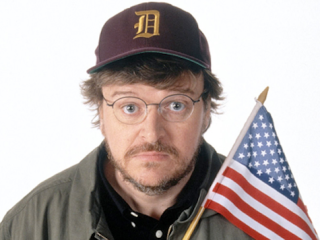
I am sorry to be the bearer of bad news, but I gave it to you straight last summer when I told you that Donald Trump would be the Republican nominee for president. And now I have even more awful, depressing news for you: Donald J. Trump is going to win in November. This wretched, ignorant, dangerous part-time clown and full time sociopath is going to be our next president. President Trump. Go ahead and say the words, ‘cause you’ll be saying them for the next four years: “PRESIDENT TRUMP.”

Never in my life have I wanted to be proven wrong more than I do right now.

I can see what you’re doing right now. You’re shaking your head wildly – “No, Mike, this won’t happen!” Unfortunately, you are living in a bubble that comes with an adjoining echo chamber where you and your friends are convinced the American people are not going to elect an idiot for president. You alternate between being appalled at him and laughing at him because of his latest crazy comment or his embarrassingly narcissistic stance on everything because everything is about him. And then you listen to Hillary and you behold our very first female president, someone the world respects, someone who is whip-smart and cares about kids, who will continue the Obama legacy because that is what the American people clearly want! Yes! Four more years of this!

You need to exit that bubble right now.

More here.

Donald Trump is Making America Crazy Again

Freddy Gray in The Spectator:

American-Gothic-art-copy_SE‘Whatever complicates the world more — I do,’ Donald Trump once said. If you can’t decipher what that means, don’t worry, that’s the point. ‘It’s always good to do things nice and complicated,’ he added, by way of explanation, ‘so that nobody can figure it out.’ That was 1996 and Trump was talking about business. But 20 years later, his approach to politics seems informed by the same perplexing mentality. Trump is the confusion candidate for President of the United States, and his platform is chaos. He promises to Make America Great Again. In reality, he’s Making America Madder Than Ever. Look at the Republican National Convention in Cleveland this week, where Trump was finally confirmed as the party’s official nominee. It ought to have been the triumphant moment when The Donald was anointed as the Chosen One, ready to lead the conservative charge to the White House. Instead it felt like madness — democracy as a cosmic joke.

Lots of Americans fear that civilised society is breaking down, and it’s easy to see why. Fifteen police officers have been killed in the line of duty this month, including three in Baton Rouge, Louisiana, just before the convention started. Around 5,000 officers were drafted into Cleveland from across the country, and were left to roam the streets with little to do. This overbearing security operation might have made delegates feel safer. But it also added to the atmosphere of dysfunction and instability which helps Donald Trump put himself across as the saviour for troubled times. Trump’s campaign manager Paul Manafort said this week that he based his acceptance speech on Richard Nixon’s 1968 effort, in which Tricky Dicky reassured Americans that he could bring stability to the country after the assassinations of Bobby Kennedy and Martin Luther King Jnr and months of civil unrest.

More here.