letters from zelda to scott

Zelda-scott-fitzgeraldZelda Fitzgerald at The Paris Review:

Our fairy tale is almost ended, and we’re going to marry and live happily ever after just like the princess in her tower who worried you so much—and made me so very cross by her constant recurrence. I’m so sorry for all the times I’ve been mean and hateful—for all the miserable moments I’ve caused you when we could have been so happy. You deserve so much—so very much— … And I do want to marry you—even if you do think I “dread” it. I wish you hadn’t said that—I’m not afraid of anything. To be afraid a person has either to be a coward or very great and big. I am neither. Besides, I know you can take much better care of me than I can, and I’ll always be very, very happy with you—except sometimes when we engage in our weekly debates—and even then I rather enjoy myself. I like being very calm and masterful, while you become emotional and sulky. I don’t care whether you think so or not—I do.

———-

Darling, I nearly sat it off in the Strand today and all because T.E. Lawrence of the Movies is your physical counter-part. So I was informed by half a dozen girls before I could slam on a hat and see for myself. He made me so homesick. I thought at first waiting would grow easier later—but every day I need you more. All these soft, warm nights going to waste when I ought to be lying in your arms under the moon—the dearest arms in all the world—darling arms that I love so to feel around me. How much longer—before they’ll be there to stay? ***

more here.

Thursday Poem

The Onion

The onion, now that’s something else.
Its innards don’t exist.
Nothing but pure onionhood
fills this devout onionist.
Oniony on the inside,
onionesque it appears.
It follows its own daimonion
without our human tears.

Our skin is just a coverup
for the land where none dare go,
an internal inferno,
the anathema of anatomy.
In an onion there’s only onion
from its top to its toe,
onionymous monomania,
unanimous omninudity.

At peace, of a piece,
internally at rest.
Inside it, there’s a smaller one
of undiminished worth.
The second holds a third one,
the third contains a fourth.
A centripetal fugue.
Polyphony compressed.

Nature’s rotundest tummy,
its greatest success story,
the onion drapes itself in its
own aureoles of glory.
We hold veins, nerves, and fat,
secretions’ secret sections.
Not for us such idiotic
onionoid perfections.

.
by Wisława Szymborska
from Poems New and Collected, 1957-1997
Harcourt Brace,1998

.

The next giant leap in human evolution

Mark Changizi in Seed:

Changizi-harnessed_HLWhere are we humans going, as a species? If science fiction is any guide, we will genetically evolve like in X-Men, become genetically engineered as in Gattaca, or become cybernetically enhanced like General Grievous in Star Wars. All of these may well be part of the story of our future, but I’m not holding my breath. The first of these—natural selection—is impracticably slow, and there’s a plausible case to be made that natural selection has all but stopped acting on us. Genetic engineering could engender marked changes in us, but it requires a scientific bridge between genotypes—an organism’s genetic blueprints—and phenotypes, which are the organisms themselves and their suite of abilities. A sufficiently sophisticated bridge between these extremes is nowhere in sight. And machine-enhancement is part of our world even today, manifesting in the smartphones and desktop computers most of us rely on each day. Such devices will continue to further empower us in the future, but serious hardware additions to our brains will not be forthcoming until we figure out how to build human-level artificial intelligences (and meld them to our neurons), something that will require cracking the mind’s deepest mysteries. I have argued that we’re centuries or more away from that.

Simply put, none of these scenarios are plausible for the immediate future. If there is something next, some imminently arriving transformative development for human capabilities, then the key will not be improved genes or cortical plug-ins. But what other way forward could humans possibly have? With genetic and cyborg enhancement off the table for many years, it would seem we are presently stuck as-is, sans upgrades. There is, however, another avenue for human evolution, one mostly unappreciated in both science and fiction. It is this unheralded mechanism that will usher in the next stage of human, giving future people exquisite powers we do not currently possess, powers worthy of natural selection itself. And, importantly, it doesn’t require us to transform into cyborgs or bio-engineered lab rats. It merely relies on our natural bodies and brains functioning as they have for millions of years. This mystery mechanism of human transformation is neuronal recycling, coined by neuroscientist Stanislas Dehaene, wherein the brain’s innate capabilities are harnessed for altogether novel functions. This view of the future of humankind is grounded in an appreciation of the biologically innate powers bestowed upon us by hundreds of millions of years of evolution. This deep respect for our powers is sometimes lacking in the sciences, where many are taught to believe that our brains and bodies are taped-together, far-from-optimal kluges. In this view, natural selection is so riddled by accidents and saddled with developmental constraints that the resultant biological hardware and software should be described as a “just good enough” solution rather than as a “fine-tuned machine.”

More here.

Wednesday, July 27, 2016

Waiting for the facts does hurt

Simon T. Meiners in the Courier-Journal:

B9317517125Z.1_20150529121838_000_G6EATVJGT.1-0“Waiting for the facts has never hurt anybody.”

A lot of moderate pundits trot out this plea for patience every time the media spotlights another black life stolen by the police. In this case, it's National Review editor Charles C.W. Cooke offering “A Few Thoughts on the Killing of Philando Castile” the morning after Castile was gunned down by Officer Jeronimo Yanez during a routine traffic stop in Falcon Heights, Minnesota. His death has become another rallying cry and another proxy for discussing state-on-black violence.

Using one tragedy as a stand-in for systemic racism is common, but it gives a lot of moderates, especially white ones, anxiety. Here's how they see it play out: police kill a black man under sketchy circumstances, and before the dust can clear, racial demagogues swoop in and shoehorn the story into some reductive narrative pitting evil racist cops against noble black victims — facts be damned; that's why fair-minded people of all races need to step up, they say, and defend the officer's right to due process.

As a recovering white moderate, I get it: you should never scapegoat one cop for the collective sins of the criminal justice system. It's illiberal. But here's the problem with that mindset: you can't referee injustices one by one, either. You'll miss the big picture. That is why the shortsighted white moderates who try to be cool-headed neutrals ought to spend a little more time meditating on big picture facts.

More here.

At the Bell House with Sean Carroll

Jerry Alper in Existential Cosmology:

EmLyWwmtOn May 8, in Manhattan, I had met with Sean Carroll for a prearranged interview on his forthcoming The Big Picture. The three hour conversation that ensued had been an exhilarating, if somewhat overwhelming experience. Before I could write about it, however, I needed to process it. Sean Carroll, for his part, wanted to do “some writing” in preparation for his scheduled May 10th talk at the Bell House in Brooklyn. This was the event that would kick off the grand book tour of his much-anticipated, new book, the wildly-ambitious, magisterial synthesis called simply The Big Picture. The pub. Date (May 10th) was two days away but already the reviews from some of the brightest names in science were starting to arrive. Here, for example, is what the brilliant quantum experimental physicist, Sabine Hossenfelder, says about the Big Picture.

“The Big Picture is, above everything else, a courageous book — and an overdue one. So, I am super happy about the book. The Big Picture should make clear that physicists aren’t just arrogant when they say their work reveals insights that reach far beyond the boundaries of their disciplines. Physics indeed has an exceptional status among the sciences.”

Be that as it may, I was of two minds about actually travelling to the Bell House which I had never heard of and to which I had never been (but to which I’ve now been invited to). On the one hand — the event being scheduled between 8 p.m. — 11 p.m. — I would be lucky if I could arrive home before midnight. On the other hand, this was a rare opportunity, perhaps a once in a lifetime opportunity, to see Sean Carroll lecture in person and I did not want to miss out on it.

More here.

The DNC Hack Is Watergate, but Worse

Franklin Foer in Slate:

ScreenHunter_2124 Jul. 27 23.05A foreign government has hacked a political party’s computers—and possibly an election. It has stolen documents and timed their release to explode with maximum damage. It is a strike against our civic infrastructure. And though nobody died—and there was no economic toll exacted—the Russians were aiming for a tender spot, a central node of our democracy.

It was hard to see the perniciousness of this attack at first, especially given how news media initially covered the story. The Russians, after all, didn’t knock out a power grid. And when the stolen information arrived, it was dressed in the ideology of WikiLeaks, which presents its exploits as possessing a kind of journalistic bravery the traditional media lacks.

But this document dump wasn’t a high-minded act of transparency. To state the obvious, only one political party has been exposed. (Selectively exposed: Many emails were culled from the abridged dump.) And it’s not really even the inner workings of the Democrats that have been revealed; the documents don’t suggest new layers of corruption or detail any new conspiracies. They’re something closer to the embarrassing emails that fly across every office in America—griping, the testing of stupid ideas, the banal musings that take place in private correspondence.

More here.

The Last Days of Foamhenge

Hanover-2810-24-1024x663Eileen Townsend at The Paris Review:

If you’ve ever taken I-81 north through Virginia, you’ve passed the town of Natural Bridge, in Rockbridge County—home to a ninety-foot limestone arch that extends over a gorge, a geological anomaly probably formed by an ancient underground river. Natural Bridge is an anachronism from the Route 66 era of highway travel, a place where you can pay twenty dollars to look at a rock, eat a rock-themed lunch, and then buy a shot glass illustrated with a picture of that same rock. As any respectable tourist trap must, the town hosts a constellation of other attractions: a petting zoo, a dinosaur/Civil War theme park, and the Natural Bridge Wax Museum (now closed, and former home to a ghoulish Obama tribute). Best of all is the featherlight, faux prehistoric monument known as Foamhenge.

As its name suggests, Foamhenge is a one-to-one scale replica of Stonehenge, made of foam. It is identical to the original, save the flecked gray paint, the accompanying statue of a deadhead-ish Merlin, and the fact that it was erected several millennia later. For the past twelve years, the henge has been the most public of Natural Bridge’s draws, garnering a steady stream of visitors and enough press to be mentioned in the same breath as the area’s actual ancient rocks. Its creator, an artist named Mark Cline, calls it his “foam-nomenon”: the unlikely culmination of his career as a sculptor of roadside attractions.

more here.

On Nihilism and the Writing Life

0300215363.01.LZZZZZZZRobert Fay at The Millions:

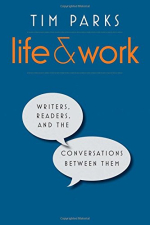
When Samuel Beckett was a young man, his parents wanted to him to work in the family’s accountancy business and assume his place in Dublin’s Protestant merchant class. As Tim Parkswrites in his new book, Life and Work: Writers, Readers, and the Conversations between Them, “a battle of wills ensued between mother and son…As the impasse intensified, [Beckett] developed a number of physical symptoms — boils, anal cysts, pelvic pains, tachycardia, panic attacks…” The panic attacks would plague Beckett for years, and his biographer Anthony Cronin tells us, inSamuel Beckett: The Last Modernist, that he didn’t reflect on his maladies in a conventional manner. In 1935 he attended a lecture by Swiss psychiatrist and former Freud protégé C.J. Jung. Beckett was 29 years old, in analysis, and believed he suffered from a neurotic disorder that “had its origins in infancy, in a time he could not remember,” Cronin writes.

In the lecture, Jung described the case of a young girl whose difficulties baffled him until he fell upon a simple, though rather esoteric diagnosis: “The girl had never really been born.” The idea immediately fired Beckett’s imagination. Cronin claims it triggered something crucial in Beckett and would become central to his self-understanding, and a recurring motif in his works. Beckett, he writes, “thought the diagnosis was a profoundly suggestive illumination of his own case, his sense of alienation from the world and of not being ready or fitted to cope with it, to join in its activities as others did, or even to understand the reasons for them.”

more here.

THE ARCHITECT WHO BECAME A DIAMOND

160801_r28460-1200x799-1469126726Alice Gregory at The New Yorker:

Last September, in Guadalajara, an American conceptual artist named Jill Magid and a pair of gravediggers convened at the Rotonda de los Jaliscienses Ilustres, a monument where the most celebrated citizens of the state of Jalisco are entombed. With them were two notaries and a handful of bureaucrats. It was just after eight in the morning, and the area was nearly silent. The quiet was disturbed by the sound of chisels striking stone. The gravediggers removed a metal plaque, then a cement wall, and, finally, a brick façade. More than an hour later, they hit what they were looking for: an oxidized copper urn, filled with the ashes of Luis Barragán, one of Mexico’s greatest architects, who died in 1988. They removed the urn from the cavity, brushing off dust and ants. Then they opened the vessel and presented it to Magid, who scooped out half a kilo of what looked like dirt and transferred it to a plastic bag, which she then put into a box. The next day, with the box in her carry-on, she flew home to New York.

In April, a diamond—2.02 carats, rough-cut, with one polished facet—arrived in Manhattan. It was sent overnight from Switzerland, and Magid had been tracking its shipping status hourly online. The package was delivered to her husband’s office, and after work he took it to Brooklyn, where they live with their two young sons. Magid did not open the small black box containing the jewel for hours, and, when she finally did, she cried. “It was way more emotional than I expected,” she told me.

more here.

Wednesday Poem

Everyone was in Love
.
One day, when they were little, Maud and Fergus
appeared in the doorway naked and mirthful,
with a dozen long garter snakes draped over
each of them like brand-new clothes.
Snake trails dangled down their backs,
and snake foreparts in various lengths
fell over their fronts. With heads raised and swaying,
alert as cobras, the snakes writhed their dry skins
upon each other, as snakes like doing
in lovemaking, with the added novelty
of caressing soft, smooth, most human skin.
Maud and Fergus were deliciously pleased with themselves.
The snakes seemed to be tickled, too.
We were enchanted. Everyone was in love.
Then Maud drew down off Fergus’s shoulder,
as off a tie rack, a peculiarly
lumpy snake and told me to look inside.
Inside the double-hinged jaw, a frog’s green
webbed hind feet were being drawn,
like a diver’s, very slowly as if into deepest waters.
Perhaps thinking I might be considering rescue,
Maud said, “Don’t. Frog is already elsewhere.”

by Galway Kinnell
from Strong Is Your Hold
Houghton Mifflin Company, 2006
.

Don’t Go, Michelle!

Sarah Larson in The New Yorker:

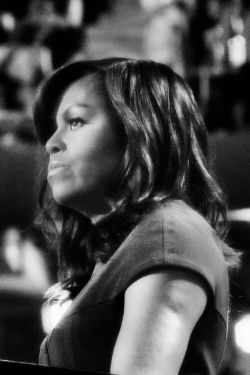
MontgomeryDNCD1-016-800Michelle Obama, who provided us with our purest moment of levity last week, provided us with our purest moment of sanity last night. She also delivered the night’s most inspiring message. The Obamas have been a bittersweet presence in this campaign season—a poignant reminder, for the many of us who love and admire them, that while we duke it out to choose their successors, the family currently occupying the White House cannot be surpassed. Michelle Obama has been the ultimate FLOTUS—funny, wise, wholehearted, down to earth, even in the moments when we’ve suspected that she wouldn’t mind some privacy or freedom. During the misery and surreality of the Republican Convention, FLOTUS was a presence in two significant ways. The first was during the Melania plagiarism flap. For a few hours after Melania’s speech, before the story broke, some of us thought, Ah, not bad! One of the few vaguely sane speeches we will hear this week. To realize later what had inspired it was heartbreaking. When videos of Melania and Michelle’s similar lines were edited to play side by side, Obama showed warmth, heart, conviction. To see those words melted down into a speech promoting Donald Trump only enhanced the sense that we are living in a dystopian novel.

…Obama’s speech was both subtle and direct. She appealed to our maturity, talking about hardworking, idealistic Americans of all backgrounds. I wish the night could have ended after this speech, which invoked everything from police shootings to Orlando to segregation and sexism, foregrounded the greatness of our national ideals, and inspired us to continue fighting for change.

More here.

Trump vs Clinton: worlds apart on science

Jeff Tollefson in Nature:

ClintonScience is slowly coming into focus in the US presidential campaign. Although neither Republican Donald Trump nor Democrat Hillary Clinton has emphasized core research issues, the candidates — and their parties — are beginning to flesh out their positions on climate change, education, biomedical research and other topics that involve the scientific community. Trump’s pick of Indiana Governor Mike Pence as his running mate on 15 July signalled a sharp turn towards the Republican party’s conservative base. Pence, a self-described Christian conservative, has questioned the existence of climate change, waffled on evolution and criticized President Barack Obama for supporting embryonic-stem-cell research. His new role aligns with the hard-line policy platform adopted at the Republican convention, where Trump officially became the party’s nominee on 19 July.

…The two candidates — whose campaign staff declined multiple interview requests — also seem to think very differently about the role of science. Although Clinton has described science and innovation as a foundation for the future, science funding seems to be an afterthought for Trump, says John Karsten, coordinator of the Center for Technology Innovation at the Brookings Institution, a think tank in Washington DC. Instead, the Republican has focused on issues such as national security, immigration and crumbling infrastructure. Climate change is one of the few science topics that has grabbed the campaign spotlight — in part because of Republican anger over Obama’s regulations to limit greenhouse-gas emissions from power plants, vehicles and oil and gas development. Clinton’s climate and energy proposals would largely maintain the current course; by contrast, in a major policy speech on 26 May, Trump promised to roll back Obama’s “totalitarian” regulations and withdraw the United States from the Paris climate agreement. Trump, who has long denied mainstream climate science, also said that his administration will focus on “real environmental challenges, not phony ones”.

More here.

Tuesday, July 26, 2016

How Friedrich Hayek Became a Monster

David Sloan Wilson in Evonomics:

ScreenHunter_2123 Jul. 26 21.27Any serious student of economics can’t help but notice that the academic and popular versions are as different from each other as Dr. Frankenstein and his monster. Take Friedrich Hayek, for example. His books could fill a bookshelf and the commentary could fill a small library, but the monstrous version can only speak in two-word sentences. “Government bad! Market good!” Likewise the monstrous version of Adam Smith, the father of economics, can only say “Invisible hand!”

Just as Dr. Frankenstein couldn’t prevent his monster from running amok, it seems that economists can’t do anything to stop the monsters they created from sowing confusion wherever they go. Some economists act genuinely alarmed but I strongly suspect that others like it that way. They are mad economists and the monsters do their dirty work for them.

The creation of the Hayek Monster is well documented and nicely summarized in a 2010 New York Times article prompted by the sudden appearance of Hayek’s 1944 book The Road to Serfdom on the New York Times best seller list. That book was Hayek’s own attempt at popularization but it received two other boosts by a Reader’s Digest version in 1945, which sold more than a million copies, and a cartoon version that was published by the General Motors Corporation in Look Magazine during the same year and widely distributed by GM as a pamphlet. By then the transformation from man to monster was complete. According to the cartoon version, any step in the direction of government planning leads to a totalitarian state. The final panel of the cartoon shows John Q. Citizen being shot by a firing squad.

I’m not here to demonize Friedrich Hayek the man. I’m here to demonize Friedrich Hayek the Monster. The man was complex and so was his time.

More here.

BREAST-FEEDING THE MICROBIOME

Ed Yong in The New Yorker:

Yong-BreastMilk-1200The Foods for Health Institute, at the University of California, Davis, has the appearance of a Tuscan villa, its terra-cotta-walled buildings overlooking a large vineyard and a garden that bursts with summer vegetables. It is led by a chemist named Bruce German, and if there were a world title in extolling the virtues of milk he would surely hold it. At our first meeting, he spent half an hour monologuing on the subject, bouncing on an exercise ball and kneading a tattered shred of bubble wrap as he spoke. Milk, he said, is a perfect source of nutrition, a superfood that is actually worthy of the label. This isn’t a common view. The number of scientific publications about milk is tiny, compared with the number devoted to other bodily fluids—blood, saliva, even urine. The dairy industry has spent a fortune on extracting more and more milk from cows, but very little on understanding just what this white liquid is or how it works. Medical-funding agencies have generally dismissed it as irrelevant, German said, because “it doesn’t have anything to do with the diseases of middle-aged white men.” And nutritionists have looked at it as a simple cocktail of fats and sugars, one that can be easily duplicated and replaced by formulas. “People said it’s just a bag of chemicals,” German told me. “It’s anything but that.”

Milk is a mammalian innovation, common to platypuses and pangolins, humans and hippos, its ingredients varying according to what each species needs. Human milk is a particular marvel. Every mammal mother produces complex sugars called oligosaccharides, but human moth­ers, for some reason, churn out an exceptional variety: so far, scientists have identified more than two hundred human milk oligosaccharides, or H.M.O.s. They are the third-most plentiful ingredient in human milk, after lactose and fats, and their structure ought to make them a rich source of energy for growing babies—but babies cannot digest them. When German first learned this, he was gobsmacked. Why would a mother expend so much energy manufacturing these complicated chemicals if they were apparently useless to her child?

More here.

Trump Is an Agent of Putin

Justin E. H. Smith in his own blog:

ScreenHunter_2122 Jul. 26 21.13The evidence has been accumulating for a long time now –the connection to Yanukovych's former advisor Paul Manafort, the apparent Russian hacking of the DNC, the flippancy about NATO's responsibilities in the Baltics, the general conspiratorial tenor that sounds so much like a typical invited loon on the RT network, the mutual public praise– that Trump is, at least unwittingly, an agent of Putin.

Whenever I try to bring this up as potentially damaging, Americans keep telling me that the Putin connection can't be made into a campaign issue, since “Trump's supporters don't really care about foreign policy.” But that can't really be true. Surely they care about possible future foreign policies that diminish US sovereignty, or that shift the balance of geopolitical power in the world towards an autocratic Eurasia. It seems to me that the real problem is just poor information in the US: Americans seem to believe that Russia ceased to exist in 1991, that Gorbachev just gave up and closed up shop. This perception only strengthened after 2001, when US triumphalism over the fall of communism in the 1990s fused with racism and 'civilisational' bigotry to convince Americans that the Arab and Muslim world was the principal geopolitical hotspot in the world.

Tellingly, Slavic-studies departments in US universities downsized, and enrolment in Arabic courses skyrocketed (studying Russian in the early 1990s, we still got to use military-issue textbooks with helpful phrases about nuclear summits and fallout shelters). But this indifference only goes one way: Putinite ideology, while also working when expedient to cultivate small autocrats such as Le Pen fille or Viktor Orban, is monomaniacally focused on the US, all the nuclear weapons are still there, and of course Putin is interested in helping to install a leader in the US who has given up on the post-war Atlanticist liberal-democratic order.

More here.

How Bollywood shuts its doors on the poor

The-Outcasts_Photo-by-Ritesh-Uttamchandani_The-Caravan-magazine_July-2016-01-652x435Tanul Thakur at Caravan:

BOLLYWOOD STARDOM, though, has a particular geography. Historically, the Hindi film industry has recognised only certain parts of Mumbai. It knows Yari Road and Lokhandwala in Andheri West, where aspiring actors, screenwriters, assistant directors and directors live; Aram Nagar, where production houses hold auditions for films, television serials and advertisements; Juhu and Bandra West, home to film stars; and south Mumbai, or Town, where many movies are shot. But it doesn’t know Dharavi, Bhiwandi, Naigaon or Nalasopara, or any of the city’s other slums and sprawling suburbs.

Still, if you visit any of those slums or suburbs, you find thousands of people who don’t know this, who don’t want to know this. They, like so many of their fellow Indians, are in thrall to Bollywood. They crowd theatres to see new releases, follow stars’ lives, and, in indulgent moments, imagine some twist of fate landing them on the silver screen. Some of them take such daydreams more seriously than others. Some, like Jadav, make that dream the centre of their lives.

So they go knocking on doors, trying to find a way in. They look for acting classes that promise them a leg-up, and approach casting agents who promise to get them auditions. And, repeatedly, they find all doors shut. Because the truth is that Mumbai’s geography of Bollywood corresponds pretty much exactly to Mumbai’s geography of wealth. The city Bollywood knows is that of the haves. The city it pays no mind to is that of the have-nots.

more here.

Nicole Eisenman’s Path to Genius

NEisenman_SundayNightDinner_2009_300-650x536Barry Schwabsky at The Nation:

The will to dissolve or relax boundaries is part of what makes Eisenman’s work feel so of the moment right now. It’s the same acceptance of ambiguity that allows the artist, when asked why her single-figure paintings have been mostly of men, to remark: “Representing bodies is complex. What looks masculine in a painting could be a self-determined gender mutineer, or trans, or something completely off the spectrum. It seems that I present as masculine in the world, and I think I use my body as a baseline jumping-off point for representation, which I think goes a long way toward explaining the preponderance of masculine-looking bodies in this show.” What’s true of the painted figure also goes for the act of painting itself. When pressed with the observation that the painters who caught her eye in the 1980s—the likes of Julian Schnabel and the German Neo-Expressionists—were “very macho and conservative,” Eisenman explains: “To me, it’s radical, and it felt radical when I saw it for the first time…. My feeling about painting and gender is that whatever any dude feels entitled to, I feel like: ‘Fuck, I’m entitled to that too.’”

The title of the New Museum show, though, points to the ambivalence of Eisenman’s relation to the age-old traditions. At least some of her paintings are genuine allegories, with appropriately moralizing titles like The Work of Labor and Care (2004); Progress: Real and Imagined (2006), a diptych oddly represented in this show by just one of its panels; and The Triumph of Poverty (2009). At the same time, they are also send-ups of allegory, maybe even expressions of disgust with it. The didactic function of painting can only be sustained, Eisenman implies, if it is pursued with self-critical humor, if it tacitly acknowledges that it does not speak from a position of vested authority— allegorizing on behalf of church or state or any social consensus on values—but instead on the basis of its own cogency.

more here.

On Ben Lerner’s “The Hatred of Poetry”

HatredofpoetryBrandon Kreitler at the LA Review of Books:

In his short new book The Hatred of Poetry, Ben Lerner glosses the problem like this: the poet wants to say more than can be said, wants language to do more than it does, wants to transcend. (The poet who merely wants to communicate would do better, in Richard Hugo’s advice, to use the phone.) The consolidation of this ambitious but diffuse impulse into a verbal act — the arrival at actual terms fixed on the page — is an unacceptable circumscription of the impulse, a failure. But the failure is unavoidable. It inheres in the activity of putting words on paper. Lerner writes: “Poetry isn’t hard, it’s impossible.”

“Poetry” here names that utterance which would somehow surpass the limits of speech: a conceptual category that, though by definition empty of examples, tempts the history of literary production like the ghost of some God or father we could have known or might know yet but can’t humanly grasp. The poet feels the dull memory of other knowledge of the tongue and can’t reproduce it. She has to use the words there are for such things as have names — language is the fallen medium, built of worn material — but what she wants from an act of reference exceeds what any amalgam of communicable content can actually do. She wants to make moonlight felt, not speak again the name of the moon.

more here.