Thursday Poem

The Gift

he walked into the bakery to buy bread
a big man
well worn cowboy hat
gentle face

we were sitting at a table
drinking our papaya juice
and talking to the dona behind the counter

he turned to us and said
“uma cancao”
and he began to sing in a soft sweet voice
he sang of his seventy-three years
he sang of his growing up
he sang of his family and the death of his wife
he sang of his travels
and he sang of his cows

I didn’t understand all the words
but I understood his song and marveled at its beauty

when he finished singing he just smiled at us
took his bread
and walked out of the bakery

there remained a silence
that was filled
with the gift of his song

by Robert Markey
from Poems From Brazil
2015

Enjoying the content on 3QD? Help keep us going by donating now.
Wednesday, May 14, 2025

“Foolishness on the Page”: Talking with Zahid Rafiq

Nafeesa Syeed at Public Books:

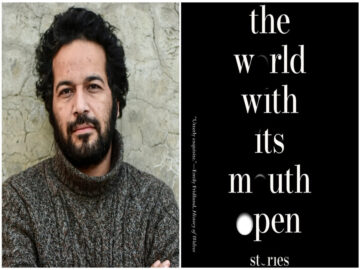
Author Zahid Rafiq spent years as a journalist covering Kashmir, one of the world’s most militarized zones. He made the switch to fiction, completing his MFA at Cornell. In his first book, The World With Its Mouth Open, Rafiq explores the lives of contemporary, everyday Kashmiris. In 11 riveting short stories, his taut but knowing prose forces us to see and hear from characters whose voices are rarely included in the geopolitical discussions around the conflict-ridden region.

Rafiq spoke to me recently over Zoom from Srinagar, Kashmir’s capital. He was sandwiched between rows of bookshelves on either side of him. He insists that accepting one’s own foolishness is key as a writer. In developing his own voice, he’s looked to Chekhov, Kafka, and “lots of Russians,” as well as the chatter of shopkeepers and autorickshaw drivers from his youth.

More here.

Enjoying the content on 3QD? Help keep us going by donating now.

The first driverless trucks have started running regular longhaul routes

Alexandra Skores at CNN:

Driverless trucks are officially running their first regular long-haul routes, making roundtrips between Dallas and Houston.

On Thursday, autonomous trucking firm Aurora announced it launched commercial service in Texas under its first customers, Uber Freight and Hirschbach Motor Lines, which delivers time- and temperature-sensitive freight. Both companies conducted test runs with Aurora, including safety drivers to monitor the self-driving technology dubbed “Aurora Driver.” Aurora’s new commercial service will no longer have safety drivers.

“We founded Aurora to deliver the benefits of self-driving technology safely, quickly, and broadly, said Chris Urmson, CEO and co-founder of Aurora, in a release on Thursday. “Now, we are the first company to successfully and safely operate a commercial driverless trucking service on public roads.”

The trucks are equipped with computers and sensors that can see the length of over four football fields. In four years of practice hauls the trucks’ technology has delivered over 10,000 customer loads across 3 million miles with human supervision. As of Thursday, the company’s self-driving tech has completed over 1,200 miles without a human in the truck.

More here.

Enjoying the content on 3QD? Help keep us going by donating now.

Demonology

David Gordon White at Aeon Magazine:

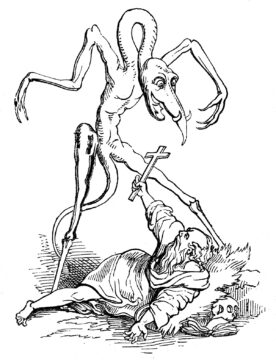
Demonology, the ‘science of demons’, has always comprised two complementary facets – the one theoretical and the other practical. If one was to battle one’s enemy effectively, one first had to know him, his human confederates, his disguises, his ruses. I use the singular here, because in many of the world’s religious traditions, the demonic hordes were held in the thrall of a single great embodiment of evil, an arch-rival to a benevolent God or gods. The relationship between the demonic host, the pandemonium, and its master was envisioned in several ways. Quite often, the demons were simply a protean swarm, overwhelming by their sheer numbers, visiting natural disasters and plagues upon the land, and madness, sickness and death upon their human victims.

In some cases, however, the pandemonium was imagined as a hierarchy whose structures mimicked those of human institutions or divine pantheons. For the monks of medieval Catholicism, the organisation of the demonic host replicated its own hierarchy. In the same way that the good angels were ranked according to their stations and functions, so too with the evil spirits: our bishops had their counterparts in their bishops, our abbots in their abbots, our priors in their priors, and so on.

more here.

Enjoying the content on 3QD? Help keep us going by donating now.

‘Outdated and unjust’: can we reform global capitalism?

John Cassidy in The Guardian:

Trump’s assault on the old global order is real. But in taking its measure, it’s necessary to look beyond the daily headlines and acknowledge that being in a state of crisis is nothing new to capitalism. It’s also important to note that, as Karl Marx wrote in The Eighteenth Brumaire of Louis Napoleon: “Men make their own history, but they do not make it as they please.” Even would-be authoritarians who occupy the Oval Office have to operate in the social, economic and political environment that is bequeathed to them. In Trump’s case, the inheritance was one in which global capitalism was already suffering from a crisis of legitimacy.

Consider the decade before he was re-elected. In 2014, the global financial crisis and the Occupy Wall Street movement were fresh in the memory. The French economist Thomas Piketty appeared on bestseller lists around the world with his tome Capital in the Twenty-First Century, which highlighted income and wealth inequality. Bankers, billionaires and defenders of free market capitalism appeared to be on the defensive.

More here.

Enjoying the content on 3QD? Help keep us going by donating now.

Is the Next Great American Novel Being Published on Substack?

Peter C. Baker at The New Yorker:

Kanakia isn’t the only one playing with fiction on Substack. The National Book Award winner Sherman Alexie posts fiction, poetry, and essays on his Substack, and Chuck Palahniuk (of “Fight Club” fame) serialized a novel on his. The renowned Israeli author Etgar Keret (who, like Alexie, is a frequent contributor to this magazine) posts fiction on his Substack. Rick Moody, one of the most critically acclaimed and commercially successful literary authors of his generation, recently published a nearly twenty-thousand-word “non-fiction novella” on the Mars Review of Books Substack, and the Times columnist Ross Douthat has, since September, been using the platform to publish “The Falcon’s Children,” a fantasy novel, at the rate of a chapter per week. This is to say nothing of the many names—including George SaundersMary Gaitskill, Catherine Lacey, and Elif Batuman—who have popular Substacks where they publish nonfiction about literature and life.

These are writers who already enjoy considerable levels of professional success and are using Substack to experiment with new styles, build direct connections with their readers, or make a few bucks selling premium-tier subscriptions to their biggest fans.

more here.

Enjoying the content on 3QD? Help keep us going by donating now.

Wednesday Poem

Postscript

And sometime make the time to drive out west
Into County Clare, along the Foggy Shore,
In September or October, when the wind
And light are working off each other
So that the ocean on one side is wild
With foam and glitter, and inland among stones
The surface of a slate-grey lake is lit
By the earthed lightning of a flock of wans,
Their feathers ruffed and ruffling, white on white,
Their fully grown headstrong-looking heads
Tucked or cresting are busy underwater.
Useless to think you’ll park and capture it
More thoroughly. You are neither here nor there,
A hurry through which known and strange thinks pass
As big soft buffetings come at the car sideways
And catch the heart off guard and blow it open.

by Seamus Heaney
from The Spirit Level
Farrar and Giroux, NY, 1996

Enjoying the content on 3QD? Help keep us going by donating now.

Who wants to live forever?

Kieran Setiya in Substack:

I made a joke, last year, about philosophy’s failure as a pedagogy of death: if it was meant to teach me how to reconcile with mortality, it doesn’t seem to have done its job. Not that philosophers haven’t tried. Some make the case directly, arguing that, since being dead is painless, it cannot harm us, or that it makes no more sense to mourn post-mortem non-existence than it does the time before we were born.

But some approach the problem back-to-front. If the opposite of dying is living forever, they reason, we can reconcile with mortality by showing that immortality is worse. Thus, Bernard Williams argued in “The Makropulos Case: Reflections on the Tedium of Immortality”—the spoiler is in the title—that immortality would be tedious to the point of becoming insufferable. Even if we took the precaution of stipulating endless youth and health as well as endless life, we would simply run out of things to do. Boredom would consume us like a never-dying flame, and we would long for death.

More here.

Enjoying the content on 3QD? Help keep us going by donating now.

‘AI models are capable of novel research’: OpenAI’s chief scientist on what to expect

Elizabeth Gibney in Nature:

OpenAI is best known for ChatGPT — the free-to-use, large language model-based chatbot that became a household name after its debut in 2022. The firm, in San Francisco, California, has since released a string of cutting-edge artificial intelligence (AI) tools, including ‘reasoning’ models that use step-by-step ‘thought’ processes to specialize in logical tasks. These tools have helped researchers to polish prose, write codereview the literature and even generate hypotheses. But, like other technology rivals, OpenAI has faced criticisms over the energy demands of its models and the way in which data are exploited for model training. And unlike some firms, OpenAI has almost exclusively released proprietary models that researchers can use, but can’t build on.

More here.

Enjoying the content on 3QD? Help keep us going by donating now.

Tuesday, May 13, 2025

Pranab Bardhan: Universal Basic Income in the World of AI?

Pranab Bardhan at his own Substack:

In my last substack piece I discussed the need for voice of labor in influencing the R & D decisions of companies in shaping the pattern of innovations in a labor-absorbing direction—otherwise increasingly more powerful AI is likely to make most workers redundant in their current jobs and tasks. In the latter eventuality how will people survive in that not-too-distant future? The Big Tech entrepreneurs of Silicon Valley and elsewhere—which include some avowed libertarians (though being libertarian has not usually stopped them from lobbying for large government contracts) and some open supporters of political parties with neo-Nazi roots—have often suggested a simple solution: Universal Basic Income (UBI).

I have been intrigued by this suggestion. If more of the current types of labor-replacing AI which Big Tech is rushing to bring about are in our inexorable future, and in that future if most people have no jobs and thus no income (nor any income taxes to pay), how will UBI be financed? In the US, for example, a level of UBI for everyone at even the current dismal official poverty line of the country will exhaust more than two-thirds of the federal budget, leaving very little for anything else.

More here.

Enjoying the content on 3QD? Help keep us going by donating now.

Why do beautiful people also seem smart and likeable?

Chris F Westbury and Daniel King at Psyche:

Have you ever noticed how someone who’s drop-dead gorgeous can also seem charming, honest and kind – even before they’ve said a word? That’s the halo effect, a common psychological bias where one trait (such as good looks) influences your impressions of someone’s other qualities. The halo effect was first systematically studied by the psychologist Edward Thorndike more than a century ago. In 1920, Thorndike reported that when he analysed the judgments of military officers evaluating their subordinates, their ratings of intelligence, leadership and physical qualities tended to blur together. If a subordinate excelled in one area, the evaluator was inclined to think he was exceptional in all of them. The effect shows up in many different fields, including social psychology, clinical psychology, child psychology, health, politics and marketing. The ‘attractiveness halo effect’ is what happens when a physically beautiful person also seems interesting, capable and good-natured. It’s as if we’re wired to judge books by their covers, even if we know we shouldn’t.

More here.

Enjoying the content on 3QD? Help keep us going by donating now.

Kenneth Roth: Dictators get an unlikely boost from the left’s identity politics

Kenneth Roth in Foreign Policy:

That willingness to abandon democracy can be traced to two primary causes: the disillusionment of some people with the democratic system, and the demagoguery of autocratic politicians. The disenchantment is found in people who believe that democratic government is leaving them behind. They feel that they are stagnating economically amid growing inequality, that they are not served, heard, or even respected by governing officials. It only makes matters worse when democratic governance is paralyzed by today’s increasingly divisive politics. The answer to this politics of despair lies in part in better governance and in promoting policies that are seen to respond to, and serve, all members of society.
That is easier said than done, but it is not as if autocrats govern any better. As they undermine the checks and balances on their power, autocrats typically deliver for themselves (and their cronies) more than for the people of their country. But they avoid outrage from their supporters because they excel at covering up their self-serving policies—at changing the subject—by scapegoating disfavored minorities.

More here.

Enjoying the content on 3QD? Help keep us going by donating now.

Lynne Tillman’s Digressive, Renegade Fictions

Jessi Jezewska Stevens at Bookforum:

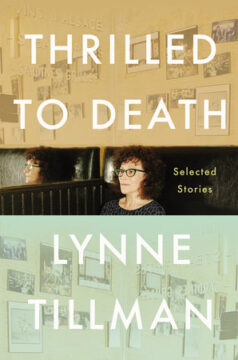
AMERICA IS A LAND OF BEGINNINGS, impatient, virginal, suspicious of foreplay. Sales are clinched on first impressions; books judged by covers; presidents, on their first one hundred days. The critic, novelist, and short story writer Lynne Tillman is an author who refreshingly resists our national logic of instant gratification. What might initially seem like a “theatrical” tendency to keep the audience at arm’s length soon gives way, as the Irish novelist Colm Tóibín once observed, to something “kinder and more considerate and oddly vulnerable.” In a Tillman story, everything can come together in the final line, and often does. In a land of beginnings, here is a master of elegant endings, the rare writer who can construct entire plots (or rather, “plots”) from false starts. By design, her stories unfold with the knowledge that she may lose some ticket holders at the intermission—but also with the confidence that those who mutiny will be the poorer for it. As usual, Tillman is correct.

more here.

Enjoying the content on 3QD? Help keep us going by donating now.

This tool-wielding assassin turns its prey’s defenses into a trap

Siddhant Pusdekar in Science News:

Add a little-known species of assassin bugs to the list of animals that can fashion and wield tools. And true to their name, the insects use that tool to draw their prey into an ambush, researchers report May 12 in Proceedings of the National Academy of Sciences.
Found in Thailand and China, Pahabengkakia piliceps is a species of predatory insects called assassin bugs that has a taste for the region’s stingless bees. When researchers at Xishuangbanna Tropical Botanical Garden in China began studying the assassin bugs in 2021, they became intrigued by how P. piliceps hunt. While lying in wait at a hive’s entrance, the assassin bugs use their front legs to proficiently pick off bees that fly by.

More here.

Enjoying the content on 3QD? Help keep us going by donating now.

When the Battle’s Lost and Won: Shulamith Firestone and the burdens of prophecy

Audrey Wollen in Harper’s Magazine:

Legends, fairy tales, and myths are rife with the constraints of prophecy: the necessity of surrender before the all-powerful grammar of future time; the hubris of trying to manipulate destiny; the shock of having already fucked your mother, despite your best efforts not to. Myth assumes that the future is like walking into a narrow tunnel, and the light at the end is neither train nor sunshine, but some terrifying third thing, blinding in its inevitability. Don’t even bother trying to guess. In these stories, the witch is always right, always in the wrong way. But what of the seers themselves? Are they never burdened, heartbroken by the unexpected shape of their own accuracy? Do they ever look at the world they predicted and say, That’s not what I meant? That’s not what I meant at all.

I must begin in the register of the mythical to discuss Shulamith Firestone, because that was the deliberate and unabashed scale of her project. It is often observed that The Dialectic of Sex, the work of theory she published in 1970, at the age of twenty-five, verges on the silvered edge of science fiction. The book floats like an opaline shape behind silhouetted winter branches, a cross-hatched, shining sky-thing, confounding yet airborne.

More here.

Enjoying the content on 3QD? Help keep us going by donating now.

The Fear Of The Occult

Frances A. Yates at the NYRB (1979):

When Fontenelle was composing his éloge of Isaac Newton for delivery in the Académie Royale des Sciences, he was able to consult notes by John Conduitt from which he would have learned that one of Newton’s motives in beginning his work in mathematics was to investigate whether judicial astrology had any claim to validity. In writing his éloge, Fontenelle omitted any reference to this fact, an omission which, as Brian Copenhaver points out, was normal in the Age of Enlightenment. Astrology for Fontenelle was unworthy of even passing reference. “The occultist tradition and all its claims about the powers of magic, alchemy, divination, witchcraft, and the secret arts, no longer demanded a serious response from serious thinkers.” How did it come about that such subjects had disappeared from the mainstream of European mental equipment, banished from the surface to pursue in future only a discredited existence underground? Copenhaver writes, “By the time the first edition of the Encyclopaedia Britannica appeared in 1771 the transformation was complete. The first Britannica gave only one hundred and thirty-two lines, less than a full page, to articles on astrology, alchemy, Cabala, demons, divination, the word ‘occult,’ and witchcraft. Astronomy occupied sixty-seven pages, and chemistry one hundred and fifteen.”

more here.

Enjoying the content on 3QD? Help keep us going by donating now.