
David Gordon White at Aeon Magazine:
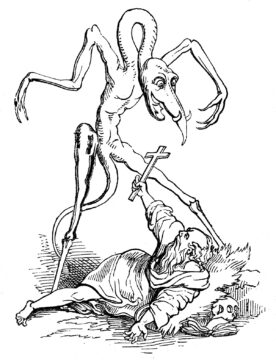
Demonology, the ‘science of demons’, has always comprised two complementary facets – the one theoretical and the other practical. If one was to battle one’s enemy effectively, one first had to know him, his human confederates, his disguises, his ruses. I use the singular here, because in many of the world’s religious traditions, the demonic hordes were held in the thrall of a single great embodiment of evil, an arch-rival to a benevolent God or gods. The relationship between the demonic host, the pandemonium, and its master was envisioned in several ways. Quite often, the demons were simply a protean swarm, overwhelming by their sheer numbers, visiting natural disasters and plagues upon the land, and madness, sickness and death upon their human victims.
In some cases, however, the pandemonium was imagined as a hierarchy whose structures mimicked those of human institutions or divine pantheons. For the monks of medieval Catholicism, the organisation of the demonic host replicated its own hierarchy. In the same way that the good angels were ranked according to their stations and functions, so too with the evil spirits: our bishops had their counterparts in their bishops, our abbots in their abbots, our priors in their priors, and so on.
more here.
Enjoying the content on 3QD? Help keep us going by donating now.