New gene-editing technology breakthroughs could help save native species from the blight of invaders—but at what risk?

Jason G. Goldman in Scientific American:

ScreenHunter_2235 Sep. 21 21.03As Earth enters the Anthropocene epoch, its biodiversity wobbles on the precipice of disaster—and island species have been hit especially hard. About 80 percent of recorded extinctions have occurred on islands and 40 percent of the world's endangered and threatened species are island dwellers. Researchers say the leading cause of these extinctions is invasive rodents—rats and mice that stowed away on ships, then quickly populated islands where they have no natural predators and often find a buffet of things like eggs and baby wildlife. Whereas there are several ways to clear such invaders, the most effective has been rodenticides. But these poisons can neither be deployed effectively on islands with large human populations nor where residents disapprove of their use. And poisons do not discriminate, killing along with unwanted pests the native species they are meant to protect.

But now a controversial new strategy called gene drive offers a brutally efficient solution by introducing genetically modified organisms designed to spread a chosen trait—such as producing infertile offspring—throughout a wild population. Scientists, government officials and other interested parties debated the idea last week at the International Union for Conservation of Nature's (IUCN) World Conservation Congress in Honolulu.

More here.

How Hillary Clinton Became a Vessel for America’s Fury

Janet Reitman in Rolling Stone:

ScreenHunter_2234 Sep. 21 20.53They were everywhere this summer, the wanna-be statesmen, the failed comedians, the conspiracy theorists and entrepreneurs with political convictions, or absolutely no convictions, selling the national id. In Cleveland, they trawled the streets outside the Republican National Convention, shouting, “Hillary's lies matter!” or “Hillary for prison!” – the slogans stamped on buttons, T-shirts, bumper stickers, decals, trucker hats, hoodies, onesies. At the Democratic National Convention in Philadelphia, diehards in Bernie 2016 shirts held signs reading “#NeverHillary” or “Shillary,” or handed out posters renaming the Democratic nominee “War Hawk” or “Goldman Girl” or “Monsanto Mama.” Everywhere the venom was carefully packaged and rigorously on-message. One button, plumbing the depths of the anti-politically correct, read “Life's a Bitch – Don't Vote for One.” Another promoted a “KFC Hillary Special: 2 Fat Thighs, 2 Small Breasts…Left Wing.” There were images of an angry Hillary giving America the finger and countless others of her yelling, scowling, looking mean. “Hillary sucks, but not like Monica!” yelled one T-shirt vendor, who told me he'd sold almost 500 shirts in Cleveland with that catchphrase. “Trump that bitch!”

More here.

A theory of creepiness

David Livingstone Smith in Aeon:

ScreenHunter_2233 Sep. 21 18.03Imagine looking down to see a severed hand scuttling toward you across the floor like a large, fleshy spider. Imagine a dog trotting up to you, amiably wagging its tail – but as it gets near you notice that, instead of a canine head, it has the head of an enormous green lizard. Imagine that you are walking through a garden where the vines all writhe like worms.

There’s no denying that each of these scenarios is frightening, but it’s not obvious why. There’s nothing puzzling about why being robbed at knifepoint, pursued by a pack of wolves, or trapped in a burning house are terrifying given the physical threat involved. The writhing vines, on the other hand, can’t hurt you though they make your blood run cold. As with the severed hand or the dog with the lizard head, you have the stuff of nightmares –creepy.

And creepiness – Unheimlichkeit, as Sigmund Freud called it – definitely stands apart from other kinds of fear. Human beings have been preoccupied with creepy beings such as monsters and demons since the beginning of recorded history, and probably long before. Even today in the developed world where science has banished the nightmarish beings that kept our ancestors awake at night, zombies, vampires and other menacing entities retain their grip on the human imagination in tales of horror, one of the most popular genres in film and TV.

More here.

Philosophy, the Sartre blend

SatreRay Monk at The New Statesman:

On YouTube there is a three-minute clip of the funeral of Jean-Paul Sartre. The funeral took place on Saturday 19 April 1980 and the television coverage from which the clip is taken follows the journey of the hearse from the hospital where Sartre died to Montparnasse Cemetery, where he was to be buried – a distance of about three kilometres. Along the way, the hearse moves through a staggering number of people. The commentator says that there are 50,000 mourners in total, 30,000 on the streets leading to the cemetery and another 20,000 at the cemetery itself. When the camera pans out, you can see how extraordinarily packed the streets are; when it homes in on some of the faces, you notice that many of the mourners are young, in their early twenties. If you did not know whose funeral it was, you would guess a famous actor or actress, a rock star, or some such popular public figure as Diana, Princess of Wales or Winston Churchill. It would never occur to you that what you were seeing was the public reaction to the death of a philosopher.

It is often remarked that this shows the difference between French and British culture, because it is unimaginable that so many people in this country would be so deeply affected by the death of an intellectual. But, in fact, it is a pretty unusual event anywhere and at any time.

more here.

Making Sense of Patterns of Police Violence

2016-07-15-1468604858-4887989-march6Adolph Reed, Jr. at nonsite:

Some readers will know that I’ve contended that, despite its proponents’ assertions, antiracism is not a different sort of egalitarian alternative to a class politics but is a class politics itself: the politics of a strain of the professional-managerial class whose worldview and material interests are rooted within a political economy of race and ascriptive identity-group relations. Moreover, although it often comes with a garnish of disparaging but empty references to neoliberalism as a generic sign of bad things, antiracist politics is in fact the left wing of neoliberalism in that its sole metric of social justice is opposition to disparity in the distribution of goods and bads in the society, an ideal that naturalizes the outcomes of capitalist market forces so long as they are equitable along racial (and other identitarian) lines. As I and my colleague Walter Benn Michaels have insisted repeatedly over the last decade, the burden of that ideal of social justice is that the society would be fair if 1% of the population controlled 90% of the resources so long as the dominant 1% were 13% black, 17% Latino, 50% female, 4% or whatever LGBTQ, etc. That is the neoliberal gospel of economic justice, articulated more than a half-century ago by Chicago neoclassical economist Gary Becker, as nondiscriminatory markets that reward individual “human capital” without regard to race or other invidious distinctions.

We intend to make a longer and more elaborate statement of this argument and its implications, which antiracist ideologues have consistently either ignored or attempted to dismiss through mischaracterization of the argument or ad hominem attack.1 For now, however, I want simply to draw attention to how insistence on reducing discussion of killings of civilians by police to a matter of racism clouds understanding of and possibilities for effective response to the deep sources of the phenomenon.

more here.

Jürgen Habermas and the unfinished project of the enlightenment

JuergenHabermasPeter E. Gordon at The Nation:

The pensive man with the snow-white hair was the philosopher and social theorist Jürgen Habermas, who for more than six decades has played the part of gadfly in modern Germany, just as Socrates did in ancient Athens. Even at his ripe age—he is now 87—Habermas’s passion remains undiminished. As a public intellectual, however, he may seem an unlikely hero. We live in an age when what some of us still fondly call “the public sphere” has grown thick with personalities who prefer the TED Talk to the printed word and the tweet to the rigors of rational argument. For Habermas, it’s clear that without the constant exercise of public deliberation, democracy will collapse, and this means that citizens must be ready to submit their arguments to the acid bath of rational criticism. The debates that preceded the construction of the Holocaust Memorial brought bitter memories to the surface—the novelist Martin Walser complained of “a monumentalization of our disgrace”—but for Habermas, a willingness to engage productively in self-criticism is a prerequisite for democratic consciousness. National pride in the conventional sense leaves him cold: In an essay for Die Zeit, he responded to Walser, emphasizing that “anyone who views Auschwitz as ‘our shame’ is more interested in the image others have of us than in the image German citizens retrospectively form of themselves in view of the breakdown of civilization, in order to be able to look each other in the face and show each other respect.” Habermas argues instead for “constitutional patriotism,” a sense of loyalty to the principles and procedures of the modern democratic state.

The ideal that most animates Habermas is a belief in the possibility of a genuinely critical and self-reflexive form of modern consciousness that can serve as the groundwork for politics.

more here.

Sad movies help us bond with those around us—and alleviate pain

Emily Underwood in Science:

FilmIf you were old enough to see a PG-13 movie in 1997, chances are you went to see Titanic. And chances are you cried. You might have even seen the film multiple times, doing your part to make it the highest-grossing sob fest in movie history. Now, a new study suggests why people want to see tragedies like Titanic over and over again: Watching dramas together builds social bonds and even raises our tolerance for physical pain. “Why on Earth would we waste so much of our time and money going back to novels and films that make us cry?” evolutionary psychologist Robin Dunbar of the University of Oxford in the United Kingdom and his team asked at the beginning of the new study. In their previous investigations of group activities like dancing, laughing, and singing, they found that feel-good chemicals called endorphins were released in the brain, leading to increased pain tolerance and stronger bonds between participants. Endorphins are also released when monkeys and other nonhuman primates groom, suggesting that this mechanism has evolved to boost social ties, Dunbar says. Watching a tragic drama unfold in a theater might harness the same system, the researchers hypothesized. So Dunbar and his colleagues recruited 169 people to watch Stuart: A Life Backwards. This made-for-TV film portrays the experiences of a disabled homeless man who was sexually abused as a child and struggles with lifelong drug use and imprisonment. He ultimately dies by throwing himself in front of a train. Based on a real man’s life, the story is “about as close to pure tragedy as Shakespeare,” Dunbar says. “People were leaving in tears.”

The researchers compared those viewers with a second group of 68 people who watched two rather sedate BBC documentaries: episode one of The Museum of Life—a behind-the-scenes look at the Natural History Museum in London—and Landscape Mysteries “In Search of Irish Gold,” which explores Irish geology and archaeology. Before and after watching the films, all participants took two tests: One measured their sense of belonging or bonding with their fellow audience members. Another was a measure of pain sensitivity, called the Roman chair, which Dunbar says is a well-established proxy for endorphin release. In it, participants brace themselves unsupported in a chairlike stance against a wall until their leg muscles burn painfully. The higher the endorphin level, the longer a person should be able to sustain the posture, Dunbar says. Participants who had watched Stuart: A Life Backwards were able to maintain the Roman chair roughly 18% longer than they had in their initial baseline test, compared with those who had watched the documentaries, the authors report today in the journal Royal Society Open Science. They also found a parallel increase in the volunteers’ sense of social bonding that was not seen in the control group, suggesting that watching the drama—and not the duller BBC shows—had boosted group coherence.

More here.

Wednesday Poem

Then Ay Know My Horse

Then Ay know my horse,
let alive and out of days,
hide now paled, hind legs slow
to drag, lower head to lift,
hoof-split, burred and rough from the dirt.

Strange when Ay speak to him.
Tremble runs under him.
What owned him fills him.

Same horse Ay tamed are you the same?
Mane-tangled, lank, and under brow,
hims eye as from a coal half-burnt
sparked up. Ay pulled my body on-

start, rear, run-
and did not loose but stormed and shaken
held as leaf to stem. Sky could hear
the finding cry Ay made.

by Joan Houlihan
from AY
Tupelo Press, 2014
.

Tuesday, September 20, 2016

My Father: A Life

Justin Erik Halldór Smith in his own blog:
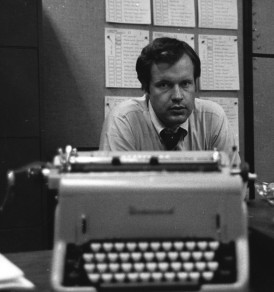
ScreenHunter_2232 Sep. 20 20.02The dolphin fish (Coryphaena hippurus) has no inner life, so its death can only play out on the surface of its body, in a spectacular display of multicoloured flashes. But where there is cognition, memory, emotion, where there is a man, the light show sometimes happens on the inside, a fireworks display of the soul's contents, transformed and expressed in a way that the nursing staff will dismiss as hallucination, but which is in fact no less true than the life itself.

In the week leading up to Friday, September 2, 2016, I accompanied my father in his transition to death. I came back and he did not. I am not yet old, and was only there to help him across. But I am not yet fully back. I know things now that I did not know before, about him, about us, about the living and the dead, and about the category of being or of mental phantasm (what is the difference, really?) that the country folk call 'ghosts'.

I always knew I would write about him. Though it may seem too soon, too raw, against protocol, to do so is the closest thing to filial piety I have in me. To do so is to honour him, who long ago vested his own dream of writerliness in me. He set up this very website over a decade ago; his final post to Facebook, in mid-August, was a review of my most recent book in The Nation. The hard drive of his laptop, which I have taken into my possession, is filled with fragments of creative writing projects, not least a folder with hundreds of files (including a home-made cover) contributory to a novel, entitled Bananaman, that would have been about the CIA and the United Fruit Company's involvement in various Central American coups d'état, and about the creation of a certain popular peelable monoculture that my father somehow saw as key to understanding his American century. Bananaman will never see the light of day, but I think that at some point my father stopped expecting it would, and that, after some years of intergenerational competition, he could now just kick back, let me do all the work, and beam with paternal pride. So this is a coda to that, a necessary culmination of who each of us was for the other.

More here.

The Strange Second Life of String Theory

K. C. Cole in Quanta:

ScreenHunter_2231 Sep. 20 19.58String theory strutted onto the scene some 30 years ago as perfection itself, a promise of elegant simplicity that would solve knotty problems in fundamental physics — including the notoriously intractable mismatch between Einstein’s smoothly warped space-time and the inherently jittery, quantized bits of stuff that made up everything in it.

It seemed, to paraphrase Michael Faraday, much too wonderful not to be true: Simply replace infinitely small particles with tiny (but finite) vibrating loops of string. The vibrations would sing out quarks, electrons, gluons and photons, as well as their extended families, producing in harmony every ingredient needed to cook up the knowable world. Avoiding the infinitely small meant avoiding a variety of catastrophes. For one, quantum uncertainty couldn’t rip space-time to shreds. At last, it seemed, here was a workable theory of quantum gravity.

Even more beautiful than the story told in words was the elegance of the math behind it, which had the power to make some physicists ecstatic.

To be sure, the theory came with unsettling implications. The strings were too small to be probed by experiment and lived in as many as 11 dimensions of space. These dimensions were folded in on themselves — or “compactified” — into complex origami shapes. No one knew just how the dimensions were compactified — the possibilities for doing so appeared to be endless — but surely some configuration would turn out to be just what was needed to produce familiar forces and particles.

More here.

I Used to Be a Human Being

Andrew Sullivan in New York Magazine:

ScreenHunter_2230 Sep. 20 19.52I was sitting in a large meditation hall in a converted novitiate in central Massachusetts when I reached into my pocket for my iPhone. A woman in the front of the room gamely held a basket in front of her, beaming beneficently, like a priest with a collection plate. I duly surrendered my little device, only to feel a sudden pang of panic on my way back to my seat. If it hadn’t been for everyone staring at me, I might have turned around immediately and asked for it back. But I didn’t. I knew why I’d come here.

A year before, like many addicts, I had sensed a personal crash coming. For a decade and a half, I’d been a web obsessive, publishing blog posts multiple times a day, seven days a week, and ultimately corralling a team that curated the web every 20 minutes during peak hours. Each morning began with a full immersion in the stream of internet consciousness and news, jumping from site to site, tweet to tweet, breaking news story to hottest take, scanning countless images and videos, catching up with multiple memes. Throughout the day, I’d cough up an insight or an argument or a joke about what had just occurred or what was happening right now. And at times, as events took over, I’d spend weeks manically grabbing every tiny scrap of a developing story in order to fuse them into a narrative in real time. I was in an unending dialogue with readers who were caviling, praising, booing, correcting. My brain had never been so occupied so insistently by so many different subjects and in so public a way for so long.

I was, in other words, a very early adopter of what we might now call living-in-the-web. And as the years went by, I realized I was no longer alone. Facebook soon gave everyone the equivalent of their own blog and their own audience.

More here.

The Unsung Hero Left Out of ‘Sully’

Clive Irving in The Daily Beast:

49138975.cachedFear of flying has no easy antidote. It’s no good telling sufferers that flying is so much safer than driving on the expressway to the airport. That’s statistics, not the reality of the human condition. But there is one feel-good story that may be invoked to calm the fever: the moment in January 2009 when 150 airline passengers suddenly found themselves heading not for their destination, Charlotte, North Carolina but the ice-cold Hudson River in New York.

This is, of course, the Miracle on the Hudson. US Airways Flight 1549 had lost power from both engines after the engines ingested a flight of Canadian geese soon after taking off from La Guardia Airport.

Few passengers ever bother to know or even care about the names of the pilots to whom they entrust their lives. In this case none of the passengers (and much of the nation) would ever forget the name of the pilot, Captain Chesley Sullenberger, or just Sully.

Now Sully has rightly been elevated into the pantheon of those American heroes worthy of being played by Tom Hanks. TheClint Eastwood directed movie,Sully, is a surprise box office hit. It seems a good moment, then, to finally give credit to a hero so far unsung in this drama.

More here. [Thanks to Victoria Schindler.]

Village Atheists, Village Idiots

Thompson_AtheistB32.3_33rgb-838x1320Sam Kriss at The Baffler:

Something has gone badly wrong with our atheists. All these self-styled intellectual titans, scientists, and philosophers have fallen horribly ill. Evolutionist faith-flayer Richard Dawkins is a wheeling lunatic, dizzy in his private world of old-fashioned whimsy and bitter neofascism. Superstar astrophysicist and pop-science impresario Neil deGrasse Tyson is catatonic, mumbling in a packed cinema that the lasers wouldn’t make any sound in space, that a spider that big would collapse under its own weight, that everything you see is just images on a screen and none of it is real. Islam-baiting philosopher Sam Harris is paranoid, his flailing hands gesticulating murderously at the spectral Saracen hordes. Free-thinking biologist PZ Myers is psychotic, screeching death from a gently listing hot air balloon. And the late Christopher Hitchens, blinded by his fug of rhetoric, fell headlong into the Euphrates.

Critics have pointed out this clutch of appalling polemic and intellectual failings on a case-by-case basis, as if they all sprang from a randomized array of personal idiosyncrasies. But while one eccentric atheist might be explicable, for all of the world’s self-appointed smartest people to be so utterly deranged suggests some kind of pattern. We need, urgently, a complete theory of what it is about atheism that drives its most prominent high priests mad.

more here.

the struggle behind brexit

Guldi_inlineJo Guldi at Boston Review:

This account of Brexit, drawing on the framework of class-consciousness, turns on the rise of a reactionary electorate outside of London. The idea, in short, is that the United Kingdom has witnessed the lumpenproletariat exact uncertain revenge upon the nation’s ruling elite. This narrative more or less parallels Marx’s account of the December 1851 coup in France in The Eighteenth Brumaire of Louis Napoleon. Marx blamed the rise of the dictatorship on the greed and disappointment of the petite bourgeoisie, who revolted against the Second Republic and the interest of the workers. This betrayal, Marx argued, precipitated an era of rule by political moron, encapsulated in the premiership of Louis-Napoléon Bonaparte (figured as a template for Boris Johnson by some and for Jeremy Corbyn by others), whom Marx memorably dubbed a “grotesque mediocrity.” Leaders such as these, several commentators have implied, are a parody of the great leadership demanded by the moment.

A closely related understanding of Brexit can be found in the accounts of political scientists who theorize a connection between class resentment and the cause of participatory democracy. Mark Blyth, for example, has argued that Brexit typifies a global moment of participatory rebellion against the structures of expert rule, and Richard Tuck avers that the Left must embrace Brexit if the EU elite is to be replaced by a participatory process.

more here.

the ruins of palmyra

Palmyra-valley-of-tombsIngrid D. Rowland at the NY Review of Books:

In September 2015, the Getty Research Institute in Los Angeles acquired the first photographs ever taken of Palmyra, the great trading oasis in the heart of the Syrian desert. Louis Vignes was a young lieutenant in the French navy whose interest in photography earned him a place on a scientific expedition to the Dead Sea region in 1863. The twenty-nine photographs he made of Palmyra during his visit in 1864 (including two panoramic shots) were finally printed in Paris by the pioneering photographer Charles Nègre (who had taught Vignes) between 1865 and 1867.

With a history that extends back nearly four thousand years, Palmyra has risen and fallen many times. Its original name was Tadmor, which probably meant “palm tree,” an indication of the site’s renowned fertility. Both the Bible and local legend credit the city’s foundation to King Solomon in the tenth century BCE, but in fact it is already mentioned in Mesopotamian texts a millennium earlier. A spring and a wadi, or dry river bed, provided the settlement with water, making it a welcome stop for travelers and traders on the road between Central Asia and the Mediterranean Sea.

The population, almost from the outset, was a mixture of Semitic peoples from surrounding areas: Amorites, Aramaeans, Arabs, and Jews, who developed a distinctive Palmyrene language and a distinctive script expressive of their distinctive cosmopolitan culture, which drew from Persia, Greece, and Rome as well as local tradition.

more here.

How cats conquered the world (and a few Viking ships)

Ewen Callaway in Nature:

CatResearchers know little about cat domestication, and there is active debate over whether the house cat (Felis silvestris) is truly a domestic animal — that is, its behaviour and anatomy are clearly distinct from those of wild relatives. “We don’t know the history of ancient cats. We do not know their origin, we don't know how their dispersal occurred,” says Eva-Maria Geigl, an evolutionary geneticist at the Institut Jacques Monod in Paris. She presented the study at the 7th International Symposium on Biomolecular Archaeology in Oxford, UK, along with colleagues Claudio Ottoni and Thierry Grange. A 9,500-year-old human burial from Cyprus also contained the remains of a cat1. This suggests that the affiliation between people and felines dates at least as far back as the dawn of agriculture, which occurred in the nearby Fertile Crescent beginning around 12,000 years ago. Ancient Egyptians may have tamed wild cats some 6,000 years ago2, and under later Egyptian dynasties, cats were mummified by the million. One of the few previous studies3 of ancient-cat genetics involved mitochondrial DNA (which, contrary to most nuclear DNA, is inherited through the maternal line only) for just three mummified Egyptian cats.

…Cat populations seem to have grown in two waves, the authors found. Middle Eastern wild cats with a particular mitochondrial lineage expanded with early farming communities to the eastern Mediterranean. Geigl suggests that grain stockpiles associated with these early farming communities attracted rodents, which in turn drew wild cats. After seeing the benefit of having cats around, humans might have begun to tame these cats. Thousands of years later, cats descended from those in Egypt spread rapidly around Eurasia and Africa.

More here.

Tuesday Poem

Settling for the Night

It’s a custom with my youngest
to sprinkle “sleeping dust”
over his eyes
before closing them,
combing the sleep down through his hair
and tenderly over his forehead

good night, Dad,
good night…

I listen to our children breathing the night,
their tiny heads under the covers
gone somewhere where we cannot follow
but at least they will return;
the stars of some eternal night
speckle their hair
and their faces are like clocks
in the bedroom twilight.

Their morning is afternoon to us;
their afternoon will see us settled for the night;
some quiet Sunday perhaps
the sun through the blinds will raise
its black ladder on my bedroom wall
and the child fists
will have become adult hands
that will sprinkle the sleeping dust
over my closed eyes
before combing it down
through my peppered grey hair…

Good night, Dad,
good night…
.

by Ifor ap Glyn
from Cerrdi Map yr Underground
publisher: Gwasg Carreg Gwalch, Llanrwst, 2001
.

Monday, September 19, 2016