
Tegan Bennet Daylight at the Sydney Review of Books:
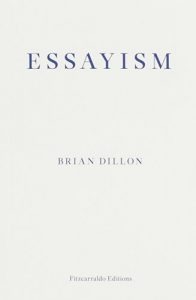 What is Essayism? Its writer admits to us that he has ‘no clue how to write about the essay as a stable entity or established class, how to trace its history diligently from uncertain origins through successive phases of literary dominance’ – and praise be for that. The book is instead a series of attempts, of essays, of course, at delineating or describing the form. Each chapter is a few pages, beginning with an idea: ‘On essays and essayists’, ‘On origins’, ‘On lists’, and as the book begins to become something else, ‘On consolation’. The book is also a story of the book being written, and of Dillon going under entirely. ‘Each day I sat at my desk in an office at the end of the garden,’ he tells us, early on, ‘and cried and smoked and tried to write – tried to write this book – and each day finally gave myself up to fantasies of suicide. I would walk out of this suburb along country lanes to a secluded stretch of railway line and lay my head on the track in the moonlight.’
more here.
 The questioning of long-held beliefs and understanding of the full histories behind institutions should have positive repercussions for everyone. But as the Brooklyn, Liverpool and Birmingham cases highlight, decolonizing cultural institutions is not straightforward. Their attempts suggest that the key issue at this early stage is a lack of understanding about what decolonizing an institution means, and what it entails. A genuinely decolonial approach would see museums interrogate their positions as apparently objective caretakers of non-Western objects and artefacts. The assumption of Western objectivity is not only divorced from the material conditions in which those objects have come to be “owned” by Western knowledge – knowledge informed by a history of contact on unequal terms – but it also instantiates the exceptionalism with which Western cultures have felt entitled to the final, objective say on other cultures. By acknowledging this, and then pursuing new roles and missions, institutions could take a number of concrete steps, such as repatriating objects where feasible, especially if they were plundered from peoples for whom they sustain cultural value; embracing greater accountability towards their local communities; and consider the colonial and racial legacies informing their operations and governance.
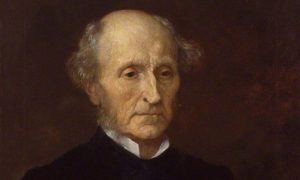 In 1826, at the age of 20, John Stuart Mill sank into a suicidal depression, which was bitterly ironic, because his entire upbringing was governed by the maximisation of happiness. How this philosopher clambered out of the despair generated by an arch-rational philosophy can teach us an important lesson about suffering. Inspired by Jeremy Bentham’s ideals, James Mill’s rigorous tutelage of his son involved useful subjects subordinated to the utilitarian goal of bringing about the greatest good for the greatest number. Music played a small part in the curriculum, as it was sufficiently mathematical – an early ‘Mozart for brain development’. Otherwise, subjects useless to material improvement were excluded. When J S Mill applied to Cambridge at the age of 15, he’d so mastered law, history, philosophy, economics, science and mathematics that they turned him away because their professors didn’t have anything more to teach him.
 Like most other neurological disorders, Huntington’s disease has proved to be a costly and frustrating target for drug developers. But it also has distinctive features that make it a good match for treatments that target genes. It arises from a mutation in a single gene that encodes the protein huntingtin, and a disease-causing copy of the gene can be readily distinguished from a normal copy by the presence of an
 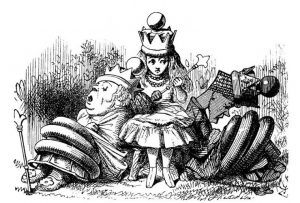 People are gullible. Humans can be duped by liars and conned by frauds; manipulated by rhetoric and beguiled by self-regard; browbeaten, cajoled, seduced, intimidated, flattered, wheedled, inveigled, and ensnared. In this respect, humans are unique in the animal kingdom.
 By weight, human beings are insignificant.
 Two reports last week exposed both the changing character of the labour market and the degree to which the power of the organised working class has eroded.
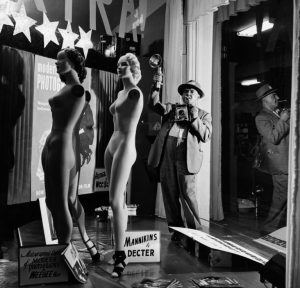 Usher Fellig was a greenhorn, a hungry shtetl child from eastern Europe who spoke no English. When he came through Ellis Island in 1909, at ten years old, he reinvented himself, as so many immigrants do. In his first years in New York, Usher became Arthur, a Lower East Side street kid who was eager to get out of what he called “the lousy tenements,” earn a living, impress girls, make a splash. He had turned his name (slightly) less Jewish and his identity (somewhat) more American, as much as he could make it. As a young man, he was shy, awkward, broke, and unpolished, and at fourteen, he became a seventh-grade dropout. He was also smart, ambitious, funny, and (as he and then his fellow New Yorkers and eventually the world discovered) enormously expressive when you put a camera in his hands.
 The show’s visual grammar reflects this anxiety and paranoia. Murai’s choice to use film is a potent reminder that this is still fiction, but the choice makes it all the more real—not only because film adds texture, but also because when the celluloid occasionally pops, that jumpiness contributes to the show’s overall tone. Late night, after the strip club gets out, there’s an Edward Hopper tableau of small, illuminated spaces engulfed in darkness. The introduction of magical realism is straight out of Gabriel Garcia Marquez, only Atlanta is a black Macondo made famous by Magic City, and instead of a woman floating up into the sky, there’s a disappearing club promoter and an invisible sports car.
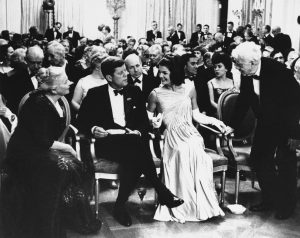 The credit for arguably the best idea ever for a White House event goes to the fertile brain of Richard Goodwin. In a note to Jacqueline Kennedy in November 1961, the president’s aide was to the point: “How about a dinner for the American winners of the Nobel Prize?” Within six months, the largest social event of the New Frontier had occurred. By contemporary accounts, it was a smash. And it has resonated through the decades as a symbol of what that “one brief, shining moment” was capable of on its best days, and of the impact a White House can have on American culture and the creative minds who inhabit it. Comparisons to the disgusting atmosphere of the present are obvious. John Kennedy was pleased, but not entirely. According to his and his wife’s friend, the artist William Walton, the president called him later to complain about the woman who had been seated on his right, Ernest Hemingway’s fourth wife and widow of a year, Mary, who gave him repeated guff for his Cuba policy; Kennedy was more impressed by the dignified woman on his left, Katherine Marshall, the widow of George C. Marshall, the World War II commander and architect of the postwar reconstruction plan that bore his name. “Well, your friend Mary Hemingway is the biggest bore I’d had for a long time,” Walton quoted JFK as saying. “If I hadn’t had Mrs. Marshall I would have had a terrible night.” Walton couldn’t say much in reply: Mary Hemingway was right next to him in his Georgetown home when the call came.
 How easy it would be,
  The 20th century was a remarkably productive one for physics. First, Albert Einstein’s
  Ask people to name the key minds that have shaped America’s burst of radical right-wing attacks on working conditions, consumer rights and public services, and they will typically mention figures like free market-champion Milton Friedman, libertarian guru Ayn Rand, and laissez-faire economists Friedrich Hayek and Ludwig von Mises.
 It is election season in
  What’s especially impressive about this adaptation is not only that it is enjoyable, but that it directly confronts the problem of addiction without glamorising it. Other dramas about womanising addicts—for example Mad Men or Californication—tend to focus on the debauchery as much as the interior consequences; this makes it easy for the viewer to avoid processing the trauma. Watching Mad Men’s Don Draper pour himself yet another glass of whiskey, having hit yet another rock bottom, doesn’t quell the desire (provoked by the sexy depiction of the world of the programme) to reach for a cigarette and a whiskey yourself. Even in Channel 4’s Sherlock, the detective’s opium habit is seen as a facet of his genius: a necessary method for him to open the doors of perception. There is something beguiling and (literally) intoxicating about watching someone dance so close to the cliff edge. Indulging this behaviour onscreen can make it seem attractive rather than repellent.