From BBC:
Eid al-Fitr is “the feast of the breaking of the fast” that begins when the moon rises on the final day of Ramadan. About 1.6 billion Muslims across the world marked the festival this year.

More here.

From BBC:
Eid al-Fitr is “the feast of the breaking of the fast” that begins when the moon rises on the final day of Ramadan. About 1.6 billion Muslims across the world marked the festival this year.
More here.
Robin Varghese in Foreign Affairs [free registration required to read]:
 After nearly every economic downturn, voices appear suggesting that Marx was right to predict that the system would eventually destroy itself. Today, however, the problem is not a sudden crisis of capitalism but its normal workings, which in recent decades have revived pathologies that the developed world seemed to have left behind.
Since 1967, median household income in the United States, adjusted for inflation, has stagnated for the bottom 60 percent of the population, even as wealth and income for the richest Americans have soared. Changes in Europe, although less stark, point in the same direction. Corporate profits are at their highest levels since the 1960s, yet corporations are increasingly choosing to save those profits rather than invest them, further hurting productivity and wages. And recently, these changes have been accompanied by a hollowing out of democracy and its replacement with technocratic rule by globalized elites.
Mainstream theorists tend to see these developments as a puzzling departure from the promises of capitalism, but they would not have surprised Marx. He predicted that capitalism’s internal logic would over time lead to rising inequality, chronic unemployment and underemployment, stagnant wages, the dominance of large, powerful firms, and the creation of an entrenched elite whose power would act as a barrier to social progress. Eventually, the combined weight of these problems would spark a general crisis, ending in revolution.
Marx believed the revolution would come in the most advanced capitalist economies. Instead, it came in less developed ones, such as Russia and China, where communism ushered in authoritarian government and economic stagnation. During the middle of the twentieth century, meanwhile, the rich countries of Western Europe and the United States learned to manage, for a time, the instability and inequality that had characterized capitalism in Marx’s day. Together, these trends discredited Marx’s ideas in the eyes of many.
More here.
Ed Yong in The Atlantic:
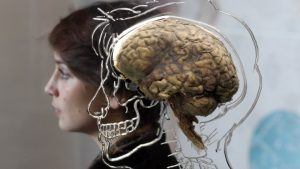 Frank Jacobs, then at the University of California at Santa Cruz, had taken stem cells from humans and monkeys, and coaxed them into forming small balls of neurons. These “organoids” mirror the early stages of brain development. By studying them, Jacobs could look for genes that are switched on more strongly in the growing brains of humans than in those of monkeys. And when he presented his data to his colleagues at a lab meeting, one gene grabbed everyone’s attention.
“There was a gene called NOTCH2NL that was screaming in humans and off in [the monkeys],” says Sofie Salama, who co-directs the Santa Cruz team with David Haussler. “What the hell is NOTCH2NL? None of us had ever heard of it.”
The team ultimately learned that NOTCH2NL appears to be inactive in monkeys because it doesn’t exist in monkeys. It’s unique to humans, and it likely controls the number of neurons we make as embryos. It’s one of a growing list of human-only genes that could help explain why our brains are so much bigger than those of other apes.
More here.
From The Guardian:
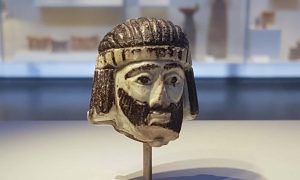 An enigmatic sculpture of a king’s head dating back nearly 3,000 years has left researchers guessing at whose face it depicts.
The 5cm (two-inch) sculpture is an exceedingly rare example of figurative art from the region during the ninth century BC – a period associated with biblical kings. It is exquisitely preserved but for a bit of missing beard, and nothing quite like it has been found before.
While scholars are certain the stern-bearded figure wearing a golden crown represents royalty, they are less sure which king it symbolises, or which kingdom he may have ruled.
More here.
Matthew Boudway interviews Wim Wenders at Commonweal:
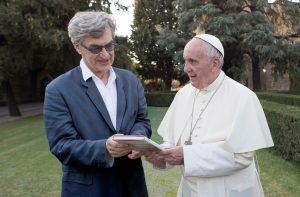 And then again this was, as filmmaking goes, not so different, at least in the impulse behind it, from some of my other films, because my documentaries don’t come out of a critical distance. Other filmmakers make films about something they want to expose or something they want to explore, or something that’s wrong with the world. My documentaries are all about things that I love and they show my affection, my desire to share this with as many people as possible, and that was definitely the case with Pope Francis. I loved this man and what he stood for, so anybody who expects a film that’s critical of the church or its policies is looking for the wrong movie. Already when I was a young film critic (I started as a film critic when I was a student and I earned money for my studies by writing criticism about movies) I refused to write about films I didn’t like. I thought it was not worth my time, or anybody’s time. I really only wrote about films I liked. And in a way that continued in my filmmaking career. I can’t even work with actors I don’t like. I don’t know what to do with them. I don’t know how to film them.
more here.
Matthew Engel at Literary Review:
 Hatherley has a remarkable set of skills: he has the architectural, historical and political knowledge and the literary gifts to make him a worthy successor to the late, great and now rediscovered Ian Nairn – and occasionally some of the passion, too. Unfortunately, it all comes together here only in fits and starts. The main reason for that becomes clear at the end, in the acknowledgements, where he admits that the book is ‘essentially an anthology’. The majority of the chapters – portraits of individual cities – started as articles, published elsewhere, mostly in the Architects’ Journal.
There seems to me to be a helluva difference between writing for architects and appealing to moderately intelligent travellers, anxious to be told what they ought to be thinking but confident enough to disagree.
more here.
Patrick William Kelly at the LARB:
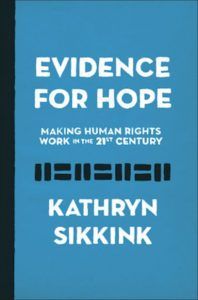 If human rights are to survive our fraught present and endure in the future, it is incumbent upon scholars to adopt a far more critical stance toward the study of human rights than they have so far been willing to do. Of course, academics have responded to the urgency of this crisis in a myriad of ways, and some had warned of the coming catastrophe from the politics of human rights. Despite the assault on human rights, some scholars cling to an uplifting and triumphalist story of the rise of human rights, one that leaves us both unable to understand the present and incapable of navigating the future. In this myth, humanity’s history is rendered as a slow but steady account of progress that will culminate in an Elysium of human rights. Far from helping us make sense of the challenges of our confusing present of human rights, these quixotic quests ransack the past in search of feel-good narratives of moral ascent and stirring stories of “hope” in the future — as if the misrepresentation of the past will magically bring about a brighter future in the name of human rights.
more here.
Kamila Shamsie in The Guardian:
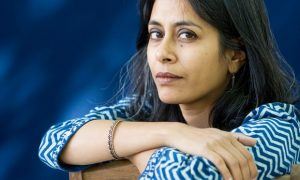 Here is a novel that could so easily have been loud. It is set among large events: the fight for Indian independence and the second world war. It features characters from history who enter the lives of the novel’s fictional characters, often to dramatic effect – the poet Rabindranath Tagore, the singer Begum Akhtar, the dancer and critic Beryl de Zoete and the German painter and curator Walter Spies. It has at its heart a young boy whose mother leaves him to live in another country, and whose father responds to this crisis by also leaving the child for an extended period of time, and who is later imprisoned for his anti-British activism. There are many reasons to turn up the volume dial.
But readers of Anuradha Roy, whose previous novel Sleeping on Jupiter was longlisted for the 2015 Man Booker prize, know that shoutiness or showiness is never her style. She is a writer of great subtlety and intelligence, who understands that emotional power comes from the steady accretion of detail. Amid all the great events and characters of history, she chooses as her narrator a horticulturalist known throughout by his nickname, Myshkin – “a man who chose neither pen nor sword but a trowel”. Myshkin is nine years old when his mother leaves him and his father in the fictitious Indian town of Muntazir, and embarks on a new life with Spies. Muntazir is 20 or so miles from the Himalayan foothills, and its name means, in Urdu, “one who waits impatiently”. After his mother’s departure, Myshkin’s life is spent anxiously waiting – for her letters to arrive, for her to return. In later years, he compares that waiting to “blood being drained away from our bodies until one day there was no more left”. The older Myshkin, a man in his 60s, narrates the story. He is the adult version of the child whose blood drained away, now living quietly, more at home among trees than people. In the course of this deliberately self-contained life, a bulky envelope arrives one day. It has something to do with his mother, he knows, and he cannot bring himself either to open it or to throw it away. Instead, his narration takes us back to his mother’s childhood, and then to his own childhood. He is a man seeking to understand why his mother, Gayatri, made the choice she did – and to this end he delves into the unusual freedom of her adolescence, compared with the rigidity and constraint of her married existence in 1930s India.
More here.
Erin Brodwin in Business Insider:
 Earlier this week, reports linking the blockbuster gene-editing tool CRISPR to cancer in two studies sent investors scrambling to pull out of companies working on the technology, which is being studied for use in everything from food to medicine. The tool’s precise cut-and-paste approach to gene editing allows for a range of promising medical applications, from curing sickle cell anemia to preventing some forms of blindness. On Monday afternoon, headlines suggested that cells edited with the tool were more likely to become cancerous. Within hours of the reports being published, shares of Editas Medicine, CRISPR Therapeutics, Intellia Therapeutics, and Sangamo Therapeutics — all of which are trying to bring CRISPR to medicine — took a significant tumble. But scientists who study CRISPR and other methods of gene editing call the reports “overblown.” They say the link to cancer is tenuous at best and an incorrect interpretation of the results at worst. “This is absurd,” John Doench, the associate director of the genetic perturbation platform at MIT’s Broad Institute, told Business Insider. “There was a massive overreaction here.”
Like many other researchers involved in the space, Doench read the two studieshighlighted in the recent report and published in the journal Nature Medicine. Instead of concluding that the technique causes cancer, Doench read the papers and thought it highlighted facts about how cells behave in response to perceived threats. Most of these are already fairly well-known to people who study gene editing. Tweaking a cell’s DNA is a violent process; when it is done, cells respond by trying to defend or repair themselves. This is one of the biggest hurdles facing most cutting-edge gene editing approaches today. It is not unique to CRISPR. “I’m honestly trying to figure out why this has generated such a response and I really can’t,” Doench said. “Everything I can see is just related to the stocks and finances and not in anyway related to the science.”
More here.
We sit side by side,
brother and sister, and read
the book of what will be, while a breeze
blows the pages over—
desolate odd, cheerful even,
and otherwise. When we come
to our own story, the happy beginning,
the ending we don’t know yet,
the ten thousand acts
encumbering the days between,
we will read every page of it.
If an ancestor has pressed
a love-flower for us, it will lie hidden
between pages of the slow going,
where only those who adore the story
ever read. When the time comes
to shut the book and set out,
we will take childhood’s laughter
as far as we can into the days to come,
until another laughter sounds back
from the place where our next bodies
will have risen and will be telling
tales of what seemed deadly serious once,
offering to us oldening wayfarers
the light heart, now made of time
and sorrow, that we started with.
by Galway Kinnell
from Collected Poems
Houghton Mifflin Harcourt
Parul Sehgal in the New York Times:
 In a famous Hindu parable, three blind men encounter an elephant for the first time and try to describe it, each touching a different part. “An elephant is like a snake,” says one, grasping the trunk. “Nonsense; an elephant is a fan,” says another, who holds an ear. “A tree trunk,” insists a third, feeling his way around a leg.
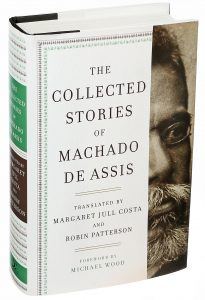
In the Anglophone world, a similar kind of confusion surrounds Joaquim Maria Machado de Assis (1839-1908), the son and sly chronicler of Rio de Janeiro whom Susan Sontag once called “the greatest writer ever produced in Latin America.”
To Stefan Zweig, Machado was Brazil’s answer to Dickens. To Allen Ginsberg, he was another Kafka. Harold Bloom called him a descendant of Laurence Sterne, and Philip Roth compared him to Beckett. Others cite Gogol, Poe, Borges and Joyce. In the foreword to “The Collected Stories of Machado de Assis,” published this month, the critic Michael Wood invokes Henry James, Henry Fielding, Chekhov, Sterne, Nabokov and Calvino — all in two paragraphs.
To further complicate matters, Machado has always reminded me of Alice Munro.
What’s going on here? What kind of writer induces such rapturous and wildly inconsistent characterizations? What kind of writer can star in so many different fantasies?
More here.
Ed Yong in The Atlantic:
 Scheib and her colleagues ultimately analyzed DNA from the remains of 91 people, who lived in California’s Channel Islands and southwestern Ontario, between 200 and 4,800 years ago. And their study both confirms and complicates the existing story of how the Americas were peopled.
The team found evidence of two distinct lines of Native American ancestry, which separated after the Americas were first peopled. These lineages, known as ANC-A and ANC-B, roughly correspond to the southern and northern groups that had been previously identified. ANC-A is the southern branch, and includes Anzick-1 and the Clovis culture. ANC-B is the northern branch, and includes the ancient Ontarians and modern Algonquians. But the split between these groups was neither neat nor absolute. “We kept getting really weird answers and it took a while to figure out what they meant,” Scheib says.
More here.
Anastasia Valassopoulos in the Journal of Postcolonial Writing:
I am looking forward to our discussion here on your latest monograph, Britain Through Muslim Eyes: Literary Representations, 1780−1988. It’s 100,000 words: that’s a very long book! But how long has it taken you to write it?
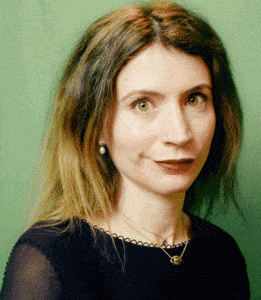 Claire Chambers (CC): In a way this book goes all the way back to the mid-1990s when I’d had a gap year in which I taught English to schoolchildren in Pakistan. I’d been motivated to go to Pakistan because of my experiences growing up in Leeds with many British-Asian friends. I first stayed briefly in a north-western city called Mardan, which was quite conservative. After leaving Mardan, my friend and I went to what seemed to us to be the big smoke of nearby Peshawar, the capital of what was then called the North-West Frontier Province, now Khyber Pakhtunkhwa. This was in 1993−94, not long after Osama bin Laden had left the city in 1990, having made it his home for eight years (Rashid [2000] 2001, 132−133). At that time few Europeans knew about the region. From spending ten months in Peshawar I became aware of tension and volatility stemming from the civil war in nearby Afghanistan, despite the city’s many charms and gracious hospitality. In my book Rivers of Ink(2017), which is a collection of essays, many of which come from the columns I regularly write for the Pakistani national newspaper Dawn, I include a short account of my time in Peshawar.
Thinking back on all this a decade later in the mid-2000s, I realized that my middle-class British-Asian friends and I hadn’t really understood what was going on in our own city.
More here.
Valdas Vasiliauskas at Eurozine:
 During the romantic 19th century, even at the beginning of the 20th, art legends were born in the attics and garrets, preferably Parisian. During the more practical decades of the late 20th century, artists relocated to much more prosaic places, such as the smoke-filled cellars of Liverpool (The Beatles) or the garages and student dormitories of the American West Coast, populated by computer magicians and IT wizards. The great legend of the Lithuanian theatre was born in a warehouse in Vilnius, more specifically, in the section of the Youth Theatre used both as a workshop and a warehouse in which stage decorations were stored. Nowadays, the building – a newly redecorated palace, originally built during the 15th and 17th centuries by the Radziwiłł family – is difficult to recognize and hosts the Museum of Lithuanian Theatre, Music and Cinema. In the 1970s, it was a dilapidated structure, despite the fancy name – Experimental Stage of the Youth Theatre – given to one of its decrepit halls. It was this stage, the most modest among the Lithuanian theatres of the time, that was chosen by Eimuntas Nekrošius for his debut as a theatre director in 1977. Then a student of GITIS, the Lunacharsky State Institute for Theatre Arts in Moscow (renamed the Russian Institute of Theatre Arts in 1991), Nekrošius directed his diploma performance A Taste of Honey (Medaus skonis) with the troupe of the Youth Theatre.
more here.
Sarah Rose Sharp at Hyperallergic:
 “These instructions enact a mimetic play with traditional ‘How-To’ manuals, which allow children to go through the process of making in a systematic way, adhering to tradition, or picking up a vernacular of handiwork,” Gallagher wrote, by way of introducing the book associated with the exhibition, which he characterizes as “a guide for emerging artists, to shepherd them through the process of making.” He added: “This prosthetic and hereditary knowledge, what we gain from those before us in their absence, is the foundation of how we understand the spaces we occupy.”
The resulting show, presented at Holding House over the weekend of June 9, and next headed for a second installation of selected works at a new gallery space in Detroit’s Southwest neighborhood, is extremely interdisciplinary and wide-ranging. Some of the proffered instructions are hilariously simple, like ‘parent’ Jayson Bimber’s instructions to Austin Brady to “Make an art.”
more here.
Michael Caines at the TLS:
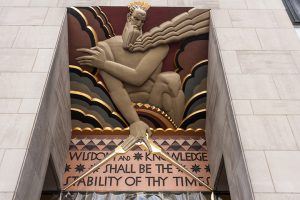 When William Blake was four years old, he saw God press his head up against the window; the poor boy was set “a-screaming”. “Sauntering along” a few years later, Blake saw – and not for the last time – “a tree filled with angels, bright angelic wings bespangling every bough like stars”. Just before he died, in 1827, “his countenance became fair, his eyes brightened, and he burst out into singing of the things he saw in heaven”. Such was the visionary life of the writer and artist, as recorded by the fond few who had paid him any attention.
Blake’s obscurity in his own lifetime has become one of the well-known facts about him. As has his mystic eccentricity. When stories such as those above began to emerge, they helped to foster the myth of an odd kind of sage.
more here.
Why does this written doe bound through these written woods?
…………………………………………………………….. —Wisława Szymborska
My handwriting is all over these woods.
No, my handwriting is these woods,
each tree a half-print, half-cursive scrawl,
each loop a limb. My house is somewhere
here, & I have scribbled myself inside it.
What is home but a book we write, then
read again & again, each time dog-earing
different pages. In the morning I wake
in time to pencil the sun high. How
fragile it is, the world—I almost wrote
the word but caught myself. Either one
could be erased. In these written woods,
branches smudge around me whenever
I take a deep breath. Still, written fawns
lie in the written sunlight that dapples
their backs. What is home but a passage
I’m writing & underlining every time I read it.
by Maggie Smith
from the Academy of American Poets
Donovan Hohn in Lapham’s Quarterly:
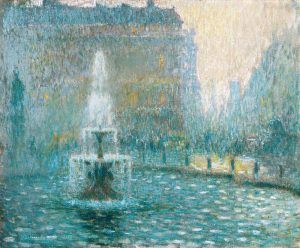
These days I live in southeast Michigan, which is to say I dwell in a watershed of paradox. Here we are, at the edge of the Great Lakes, which together contain 84 percent of North America’s and 20 percent of the world’s accessible freshwater. The Great Lakes are puddles of glacial melt. Rainfall and tributaries contribute only 1 percent of their total volume. Much of the rest is “fossil water,” sequestered from the water cycle since the last ice age. Under a recently issued state permit, the Nestlé corporation, a major purveyor of bottled water, can now draw up to four hundred gallons of Michigan groundwater per minute for just two hundred dollars a year. And yet in Flint, people now regard their faucets with warranted suspicion, and in Detroit, whose water treatment plant would have spared the people of Flint from mass poisoning, the water company has been turning the spigots off, letting their delinquent customers go thirsty or purchase bottled water from Nestlé.
Two years ago, during the federal emergency in Flint, I spent some time in the city following a team of civil engineers conducting an investigation. I watched as contractors excavated a residential street, extracting a service line from under the asphalt. The line—a few dozen yards of copper pipe—was evidence at a crime scene, and the scientists labeled it with forensic care. Looking at it coiled on a sun-dappled lawn, dirt still clinging to the copper, I experienced a feeling that I later recognized as disenchantment. What I couldn’t get over was how small the pipe’s diameter was: three-quarters of an inch. This was it? The source of the everyday magic?
For most of my life, running water had been one of those technologies, like the telephone or electric light, that I took for granted. Where the water came from and where it went when it gurgled down the drain were both mysteries that I’d only rarely wondered about. Living in the age of indoor plumbing is a bit like living beside a stream whose headwaters and mouth are distant rumors. The waterworks of wealthy nations, or at least those of certain zip codes, are a kind of man-made River Lethe. In imperial Rome the aqueduct was a public monument as well as an engineering feat. Buried underground, our own aqueducts invite forgetting. In New York City the subterranean water tunnels constitute, writes David Grann, “a city under the city,” one that few New Yorkers know about, let alone ever see.
More here.