
Ed Yong in The Atlantic:
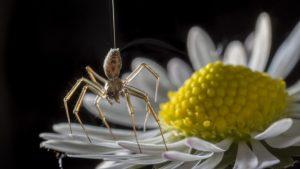 Spiders have no wings, but they can take to the air nonetheless. They’ll climb to an exposed point, raise their abdomens to the sky, extrude strands of silk, and float away. This behavior is called ballooning. It might carry spiders away from predators and competitors, or toward new lands with abundant resources. But whatever the reason for it, it’s clearly an effective means of travel. Spiders have been found two-and-a-half miles up in the air, and 1,000 miles out to sea.
It is commonly believed that ballooning works because the silk catches on the wind, dragging the spider with it. But that doesn’t entirely make sense, especially since spiders only balloon during light winds. Spiders don’t shoot silk from their abdomens, and it seems unlikely that such gentle breezes could be strong enough to yank the threads out—let alone to carry the largest species aloft, or to generate the high accelerations of arachnid takeoff. Darwin himself found the rapidity of the spiders’ flight to be “quite unaccountable” and its cause to be “inexplicable.”
More here.
 The starkest example of the many racist and anti-poor measures directed at African Americans and passed during his administration was the 1996 welfare reform bill, which transformed welfare from an exclusive and unequal cash assistance system that stigmatized its recipients into one that actually criminalized them.
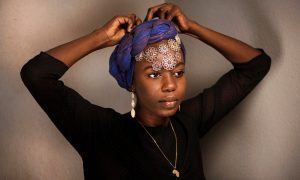 Emtithal Mahmoud was brimming with rage and misery when she sat down to write her poem Mama. Her grandmother had just died in
 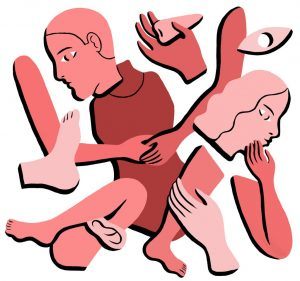 In the 12 wide-ranging stories of her latest collection, “Days of Awe,” A. M. Homes skillfully circles and tugs at the question of what it means to live in flawed, fragile, hungry human bodies. One character embeds rose thorns in her feet; several have very disordered eating habits; people die too young, go to war and hold in their cells and minds the memories of past trauma. The title story is about a war reporter and a novelist who meet at a conference on genocide and have a weekend affair. Here the body is death — the millions killed who haunt the conference attendees — but it’s also desire. The affair is vivid and real and yet there is a shard of violence in it, the everyday violence of two people using each other to counter pain they don’t know how to digest.
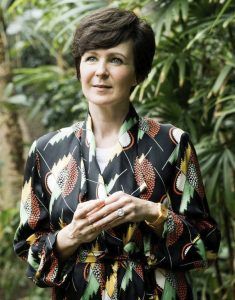 At the age of 39 I was fairly sure I would spend the rest of my life alone. I lived alone, I worked alone. No matter what I did, or who I dated, I didn’t seem to be able to find the relationship I longed for.
 If the ICS [International Commission on Stratigraphy] declares the Anthropocene as a new epoch, it will reverse at one stroke three great humiliations science has inflicted on humanity. First, it will restore humanity to the self-importance it knew when people believed that the Earth and humanity were created at about the same time. The Anthropocene, as Erle Ellis and colleagues have written, “will divide Earth’s story into two parts: one in which humans are a geological superpower — an epoch called the Anthropocene — and the other encompassing all that came before our species had a major influence on Earth’s functioning.”
 “Democracies erode slowly, in barely visible steps” these days, Steven Levitsky and Daniel Ziblatt write in
  The tropics are, like many cities, hot, busy and crowded. It was previously thought
 Fireworks, hypnotic and sublime, are used to celebrate national independence around the globe, as signs of sovereignty or political autonomy. They are the window dressing of the modern state. The exploding rainbows are a tribute to the bloody wars that made the celebration possible. They are a reminder that—under that same sky and upon that same land to which the ashes float—we are kinfolk.
 We are living in new Bayesian age. Applications of Bayesian probability are taking over our lives. Doctors, lawyers, engineers and financiers use computerized Bayesian networks to aid their decision-making. Psychologists and neuroscientists explore the Bayesian workings of our brains. Statisticians increasingly rely on Bayesian logic. Even our email spam filters work on Bayesian principles.
 In
In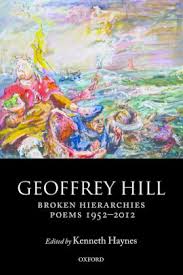 As many critics have noted, Hill established himself from the beginning as an elegist. The title For the Unfallen promises a
memorial for the living, and the book itself contains “
As many critics have noted, Hill established himself from the beginning as an elegist. The title For the Unfallen promises a
memorial for the living, and the book itself contains “ Laura Ingalls Wilder
 Like many women, Baskin was buying things that male dealers weren’t interested in, such as women printers and artists, which put her under the radar. “In the sixties, I could be a ferret and find things,” she said, citing a late 17th century-early 18th century book by Maria Sibylla Merian, the first person of either gender to observe and draw the metamorphoses of insects in the field. “She made some of the most beautiful books,” Baskin said. “As a child, Merian was fascinated by watching caterpillars turn into moths. She made a book about the insects of Suriname and another about the insects of Europe.” Baskin purchased a copy of Merian’s De Europische Insecten (1730); copies of the book about the insects of Suriname go for hundreds of thousands of dollars now. “The issue is: Are women taken seriously as dealers and as collectors? I don’t think it’s a reflection on the works they sell or collect. I think these works were, and are, valued less,” says Baskin. She mentions J.P. Morgan’s (d. 1913) great Morgan Library, whose collection—of books by both men and women—was largely acquired by its director and librarian Belle da Costa Greene, daughter of the first African American to graduate from Harvard. “It was said that da Costa Greene had the brains and the wit and Morgan had the money,” Baskin says.