
Mural with HUD Housing and Schoolbus
When 213b finally opens in a crack of yellow linoleum,
Garrett comes out with the left side of his afro as flat
as the tire that used to be on his mom’s car & the stuck
snick of the cheap door locking behind him sounds exactly
like someone trying to light a smoke with an empty lighter.
Carriage House East, where menthols cough like a window
slamming shut & outside that window, somebody’s radio
is already popping static. What’s left of the moon is popping
white on blue. That’s when we stamp past the squat HUD
brick toward school in the dark: shadow of the green trash
can gang signed with misspellings, a mimeograph of Mickey
Mouse flipping Iran the bird in the landlord’s lit window.
We made the same middle-finger motion to the school bus
before ignoring our bus stop & kept walking neighborhood-
style—right hands skimming from chest down to waist
then behind the back like a bad breast-stroker cupping air.
Cue the sirens snagging the matted air like a cheap pick.
Cue the smoker’s cough of early-morning walks to school.
We strutted a backward lean like every one of the unconcerned
streetlamps alternating between our side of the street
& over there—in front of the fenced-in porches missing slats
like teeth in a punched smile where Garrett’s cousin leaned
against the side of one of the front buildings. She put
two-fingered guns to her temples when she saw us: red patch
of smoker’s skin around her mouth like a raw sun rising.
by Adrian Matejka
from poets.org
 In spite of the obsession with Soros, there has been surprisingly little interest in what he actually thinks. Yet unlike most of the members of the billionaire class, who speak in platitudes and remain withdrawn from serious engagement with civic life, Soros is an intellectual. And the person who emerges from his books and many articles is not an out-of-touch plutocrat, but a provocative and consistent thinker committed to pushing the world in a cosmopolitan direction in which racism, income inequality, American empire, and the alienations of contemporary capitalism would be things of the past. He is extremely perceptive about the limits of markets and US power in both domestic and international contexts. He is, in short, among the best the meritocracy has produced.
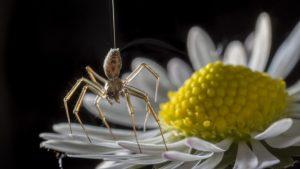 Spiders have no wings, but they can take to the air nonetheless. They’ll climb to an exposed point, raise their abdomens to the sky, extrude strands of silk, and float away. This behavior is called ballooning. It might carry spiders away from predators and competitors, or toward new lands with abundant resources. But whatever the reason for it, it’s clearly an effective means of travel. Spiders have been found two-and-a-half miles up in the air, and 1,000 miles out to sea.
 The starkest example of the many racist and anti-poor measures directed at African Americans and passed during his administration was the 1996 welfare reform bill, which transformed welfare from an exclusive and unequal cash assistance system that stigmatized its recipients into one that actually criminalized them.
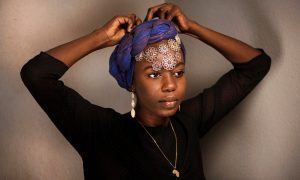 Emtithal Mahmoud was brimming with rage and misery when she sat down to write her poem Mama. Her grandmother had just died in
 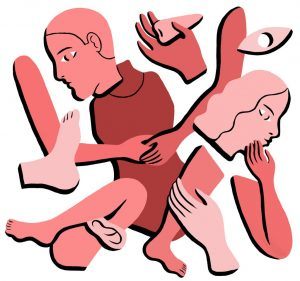 In the 12 wide-ranging stories of her latest collection, “Days of Awe,” A. M. Homes skillfully circles and tugs at the question of what it means to live in flawed, fragile, hungry human bodies. One character embeds rose thorns in her feet; several have very disordered eating habits; people die too young, go to war and hold in their cells and minds the memories of past trauma. The title story is about a war reporter and a novelist who meet at a conference on genocide and have a weekend affair. Here the body is death — the millions killed who haunt the conference attendees — but it’s also desire. The affair is vivid and real and yet there is a shard of violence in it, the everyday violence of two people using each other to counter pain they don’t know how to digest.
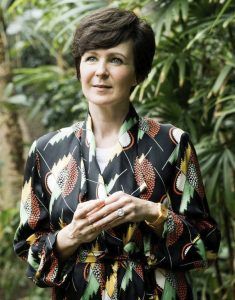 At the age of 39 I was fairly sure I would spend the rest of my life alone. I lived alone, I worked alone. No matter what I did, or who I dated, I didn’t seem to be able to find the relationship I longed for.
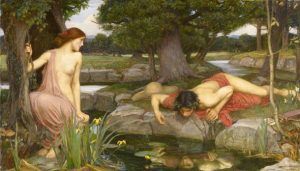 If the ICS [International Commission on Stratigraphy] declares the Anthropocene as a new epoch, it will reverse at one stroke three great humiliations science has inflicted on humanity. First, it will restore humanity to the self-importance it knew when people believed that the Earth and humanity were created at about the same time. The Anthropocene, as Erle Ellis and colleagues have written, “will divide Earth’s story into two parts: one in which humans are a geological superpower — an epoch called the Anthropocene — and the other encompassing all that came before our species had a major influence on Earth’s functioning.”
 “Democracies erode slowly, in barely visible steps” these days, Steven Levitsky and Daniel Ziblatt write in
  The tropics are, like many cities, hot, busy and crowded. It was previously thought
 Fireworks, hypnotic and sublime, are used to celebrate national independence around the globe, as signs of sovereignty or political autonomy. They are the window dressing of the modern state. The exploding rainbows are a tribute to the bloody wars that made the celebration possible. They are a reminder that—under that same sky and upon that same land to which the ashes float—we are kinfolk.
 We are living in new Bayesian age. Applications of Bayesian probability are taking over our lives. Doctors, lawyers, engineers and financiers use computerized Bayesian networks to aid their decision-making. Psychologists and neuroscientists explore the Bayesian workings of our brains. Statisticians increasingly rely on Bayesian logic. Even our email spam filters work on Bayesian principles.
 In
In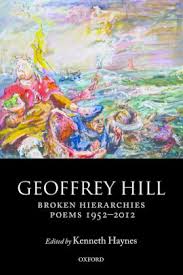 As many critics have noted, Hill established himself from the beginning as an elegist. The title For the Unfallen promises a
memorial for the living, and the book itself contains “
As many critics have noted, Hill established himself from the beginning as an elegist. The title For the Unfallen promises a
memorial for the living, and the book itself contains “ Laura Ingalls Wilder