
by Christopher Bacas
Because we remained so long in Housing Court’s trash-strewn orbit, Management assigned us our own agent. Every week, I saw Hassidim in our lobby. One was bigger than the others, with a jellied midsection spilling over pants, bowing his long black lapels. He moved like a man barely acclimated to walking; legs chugging ahead, thighs rubbing, wisps of beard waving cilia-like from his jowls.
To introduce our new handler, Matthew, the property manager, came by. He was a small man who always spoke quickly, words folding back on each other, nervous laughter erasing their authority.
“This is Jo-El. He doesn’t work for me (chuckle, chuckle), the landlord brought him on to work with the building.”
In fact, our landlord’s name was posted on a public list of “New York’s Worst Landlords”. I submitted the open violations in our building to the Public Advocate and within days, his name appeared. The new arrangement was designed to get the owner off that embarrassing list. Jo-El wasn’t a lawyer by training, he was a fixer. His fixing kept broken things broken.
We shook hands. Jo-El didn’t smile. He pressed his lips together and looked down. Read more »
 It turns out you learn a lot when you write a book. This may seem counterintuitive. Perhaps you think, “Well, that’s dumb. If you write a book about something you should already be an expert on it.”
  When we were teaching at Stanford in the late 2000s, the terms “techie” and “fuzzy” became cultural touchstones: The “techies” majored in engineering and the sciences, the “fuzzies” in arts and the humanities. Faculty and administrators deplored those words, and students furiously debated them, but the terms — and the split they describe —
 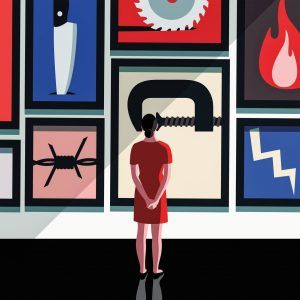 For scientists, pain has long presented an intractable problem: it is a physiological process, just like breathing or digestion, and yet it is inherently, stubbornly subjective—only you feel your pain. It is also a notoriously hard experience to convey accurately to others. Virginia Woolf bemoaned the fact that “the merest schoolgirl, when she falls in love, has Shakespeare or Keats to speak her mind for her; but let a sufferer try to describe a pain in his head to a doctor and language at once runs dry.” Elaine Scarry, in the 1985 book “The Body in Pain,” wrote, “Physical pain does not simply resist language but actively destroys it.”
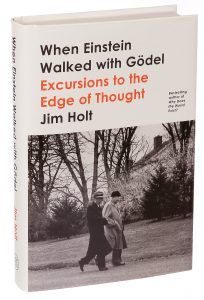 “My ideal is the cocktail-party chat,” [Jim Holt] writes in the preface to his new essay collection, “When Einstein Walked with Gödel,” “getting across a profound idea in a brisk and amusing way to an interested friend by stripping it down to its essence (perhaps with a few swift pencil strokes on a napkin). The goal is to enlighten the newcomer while providing a novel twist that will please the expert. And never to bore.”
 In 1997, when Dani Rodrik, a Turkish-born professor at Harvard’s Kennedy School of Government, published his brief book Has Globalization Gone Too Far?, progressive economists widely embraced his arguments that many free trade policies adopted by the US, which reduced tariffs and other protections, also weakened the bargaining power of American workers, destabilized their wages, and encouraged social conflict. “The danger,” Rodrik wrote presciently, “is that the domestic consensus in favor of open markets will ultimately erode to the point where a generalized resurgence of protectionism becomes a serious possibility.” I remember that Robert Kuttner, the coeditor of The American Prospect, was particularly enthusiastic about the book. Almost twenty years later, he again praised Rodrik for his continued devotion to an empirically grounded skepticism of what Rodrik now calls “hyperglobalization.”
 Novelist, poet, and essayist
 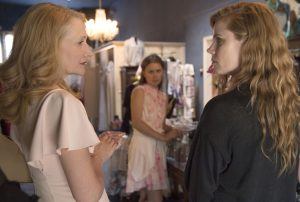 Some nightmares, the worst ones, move so slowly that you don’t wake up from them right away. The terror feels normal, even though you may know something’s not right. It’s a usual sort of bad feeling, typical enough to fool the mind into believing that you may be awake. That is, until the monster shows up. Only then does the brain recognize it is inside something that isn’t real. “Sharp Objects,” HBO’s latest limited series from “Dietland” creator Marti Noxon and Jean-Marc Vallée, and based on a novel by Gillian Flynn (“Gone Girl”), reproduces that sensation throughout the seven of its eight episodes that were provided for review.
 ON JUNE
  In spite of the obsession with Soros, there has been surprisingly little interest in what he actually thinks. Yet unlike most of the members of the billionaire class, who speak in platitudes and remain withdrawn from serious engagement with civic life, Soros is an intellectual. And the person who emerges from his books and many articles is not an out-of-touch plutocrat, but a provocative and consistent thinker committed to pushing the world in a cosmopolitan direction in which racism, income inequality, American empire, and the alienations of contemporary capitalism would be things of the past. He is extremely perceptive about the limits of markets and US power in both domestic and international contexts. He is, in short, among the best the meritocracy has produced.
 Spiders have no wings, but they can take to the air nonetheless. They’ll climb to an exposed point, raise their abdomens to the sky, extrude strands of silk, and float away. This behavior is called ballooning. It might carry spiders away from predators and competitors, or toward new lands with abundant resources. But whatever the reason for it, it’s clearly an effective means of travel. Spiders have been found two-and-a-half miles up in the air, and 1,000 miles out to sea.
 The starkest example of the many racist and anti-poor measures directed at African Americans and passed during his administration was the 1996 welfare reform bill, which transformed welfare from an exclusive and unequal cash assistance system that stigmatized its recipients into one that actually criminalized them.
 Emtithal Mahmoud was brimming with rage and misery when she sat down to write her poem Mama. Her grandmother had just died in
 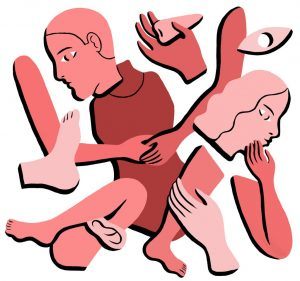 In the 12 wide-ranging stories of her latest collection, “Days of Awe,” A. M. Homes skillfully circles and tugs at the question of what it means to live in flawed, fragile, hungry human bodies. One character embeds rose thorns in her feet; several have very disordered eating habits; people die too young, go to war and hold in their cells and minds the memories of past trauma. The title story is about a war reporter and a novelist who meet at a conference on genocide and have a weekend affair. Here the body is death — the millions killed who haunt the conference attendees — but it’s also desire. The affair is vivid and real and yet there is a shard of violence in it, the everyday violence of two people using each other to counter pain they don’t know how to digest.
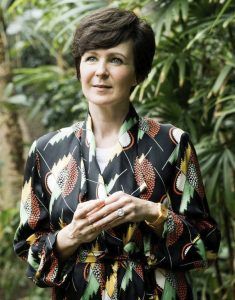 At the age of 39 I was fairly sure I would spend the rest of my life alone. I lived alone, I worked alone. No matter what I did, or who I dated, I didn’t seem to be able to find the relationship I longed for.