
Jonathan Tran at The Marginalia Review of Books:
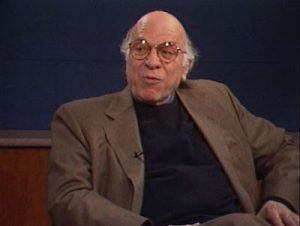 Inasmuch as he had a specialization, Cavell’s was our human life in words and he, along with Cora Diamond and James Conant, is credited with giving second life to a hitherto expiring mode of thought known as ordinary language philosophy. Cavell was fascinated by how language proves constitutive of what it means to be human, and was further fascinated by how much we humans want to deny that—probably, he thought, because of what the implications would demand of us. In a characteristically exquisite passage from the legendary fourth part of The Claim of Reason, Cavell wrote, “There is no assignable end to the depth of us to which language reaches; that nevertheless there is no end to our separateness. We are endlessly separate, for no reason. But then we are answerable for everything that comes between us; if not for causing it then for continuing it; if not for denying it then for affirming it; if not for it then to it.”
There is an emancipatory tone to Cavell’s writing, licensing in his readers intellectual possibilities they did not know existed. The somewhat religious devotion of his academic followers, including the many religious ones, can in part be explained by how his work reconciles them to the impulses that drove them to take up teaching and writing in the first place.
more here.
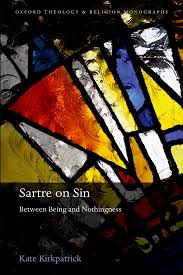 Kate Kirkpatrick’s provocative interdisciplinary study argues that Sartre’s conception of nothingness in Being and Nothingness (BN) can be fruitfully understood as an iteration of the Christian doctrine of original sin, “nothingness” being synonymous with sin and evil in the Augustinian tradition. Hence, Sartre in BN presents us with “a phenomenology of sin from a graceless position” (10). For readers used to understanding Sartre through the lens of German phenomenology, this will come as a surprise. However, the book should be welcomed by all readers as it breathes life into the field of Sartre studies, offering a fresh perspective from which to judge the magnum opus of French existentialism.
 W
W As we commence celebrating July 4th with the time-honored traditions of beer, block parties and cookouts, it’s fun to imagine a cookout where the Founding Fathers gathered around a grill discussing the details of the Declaration of Independence. Did George Washington prefer dogs or burgers? Was Benjamin Franklin a ketchup or mustard guy? And why did they all avoid drinking water?
 A striking show of sculpture from 14th century Europe to the present,
 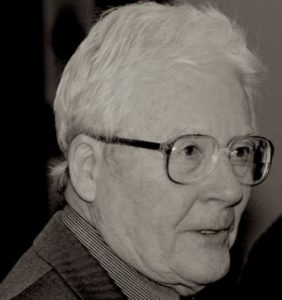 I WAS TOLD by Stephan Harding that “if there was the slightest chance of a cold, we will have to cancel. He had bronchitis not long ago; we can’t afford to take any risks.” But, despite the Arctic cold that had descended on England in February, I wasn’t coughing or anything, so we decided to embark. Nevertheless, we took the precaution of washing our hands carefully with antiseptic soap a few times. And then we were off for the coast of Dorset, in the south of England, in the direction of Cornwall.
 One summer night, when I was a child, my mother and I were scouring the night sky for stars, meteors, and planets.
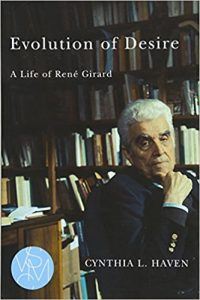 Cynthia L. Haven’s “Evolution of Desire: A Life of René Girard” is the first full-length biography of the acclaimed French thinker. Girard’s “mimetic theory” saw imitation at the heart of individual desire and motivation, accounting for the competition and violence that galvanize cultures and societies. “Girard claimed that mimetic desire is not only the way we love, it’s the reason we fight. Two hands that reach towards the same object will ultimately clench into fists.”
 At a book reading in Kolkata, about a week after my first novel,
  Born to an Ashkenazi Jewish father and mother of Irish and German descent, science and heredity has long fascinated Carl Zimmer.
 Cavell, rather than being the type of all college professors, turned out to be unique. His tutelage at that time seemed the big experience of my life, and I can’t say that it wasn’t, even now. I was afraid of him, personally—afraid, I mean, of damaging the relation by something personal. I went in later years to his lectures on aesthetics, attended his screenings of operas and films, tried to focus on sessions on Wittgenstein, on language and epistemology.
 In July of 2008, as a national broadcast correspondent, I reported on environmental conditions in Newtok, a remote community of roughly 400 Yup’ik people in Northwest Alaska. Newtok was losing forty to a hundred feet of coastline a year to erosion, and sinking because of “permafrost” that is no longer permanent, the direct result of a warming climate. Flooding threatened homes, the school, and the only supply of clean water. I chose to report on Newtok because the community was actively working on a relocation plan after voting to move to higher, more stable ground. My story compared the actions of Newtok with Kivalina, an Inupiaq community of the same size situated on a barrier island further north. Kivalina faced similar conditions and had filed suit that same year against ExxonMobil Corp. for damages caused by climate change.
 Old houses are full of holes. Creatures sneak into the living room. A summer ago, a garter snake entered and slithered across my living room. I stepped on its head and threw it outside. The same year, I discovered a visitor who became my favorite for persistence. A chipmunk took up residence and remained on the first floor for two or three months. Every day I would hear chirping, at first sounding like an electronic signal. Then the chipmunk came into sight, pausing with its paws tucked or folded before it, I suppose sustained by my cat’s kibble and water. As for my cat, she stared at it intently, fascinated. My housekeeper, Carole, bought a tiny Havahart trap and baited it with whatever we imagined was a chipmunk treat. Every morning the bait was gone, but so was the chipmunk. One morning the creature skittered from the kitchen into the toolshed, where the door showed a wide space at its bottom, and never appeared again. I felt abandoned. When autumn descended into winter, I walked into the cluttered dining room, never used in old age, and smelled something rotten in a box of unsorted snapshots. Under a layer of pictures I found the small body of our chipmunk. It had not escaped after all. With a paper towel I picked it up, rigid and almost weightless, and threw it from the door as far as I could. Next morning when I opened the door to pick up the newspaper, half of his small mummified corpse lay beside the door.
 Books are so intimate, somehow, and perhaps this is one reason why so many of the current glut of reading memoirs leave me cold. Even as they strain for this sense of disclosure – don’t you feel like this, too? they ask – their tone is proprietorial, hellbent on exceptionality (I love the Brontës even more than you). You would, I think, accept this from a lover, but not from a writer you’ve never met – unless, I will now add, that writer happens to be Edmund White, the tone of whose new book, The Unpunished Vice: A Life of Reading, quite often resembles the gentle whisper of a sweetheart. Ownership, you see, is not at all his style. In fact, he doesn’t claim always to understand the books that he loves most. “I’ve read it 10 times, though I’m none the wiser for it,” he writes of
  Since 1900, average life expectancy around the globe