
Sudhir Hazareesingh at the TLS:
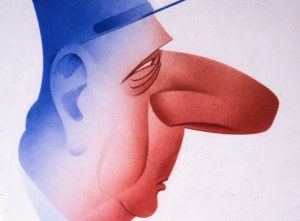 There can be few more compelling subjects for a biography than Charles de Gaulle, the modern symbol of French grandeur. During his remarkable political career, he twice rescued his country from disaster: first through his bold leadership of the Resistance after France’s defeat by the Nazis in 1940, and later by his skilful handling of the crisis provoked by the Algerian war of national liberation. As the founder of the Fifth Republic in 1958, he redesigned France’s political system along presidential lines, and his shadow has loomed heavily over all his successors (on his official photograph, Emmanuel Macron’s most prominent talisman is an open copy of de Gaulle’s War Memoirs). Once reviled by liberals and progressives for his authoritarianism, and by the extreme Right for his anti-fascism and anti-colonialism, de Gaulle is now celebrated by the entire French political class. Indeed, le grand Charles has become the nation’s most revered historical figure, with thousands of streets, schools and public squares across France bearing his name. His vision of Frenchness has reshaped his compatriots’ sense of their collective self, and of their country’s rightful place in the world. To understand de Gaulle, in sum, is to appreciate what it means to be French, both intellectually and emotionally.
more here.
 Eric Lundgren, the 33-year-old, fedora-wearing CEO of a major electronic waste recycling plant in Los Angeles, could be called both the Elon Musk and the Edward Snowden of e-waste. Elon Musk because in 2017 he built an electric car out of recycled batteries that broke the world record for electric vehicle range. Edward Snowden because he’s currently serving a prison sentence for copyright infringement, as a result of printing 28,000 Windows restore disks to be distributed with repaired computers. Lundgren’s court case and electronic creations have made him an icon for the Right to Repair Movement and e-waste reuse.
 At the time my wife and I were beginning to date, I owned a broken bed. The box spring had a biggish crack on one side, which caused you to feel like you were being gradually swallowed in the night—an effect seriously exacerbated by the presence of a second person. I had not bothered to buy pillows when I moved to Milwaukee, reasoning that old pants stuffed in a pillowcase could not possibly feel that different. I did, however, have a desk, which I had carried from the Salvation Army, a mile and a half, on my shoulders, in August. I should mention here that I have never been what anyone would consider macho. It simply hadn’t occurred to me that I was allowed to live any other way.
 In a recent Nature Sustainability
  On 3 May, at around 4.45pm, a short, trim Indian man walked quickly down London’s Old Compton Street, his head bowed as if trying not to be seen. From his seat by the window of a nearby noodle bar, Anuvab Pal recognised him instantly. “He is tiny, and his face had been all over every newspaper in
  For the first full episode of Mindscape, it’s an honor to welcome social psychologist Carol Tavris. Her book with co-author Eliot Aronson,
 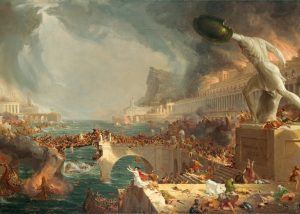 If these paintings were all about the inherent self-destructiveness of man, Cole was just as concerned with the fate of nature. He took a break from painting The Course of Empire to work on a large allegorical landscape called View from Mount Holyoke, Northampton, Massachusetts, after a Thunderstorm – The Oxbow (1836). It is no mere view: the left-hand side of the picture shows wild, wooded hilltops under a lowering sky while the right-hand side shows the tight bend of the oxbow river and a vista of carefully tended fields bathed in sunlight.
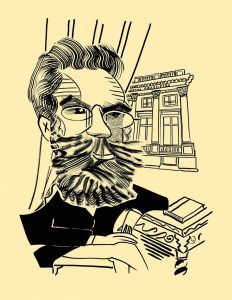 Whichever your take, the narrative abides: Modernity, thus understood, is an age of rationalism, science, and technology that eventually (and inevitably) overcame the mysterious wonders of magic, religion, and superstition. But this story, Josephson-Storm argues, is a myth. Why else, he suggests, would an esteemed scientist like Curie be cavorting with the likes of Palladino?
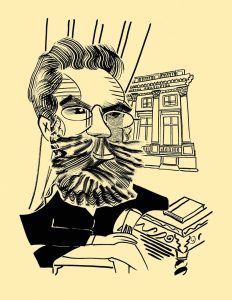 Machado “had a half dozen gestures, habits, and pat phrases,” an early biographer, Lúcia Miguel Pereira, wrote, in 1936. He avoided politics. He was an ideal husband. He spent his free time at the bookshop. And, in founding the Academy of Letters, he brought an administrative structure to literature.
 In 1967 British biologist and Nobel laureate Sir Peter Medawar famously characterized science as, in book title form, The Art of the Soluble. “Good scientists study the most important problems they think they can solve. It is, after all, their professional business to solve problems, not merely to grapple with them,” he wrote. For millennia, the greatest minds of our species have grappled to gain purchase on the vertiginous ontological cliffs of three great mysteries—consciousness, free will and God—without ascending anywhere near the thin air of their peaks. Unlike other inscrutable problems, such as the structure of the atom, the molecular basis of replication and the causes of human violence, which have witnessed stunning advancements of enlightenment, these three seem to recede ever further away from understanding, even as we race ever faster to catch them in our scientific nets.
 Immigrant life easily slips into melodrama. A whiff of blood sausage has me tearfully recalling the evenings when my grandmother cooked it for me. An unexpected “cześć,” or hello, overheard between two fellow Poles immerses me in involuntary memories, as I mourn greetings I shared with high school friends. I never actually liked blood sausage, or high school, and had rejoiced to leave them behind when I moved here. But for a moment, my unconscious fools me, and these recalled sensations compose themselves into a Hallmark card.
 From the start, the people of Flint, Mich., knew something was wrong with the water coming out of their taps — it was brown and orange, visibly full of particles, frothy and foul-smelling. Their hair started falling out, and showers left their bodies burning with red welts. Their plants and pets began to die. On a hot day, children playing in the spray of a water hydrant were streaked with coffee-colored liquid.
 Biased education poisons minds. The curriculum, textbooks, teachers and exams all act to create an ‘us’ versus ‘them’ mentality. Islam is shown as under siege by the evil West as well as India. And then there’s the electronic and print media – mostly privately owned – which drips with piety and with conspiracy theories that attribute all our ills to India, Israel and the United States. It seizes upon their every fault and then multiplies by ten. So a mindset is created wherein young people imagine that they, and their religion, are beset by enemies lurking behind every bush. The West is excoriated for being selective and hypocritical – which it surely is. But there’s no introspection, no explanation for how we went wrong. Ask a student why East Pakistan broke off to become Bangladesh and you’ll get the pat answer: it was a Hindu conspiracy. They won’t know of the genocide West Pakistan carried out there in 1971.
 In 1973, a 22-year-old named Jonathan Richman wrote a letter to the editor of Creem. The Detroit magazine, which started in 1969 when both New Journalism and the archetype of the music critic were solidifying in the consciousness of American counterculture, was an iconic purveyor of rock ‘n’ roll criticism and culture. It had recently run a short, positive notice about Richman’s band, the Modern Lovers, whose fast, angry guitar music had given them a reputation in their native Boston. With its signature hopscotch of irony and humor, Creem synthesized the Lovers’ sound: “More than a little like a teenage Velvet Underground.” The magazine called one of their songs, “a guaranteed hit single” and another, “possibly the next national anthem.” Creem’s kidding aside, by most metrics, the Modern Lovers were in a good place in 1973. John Cale, legendary member of the Velvet Underground, was producing the Lovers’ debut album for Warner Brothers when their singer decided to write a letter to Creem.
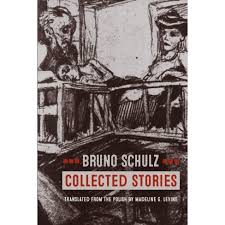 Lovers of a spare prose style, not to mention tight plotting, may be disappointed by Bruno Schulz:
 To read a novel by D. H. Lawrence is to acquire – not always without resistance – a language of the feelings that is new to us: words we thought we knew well already are made to work in unexpected ways, locating places in the human heart we didn’t know existed, even changing what we understand by human nature. What else, we now ask, were those words ever for? To read Henry James is to inhabit an unaccustomed grammar of thought. Some readers find James’s style tortuous; but those snaking parentheses sharpen our wits; without them we will not keep up with the moral quandaries and vacillations of his characters. They are markers, not just of our penetration, but of our emotional largesse. We are inclined to believe it’s the characters in a novel that extend our sympathies. “We are all of us born in moral stupidity”, George Eliot tells us, whereupon, chastened, we practise acts of reflective empathy on Mr Casaubon. But it is truer to say that it is first of all a novel’s language – its syntactical orchestration of our thinking and feeling faculties – that enables us to go where George Eliot wants us to go, to conceive another person’s equivalence of self with what she rather wonderfully calls “that distinctness which is no longer reflection but feeling”.
 T
T