
Omar Waraich in The Atlantic:
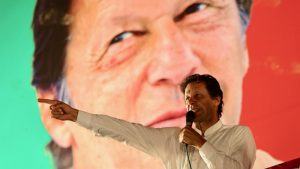
At long last, Imran Khan is the prime minister of Pakistan. After winning the highest number of seats in parliament in this week’s election, the former cricket legend and philanthropist is now set to form a national government and possibly rule two of Pakistan’s four provinces, making him the country’s most powerful civilian leader in decades. It’s a remarkable reversal of fortunes for Khan, who for decades was mocked by his opponents as a naïve, inexperienced celebrity keen to perpetuate his own fame. Khan, however, remained determined. “I always fight till the last ball,” he told me a few years ago.
Khan won a special place in Pakistani hearts in 1992, when he led the national cricket team to victory at the World Cup. In a country where passions for cricket can reach near-religious fervor, the cricket team is seen as a metaphor for the government: full of rarely realized potential, but thwarted by poor leadership and appalling greed. After the World Cup, and Khan’s retirement, there were lurid allegations of ball-tampering and match-fixing. The sporting heroes were reduced to the status of grasping politicians. Khan’s fans wistfully recalled the glory days of his captaincy; now they hope he can do the same for the country.
More here.
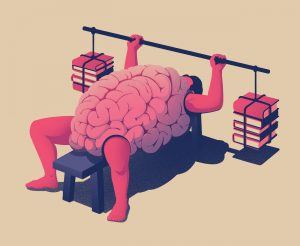 This is a story about a book that just kept selling, catching publishers, booksellers and even its author off guard. In seeking to understand the reasons for the book’s unusually protracted shelf life, we uncover important messages about our moment in history, about the still-vital place of reading in our culture, and about the changing face of publishing. The book is
  The suffragist heroes Elizabeth Cady Stanton and Susan B. Anthony seized control of the feminist narrative of the 19th century. Their influential history of the movement still governs popular understanding of the struggle for women’s rights and will no doubt serve as a touchstone for commemorations that will unfold across the United States around the centennial of the 19th Amendment in 2020.
 Plants could soon provide our electricity. In a small way they already are doing that in research labs and greenhouses at project Plant-e — a university and commercially sponsored research group at Wageningen University in the Netherlands. The Plant Microbial Fuel Cell from Plant-e can generate electricity from the natural interaction between plant roots and soil bacteria. It works by taking advantage of the up to 70 percent of organic material produced by a plant’s
  There are books that enter your life before their time; you can acknowledge their beauty and excellence, and yet walk away unchanged. This was how I first read Elizabeth Hardwick’s “Sleepless Nights,” after it was recommended in David Shields’ “Reality Hunger,” a thrilling manifesto that tries to make the case that our contemporary world is no longer well represented by realist fiction. While I loved “Sleepless Nights” on that first read — it is brilliant, brittle and strange, a book unlike any preconceived notion I had of what a novel could be — I moved on from it easily. I’ve lived two thousand and some odd days since, read hundreds of other books and published three of my own, all in a bright, hot landscape of somewhat-realist fiction.
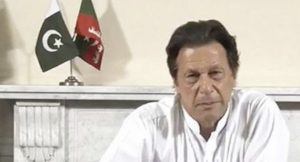 The Oxford-educated leader delivered his victory speech in Islamabad on Thursday declaring himself as the new Prime Minister, despite the official figures of the
  Last week the
 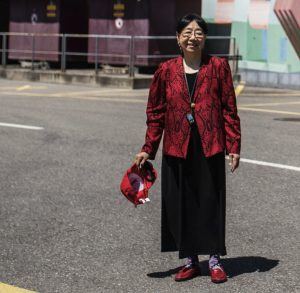 In 1963, Maria Goeppert Mayer won the Nobel Prize in physics for describing the layered, shell-like structures of atomic nuclei. No woman has won since.
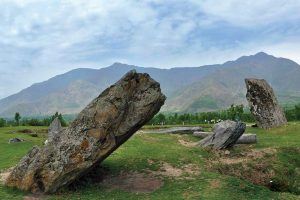 SAY ‘KASHMIR’, and most people would reach for images of stone-throwing teenagers and harried soldiers. Every other aspect of life has been eclipsed by the protracted violence. Or been devalued as insufficiently urgent by comparison with the fight-to-the-death between the State and militant groups. For many of us, the first, instinctive, tragic response on hearing a Kashmiri place name is to locate it on a list of towns and villages associated with some horrible atrocity, some act of brutalisation. Such a list of place names would not—thankfully, not yet—feature Burzahom (Burzahama), 16 km northeast of Srinagar, and Gufkral, near Tral in the troubled Pulwama district.
 W
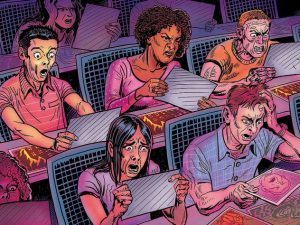
W A whole lot of books on the brain are published these days and you can read yourself into a coma trying to make sense of their various messages. So it was with my usual low-burn curiosity that I starting reading The Mind Is Flat by British behavioral scientist Nick Chater. At least the title is intriguing. But as I started reading it, I perked right up. Maybe that’s because it starts with a long riff on Anna Karenina and asks us to plumb the motivations of her suicide. Can we explain them? What if the great steam engine slammed on its brakes and Anna didn’t die? Would she be able to explain her own motivations to a psychologist while convalescing in a Swiss sanatorium?
 Henry Farrell in Crooked Timber:
 John Horgan in Scientific American:
 Adam Tooze in Dissent:
 Merve Emre in Boston Review: