Nadja Spiegelman at The Paris Review:
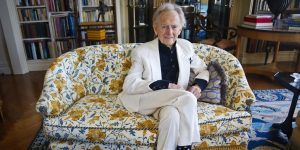 Tom Wolfe died yesterday at age eighty-eight. Between 1965 and 1981, the dapper white-suited father of New Journalism chronicled, in pyrotechnic prose, everything from Ken Kesey’s Merry Pranksters to the first American astronauts. And then, having revolutionized journalism with his kaleidoscopic yet rigorous reportage, he decided it was time to write novels. As he said in his Art of Fiction interview, “Practically everyone my age who wanted to write somehow got the impression in college that there was only one thing to write, which was a novel and that if you went into journalism, this was only a cup of coffee on the road to the final triumph. At some point you would move into a shack—it was always a shack for some reason—and write a novel. This would be your real métier.” With The Bonfire of the Vanities, Wolfe wrote a sprawling, quintessential magnum opus of New York in the eighties. His first two novels were runaway best sellers, and his success won him the bitter envy of Norman Mailer, John Updike, and John Irving, among others.
more here.
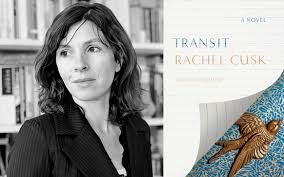 Cusk has glimpsed the central truth of modern life: that sometimes it is as sublime as Homer, a sail full of wind with the sun overhead, and sometimes it is like an Ikea where all the couples are fighting. ‘I wonder what became of the human instinct for beauty,’ she writes in The Last Supper, ‘why it vanished so abruptly and so utterly, why our race should have fallen so totally out of sympathy with the earth.’ A line like this is both overwrought and what I think myself when I look at these scenes. Why must we live in these places? Why must these be our concerns? Why do I have to know what McDonald’s is? It is a dissociate age and she is a dissociate artist. She is like nothing so much as that high little YouTube child fresh from the dentist, strapped into a car going he knows not where, further and further from his own will. Where is real life to be found? Is this it?
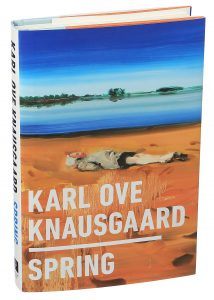 The first time Karl Ove Knausgaard saw Linda Bostrom, the Swedish writer he would later marry, he dropped everything he was holding. The first time she turned him down, he sliced his face to ribbons with a piece of broken glass. The first time they kissed, he fainted dead away.
 About a year ago, the theoretical chemist
  Arthur Brooks is president of the American Enterprise Institute, the center-right Washington think tank that has, amid a decade of turmoil inside the Republican Party, remained a sober, respected voice on matters of policy—while gradually shedding its George W. Bush-era reputation as a leading voice for pugnacious, interventionist foreign policy.
 On Monday, Ivanka Trump, Jared Kushner and other leading lights of the Trumpist right gathered in Israel to celebrate the relocation of the American Embassy to Jerusalem, a gesture widely seen as a slap in the face to Palestinians who envision East Jerusalem as their future capital.
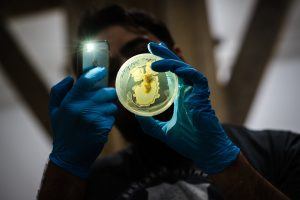 As a teenager, Keoni Gandall already was operating a cutting-edge research laboratory in his bedroom in Huntington Beach, Calif. While his friends were buying video games, he acquired more than a dozen pieces of equipment — a transilluminator, a centrifuge, two thermocyclers — in pursuit of a hobby that once was the province of white-coated Ph.D.’s in institutional labs. “I just wanted to clone DNA using my automated lab robot and feasibly make full genomes at home,” he said. Mr. Gandall was far from alone. In the past few years, so-called biohackers across the country have taken gene editing into their own hands. As the equipment becomes cheaper and the expertise in gene-editing techniques, mostly Crispr-Cas9, more widely shared, citizen-scientists are attempting to re-engineer DNA in surprising ways. Until now, the work has amounted to little more than D.I.Y. misfires. A year ago, a biohacker famously injected himself at a conference with modified DNA that he hoped would make him more muscular. (It did not.)
 We are still working on a few things, such as getting old posts from October 2017 up until April 2018 imported into the archives; fixing some issues with images not displaying correctly in a few old posts; problems with the daily emails not showing all posts; and a couple of other smaller issues.
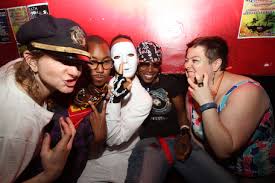 The HAGS’ primary activities—and these remained constant throughout their existence—were roaming in a protective pack around San Francisco, getting drunk, going to punk shows, and the light vandalism known as tagging, leaving your gang’s name or your own inked somewhere it shouldn’t be.
 To read well, Roupenian avers, is to “unmask.” To peel away the “pretty words” and reveal the “actual physical experiences” that lie beneath. Keep your guard up or you might just end up getting finger-fucked by a fat old man who will call you a whore. This ethic of suspicion is a lesson that many have already internalized: the revelation of any failure, in a person or an artwork, has become sufficient to dismiss either out of hand. In the case of art, in some circles it has become the whole point of confronting it.
  I
I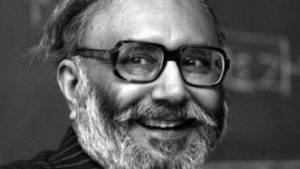 Dr Abdus Salam had once said, “It became quite clear to me that either I must leave my country or leave physics. And with great anguish, I chose to leave my country.”
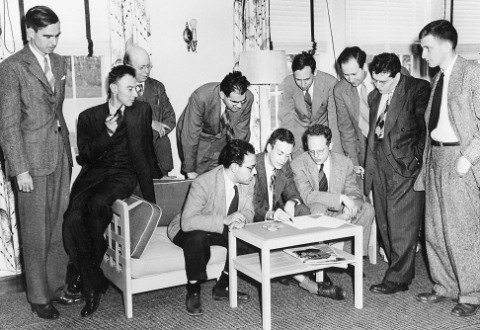 A new theory seldom comes into the world like a fully formed, beautiful infant, ready to be coddled and embraced by its parents, grandparents and relatives. Rather, most new theories make their mark kicking and screaming while their fathers and grandfathers try to disown, ignore or sometimes even hurt them before accepting them as equivalent to their own creations. Ranging from Darwin’s theory of evolution by natural selection to Wegener’s theory of continental drift, new ideas in science have faced scientific, political and religious resistance. There are few better examples of this jagged, haphazard, bruised birth of a new theory as the scientific renaissance that burst forth in a mountain resort during the spring of 1948.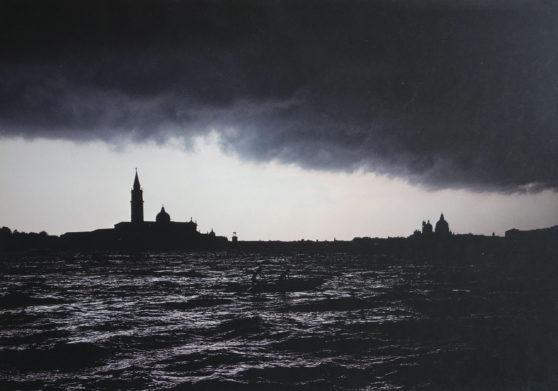
 “Griselda was fighting against the patriarchy the only way she knew – through her unquenchable lust for venison.”