
Tim Vernimmen in Nautilus:
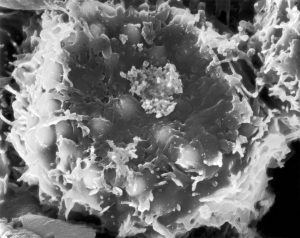
 You don’t often see the word beautiful in scientific articles. Yet it’s easy to see why cell biologists Niccolò Banterle and Pierre Gönczy used the word when describing a crucial cell structure called the centriole in a recent review. The scientists, of the Swiss Federal Institute of Technology Lausanne, are helping to provide a more precise view of how our cells construct this microscopic marvel.
Seen in the image in cross section, the centriole is a cylindrical cell organelle built of nine elegant groupings of three hollow tubes known as microtubules. Each centriole is about one-300th the width of a thickish human hair (about 250 nanometers) in diameter and as much as twice as long. It sits in an area of the cell that looks distinctly fuzzy under the microscope; that fuzzy spot plus the centriole are together known as the centrosome. Each human body contains trillions of them. Centrosome disorders have been implicated in a variety of birth defects, such as certain forms of dwarfism and microcephaly, and may have a role in cancer. Centrioles have existed for over two billion years and are found in a wide variety of life forms that may use them in different ways. In single-celled organisms such as Euglena or Trypanosoma brucei (the parasite that causes sleeping sickness), centrioles form the core of a flagellum, a whipping appendage that enables cells (including human sperm cells) to propel themselves. That’s probably the job that centrioles first evolved to do, says Gönczy. Over time, though, the same structure was adapted for another function: fine-tuning the orderly division of cells. Every one of us starts out as a single fertilized egg cell, which then divides into two daughter cells that each produce two daughters of their own, and so on. Getting enough divisions done in the right way and in adequate time is crucial for correctly structuring developing tissues.
More here.

 The themes of John Cheever’s journals—God, sex, guilt, and nature—manage to instill genteel ennui with the anguished moral passion of a Russian novel. Published in 1990, eight years after his death from lung cancer, and decades after he had been enshrined as America’s premiere bourgeois fabulist, the journals shocked in their revelation of the self-lacerating, booze-addled voluptuary hiding in the fine suit of a country squire. “Rarely has a gifted and creative life seemed sadder,” a chastened John Updike wrote upon their publication. But though the gap between Cheever the cultural effigy and Cheever the man was received with surprise and consternation, the ambiguity of his work had always betrayed such a fissure. Cheever’s greatest fiction enacts a kind of doubleness, a yearning for grace darkly marbled with lust and duplicity. The rapturous moments—one thinks of the beautiful early story “Goodbye, My Brother,” with its darkness and iridescence, the naked women walking out of the sea—barely conceal the saturnine streaks.
 Those who still want to stand with their Catholic brothers and sisters should not merely dissent in private ways, but should also speak up and demand what opinion polls show they really want for the church as the people of God. It is mandatory celibacy and male-only priesthood that is “unnatural.” Even an admired spiritual leader like Thomas Merton, who thought he could get away from temptation by sealing out “the world” in a monastery, fell madly in love with a young nurse when he had to go to a hospital. It was a love that Kaya Oakes, in a new book of tributes to Merton, thinks made him fully human for the first time.
 In late 1979, V. S. Naipaul, then middle-aged and of some literary stature, traveled to the newly declared Islamic Republic of Iran for what would eventually become his travelogue Among the Believers. He hated the place, beginning with his guide, a man named Sadeq:
 Here’s a fun experiment to try. Go to your pantry and see if you have a box of spaghetti. If you do, take out a noodle. Grab both ends of it and bend it until it breaks in half. How many pieces did it break into? If you got two large pieces and at least one small piece you’re not alone.
 The Republican political consultant
  Drugs that activate the immune system to fight cancer have brought remarkable recoveries to many people in recent years. But one of those drugs seems to have had the opposite effect on three patients with an uncommon blood cancer who were taking part in a study. After a single treatment, their disease quickly became much worse, doctors reported in a
 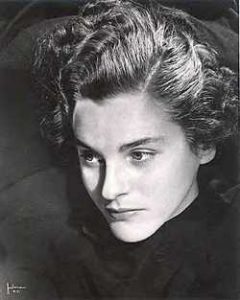 McCarthy’s fiction, collected by the Library of America in two new volumes, shows how her preoccupation with factuality shaped her art. The collection includes all seven of her novels—the first published in 1942, the last in 1979—as well as collected and uncollected stories and an essay on “the novels that got away.” Through it all, we see McCarthy’s fixation on the surface details that distinguish class and character: a middle-aged man from the Midwest who is given to wearing Brooks Brothers suits; a Yale man working at a leftist magazine who sports a “well-cut brown suit that needed pressing”; bohemian couples living on Cape Cod who drink too much and don’t bother keeping house. We learn that it was a status symbol in 1930s New York for a Vassar graduate to serve coffee with real cream.
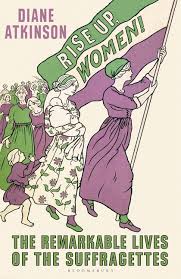 The
The Pankaj Mishra and Nikil Saval discuss V.S. Naipaul in n+1:
 Few nations have been as obsessed with their status in the world as Great Britain. Not surprisingly, the
 From the start of the Russia investigation, President Trump has been working to discredit the work and the integrity of the special counsel, Robert Mueller; praising men who are blatant grifters, cons and crooks; insisting that he’s personally done nothing wrong; and reminding us that he hires only the best people.
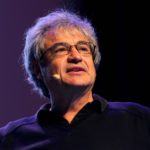 Quantum mechanics and general relativity are the two great triumphs of twentieth-century theoretical physics. Unfortunately, they don’t play well together — despite years of effort, we currently lack a completely successful quantum theory of gravity, although there are some promising ideas out there. Carlo Rovelli is a pioneer of one of those ideas, loop quantum gravity, as well as the bestselling author of such books as