
by Samia Altaf
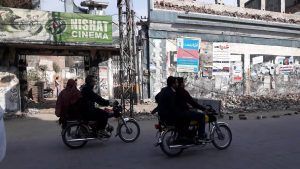 In the 1960s, in the sleepy little city of Sialkot, almost in no-man’s land between India and Pakistan and of little significance except for its large cantonment and its factories of surgical instruments and sports goods, there were two cinema houses, all within a mile of our house, No. 3 Kutchery Road. Well three to be exact, the third being an improvisation involving two tree trunks with a white sheet slung between them at the Services club and only on Saturday nights.
The one closest to us our house, just this side of the railway crossing, was Nishat, popularly known as Begum’s cinema with a risqué aura because it was owned and managed by the ‘Begum,’ a burqa-clad, not so young, but still beautiful woman. There was hushed talk about the Begum’s morals because she, a single woman, owned and managed a cinema house in a time when so-called ‘decent’ women rarely went to the cinema let alone own one.
The second, past the railway crossing on the other side of the ‘drumma wallah chowk,’ the main city square, was the Lalazar. Lalazar was considered to be in a class above the others partly for its sweeping marble staircase curving upwards to the gallery and partly for its owner Mr. Majeed’s newly acquired daughter-in-law Mussarat Nazir, the rustic Punjabi beauty and a leading lady of film industry. Mr. Majeed, a portly gentleman with a loud laugh, was among the city fathers, the ‘shurafa,’ of the city. Mussarat Nazeer, still in her teens, came to public attention in the movie Yakkey Wali. My father tells how he and his friends, all grown and married men, saw that movie about twenty times and every time M. Nazir appeared on screen, they along with the whole house threw coins at the screen in the age old tradition of showing one’s appreciation. M. Nazir’s untimely departure at the height of her career to lead a life of married bliss in Canada was mourned by all till she returned thirty years later, still the rustic beauty, and became a household name selling millions of audio cassettes of Punjabi wedding and folk songs. My older son, then three years old, heard her signature folk song ‘Laung gwacha,’ saw her face on the grimy cover of a much used audio cassette, fell immediately in love and vowed to marry her. His grandfather understood completely. Read more »
 Would I rather go deaf or blind? Every once in a while, I come back to this question in some version or another. Say I had to choose which sense I’d lose in my old age, which would it be? I always give myself, unequivocally, the same answer: I’d rather go blind. I’d rather my world go darker than quieter. I imagine it as a choice between seeing the world and communicating with it; in this hypothetical, communication with the world is all-encompassing, its loss more devastating than the loss of sight. It is perhaps clear from the mere fact that I pose this question that I do not live with a disability involving the senses. Individuals who are vision- or hearing-impaired would have an entirely different take on this question and on the issues I raise below, but hopefully what I write here will go beyond stating my own prejudices.
 The idea of ‘good corporate citizenship’ has become popular recently among business ethicists and corporate leaders. You may have noticed its appearance on corporate websites and CEO speeches. But what does it mean and does it matter? Is it any more than a new species of public relations flimflam to set beside terms like ‘corporate social responsibility’ and the ‘triple bottom line’? Is it just a metaphor?
 Learning Objectives. Measurable Outcomes. These are among the buzziest of buzz words in current debates about education. And that discordant groaning noise you can hear around many academic departments is the sound of recalcitrant faculty, following orders from on high, unenthusiastically inserting learning objectives (henceforth LOs) and measurable outcomes (hereafter MOs) into already bloated syllabi or program assessment instruments.


 One of the problems in discussing censorship is that we often don’t recognize censorship for what it is. There is no longer the Lord Chamberlain marking scripts and cutting out the unacceptable. Instead, we, in effect, ourselves mark them. And that, ironically, makes censorship not more, but less, visible.
 Around 558 million years ago, a strange … something dies on the floor of an ancient ocean. Its body, if you could call it that, is a two-inch-long oval with symmetric ribs running from its midline to its fringes. It is quickly buried in sediment, and gradually turns into a fossil.
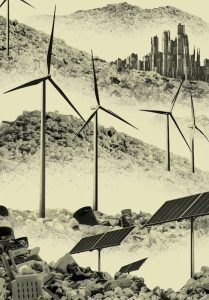 Warnings about ecological breakdown have become ubiquitous. Over the past few years, major newspapers, including the Guardian and the New York Times, have carried alarming stories on soil depletion, deforestation, and the collapse of fish stocks and insect populations. These crises are being driven by global economic growth, and its accompanying consumption, which is destroying the Earth’s biosphere and blowing past key planetary boundaries that scientists say must be respected to avoid triggering collapse.
 It was entirely a coincidence that I found myself reading Jonathan Haidt and Greg Lukianoff’s
  I have spent much of the last few days destroying my own work. It turns out that obliterating it neatly is almost as difficult as making it. It’s publication week of my latest, The Book of Humans, and we’ve been running various competitions to draw people’s eyes in. I have great fondness for hiding secrets in my books. In one, I encoded a message in the letters of the genetic code – an email address that revealed the instructions for a treasure hunt. For The Book of Humans – surely conceived by me as an epic act of procrastination – I have dug out a hole in the middle of one copy, as if to hide a wad of cash, and inside this book-box I’ve stashed a small treasure, something mentioned in the book and of relevance to the story. So far, I’ve destroyed two practice copies with a multi-tool trying to carve and glue a neat rectangular box inside 250 pages of human evolution. I’ll push the button for this hunt to begin on Twitter this week. Let’s see how long it takes people to work out what’s in the box.
 “You’re dead,” said the meditation guide. “You’ve been dead a long time.” I start crying. “What do you see?” she asked. I whimpered, “My dad somewhere, cremated, maybe a river, gone for decades. My son is older. He has a family. He thinks of me sometimes. I can’t stand it.”
 In the beginning was the map.
  In the tempest-plagued teapot of English translation, Michael Hofmann’s dust-ups are notorious: he compared Stefan Zweig’s suicide note to an Oscar acceptance speech, eviscerated James Reidel’s translations of Thomas Bernhard’s poems, brushed off George Konrad’s A Feast in the Garden as “dire… export-quality horseshit.” Critics seem generally pleased with his translations, but then, critics like Toril Moi, Tim Parks, or Hofmann himself—that is to say, those willing and able to scrutinize the changes a text in translation undergoes, and the details of what is gained and lost alone the way—are rare, and the newspaper reviewer’s “cleverly translated,” “serviceably translated,” and suchlike don’t count for too much. Readers I know are not of one mind about his work: some are unqualified fans, particularly of Angina Days, his selected poetry of Günter Eich. What seems to grate on the less enthusiastic are his translations’ motley surfaces, the “occasional rhinestones or bits of jet,” as he has it in one interview, which mark them, not as the pellucid transmigration of the author’s inspiration from source language into target, but as a patent contrivance in the latter.
 “The trouble with life (the novelist will feel) is its amorphousness, its ridiculous fluidity,” writes Martin Amis in his memoir Experience. “Look at it: thinly plotted, largely themeless, sentimental and ineluctably trite. The dialogue is poor, or at least violently uneven. The twists are predictable or sensationalist. And it’s always the same beginning; and the same ending…”