
by Joshua Wilbur
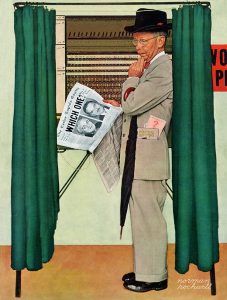
This past Tuesday—September 25th 2018—was “National Voter Registration Day” in the United States. I didn’t register to vote on September 25th, and I’m not registered to vote as I write this now.
I’m not proud of the fact. Far from it, I feel intensely guilty when I imagine some upstanding acquaintance asking me, “Are you registered to vote yet?”, so that I am forced to stammer through an explanation as to why not. (The alternative in this scenario would be to lie, to simply say “Yes,” which many people do when questioned about voting habits. It is shameful to have done nothing on election day, but, even still, our society imparts no immediate negative consequences on non-voters, and no one knows who actually voted and who did not.)
But I’ll admit it openly: I’m not registered to vote because my printer is out of ink.
You see, I recently moved to a new address in a different state. The county must be made aware of my presence here if I am to be added to the electoral roll. Thirty-seven states allow online voter registration, but, unfortunately, my new home state is not one of them. This means that I must print, complete, and mail a form to the “County Commissioner of Registration” at least twenty-one days prior to Election Day on November 6th.
This is mildly annoying, a minor inconvenience. It doesn’t deserve mention alongside the history of American voter suppression in all its contemptible forms, beginning with poll taxes, grandfather clauses, and literacy tests in the Jim Crow South and persisting in the guises of photo ID laws, district realignment, felony disenfranchisement, and voter purges, to name just a few contemporary tactics.
No one is actively trying to suppress my vote. I have a problem with my printer. I just need to order some ink (and I guess a box of envelopes), print the form, fill out the form, put it in the envelope, seal the envelope, walk a few blocks, and drop it in a mailbox. It really isn’t that difficult. Read more »
 One of the things I love about sports is they’re a low-stakes environment in which to practice high-stakes skills. For most people, most of the time, the results of a sporting match don’t affect the long-term quality of their lives. This is what I mean by “low-stakes.” In the grand scheme and scope of our lives, the outcomes of games rarely matter. Which is what makes sports such a great place to practice skills that really can and do impact our lives for the better. This is what I mean by “high-stakes.”
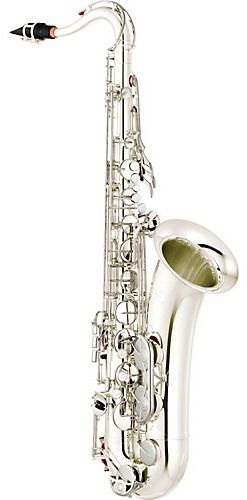 In the fall of 1970, I brought a Bundy tenor saxophone home from school. I was nine and in Mrs Farrar’s 5th grade class. To celebrate, my father slid an LP called “Soultrane”out of a blue and white cardboard jacket. The first sounds from the record player’s single speaker: a muscular folk song with rippling connective tissue that quickly spun free into endless cascades. Dad explained that it was my new horn, in the hands of John Coltrane. I didn’t know his name and nothing that day seemed possible, anyway.
 Thirty years ago last week, Salman Rushdie’s The Satanic Verses was published. Rushdie was then perhaps the most celebrated British novelist of his generation. His new novel, five years in the making, had been expected to set the world alight, though not quite in the way that it did.
 Dangling from a balloon high above Antarctica, a particle detector has spotted something that standard physics is at a loss to explain.
 The cries of “Shame! Shame! Shame!” rang throughout the marbled walls of the
  The man was 23 when the delusions came on. He became convinced that his thoughts were leaking out of his head and that other people could hear them. When he watched television, he thought the actors were signaling him, trying to communicate. He became irritable and anxious and couldn’t sleep. Dr. Tsuyoshi Miyaoka, a psychiatrist treating him at the Shimane University School of Medicine in Japan, eventually diagnosed paranoid schizophrenia. He then prescribed a series of antipsychotic drugs. None helped. The man’s symptoms were, in medical parlance, “treatment resistant.” A year later,
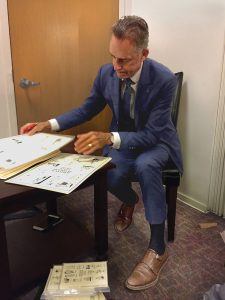 Before 2016 Jordan Peterson was indistinguishable from any other relatively successful academic with a respectable scholarly pedigree: B.A. in political science from the University of Alberta (1982), B.A. in psychology from the same institution (1984), Ph.D. in clinical psychology from McGill University (1991), postdoc at McGill’s Douglas Hospital (1992–1993), assistant and associate professorships at Harvard University in the psychology department (1993–1998), full tenured professorship at the University of Toronto (1999 to present), private clinical practice in Toronto, and a scholarly book by a reputable publishing house (Routledge). This ordinary career path turned extraordinary in 2016 when the controversial Bill C-16, a federal amendment to the Canadian Human Rights Act and Criminal Code, was passed, “to protect individuals from discrimination within the sphere of federal jurisdiction and from being the targets of hate propaganda, as a consequence of their gender identity or their gender expression.”
 In 1921, 24-year-old William Faulkner had dropped out of the University of Mississippi (for the second time) and was living in Greenwich Village, working in a bookstore—but he was getting restless. Eventually, his mentor, Phil Stone, an Oxford attorney, arranged for him to be appointed postmaster at the school he had only recently left. He was paid a salary of $1,700 in 1922 and $1,800 in the following years, but it’s unclear how he came by that raise, because by all accounts he was uniquely terrible at his job. “I forced Bill to take the job over his own declination and refusal,” Stone said later, according to David Minter’s biography. “He made the damndest postmaster the world has ever seen.”
 When René Descartes was 31 years old, in 1627, he began to write a manifesto on the proper methods of philosophising. He chose the title Regulae ad Directionem Ingenii, or Rules for the Direction of the Mind. It is a curious work. Descartes originally intended to present 36 rules divided evenly into three parts, but the manuscript trails off in the middle of the second part. Each rule was to be set forth in one or two sentences followed by a lengthy elaboration. The first rule tells us that ‘The end of study should be to direct the mind to an enunciation of sound and correct judgments on all matters that come before it,’ and the third rule tells us that ‘Our enquiries should be directed, not to what others have thought … but to what we can clearly and perspicuously behold and with certainty deduce.’ Rule four tells us that ‘There is a need of a method for finding out the truth.’
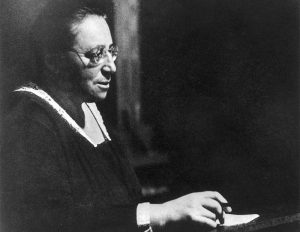 Emmy Noether was a force in mathematics — and knew it. She was fully confident in her capabilities and ideas. Yet a century on, those ideas, and their contribution to science, often go unnoticed. Most physicists are aware of her fundamental theorem, which puts symmetry at the heart of physical law. But how many know anything of her and her life?
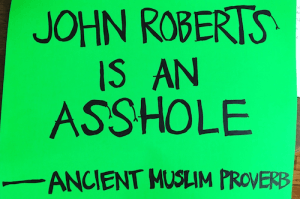 When last June we heard about the kids arriving in New York from the Southern border—the first moment the child separation policy flared into the public eye, the first I knew of its systematic existence—we raced to LaGuardia to witness, to support, to stage something visible, at least. We made posters on the M60 bus. I passed around fat sharpies, brought extra neon poster-board. No one knew what to write, or who to address. The children? Their captors? The news cameras? It maybe wasn’t a great decision. The couple of kids I saw filing out of side doors were so little and tired and quiet. I’m not sure a phalanx of screaming adults helped, though it gave the TV cameras something to show other than their tiny bodies. Some stubborn questioners managed to get information about where the children were being taken in the unmarked vans.
 Cicadas might be a pest, but they’re special in a few respects. For one, these droning insects have a habit of emerging after a prime number of years (7, 13, or 17). They also feed exclusively on plant sap, which is strikingly low in nutrients. To make up for this deficiency, cicadas depend on two different strains of bacteria that they keep cloistered within special cells, and that provide them with additional amino acids. All three partners – the cicadas and the two types of microbes – have evolved in concert, and none could survive on its own. These organisms together make up what’s
 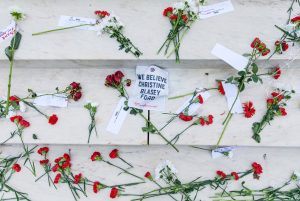 “Look at me when I’m talking to you! You’re telling me that my assault doesn’t matter. That what happened to me doesn’t matter!” Those anguished words came from Maria Gallagher, who, along with Ana Maria Archila,