
by Joan Harvey

When the bobbling, babbling, unhinged conspiracy theorist, Alex Jones, warned of a second Civil War starting on the 4th of July, most of us laughed, people marked themselves “Safe,” and we enjoyed the holiday. But one thing we’ve learned in these times is that both the Civil War and WWII are still underway. Not the second Civil War, but a continuation of the first. While both wars seemed to have had clear endings, in reality they continue, but until now mostly buried underground. How could we have been so oblivious? So complacent? I think of Freud and the unconscious, Jung and the shadow. Psycho-history.
Our country is mentally ill.
Politicians, it seems, think the answer is in being led by the nose by the Russian government. Oh, that and arming toddlers.
But America is changing. Across the West on the 4th of July this year fireworks displays were cancelled. Fire danger was too high. Every year is like this now. And every year, we too act mentally ill, behaving as if this year were aberrant. We get through fire season crossing our fingers, a fire season that extends for more months every year. Every year we hope a fire won’t burn too close to us, we hope it won’t force us out, we hope it won’t destroy our homes. Wiser politicians talk of turning to green energy to slow climate change, while the others push for more fossil fuel development. But no one addresses the fact that we’re past the tipping point. Even if we’re able to slow climate change, it’s still too late. Every year we burn. Then the floods come to finish the job. Read more »
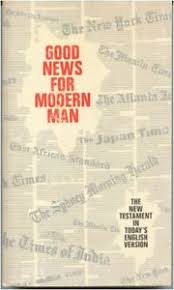 For a Baptist, the Bible exists like gravity. Not believing in gravity will not change the outcome if you step off a building; not believing the Bible will not change the consequences if you ignore its precepts and commands. Both are laws of nature, fixed and unchanging.
 Few topics have captured the attention of the internet literati more than the topic of Jordan B. Peterson. Peterson,
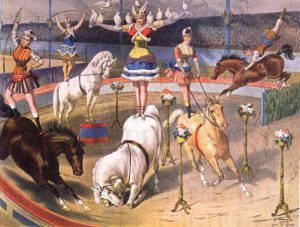 What follows is part of a collaborative project between a historian and a student of medicine called “The Temperature of Our Time.” In forming diagnoses, historians and doctors gather what Carlo Ginzburg has called “small insights”—clues drawn from “concrete experience”—to expose the invisible: a forensic assessment of condition, the origins of an idiopathic illness, the trajectory of an idea through time. Taking the temperature of our time means reading vital signs and symptoms around a fixed theme or metaphor—in this case, the circus.
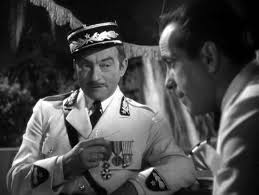 There is a famous exchange in Casablanca between Rick (Humphrey Bogart) and Captain Renault (Claude Rains):

 Translation is the silent waiter of linguistic performance: It often gets noticed only when it knocks over the serving cart. Sometimes these are relatively minor errors — a ham-handed rendering of an author’s prose, the sort of thing a book reviewer might skewer with an acid pen.
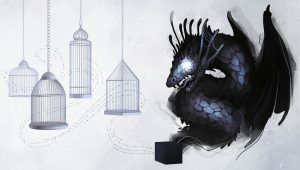 The theoretical physicist John Wheeler once used the phrase “great smoky dragon” to describe a particle of light going from a source to a photon counter. “The mouth of the dragon is sharp, where it bites the counter. The tail of the dragon is sharp, where the photon starts,” Wheeler wrote. The photon, in other words, has definite reality at the beginning and end. But its state in the middle — the dragon’s body — is nebulous. “What the dragon does or looks like in between we have no right to speak.”
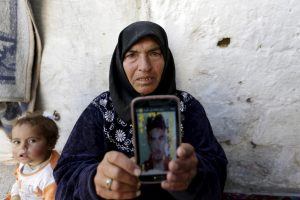 The endgame of the war in Syria is likely to come down to the northwestern province of Idlib, on the Turkish border, where some 2.3 million people are now trapped. As Russian-Syrian forces now finish retaking the smaller southwestern province of Daraa, Idlib will be the last significant enclave in anti-government hands. If Russian-Syrian forces resume pummeling the city and surrounding area from the air, its civilians could face the horrible choice of bunkering in place or desperately trying to cross the Turkish border, which has been effectively closed since 2015.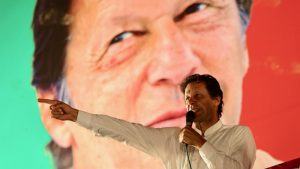
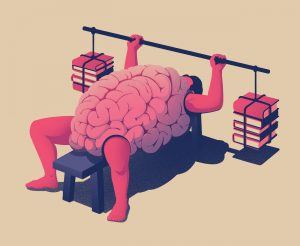 This is a story about a book that just kept selling, catching publishers, booksellers and even its author off guard. In seeking to understand the reasons for the book’s unusually protracted shelf life, we uncover important messages about our moment in history, about the still-vital place of reading in our culture, and about the changing face of publishing. The book is
  The suffragist heroes Elizabeth Cady Stanton and Susan B. Anthony seized control of the feminist narrative of the 19th century. Their influential history of the movement still governs popular understanding of the struggle for women’s rights and will no doubt serve as a touchstone for commemorations that will unfold across the United States around the centennial of the 19th Amendment in 2020.
 Plants could soon provide our electricity. In a small way they already are doing that in research labs and greenhouses at project Plant-e — a university and commercially sponsored research group at Wageningen University in the Netherlands. The Plant Microbial Fuel Cell from Plant-e can generate electricity from the natural interaction between plant roots and soil bacteria. It works by taking advantage of the up to 70 percent of organic material produced by a plant’s