
Amanda Petrusich at The New Yorker:
 Previously, Van Etten sang of the vagaries of loving too hard, or, worse, of loving the wrong person. “Remind Me Tomorrow” is focussed, lyrically, on how it feels to find peace after a long stretch of ache. It is full of glowing, grounded snapshots, as if Van Etten were trying to pause and capture fulfilled moments so that she might savor them longer. “Malibu,” a road-trip song that takes place on California’s Highway 1, is a slow encomium to a carefree couple steering a “little red number” along the Pacific Coast. Van Etten has written about these sorts of scenarios before—dreamy lost weekends, salty breezes, the world becoming so small and complete that it can only accommodate two people. The difference, this time, is that the fantasy turns real, domestic: “I walked in the door / The Black Crowes playin’ as he cleaned the floor / I thought I couldn’t love him any more.” Van Etten regards her present relationship with the wonderment and gratitude of someone who had perhaps briefly given up on love altogether.
more here.
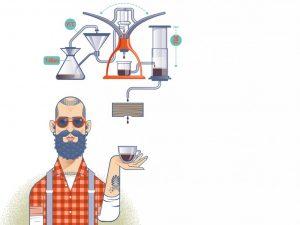 Every morning, I buy a black filter coffee from Pret A Manger. There is nothing refined about this. It looks and smells like something you would use to asphalt a road. But the slap of acrid liquid onto tongue is as invigorating as the caffeine itself. Yet though coffee is, ultimately, so much fuel, the means of its production are far from utilitarian: the essence of character and identity are laid bare over the decision to pop a pod in a Nespresso machine (a device whose brilliance lay in convincing Americans that George Clooney was an adequate substitute for sugar and cream) or listen to a Bialetti pot rattle and bubble on the stove top.
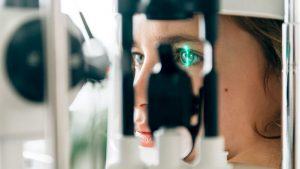 Curing the childhood eye cancer retinoblastoma often comes at a cost. The tumor, which sprouts in the retina and primarily occurs in children under the age of 5, is fatal if not treated. Yet chemotherapy can cause permanent vision loss, and patients sometimes need surgery to remove one or both eyes. Now, scientists have found that a cancer-slaying virus seems to combat this cancer in mice without serious side effects. A clinical trial has also shown early signs of promise. “It’s potentially a game-changer,” says ophthalmic oncologist David Abramson of Memorial Sloan Kettering Cancer Center in New York City, who wasn’t connected to the study. Researchers have tested cancer-targeting viruses in other types of tumors, but no one had pitted them against retinoblastoma. The tumors grow when there are defects in a molecular pathway that keeps cells from dividing out of control. Oncology researcher Ángel Montero Carcaboso of the Sant Joan de Déu Research Institute in Barcelona, Spain, and colleagues used a type of virus known as adenovirus that typically causes only mild respiratory infections in people. It had been genetically modified so it was missing a key gene and could only reproduce inside cells in which the retinoblastoma pathway had malfunctioned.
 The sixties were a decade of upheaval and progress, and one of the many areas where that revolutionary spirit reared its head was in the art of nonfiction. In previous decades, nonfiction—particularly if written for periodicals—had been seen mostly as ephemeral reportage. It was for catching up on world events, local matters, and human interest, usually read over a morning cup of coffee, stained with those wet, brown rings. Partially because it was churned out on deadline, factual writing was often pooh-poohed as a lesser art form than fictional writing, with the focus merely on the transfer of information, rather than aesthetic splendor, thematic heft, and formal precision.
 It’s hardly news that computers are exerting ever more influence over our lives. And we’re beginning to see the first glimmers of some kind of artificial intelligence: computer programs have become much better than humans at well-defined jobs like playing chess and Go, and are increasingly called upon for messier tasks, like driving cars. Once we leave the highly constrained sphere of artificial games and enter the real world of human actions, our artificial intelligences are going to have to make choices about the best course of action in unclear circumstances: they will have to learn to be ethical. I talk to Derek Leben about what this might mean and what kind of ethics our computers should be taught. It’s a wide-ranging discussion involving computer science, philosophy, economics, and game theory.
 What makes people susceptible to fake news and other forms of strategic misinformation? And what, if anything, can be done about it?
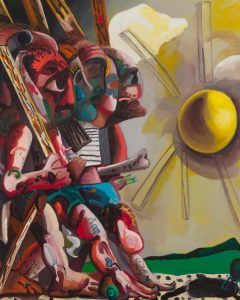 In her new work, artist Dana Schutz takes back her painterly name. Her current canvasses are hyperassertive, full of operatic grandeur, self-mocking turbulence, acidified flooded color, disfigured hideousness, and the psychopathology of her figures — all clawing in some Malthusian struggle for existence. Like this work or not, Schutz is claiming a lot of visual territory for herself. This means more tenacity in the paint, irrepressible surfaces, ambitious scale, and mixed — conflicted — compositional structures.
 She has been called the Godmother of the New Wave, sometimes the Big Sister, even the Grandmother, but Agnès rides her own wave. She has never slowed down: a ceaseless creative force, she has been on the spot at historic moments. She never puts anything away for good, so old photos turn into films, and whatever she can’t use right away may turn up later in her short films, recycled with fresh invention. On a trip to Germany, the history of 4711 eau de cologne captivates her as much as the venerable cathedral and re-appears in her Agnès de ci de là Varda (Agnes Varda: From Here to There, 2012). She sees the world in a grain of sand—or in a heart-shaped potato. In her garden, she pays as much attention to a tree’s growth as to any honored guest.
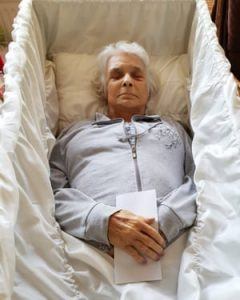 The underlying problem with the advance directives is that they imply the subordination of an irrational human being to their rational former self, essentially splitting a single person into two mutually opposed ones. Many doctors, having watched patients adapt to circumstances they had once expected to find intolerable, doubt whether anyone can accurately predict what they will want after their condition worsens.
 It can be reassuring to reassess life by taking a long view. In this book about “how the Earth made us”,
  Does the language you speak influence how you think? This is the question behind the famous
  By 2014, many Americans had forgotten about New Atheism. For liberal Americans in the depths of the Bush years, anti-religious best sellers by Sam Harris, Richard Dawkins and Christopher Hitchens came as—for lack of a better word—a godsend. With the Christian right in the White House, and jihadist terrorism perceived to be a constant danger in the wake of 9/11, a vocal rationalist atheism appeared to many a natural and necessary counterweight. But after nearly six years of Barack Obama’s presidency, Bush and his born-again gang were far from the high seats of power, the War on Terror was no longer a feature of most people’s daily lives, and there was a widespread impression of leftward progress on social issues. The services of the anti-religious crusaders were no longer needed.
 One of the greatest puzzles in the entire Universe is the dark matter mystery. In theory, for every bit of normal matter (like us) in the Universe, there should be approximately five times as much dark matter. Both normal and dark matter should experience gravitation equally, meaning that the largest structures in the Universe — galaxies, clusters of galaxies, and cosmic filaments — should contain and be dominated by dark matter. When we measure the motions of individual galaxies, both isolated and in clusters, the normal matter alone is not enough to explain what we see. Dark matter is also required.
 So, there you are, having worked your way through a crowd denser than a Brexit negotiation, standing in front of your prize. The Mona Lisa in the Louvre. What do you do? Look more closely at that enigmatic smile? Wonder at the subtle gradations of light and shadow in Leonardo’s rendering of the face? Admire the illusion of depth?
 Sometimes my experiences with the Postal Service are almost enough to turn me into a right-wing libertarian. For instance: They offer a special discounted rate for sending magazines through the post. Which is good—I run a magazine that is sent through the post! In order to get the rate, however, you have to meticulously obey every single instruction in the 56 pages of
  In his columns, Indiana skewered the art world’s bloated egos and grotesque superficiality, but he was interested, above all, in scrutinizing who held power and how it was deployed. In a particularly trenchant essay on Richard Serra’s lawsuit against the General Services Administration—the government agency that had commissioned his 1981 public sculpture Tilted Arc for the plaza outside the Jacob K. Javits Federal Building in Manhattan and, at the urging of the people who worked there, now planned to remove it against the artist’s wishes—Indiana chides Serra and his defenders for their naivete: “Who on earth did these people think they were dealing with in the first place?” he asks. “If you are so enamored of [power] that you regularly ornament its dinner tables, ride cackling through the night in its limousines, and sign worthless contracts with it, it is no problem of mine or anyone else’s if power decides, one bored afternoon, to add you to the menu instead of inviting you to eat.”