Larry Arnhart in The New Atlantis:
 In the first issue of The New Atlantis, Leon Kass suggests that if biotechnology were to transform human nature, it would do so to satisfy the human dream of physical and mental perfection — “ageless bodies, happy souls.” But how likely is that? As an indication of what he foresees, Kass says that with drugs, “we can eliminate psychic distress, we can produce states of transient euphoria, and we can engineer more permanent conditions of good cheer, optimism, and contentment.” He refers to those “powerful yet seemingly safe anti-depressant and mood brighteners like Prozac, capable in some people of utterly changing their outlook on life from that of Eeyore to that of Mary Poppins.” Similarly, psychiatrist Peter Kramer — in his best-selling book Listening to Prozac — described patients using Prozac who were not just cured of depression but so transformed in their personalities as to be “better than well.” Shy, quiet people were apparently turned into ebullient and socially engaging people. “Like Garrison Keillor’s marvelous Powdermilk biscuits,” Kramer observed, “Prozac gives these patients the courage to do what needs to be done.” This was the beginning, he concluded, of “cosmetic psychopharmacology,” by which people could use chemicals to take on whatever personality they might prefer.
But as even Kramer has conceded, this chemical transformation in personality appears to work well in only a minority of the people taking Prozac. And in recent years, there have been increasing reports of many harmful side effects. This is to be expected, because like all psychotropic drugs, Prozac disrupts the normal functioning of the brain, and the brain responds by countering the effect of the drug, which then induces harmful distortions in the neural system. Specifically, Prozac blocks the normal removal of the neurotransmitter serotonin from the space between nerve cells. This creates an overabundance of serotonin, and the brain responds either by reducing receptivity to serotonin or by reducing the production of serotonin. As a result, the brain creates an imbalance in response to the disruption of the drug and cannot function normally. There is also growing evidence that Prozac does not really cure depression. Many studies have shown that the antidepressant effects of taking Prozac are not much greater than what occurs when people take a placebo pill.
But the most fundamental problem with Prozac is one that it shares with all psychotropic drugs (including old-fashioned ones like alcohol). Emotional suffering is a capacity of human nature shaped by evolutionary history for an adaptive purpose. Emotional suffering is almost always a signal that something is wrong in our lives. It alerts us that there is some problem either in our internal lives, in our social relationships, or in our external circumstances. A psychotropic drug does not help us to understand or solve the problem. Rather, the drug deadens the emotional response of our brain without changing the problem that provoked the emotional response in the first place. When we feel bad because of a problem in our lives, taking a psychotropic drug to make us feel better is evasive and self-defeating.
More here. (Note: From the Summer 2003 issue)

 In such circumstances, the “Guantánamo Blues” that the anonymous writer struggled with in the 1930s became all the more acute. Visiting journalists in the 1960s and 1970s reported on racial tensions, drug and alcohol problems, and occasional violence. According to a 1973 article in Esquire, “Guantánamo is a good place to become an alcoholic. During the last twelve months gin has been the leading seller at the base Mini-Mart, with vodka a close second.”
 Female pop geniuses who exercise their gifts in rampant, restless fashion over decades, writing, performing, and producing their own work, are as rare as black opals. Shape-shifting brilliance and an airy indifference to what’s expected of you are not the music industry’s favorite assets in any performer, but they are probably easier to accept in a man than in a woman. And such a musician, even today, is subject to the same pressures that have always hindered women’s artistic expression. Like the thwarted writers whom Virginia Woolf described in “
 Elaine Pagels, people say, is a heretic. It’s an ancient accusation, of course, and it hardly wields as much power as it used to, especially in the free-wheeling religious landscape of America. And Ms. Pagels is, in fact, one of the globe’s foremost experts in early Christian heresies. But as a woman who has been disrupting established orthodoxies for nearly half a century, her name still has the power to arouse disdain in certain religious circles. “You know, people have sometimes called me ‘Elaine Pagan’,” the Princeton University professor says during an interview with the Monitor, smiling as she reflects on the trajectory of her life’s work, her many orthodox critics, and
  Picture a creche with baby Jesus in a manger and shepherds and angels and three kings and a star over the stable roof. We think of this traditional scene as representing the Christmas story, but it actually mixes elements from
  It’s mid-December, and likely you are sick and tired of best-of lists. I know, because I am too—especially after reading 52 of them and tracking their contents for the very piece you are reading—so trust me when I say that the monstrosity below is the last best-books-of-2018 list you’ll ever have to read.
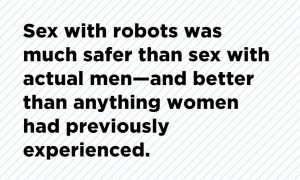 A lot of people don’t know this, but we once thought cyborg sex might be a bad idea. Back in the 2010s, serious concerns were raised by prominent scholars that sex robots were made by men, for men. The general consensus was that cyborg sex would further support the notion that women’s bodies were available for objectification, sexual gratification, and violence.
 In the mid-1990s, when I was a student of creative writing, there prevailed a quiet but firm admonition to avoid composing political poems. It was too dangerous an undertaking, one likely to result in didacticism and slackened craft. No, in American poetry, politics was the domain of the few and the fearless, poets like Adrienne Rich or Denise Levertov, whose outsize conscience justified such risky behavior. Even so, theirs weren’t the voices being discussed in workshops and craft seminars.
 It’s a big universe out there, full of an astonishing variety of questions and puzzles. Today’s guest, Janna Levin, is a physicist who has delved into some of the trippiest aspects of cosmology and gravitation: the topology of the universe, extra dimensions of space, and the appearance of chaos in orbits around black holes. At the same time, she has been a pioneer in talking about science in interesting and innovative ways: a personal memoir, a novelized narrative of famous scientific lives, and a journalistic exploration of one of the most important experiments of our time. We talk about how one shapes an unusual scientific career, and how the practice of science relates to more traditionally humanistic concerns.
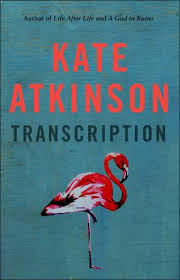 This is a novel about double-dealing, about honourable and dishonourable forms of duplicity, about multiple impersonations, about lies and secrets and their ultimate consequences. Juliet is soon provided with an alternative identity ‑ Iris Carter-Jenkins is her bogus name ‑ and sent to infiltrate a fascist organisation known as the Right Club. This club holds its meetings in a flat above a cafe in South Kensington called the Russian Tea Rooms, which is run by an Admiral Wolkoff and his daughter Anna. The young transcriber has been upgraded to a full-blown MI5 agent, and adopts a mettlesome personality to go with her new role. “She had already decided that Iris Carter-Jenkins was a gutsy kind of girl.” Gutsy enough to carry a small gun in her handbag, and keep her nerve in the face of imminent unmasking.
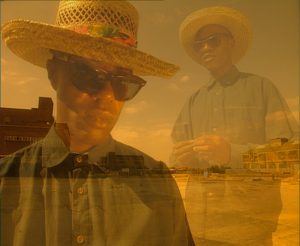 I first saw an Akomfrah film before I knew it was an Akomfrah film. I remember watching the documentary Seven Songs for Malcolm X (1993) in my single dorm room at the top of a hill on McGill’s campus in Montreal. I was alone in college, surrounded by people, and had settled into a life of solemnity. My first laptop had a disc drive, and I had gotten into the habit of borrowing DVDs from the university library in a forlorn attempt to stay in at least one night on the weekends. I, like my father, had gone through a phase contemplating conversion to Islam. Converting from what, I never knew. I didn’t take it as seriously as he did (I never went to mosque), and mostly I just crushed on the hero, who I referred to in the margins of his autobiography as “Mal.” (Unlike my entrepreneurial Jamaican father, I had confused wanting to be a black Muslim with wanting to be a black Marxist.)
 The story of energy metabolism—the basic engine of life at the cellular level—is one of electrons flowing much like water flows from mountains to the sea. Our cells can make use of this flow by regulating how these electrons travel, and by harvesting energy from them as they do so. The whole set-up is really not so unlike a hydroelectric dam. The sea toward which these electrons flow is oxygen, and for most of life on earth, iron is the river. (Octopuses are strange outliers here—they use copper instead of iron, which makes their blood greenish-blue rather than red). Oxygen is hungry for electrons, making it an ideal destination. The proteins that facilitate the delivery contain tiny cores of iron, which manage the handling of the electrons as they are shuttled toward oxygen.
 Decades before the rise of social media, polarisation plagued discussions about language. By and large, it still does. Everyone who cares about the topic is officially required to take one of two stances. Either you smugly preen about the mistakes you find abhorrent – this makes you a so-called prescriptivist – or you show off your knowledge of language change, and poke holes in the prescriptivists’ facts – this makes you a descriptivist. Group membership is mandatory, and the two are mutually exclusive.
 The concept of