
Category: Recommended Reading
Martin Luther King Jr. and the Meaning of Emancipation
Asad Haider at n+1:
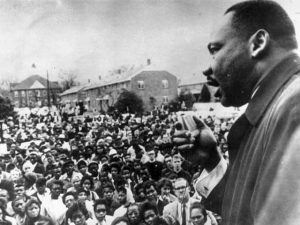 King was not the empty symbol Reagan and others claimed he was. He was a revolutionary, if one committed to nonviolence. But nonviolence does not exhaust his philosophy. As political theorist Brandon M. Terry puts it, King was not only an icon, but “a vital political thinker.” A half a century ago, Terry argues, King theorized the foundations of racism in a way that vastly surpasses the fashionable contemporary ideologies that “treat racism as near-immutable and overstate its explanatory effects.” As Terry points out, King understood that the racial question was overdetermined by wage stagnation, the declining power of organized labor, and the expulsion of workers from employment by automation. King had come to believe that transforming this structural injustice could only be achieved through mass civil disobedience.
As a theorist of inequality, King is our contemporary. But he was also a philosopher of equality, and thus of emancipation. At the core of his thought one finds the political subjectivity that the civil rights struggle was helping to engender. Important as his final year was, the radical outlines of this project are visible from 1955 to 1963, as King was drawn deeper into political activism and answered the call to engage in a political sequence that exceeded the boundaries of the existing situation.
more here.
David Wojnarowicz: Uncompromising Artist of the 1980s
Lara Pawson at the TLS:
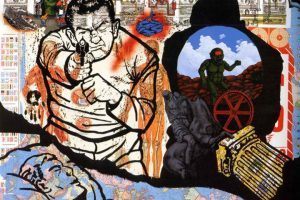 David Wojnarowicz did not write dark fantasy. He wrote real life. In The Waterfront Journals he brilliantly captures electric tales from the mouths of strangers, those he described as “junkies, prostitutes, male hustlers, truck drivers, hobos, young outlaws, runaway kids, criminal types”, whose lives echo his own ostracized existence. He was thirteen when he was first paid for sex and sixteen when he started “turning tricks” regularly. His mother kicked him out of the house. By the time Wojnarowicz came out to friends in New York, he was in his early twenties. He was on the cusp of finding his voice as a writer and his confidence as an artist. It was the mid-1970s. AIDS was about to tear through the gay community.
Another journal, Weight of the Earth, gives form to Wojnarowicz’s own extraordinary life as it creeps closer and closer towards death. Originally taped as free-form audio diaries spanning the 1980s, these short dispatches offer insights into the mind of a man who was experiencing true love for the first time while also gaining a reputation on the New York art scene.
more here.
A Translator’s Diary: A Year in the Life of Emma Ramadan
Emma Ramadan at The Quarterly Conversation:
 When a sentence isn’t right, I feel it immediately in my back. I’ve said this before. Sometimes I can’t type fast enough to keep up with my thoughts and a specific word disappears from my train of thought forever. Sometimes my body has enough energy to take me to a translation workshop at a friend’s home and my translation is changed for it. Sometimes my body is tired from my day job and I work half as quickly as I used to. Sometimes my body catches cold and my brain muddles words on the page. Once I had a translation deadline to meet but I had just had my tonsils removed and could barely make out the page through the muck of medication. I realized shortly after that I had wound up with something that was half truth and half lie.
At Riffraff, we host an event to discuss my translation of Virginie Despentes’s Pretty Things. I am in conversation with a local trans woman and activist, who quite fairly makes the point that while Despentes’s book has been lauded as a feminist critique of the ways in which the beauty industry corrodes our confidence and distorts our sense of self-worth, what is left out of this book and its surrounding discussion is that this lens of feminism is not universal.
more here.
Francine du Plessix Gray and Sorrel Soup
Vasily Rudich and Gabriella De Ferrari in The Paris Review:
 By her own account, writing wasn’t easy for Francine du Plessix Gray, who died last Sunday at the age of eighty-eight. As she told Regina Weinreich in her 1987 Art of Fiction interview, “I’ve always had a terrifically painful ambivalence of love and terror towards the act of writing.” But this doesn’t come through in her fearless books, such as the novel Lovers and Tyrants, a semiautobiographical account of her childhood, and Them, an unsparing look at her tyrannical parents. She was born in 1930 at the French embassy in Warsaw, but after her father died in 1940, Gray and her mother emigrated to America. Gray arrived in the country knowing not a lick of English; fourteen months later, she won the school spelling bee.
…When Francine lived in her house in Connecticut, she loved to entertain her friends. Her dinners were small, and dotted with members of the local intellectual community. I was lucky enough to be invited to several. Francine envisioned herself a great cook. She was not. One of her favorite dishes to make was sorrel soup. She grew the sorrel in her garden and was very proud of it. The soup was dark green, creamy and bitter. Her enthusiasm for it was such that we all ate it quietly and fast. She insisted on seconds. As with everything else in her life: if she loved it, you were to love it, too. In the last years of Francine’s life, she left her house in Warren to be near her sons and doctors. She moved to a small, rather dark apartment in New York City. She insisted on filling the new apartment with as much of her furniture as possible. Her friend Peter Vaughn, who helped her move, stuffed in as much as he could. On the walls, she placed beautiful photographs of herself in her younger days. She greeted you in that apartment the way a princess would greet you: as if in a palace. She made the best of everything, and she made the best of this too. I so admired that about her. Not too long ago, I invited Francine to the opera. I believe it was Aida. A few minutes after the opera began, she fell asleep. After each intermission, and at the end of the show, she proclaimed it to have been a great cast and a great production. I never told her she slept through the whole thing. When I had dinner at her apartment in New York, she never spoke of sorrel. She no longer cooked, and we ate takeout. She must have missed the sorrel, but she never complained. Her emotions were hers alone. I hope they serve sorrel soup in heaven.
More here.
Dealing With Anxiety, Mental Illness and Grief
Judith Newman in The New York Times:
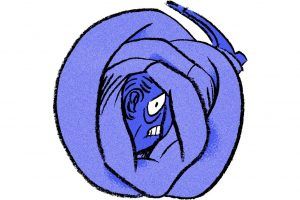 How did I know my anxiety had gotten the better of me? When I found myself taking meticulous notes on a forthcoming book by Erica Feldmann called HAUSMAGICK: Transform Your Home With Witchcraft (HarperOne, $25.99, available in March). The year 2018 hadn’t been so great, what with the death of a husband and, possibly, a republic. Maybe 2019 would be better if I bought certain purifying elements for my home. The right crystals, sage sticks and — salt? Apparently, you can sprinkle salt around the house after a person with “toxic energy” visits. Attention future dates: If you see me reaching for the shaker as you’re leaving, you know things haven’t gone well. If my nerves are frayed, I take cold comfort in knowing I’m not alone. Whether it’s our political situation, the jangling distractions of everyday life or the not-irrational sense that mankind’s need to find another planet isn’t just a sci-fi plotline, we seem to be in the midst of one massive freakout. Kierkegaard argued that anxiety stemmed from the “dizziness of freedom,” the paralysis that comes from infinite choice and possibility. That was in 1844. Imagine what he would have thought about today.
But here’s some good news: If we’re all a little tense, well, there’s a book for that. Many books, actually. Several of the ones I consulted were so wrongheaded or incomprehensible they made me more nervous. (“Motivation is a Unicorn Fart” almost made me hurl in a glittery rainbow arc.) Here are three that worked.
Recently a friend told me that he had reached what he calls his vidpoint: the moment you realize you have more movie hours stored on your DVR than you have hours left to live. I thought about that friend while reading Matt Haig’s NOTES ON A NERVOUS PLANET (Penguin, paper, $16), a follow-up to his previous book “Reasons to Stay Alive,” which chronicled his struggles with anxiety and depression. The core of first-world malaise, he argues, can be summed up by something T. S. Eliot observed in “Four Quartets”: We are “distracted from distraction by distraction.” Here, in clever chapterettes and listicles (he seems to assume we’re all too jumpy to read more than a few pages at a time), Haig muses about our anxieties: our fears of aging, of not being rich, of not being beautiful or successful enough. All while being massive consumers of everything.
More here.
Saturday Poem
Some Questions You Might Ask
Is the soul solid, like iron?
Or is it tender and breakable, like
the wings of a moth in the beak of an owl?
Who has it, and who doesn’t?
I keep looking around me.
The face of the moose is as sad
as the face of Jesus.
The swan opens her white wings slowly.
In the fall, the black bear carries leaves into the darkness.
One question leads to another.
Does it have a shape? Like an iceberg?
Like the eye of a hummingbird?
Does it have one lung, like the snake and the scallop?
Why should I have it, and not the anteater
who loves her children?
Why should I have it, and not the camel?
Come to think of it, what about the maple trees?
What about the blue iris?
What about all the little stone, sitting alone in the moonlight?
What about roses, and lemons, and their shining leaves?
What about the grass?
by Mary Oliver
from House of Light
Friday, January 18, 2019
Mary Oliver (1935 – 2019) did something rare: She made poetry accessible
Maggie Smith in the Washington Post:
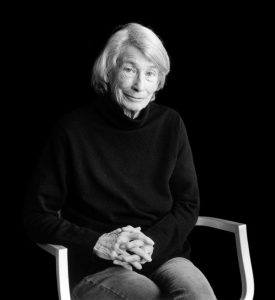 “Wild Geese” was trending on Twitter on Thursday, and poetry lovers — not naturalists or ornithologists — were responsible. Mary Oliver, arguably America’s most beloved best-selling poet, had died earlier in the day, at the age of 83. Her poem “Wild Geese,” from her 1986 collection “Dream Work,” was written in the second person, so the poet seems to be speaking directly to us. It ends this way:
Whoever you are, no matter how lonely,
the world offers itself to your imagination,
calls to you like the wild geese, harsh and exciting —
over and over announcing your place
in the family of things.
As the news of her death spread across the country and around the world, my social media feeds filled with poems, quotes, links to Oliver’s work and personal stories. What struck me was how many people were moved to tears by her death, people who had never met her. Her work touched millions of people deeply, and not only those who consider themselves poets or poetry lovers. Oliver’s work managed to do something rare: It reached people who didn’t particularly like or “get” contemporary poetry.
More here.
The Killing of Hypatia
Soraya Field Fiorio in Lapham’s Quarterly:
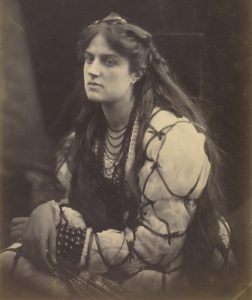
One early spring day during the year 415 in the city of Alexandria—the intellectual heart of the waning Roman Empire—the pagan philosopher Hypatia was murdered by a mob of Christian men. These men, the parabalani, were a volunteer militia of monks serving as henchmen to the archbishop. Their conscripted purpose was to aid the dead and dying but they could be more readily found terrorizing opposing Christian groups and leveling pagan temples. At the urging of Cyril, bishop of Alexandria, they had already destroyed the remains of the Library of Alexandria. The parabalani razed pagan temples, attacked the Jewish quarters, and defiled masterpieces of ancient art they considered demonic by mutilating statues and melting them down for gold. They now set their gaze on the city’s beloved teacher of mathematics and philosophy, whose social ranking was on par with Alexandria’s most important men. Understanding nothing of her philosophy, they called her a witch. They pulled the elderly teacher from her chariot as she rode through the city and dragged her to a temple. She was stripped naked, her skin flayed with jagged pieces of oyster shells, her limbs pulled from her body and paraded through the streets. Her remains were burned in a mockery of pagan sacrifice.
Hypatia’s death marked the end of paganism and the triumph of Christianity, the final act of a one-hundred-year-old feud waged by the new religion against the ancient world.
More here.
Michael Atiyah 1929-2019
Peter Woit in Not Even Wrong:
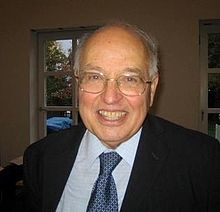 While away on vacation, I heard last week the sad news of the death last week of Michael Atiyah, at the age of 89. Atiyah was both a truly great mathematician and a wonderful human being. In his mathematical work he simultaneously covered a wide range of different fields, often making deep connections between them and providing continual new evidence of the unity of mathematics. This unifying vision also encompassed physics, and the entire field of topological quantum field theory was one result.
I had the great luck to be at MSRI during the 1988-89 academic year, when Atiyah spent that January there. Getting a chance to talk to him then was a remarkable experience. He had one of the quickest minds I’ve ever seen, often grasping what you were trying to explain before the words were out of your mouth. At one point that month I ran into Raoul Bott walking away from an ongoing discussion with Atiyah and Witten at a blackboard. Bott shook his head, saying something like “it’s just too scary listening to the two of them”.
More here.
How Trump could wind up making globalism great again
Robert Wright in Wired:
 A FEW DAYS before the 2016 election, journalist Andrew Sullivan wrote this about Donald Trump: “He has no concept of a nonzero-sum engagement, in which a deal can be beneficial for both sides. A win-win scenario is intolerable to him, because mastery of others is the only moment when he is psychically at peace.”
I’m not sure dominating other people is the only occasion when Trump feels at peace. Presumably there’s a moment during what is reportedly his standard McDonald’s meal—two Big Macs, two Filets-O-Fish, and a chocolate milkshake—when all seems right with the world.
Still, in Trump’s hierarchy of bliss, dominance does seem to rank at the top. “I love to crush the other side and take the benefits,” he wrote in a book called Think Big. “Why? Because there is nothing greater. For me it is even better than sex, and I love sex.” He went on to observe: “You hear lots of people say that a great deal is when both sides win. That is a bunch of crap. In a great deal you win—not the other side. You crush the opponent and come away with something better for yourself.”
So it makes sense that, two years after Trump entered office, Sullivan’s game-theoretical framing has caught on.
More here.
Ken Albala reads from the Rubaiyyat of Omar Khayyam
Tucker Carlson has sparked the most interesting debate in conservative politics
Jane Coaston in Vox:
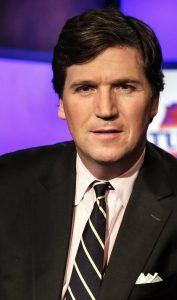 Last Wednesday, the conservative talk show host Tucker Carlson started a fire on the right after airing a prolonged monologue on his show that was, in essence, an indictment of American capitalism.
America’s “ruling class,” Carlson says, are the “mercenaries” behind the failures of the middle class — including sinking marriage rates — and “the ugliest parts of our financial system.” He went on: “Any economic system that weakens and destroys families is not worth having. A system like that is the enemy of a healthy society.”
He concluded with a demand for “a fair country. A decent country. A cohesive country. A country whose leaders don’t accelerate the forces of change purely for their own profit and amusement.”
The monologue was stunning in itself, an incredible moment in which a Fox News host stated that for generations, “Republicans have considered it their duty to make the world safe for banking, while simultaneously prosecuting ever more foreign wars.” More broadly, though, Carlson’s position and the ensuing controversy reveals an ongoing and nearly unsolvable tension in conservative politics about the meaning of populism, a political ideology that Trump campaigned on but Carlson argues he may not truly understand.
More here.
Did Salinger Go Awry?
Adam Kirsch in Tablet:
 The first literary anniversary of 2019 will be one of the biggest: Jan. 1 marks the centenary of J.D. Salinger. (To mark the occasion, his four books are being reissued in a boxed set by Little Brown.) A hundred years seems like it ought to be a long time in literary history—Salinger is as distant from a child born in 2019 as he himself was from Herman Melville. Yet somehow he doesn’t feel as far removed from us as the other writers of his generation—figures like Saul Bellow, Norman Mailer, or John Updike, who also became famous in the post-World War II years. Our readerly accounts with those famous names are basically settled, but Salinger’s remains open; his achievement feels unsettled, incomplete. One reason for this, of course, is that he never completed the ordinary life cycle of a writer. His first book, The Catcher in the Rye, appeared in 1951 and was an immediate sensation. It was followed two years later by Nine Stories, a collection of short stories that Salinger had published in magazines, including classics like “A Perfect Day for Bananafish” and “For Esme, With Love and Squalor.”
But there was no second novel to follow Catcher, and as the years passed Salinger’s stories grew rarer, longer, and much odder. He produced only two more books, each of which collected two of these long stories: Franny and Zooey in 1961 and Raise High the Roof Beam, Carpenters and Seymour: An Introduction in 1963. His last published fiction, the story “Hapworth 16, 1924,” appeared in The New Yorker, his longtime literary home, in 1965. All of these stories dealt with various members of the fictional Glass family—seven siblings whose precocity, wit, and spiritual depth made them beloved by some readers, and seriously annoying to others.
Then the great silence began. Already in 1953, Salinger had left New York, the scene of almost all his fiction, and moved to Cornish, New Hampshire, where he did his best to drop off the face of the Earth. By the time he died, in 2010, it had been more than half a century since he had published a story or made a public appearance. What news did emerge about Salinger tended to be unwholesome: Memoirs by his much younger lover, Joyce Maynard, and his daughter Margaret Salinger created the impression of a weird control freak, forever experimenting with fad diets and religions.
Yet Salinger’s withdrawal from the world, whatever its motives, had a remarkable effect on his work.
More here.
Friday Poem
Oral History
Something was to happen in the seventies but it did not happen.
Strange winds began to blow in the eighties.
And in the nineties what was not to happen, happened.
And so did an entire century take leave
before the century had ended.
All this is now an object of study.
And since we happen to be some of the representative specimens
of the twentieth century,
they are arriving on the scene
– for the Oral History Project of the Galaxy Channel –
with questionnaire and microphone,
these researchers of the Generation 21st
who can barely figure out the alphabet
of either the twenty first or the century.
What will they be able to ask?
What shall we be able to explain to them?
Except that I should get myself a good clean shave
and sit erect in the chair.
Except that my wife too should comb her hair
for the occasion.
by Asad Zaidi
from Poem Hunter
When Leaders are Bullies
Dawn Starin in Scientific American:
 For years I spent my days, from before dawn until after dusk, following a troop of endangered red colobus monkeys around a small West African forest. For the most part the simian soap opera taking place above my head was based around everyday practical domestic themes like gorging; sleeping; snacking; resting; leaping; and forming and maintaining alliances. But, as with many soap operas, from time to time life here became totally unfocused and utterly confusing. The plots—and there were many—often drifted: sometimes boring, sometimes sitcom, sometimes rom-com, sometimes melodrama, sometimes kill-‘em-dead bloody action and sometimes high scary political drama. The characters, with enough variety to delight any casting director, ranged from gentle to not-so-nice, helpful to nasty, benevolent to downright wicked.
With each passing day spent with these red- and black-haired, potbellied, thumbless, sometimes clumsy acrobats, it became more and more obvious to me that many things happening in this simian population were likely to have strong evolutionary continuity with what happens both with and to us humans. Their behaviors made it increasingly apparent that gaining a better understanding of them helps to understand ourselves.
More here.
What Antonioni’s Movies Mean Today
Stephen Dalton at BFI:
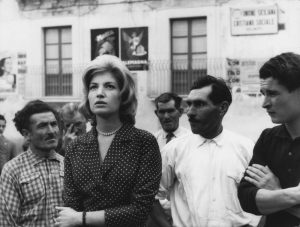 Antonioni films typically featured jaded lovers in middle-class urban settings, their lives blighted by quiet desperation, joyless sex and existential ennui. His open-ended plots were elliptical, elusive and experimental, providing rich material for both his most ardent admirers and harshest critics. Inevitably, after an almost unblemished run of classic films spanning the 1960s and 70s, shifting fashion and ill health forced him into semi-retirement. It makes perfect sense that he spent his twilight years painting big, bold, colourful abstract art.
Revisiting Antonioni’s classic films from a 21st-century viewpoint, their erotic frankness and modernist urban geometry no longer have the shock of the new. But as timeless cinematic explorations of the human condition, they stand up surprisingly well. In an era of sense-pummelling blockbusters and multi-media overload, these slow-paced ruminations on desire, despair and alienation feel strangely, jarringly fresh.
more here.
Revisiting Malcolm Lowry’s ‘Under the Volcano’
Seth L. Riley at The Millions:
 The ultimate tragedy of Under the Volcano is that of humanity’s wasted potential. Can, Lowry pondered, the psyche repair itself? We are capable of such great things, yet we choose mollification and comfort over almost anything—sometimes even over life itself. “I love hell,” Firmin claims. “I can’t wait to get back there. In fact I’m running, I’m almost back there already.” Under the Volcano is Firmin’s attempt to reckon with himself. He is alone, alienated and is finally unable to square himself with the world he has built for himself within the world he has, in many respects, stolen from others. And, in this, he has everything in common with those around him but, from Firmin’s point of view, the other characters are often reduced to minor characters, walk-ons. The only character that truly comforts Firmin is the beverage waiting before him. This minimization is not only Firmin’s: Each of the novel’s characters, in different ways, attempts to reduce the other to satiate the self.
more here.
On Natalia Ginzburg
Margaret Drabble at the TLS:
Rachel Cusk in her introduction (excerpted in the TLS April 18, 2018) makes a feminist case for Ginzburg’s evolution as a writer, citing Virginia Woolf’s conjectures that conventional structures of thought and expression would have to be “swept away if an authentic female literature were to be born”. She claims that Ginzburg “gives us a new template for the female voice and an idea of what it might sound like”. This is true, in a sense, but only in a sense. Ginzburg was not thinking in terms of templates, or of an authentic female literature. In the essay “He and I”, describing her relationship with her second husband Gabriele Baldini, she joyfully embraces various female stereotypes: she has no sense of direction, she doesn’t know how to drive, she is very untidy, she can’t fold blankets symmetrically. (This last peculiarly arresting trait also surfaces in another essay, not included in this volume, as a confession to her psychoanalyst.) Elsewhere she claims she is hopeless at mathematics, useless in the publishing office, bored in the theatre, doesn’t understand music, and is frightened of her maid. She doesn’t know how to knit, is no good at public speaking, and is not very good at writing for the press. In short, she is thoroughly self-deprecating. But at the same time she is also extraordinarily sure of herself. She says she likes to sing, although she always sings completely out of tune. Like many of the characters in her novels, she repeatedly sings the words of songs that she remembers: “I can repeat words that I love over and over again. I repeat the tune that accompanies them too, in my own yowling fashion, and I experience a kind of happiness as I yowl”.
more here.
Thursday, January 17, 2019
Do social media bots have a right to free speech?
Matt Field in the Bulletin of the Atomic Scientists:
 People who tweet in their jobs—let’s say 21st century journalists, just for example—might say that writing two million tweets represents a daunting challenge. That’s the rough number, Twitter says, that a Russian-linked set of accounts cranked out on the 2016 US presidential race in just the 10 weeks leading up to the election. Of course, in that case, the prolific “authors” were a collection of about 50,000 automated accounts often called bots. A new law in California will soon force bots that engage in electioneering or marketing to declare their non-human identity.
While the Kremlin agents who interfered in the US election likely wouldn’t be beholden to a state-level law in the United States, or deterred by it, domestic political campaigns and businesses might. For at least one constitutional scholar, that possibility raises this question: Do bots, like citizens, have that most sacred right enshrined in the First Amendment to the US Constitution, the right to free speech? Laurent Sacharoff, a law professor at the University of Arkansas, thinks the people programming bots may want US courts to answer that in the affirmative.
More here.