
Thomas Nagel at the NYRB:
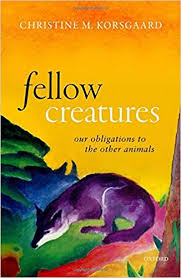 Christine Korsgaard is a distinguished philosopher who has taught at Harvard for most of her career. Though not known to the general public, she is eminent within the field for her penetrating and analytically dense writings on ethical theory and her critical interpretations of the works of Immanuel Kant. Now, for the first time, she has written a book about a question that anyone can understand. Fellow Creatures: Our Obligations to the Other Animals is a blend of moral passion and rigorous theoretical argument. Though it is often difficult—not because of any lack of clarity in the writing but because of the intrinsic complexity of the issues—this book provides the opportunity for a wider audience to see how philosophical reflection can enrich the response to a problem that everyone should be concerned about.
Since the publication of Peter Singer’s Animal Liberation in 1975, there has been a notable increase in vegetarianism or veganism as a personal choice by individuals, and in the protection of animals from cruel treatment in factory farms and scientific research, both through law and through public pressure on businesses and institutions. Yet most people are not vegetarians: approximately 9.5 billion animals die annually in food production in the United States, and the carnivores who think about it tend to console themselves with the belief that the cruelties of factory farming are being ameliorated, and that if this is done, there is nothing wrong with killing animals painlessly for food.
more here.
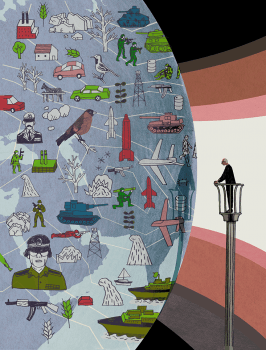 “Prof” was the English physicist and mathematician Lewis Fry Richardson, for whom doing science came as naturally as breathing. “It was just the way he looked at the world,” recalls his great-nephew, Lord Julian Hunt. “He was always questioning. Everything was an experiment.” Even at the age of 4, recounts his biographer Oliver Ashford in Prophet or Professor? Life and Work of Lewis Fry Richardson, the young Lewis had been prone to empiricism: Told that putting money in the bank would “make it grow,” he’d buried some coins in a bank of dirt. (Results: Negative.) In 1912, the now-grown Richardson had reacted to news of the Titanic’s sinking by setting out in a rowboat with a horn and an umbrella to test how ships might use directed blasts of noise to detect icebergs in fog. (Onlookers might have shaken their heads, but Richardson later won a patent for the fruit of that day’s work.) Nothing—not fellow scientists’ incomprehension, the distractions of teaching, or even an artillery bombardment—could dissuade him when, as he once put it, “a beautiful theory held me in its thrall.”
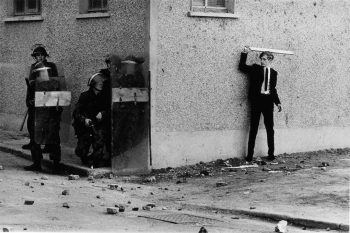 The horrors of the battlefield are never far away in Tate Britain’s retrospective of Don McCullin’s work: the dead Khmer Rouge soldiers in a crater in Cambodia, Congolese soldiers tormenting freedom fighters in Stanleyville, young Christians on a bombed-out Beirut street, posing like a boy band over the body of a dead Palestinian girl. But McCullin has said again and again that he doesn’t like to be called a war photographer; preferring, simply, “photographer”. He is as interested in the people fighting wars as the people caught in their rip tide. “Starving Twenty Four Year Old Mother With Child” taken in Biafra in 1968, shows a woman, so gaunt she appears elderly, trying to feed her baby, who is sucking on empty, wrinkled breasts. Another picture, taken in a psychiatric hospital in Beirut in 1982, shows a child curled up on a mattress, flies settled on his body. He is tied to the metal bedstead with string, to stop him wandering off amid the broken glass. There is no need to see or hear the bombs to understand their effect on the helpless, and the desperation of those who care for them.
 Anthropologists at the University of Oxford have discovered what they believe to be seven universal moral rules.
 Once upon a time, the task of scientists was to understand nature. “Merchants of Light,” Francis Bacon called them. They were a community of knowledge-seekers who subjected hypotheses to experimental test, using what we now simply call “the scientific method.” Understanding nature, so the idea, would both satisfy human curiosity and better our lives.
 Now that policies made famous by Bernie Sanders, like Medicare for All and free college, and newer ones like the
  The daguerreotype shows a 7-year old girl. Her face is pale, her expression somber. Her elegant plaid dress, trimmed in lace, and the notebook on the cloth-covered table behind her, suggest that she comes from a prosperous family.
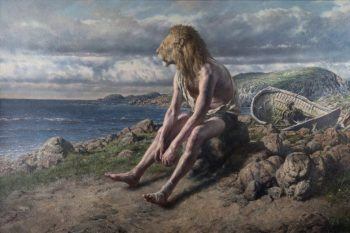 What was the driving force that made us human, akin to but separate from other apes and our evolutionary cousins such as the Neanderthals? In The Goodness Paradox, the anthropologist Richard Wrangham approvingly quotes Frederick the Great in pointing to “the wild beast” within each man: our nature, he argues, is rooted in an animal violence that morphed over time to become uniquely human. When male human ancestors began to plot together to execute aggressive men in their communities, indeed to carry out such killings through what Wrangham calls “coalitionary proactive aggression”, they were launched towards full humanity.
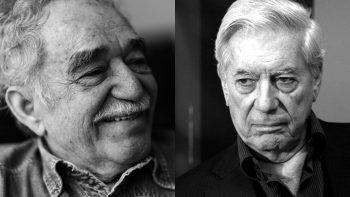 It was about eleven or twelve in the morning and I was in my house in Colonia Nápoles, where I had an office, a big house with an editorial office in one part, and in the other part I lived with my girlfriend and my two children. There’s a knock at the door and it’s Gabo and Mercedes. I was very happy and very surprised to see him. Gabo was already a friend of mine, but there are hierarchies in friendships. It was a friendship of guarded proportions. I was a newspaper photographer and he was what he is. Back then I didn’t presume to call him Gabo. Calling him Gabito was for me like calling Cervantes “Miguelito.” For me, he’s Gabriel García Márquez. They came for the photographs. He told me, “I want you to take some pictures of my black eye.” They came to my house because they trust me.
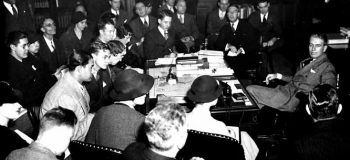 Donald Trump campaigned for the presidency and continues to govern as a man who is anti-intellectual, as well as anti-fact and anti-truth. “The experts are terrible,” Trump said while discussing foreign policy during the 2016 campaign. “Look at the mess we’re in with all these experts that we have.” But Trump belongs to a long U.S. tradition of skepticism about the role and motivations of intellectuals in political life. And his particularly toxic version of this tradition raises provocative and difficult questions: Are there occasions when anti-intellectualism is defensible or justified? Should we always dismiss charges that intellectuals are out of touch or too protective of established ways of thinking?
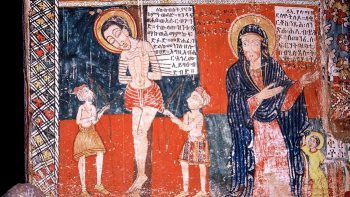 In the 14th century, the Black Death swept across Europe, Asia, and North Africa, killing up to 50% of the population in some cities. But archaeologists and historians have assumed that the plague bacterium Yersinia pestis, carried by fleas infesting rodents, didn’t make it across the Sahara Desert. Medieval sub-Saharan Africa’s few written records make no mention of plague, and the region lacks mass graves resembling the “plague pits” of Europe. Nor did European explorers of the 15th and 16th centuries record any sign of the disease, even though outbreaks continued to beset Europe. Now, some researchers point to new evidence from archaeology, history, and genetics to argue that the Black Death likely did sow devastation in medieval sub-Saharan Africa. “It’s entirely possible that [plague] would have headed south,” says Anne Stone, an anthropological geneticist who studies ancient pathogens at Arizona State University (ASU) in Tempe. If proved, the presence of plague would put renewed attention on the medieval trade routes that linked sub-Saharan Africa to other continents. But Stone and others caution that the evidence so far is circumstantial; researchers need ancient DNA from Africa to clinch their case. The new finds, to be presented this week at a conference at the University of Paris, may spur more scientists to search for it.
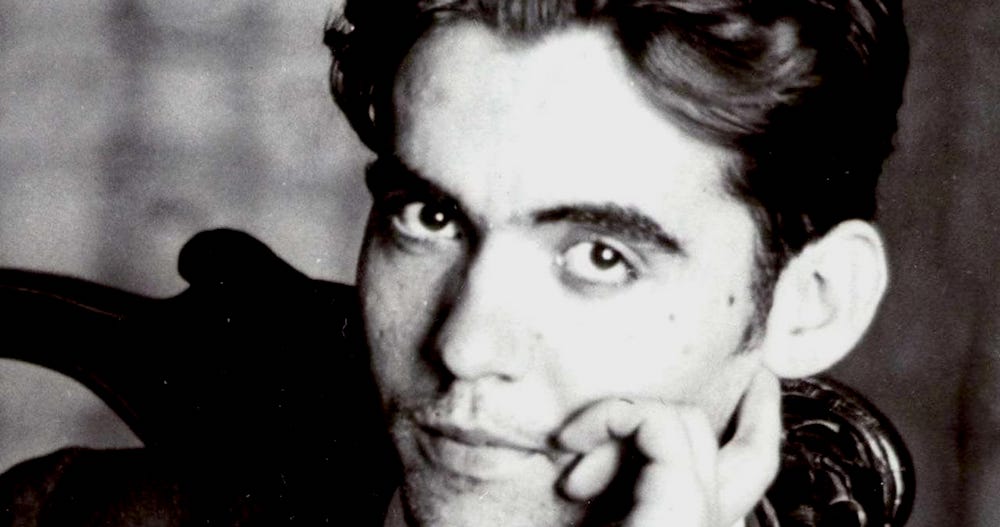 Before dawn on August 17th, 1936, a man dressed in white pajamas and a blazer stepped out of a car onto the dirt road connecting the towns of Víznar and Alfacar in the foothills outside Granada, Spain. He had thick, arching eyebrows, a widow’s peak sharpened by a tar-black receding hairline, and a slight gut that looked good on his 38-year-old frame.
 In
In It should be “okay” for Americans who want their country to have a close alliance with a foreign power to form political organizations that advance their views. The problem with AIPAC is not that it pushes American lawmakers to show deference to the interests of another country. The problem is that it pushes them to
 C
C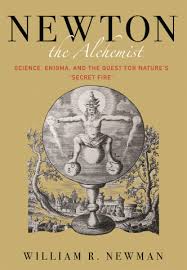 The discovery of Newton’s alchemical manuscripts – containing no fewer than a million words, some of the pages mutilated by the acids used during his quest for the philosopher’s stone – led to a flurry of scholarly activity. This culminated in the 1980s in the work of Richard Westfall, still Newton’s greatest biographer, and Betty Jo Teeter Dobbs. In a spectacular rejection of Butterfield’s dismissiveness, they argued that alchemy underpinned Newton’s whole world-view. Newton’s belief in transmutation, Dobbs claimed, was akin to a religious quest, with the ‘philosophic mercury’, believed to be ableto break down metals into their constituent parts, acting as a spirit mediating between the physical and divine realms. Westfall suggested that it was assumptions born in Newton’s alchemical researches about invisible forces acting at a distance that allowed him to develop his greatest theory: that of universal gravitation, which he announced to the world in his Principia of 1687.
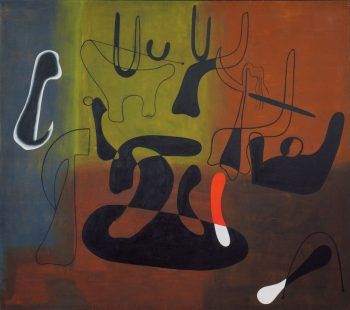 “Painting,” painted by Joan Miró in 1933, in Barcelona, is a composition of black, red, and white blobby shapes and linear glyphs on a ground of bleeding and blending greens and browns. It hangs in “Joan Miró: Birth of the World,” an enchanting show at the Museum of Modern Art that draws on the museum’s immense holdings of Miró’s work, along with a few loans. “Painting” is a bit sombre, for him, but it has the ineffably friendly air of nearly all his art: adventurous but easy-looking, an eager gift to vision and imagination. It invokes a word inevitably applied to Miró: “poetic,” redolent of the magic, residual in us, of childhood rhymes, with or without figurative elements. Never unsettling in the ways of, say, Matisse or, for heaven’s sake, Picasso, Miró is a modernist for everybody. (He died in 1983, at the age of ninety.) This has given him a peculiar trajectory in the modern-art canon: he was considered majestic at points in the past, in ways that feel somewhat flimsy now. Looking at “Painting” helps me think about the art world’s shifting estimation of the “international Catalan,” as Miró termed himself. It stirs a personal memory.