
Kate Stanley in the Los Angeles Review of Books:
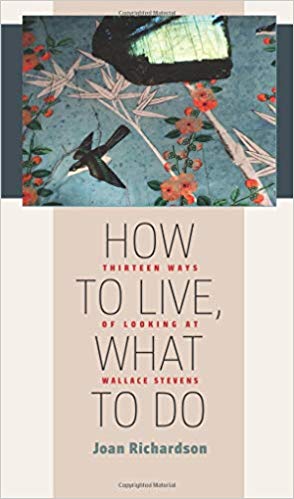 CAN POEMS TEACH US how to live? What does it mean to approach poetry as a source of self-help? It’s not hard to call to mind examples of poetry that rouse or soothe or refocus a reader, lifting or quieting the mind like a deep breath. Yet much of the poetry encountered in literature classrooms and canonical anthologies may not readily reflect the self that is reading it, and therefore may not readily become a tool of self-improvement. The work of many modernist poets in particular is placed under the banner of “art for art’s sake,” a motto meant to explicitly free such poetry from the responsibility of serving a didactic or utilitarian function. The poems of Wallace Stevens, for instance, are frequently taken to epitomize the kind of high modernist difficulty that in its slippery symbology and ambiguous affect would seemingly resist being reliably employed for any useful purpose.
But Joan Richardson’s How to Live, What to Do: Thirteen Ways of Looking at Wallace Stevens emphatically asserts the practical use-value of poetic difficulty. As is suggested by Richardson’s title (which borrows from a Stevens poem), Stevens is in fact concerned above all with improving the daily lives of his readers. However, unlike the literature of self-help, these poems seem to offer very little by way of straightforward advice or therapeutic instruction.
More here.
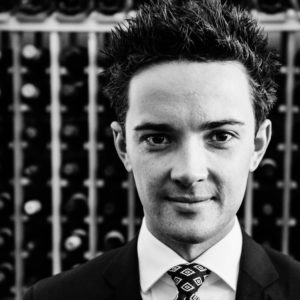 Some people never drink wine; for others, it’s an indispensable part of an enjoyable meal. Whatever your personal feelings might be, wine seems to exhibit a degree of complexity and nuance that can be intimidating to the non-expert. Where does that complexity come from, and how can we best approach wine? To answer these questions, we talk to Matthew Luczy, sommelier and wine director at Mélisse, one of the top fine-dining restaurants in the Los Angeles area. Matthew insisted that we actually drink wine rather than just talking about it, so drink we do. Therefore, in a Mindscape first, I recruited a third party to join us and add her own impressions of the tasting: science writer

 “
“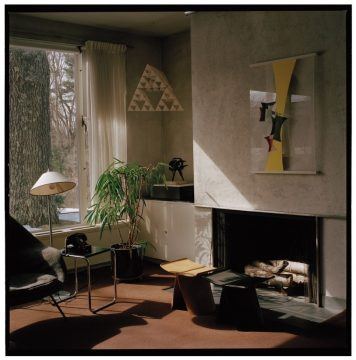 Because his genius was untethered to his misery, and because he often handed his ideas off to others, Gropius is a tricky subject for a biographer. Following his lead, we focus on his colorful and eccentric supporting players. As MacCarthy suggests, he had none of the puffery we associate with great architects. He was more a technocrat than a shaman. In a sense, therefore, MacCarthy’s book is a biography of the Bauhaus itself. It’s a story that she presents with a distinctly human-seeming arc. Its childhood unfolded in Weimar, where Itten impressed the students with his mantra, “Play becomes party—party becomes work—work becomes play,” and Gropius read the Christmas story aloud every year. But by early adolescence, in the mid-twenties, the Bauhaus had outstayed its welcome. In 1924, a new provincial government threatened to cut off the school’s subsidies. Nazi factions in the region supposed that all those foreign-looking students were Jews or Jewish sympathizers. The following year, Gropius moved the school to Dessau, an engineering and manufacturing center, southwest of Berlin. There, for the first time, the Bauhaus built itself a campus.
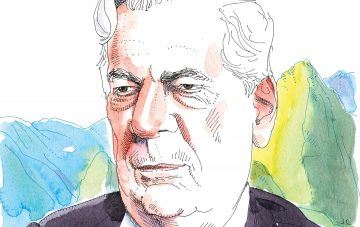 Literature is fire,” Mario Vargas Llosa declared in 1967, when he accepted a prize commemorating Rómulo Gallegos, the esteemed Venezuelan novelist and former president. Gallegos represented the center-left tradition in Latin America, and Vargas Llosa was determined to challenge his audience from the left. Literature, the Peruvian novelist continued, “means nonconformism and rebellion…. Within ten, twenty or fifty years, the hour of social justice will arrive in our countries, as it has in Cuba, and the whole of Latin America will have freed itself from the order that despoils it, from the castes that exploit it, from the forces that now insult and repress it.” Nearly 40 years later, in 2005, Vargas Llosa received a very different sort of prize and delivered a very different kind of speech. Accepting the Irving Kristol Award from the American Enterprise Institute, he denounced the Cuban government and called Fidel Castro an “authoritarian fossil,” praised the Austrian School economist Ludwig von Mises as a “great liberal thinker,” and defended calls for privatizing pensions. It was quite a remarkable transformation. In the opening paragraph of Vargas Llosa’s 1969 novel, Conversation in the Cathedral, the protagonist asks: “At what precise moment had Peru fucked itself up?” It is a question that many people have asked as well of Peru’s greatest novelist.
 IT WAS A
  The great surprise of this debate turned out to be how much in common the old-school Marxist and the Canadian identity politics refusenik had.
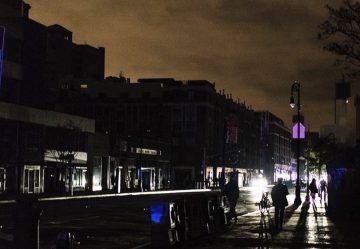 You might find your car dying on the freeway while other vehicles around you lose control and crash. You might see the lights going out in your city, or glimpse an airplane falling out of the sky. You’ve been in a blackout before but this one is different.
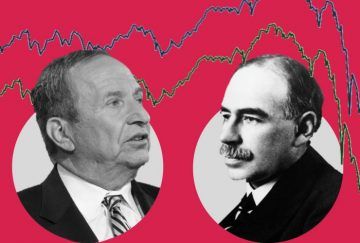 “Has economics failed us?” Larry Summers, the former president of Harvard and economic adviser for presidents Barack Obama and Bill Clinton, recently asked
 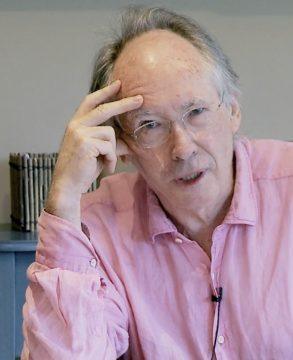 What’s been preoccupying me the last two or three years is what it would be like to live with a fully embodied artificial consciousness, which means leaping over every difficulty that we’ve heard described this morning by Rod Brooks. The building of such a thing is probably scientifically useless, much like putting a man on the moon when you could put a machine there, but it has an ancient history.
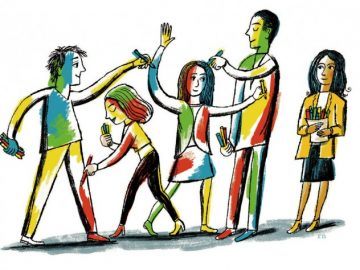 WHEN JAL MEHTA
 One afternoon in August 2010, in a conference hall perched on the edge of San Francisco Bay, a 34-year-old Londoner called Demis Hassabis took to the stage. Walking to the podium with the deliberate gait of a man trying to control his nerves, he pursed his lips into a brief smile and began to speak: “So today I’m going to be talking about different approaches to building…” He stalled, as though just realising that he was stating his momentous ambition out loud. And then he said it: “AGI”. AGI stands for artificial general intelligence, a hypothetical computer program that can perform intellectual tasks as well as, or better than, a human.