
Terry W. Hartle in The Christian Science Monitor:
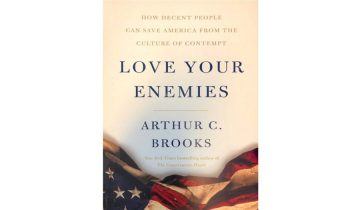 Arthur Brooks is one of the limitless number of policy analysts who toil in Washington. He stands out both because he is prolific and his work has had an impact. He has already written 10 books on a wide range of subjects, served as president of the influential center-right American Enterprise Institute, and writes a column for the Washington Post. His background sets him apart. An accomplished classical musician, he spent 12 years playing in a symphony orchestra. He worked his way through college and attended Thomas Edison State University in New Jersey – not exactly a “big name” school in the corridors of power (though he did earn a Ph.D. in public policy from the Rand Institute). On a personal level, he is deeply religious (Roman Catholic) and calls the Dalai Lama a friend and mentor.
In his latest book, Love Your Enemies: How Decent People Can Save America From the Culture of Contempt, Brooks takes aim at the hypertoxic climate that affects our civic culture. His description of the current situation is essentially that “hyperbolic” public discourse driven by an “outrage industrial complex” has produced a culture of contempt that is tearing America apart.
He uses the word “contempt” deliberately because it is more than mere anger. A culture of contempt reflects a desire to “mock, shame, and permanently exclude [the other side] from relationships by belittling, humiliating, and ignoring” those with whom we disagree. “Contempt” says to others: “You disgust me. You are beneath caring about.” Brooks marshals an impressive amount of evidence to make his point. Not only is such behavior damaging to the public discourse, he writes, but it undermines the health of not only its practitioners but also of those on the receiving end. He cites research to suggest that humans are likely hard-wired to be decent and kind and to seek common ground. To him, the toxic political culture undermines our democracy and health and is contrary to human nature.
More here.
 As the French novelist Albert Camus said, life is “absurd,” without meaning. This was not the opinion of folk in the Middle Ages. A very nice young Christian and I have recently edited a history of atheism. We had a devil of a job – to use a phrase – finding people to write on that period. In the West, Christianity filled the gaps and gave life full meaning. The claims about our Creator God and his son Jesus Christ, combined with the rituals and extended beliefs, especially about the Virgin Mary, meant that everyone’s life, to use a cliché from prince to pauper, made good sense. The promises of happiness in the eternal hereafter were cherished and appreciated by everyone and the expectations put on a godly person made for a functioning society.
 For me — and, I suspect, for many others — my crush on Rogers has something to do with seeing a man play, and make-believe, and talk openly about his feelings; it’s about what it means to see a man not acting like “a man” at all. And the excitement of that — political, ethical, and, yes, sexual. What would it be like, I wonder as I watch Rogers, to fuck a man who rejects masculinity? How does Rogers, embodying this alternative, make us think about sex, about who it is safe to do it with, and how, and why, and who we become when we fuck, and what hurts when we do, and what might feel good, and what never did, and why our sex is so often marked by violence, physical or mental or emotional. The Rogers phenomenon is about what masculinity might look like if one rejects its patriarchal construction; it’s about the fear of — and intense desire for — a radical alternative.
 What Overton proposes is a sort of grand unified theory of suicide bombing, tracing a thread of bloody utopian thinking through a century or so of self-destructive murder, where the act prefigured either an idea of self-sacrifice for a greater good or reflected the religious conviction that the self continues.
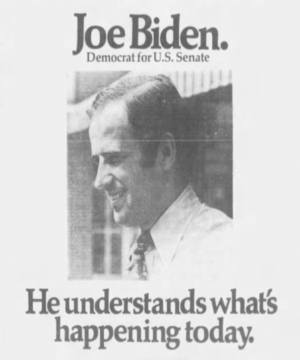 “Joe Biden. He understands what’s happening today.”
 Shakespeare’s power to endure has been ensured by twin track modes of survival: his life on the page and on the stage. His texts are pored over scrupulously by academics, read dreamily by kids and scanned with soft remembrance by the sere. At any given moment, his dramatic verse is sung, shouted, muttered and sometimes spoken with the warm assurance it needs, from hundreds of stages to thousands of eager spectators.
 Ten thousand years ago, in the Neolithic period, before human beings began making pottery, we were playing games on flat stone boards drilled with two or more rows of holes.
 One parasite that feeds on algae is so voracious that it even stole its own mitochondria’s DNA.
 Halfway through his first five-year term, U.N. Secretary General
  P
P “I’ll be wearing a blue anorak,” he said to me on the phone, so I could identify him when we met. We were more like immediate siblings than date possibilities for each other, and I repeated this line about a blue anorak to him for twenty years. He claims there was no blue anorak and what the fuck is an anorak, anyhow? But that’s what I remember. We went to see a Gerhard Richter show at Marian Goodman. I was aware that Alex’s grandfather Alexander Lippisch was a famous Luftwaffe aeronautical engineer who was recruited to White Sands Missile Range after the war. Looking at Richter’s paintings together, I immediately associated Richter’s blend of formal precision and German trauma with Alex’s. From the gallery, we walked into Central Park. We sat on a rock and Alex told me that one day, on a very similar rock, he’d been on acid with his friend the painter Alexander Ross. As they sat on this rock, tripping, they watched Alex Katz approach a Sabrett cart and buy a hot dog. Three painters named Alex: two on acid, one eating a hot dog. They left and went to Alex Brown’s place on Forsyth Street and, still tripping, walked into the scene of a dramatic drug bust.
 A young bank teller is shot dead during a robbery. The robber flees in a stolen van and is chased down the motorway by a convoy of police cars. Careening through traffic, the robber runs several cars off the road and clips several more. Eventually, the robber pulls off the motorway and attempts to escape into the hills on foot, the police in hot pursuit. After several tense minutes, the robber pulls a gun on the cops and is promptly killed in a hail of gunfire. It is later revealed the robber is a career criminal with a history of violent crime stretching all the way back to high school.
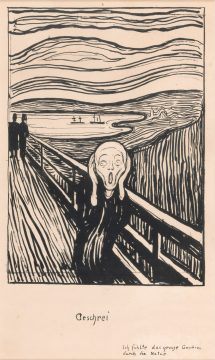 At the start of the 20th century Sigmund Freud observed the psychological phenomenon of “repetition compulsion”, the pathological desire to repeat a pattern of behaviour over and over again. He no doubt would have diagnosed the painter Edvard Munch with such an affliction. As the British Museum’s new exhibition of his work demonstrates, Munch returned obsessively to certain visual motifs: uncanny sunsets, zombie-like faces, threateningly sexualised female bodies.
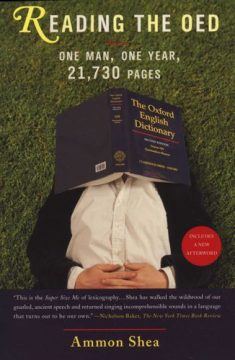 Ammon Shea loves dictionaries – especially the OED. He loves the OED so much, he read it – the whole thing, in its second edition: 21,730 pages with around 59 million words. It took him a year, full-time, and he wrote a book about it, titled
  These days you can dismiss anything you don’t like by calling it “a religion.” Science, for instance,