
Category: Archives
Thursday Poem
Unto Others
….. To a roomful of people at a private fundraiser for Mitt
….. Romney, Mormon; US presidential candidate, May 2012
….. “There are 47 percent who are with (the President),
….. who are dependent upon government, who believe that
….. they are victims, who believe that government has a
….. responsibility to care for them, who believe that they
….. are entitled to health care, to food, to housing, to you
….. name it. . . . That’s entitlement.” —Mitt Romney
….. “All things therefore whatsoever ye would that men should
….. do unto you, even so do ye also unto them.” —Matthew 7:12
….. “Who is here so vile that he will not love his country? If any,
….. speak; for him have I offended.” —Julius Caesar, act 3, scene 2
Who there knows how good it is to know
a warm bed and a roof? If any, speak.
Who there knows how good it is to know
a schoolroom? If any, speak.
Who there knows how good it is to know
the stiffness of new shoes? If any, speak.
Who there knows how good it is to know
the steam of a meal on your cheeks? If any, speak.
Who there knows how good it is to know
some God hears you weep? If any, speak.
Who there knows how good it is to know?
All of you know, so speak.
Say you know how good it is to know.
All of you know, so speak. Say it’s OK
for others to know how good it is to know.
Go ahead, speak.
If you know how good it is to know,
why then don’t you speak?
Why then don’t you speak?
Say something. Speak. Speak. Speak.
by Lauren Marie Schmidt
from Filthy Labors
Curbstone Books, 2017
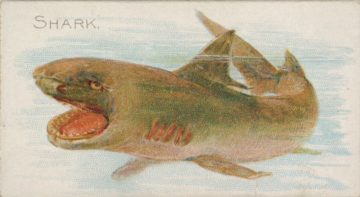
Shark’s Eye: The more I learned about the pain humans can cause each other, the more I turned to sharks
Rebecca Flowers in Guernica:
It was the year that my sister, feeling depressed and isolated, swallowed an entire bottle of pills. For that day, and perhaps a few days afterward, my brain stopped making memories. There are fragments that float to the surface. The doctor telling us she might have ruined her kidneys forever. The image of a scene I hadn’t actually witnessed: the plastic pill bottle falling from my sister’s limp hands and clattering to the tile floor. The blur of an ambulance ride. The clearest memory I have is from a few weeks later: I am doing homework by my sister’s hospital bed, she in her hospital gown, my uniform still on from the school day.
Three years later, my parents split up. In the fallout, my sister went to live with my father. I stayed with my mother, who was heartbroken. I tried to comfort her, but by now all I knew was how to be quiet.
…The more I learned about the world of humans — the pain they can cause each other, the fighting and the guilt — the more I turned to sharks. I caught a Shark Week special depicting the rash of shark attacks in the summer of 1916 that had inspired Jaws. I watched eyewitness videos and documentaries about marine biologists. I grew on a diet of encyclopedias and books filled with Latin names and anatomically correct illustrations of sharks.
More here.
Nancy Pope: Smithsonian’s National Postal Museum
Joshua Bauchner and Nancy Pope at Cabinet Magazine:
 CABINET: Let’s start with something very basic: When I send a hand-addressed letter from here in New York to a friend in Oakland, how does it get there? Why do letters go places when I put them in the mailbox?
NANCY POPE: Getting the mail from one place to another has four basic segments: acceptance, processing, transportation, and delivery. Acceptance can happen in your mailbox, in one of the on-street blue collection boxes, or at a local post office, and conveys your letter, via the local post office, to the nearest processing center; this still happens mostly by hand. The next two steps are really all a question of automation, as they have been since after the end of World War II. Processing comes down to machinery. Each of the three different types of mail—letters, packages, and flats, which include catalogues and magazines—has its own way through the system, its own machines. Your letter first goes through a culler, which separates the letters from the packages. It then enters a machine that does facing and canceling. The machine finds the stamp thanks to a phosphor in the stamp; it senses the phosphor, flips the envelope face up if necessary, cancels the stamp, and sends the letter on to a barcode machine, which will actually read the address, your handwriting.
more here.
In A Post-Hegelian Spirit
Byron Belitsos at Marginalia:
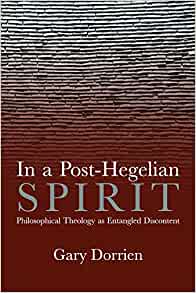 But Dorrien takes a new turn in his monumental reprise of his previous work on the post-Kantian epoch in theology. In a Post-Hegelian Spirit elevates Hegel’s status as the indispensable philosopher, and we even hear Dorrien say that, like himself, “Adorno, throughout his career, and Derrida, in his later career, similarly grasped that we are never done with Hegel.” But Dorrien’s new tome has another broad mission, that of highlighting his “discontent” with the present moment, which is advertised right up front in his subtitle: Philosophical Theology as Idealistic Discontent. But why an idealistic discontent?
Dorrien makes clear in the book’s opening page that he is “making an argument for a liberationist form of religious idealism” while also critiquing post-Hegelian theologians like Karl Barth who may have been “penetrating” thinkers but were “one-sided compared to Hegel.”
more here.
We Have Never Been Modern With Tim Howles
I sank into severe depression during the pandemic. Here’s how I emerged
EAD in Science:
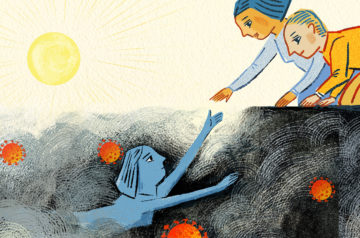 The tile floor was cold and hard against my knees, but I couldn’t move from my spot in front of the toilet. It was the third morning that week I had spent violently throwing up because of anxiety at the prospect of going into the lab. So far, I had been able to stay home without consequence. But that day I was scheduled to meet other lab members to work on an experiment essential for my Ph.D. project. At 5:45 a.m. I let them know I wouldn’t be coming in, feeling a wave of guilt. “How did I get here?” I wondered.
I entered grad school in July 2019. The first semester went smoothly—I did well in my classes, met interesting people, and found an adviser after a series of lab rotations. But everything changed during my second semester, as COVID-19 spread. With our lab shut down and bench work impossible, I tried to focus on my classes, which had gone virtual. Eventually, though, I experienced Zoom burnout and began to pay less attention. As in-person interactions waned, so did my mental health. When the semester finished, I moved to doing research full time, and my days had even less structure and social connection. My university lifted restrictions on lab work in July 2020, but I couldn’t find the will to go in. The only person I saw for the next few months was my husband. Friends and family reached out, but as I sank deeper into depression, I stopped responding.
Throughout my life I had dealt with more minor mental health issues, but what I experienced during the pandemic was unlike anything before. My depression was so bad I was essentially bed-bound. I barely managed to shower once a week, could not sleep, and had zero motivation to work—a problem I never imagined I would have. Yet there I was, doing nothing day after day. The inertia was insurmountable.
I noticed that many of my peers were publishing papers and winning awards. I felt certain I didn’t belong in my program and would be asked to leave as soon as my lack of progress was brought to light. I canceled meetings with my adviser for 2 months straight, hoping she wouldn’t notice.
More here.
Wednesday, November 17, 2021
Wittgenstein’s “Tractatus” at 100
Jared Marcel Pollen in the Los Angeles Review of Books:
 It surprises us to learn how much literature was penned in the trenches of World War I. The poems of Wilfred Owen or the early tales of Tolkien, for example, are all the more exceptional when we consider that they were composed amid states of mortal terror. But the most incredible and most stupefying example perhaps is Ludwig Wittgenstein’s Tractatus Logico-Philosophicus. Less than a hundred pages long, it is a slender book that, according to its author, set about to find a “final solution” to the problems of philosophy (a phrase made even more cryptic by the knowledge that Wittgenstein and Hitler were once schoolmates). And indeed, when the Tractatus was published in the fall of 1921, Wittgenstein effectively “retired” from his trade, believing that he’d found the basement of Western philosophy and had turned off the lights when he left.
The Tractatus began as a series of notes that Wittgenstein kept in his bag throughout his tours with the Austrian army.
More here.
Evidence from evolutionarily ancient creatures is revealing that sleep is not just for the brain
Elizabeth Pennisi in Science:
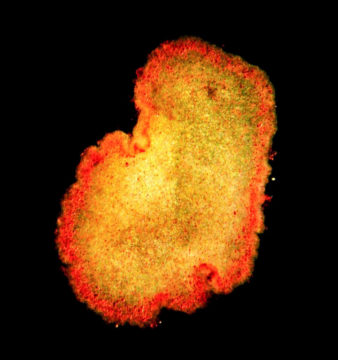
Dive among the kelp forests of the Southern California coast and you may spot orange puffball sponges (Tethya californiana)—creatures that look like the miniature pumpkins used for pies. No researchers paid them much mind until 2017, when William Joiner, a neuroscientist at the University of California (UC), San Diego, decided to look into whether sponges take naps.
That’s not as silly a question as it seems. Over the past few years, studies in worms, jellyfish, and hydra have challenged the long-standing idea that sleep is unique to creatures with brains. Now, “The real frontier is finding an animal that sleeps that doesn’t have neurons at all,” says David Raizen, a neurologist at the University of Pennsylvania (UPenn) Perelman School of Medicine. Sponges, some of the earliest animals to appear on Earth, fit that description. To catch one snoozing could upend researchers’ definition of sleep and their understanding of its purpose.
More here.
The Choking of the Global Minotaur
James K. Galbraith in Project Syndicate:
 A supply chain is like a Rorschach Test: each economic analyst sees in it a pattern reflecting his or her own preconceptions. This may be inevitable, since everyone is a product of differing educations, backgrounds, and prejudices. But some observed patterns are more plausible than others.
Consider the following sampling of perspectives. For Jason Furman, formerly US President Barack Obama’s chief economic adviser, and Lawrence H. Summers, a former US secretary of the treasury, today’s supply-chain problem is one of excessive demand. According to Furman, it is a “high class” issue that reflects a strong economy. The “original sin” was the American Rescue Plan, which provided too much support through funds disbursed directly to US households.
For John Tamny of RealClearMarkets, the supply-chain problem is one of “central planning.” Had President Joe Biden’s administration not sent directives to port managers, free markets would have sorted everything out. And for Awi Federgruen, a professor of management at the Columbia Business School, the issue is inefficiency, the remedy for which is to work harder and do more with less.
None of these interpretations withstands scrutiny.
More here.
Lawrence Krauss interviews Sabine Hossenfelder
Wednesday Poem
Four Poems of Han-shan, the master of Cold Mountain
I
Don’t you know the poems of Han-shan?
They’re better for you than scripture-reading.
Cut them out and paste them on a screen,
Then you can gaze at them from time to time.
II
Where’s the trail to Cold Mountain?
Cold Mountain? There’s no clear way.
Ice, in summer, is still frozen.
Bright sun shines through thick fog.
You won’t get there following me.
Your heart and mine are not the same.
If your heart was like mine,
You’d have made it, and be there!
III
Cold Mountain’s full of strange sights
Men who go there end by being scared.
Water glints and gleams in the moon,
Grasses sigh and sing in the wind.
The bare plum blooms again with snow,
Naked branches have clouds for leaves.
When it rains, the mountain shines –
In bad weather you’ll not make this climb.
IV
A thousand clouds, ten thousand streams,
Here I live, an idle man,
Roaming green peaks by day,
Back to sleep by cliffs at night.
One by one, springs and autumns go,
Free of heat and dust, my mind.
Sweet to know there’s nothing I need,
Silent as the autumn river’s flood.
by Han-shan
Translated by A. S. Kline © Copyright 2006 All Rights Reserved.
Michael Shellenberger On Why Environmental Alarmism Hurts Us All
Brendan Foht and Michael Shellenberger at The New Atlantis:
 We’re doing astonishingly well, and most environmental trends are going in the right direction. Carbon emissions have declined more in the United States than in any other country over the last twenty years, mostly due to fracking. Carbon emissions peaked in Europe in the mid-seventies, in the main European countries I should say. And some people think carbon emissions have peaked globally. I personally think they probably have another ten years of growth, but we’re close to global peak emissions, after which they will go down. We appear to be at peak agricultural land use, and that will go down. So Malthus was sort of spectacularly wrong, both on human progress, but also environmental progress.
But I don’t think that apocalyptic environmentalists are wrong because they are not good at math, or because they don’t know how to read a scientific paper, or because they don’t know what the UN Food and Agriculture Organization data say, or because they don’t know that the Intergovernmental Panel on Climate Change doesn’t predict any increase of deaths from natural disasters or food scarcity.
It’s not that they don’t know those things. They do know those things. They are motivated by something much more, much deeper, and it is definitely a morality.
more here.
Nuclear Power Debate
Another View of Kikuji Kawada’s Hiroshima
Brian Dillon at Artforum:
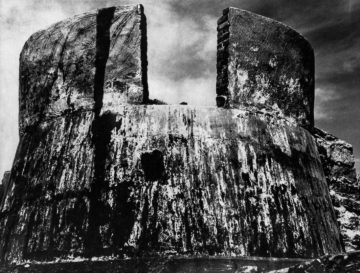 EARLY IN JULY 1958, the Japanese photographer Kikuji Kawada, then aged twenty-five and a staffer at the weekly magazine Shukan Shincho, visited Hiroshima for a cover story to run in the month following. He was there to photograph another photographer, Ken Domon, whose book Hiroshima had been published in the spring. Among Domon’s subjects: the scarred bodies of survivors of the atomic-bomb attack of August 6, 1945, and the skeletal dome of the city’s riverside industrial exhibition hall. When he had finished his assignment, Kawada lingered in the ruins below the Genbaku Dome, where brick and concrete walls were covered with stains composing, as he put it, “an audibly violent whirlpool.” Kawada took no photographs of the enigmatic markings, but returned two years later with a 4 x 5 view camera, and began making long exposures in “this terrifying, unknown place.”
The book that resulted, Chizu (The Map), first published in 1965, is one of the wonders of postwar Japanese photography, as much in Kawada’s approach to the form and boundaries of the photobook as his singular address to the atomic history that was then exercising Japanese artists as well as antinuclear activists.
more here.
The Book of Emotions – how does it feel?
Kate Kellaway in The Guardian:
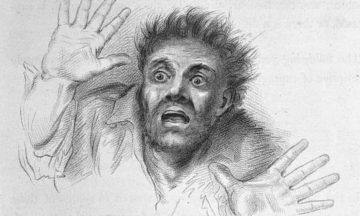 There is a sense in which we are all books of emotions: we flip through our pages and think we know how to name what we are feeling. What makes this book so fresh, fascinating and unusual is that it takes nothing for granted and raises new questions at every turn. It reminds us that the language we use to name and nail emotions is provisional (as rough and ready as pinning the tail on the donkey). In Marina Warner’s superb foreword, she mentions in passing that “the word emotion only emerges in English in the 17th century”. I read this with sudden insecurity. Without the containment of the word, what might emotion mean?
“For something so powerful and fundamental, emotion is a slippery concept,” the book’s editor, Edgar Gerrard Hughes, suggests, before asking us to consider whether hope, curiosity, thoughtfulness, aggression and concentration count as emotions. But the overarching question is whether the concept of emotion is “too vague and multivalent to be of real use”. What follows is a meticulously chosen selection of serious and playful contributions that include blushing, the pre-history of emojis and disgust. There is a brilliant fictional piece, After the Party, by Natalie Hume, in which a woman writes a note to the father of her children in the sweetest tone (rage with sugar added) to explain why she no longer wants to live with him.
More here.
New technologies are promising a shortcut to enlightenment
Sigal Samuel in Vox:
 It was a Monday morning, which was reason enough to meditate. I was anxious about the day ahead, and so, as I’ve done countless times over the past few years, I settled in on my couch for a short meditation session. But something was different this morning.
Gently squeezing my forehead was a high-tech meditation headset, outfitted with sensors that would read my brain waves to tell me when I was calm and when I was, well, me. Beside me, my phone was running an app that paired over Bluetooth with the headset. It would give me audio feedback on my brain’s performance in real time, then score me with points and awards.
This was the Muse headband, an innovation in mindfulness that picks up on Silicon Valley’s penchant for quantifying every aspect of ourselves through wearable tech — the idea being that the more data you have on your brain waves, heart rate, sleep, and other bodily functions, the more you can optimize the machine that is you. But a thought nagged at me: Isn’t there something self-defeating and contradictory about trying to optimize meditation by making it all about achieving success in a gamified app? The underlying technology is definitely intriguing. Muse is an application of neurofeedback, a tool for training yourself to regulate your brain waves. Neurofeedback began gaining popularity years ago in clinical contexts, as research showed it had the potential to help people struggling with conditions like ADHD and PTSD.
More here.
Tuesday, November 16, 2021
Justin E. H. Smith On David Graeber and David Wengrow’s New History of Humanity
Justin E. H. Smith in his Substack newsletter, Hinternet:
 I have seen many things (corpses, the Northern Lights, a beached whale), but a few sights have left a particularly vivid impression. One is of a boy I spotted in Istanbul eighteen years ago. He was fifteen or so, with a pathetic whispy moustache, wearing a suit for what appeared to be the first time. We were in the textile district of Zeytinburnu, and it seemed to me he was likely beginning a new life in his father’s small business, though I could be wrong. Whatever the occasion, the boy had deemed fitting to commission the labor of an even smaller boy, nine years old or so, to shine his shoes. The shoeshine kid was kneeling on the ground, scrubbing away with rags and polish from his portable kit, a borderline-homeless street gamin for whom all of our rhetoric about the sacred innocence of childhood means nothing at all. The fifteen-year-old stared down haughtily, like a small sovereign, and the nine-year-old, knowing his place, did not dare even to look up.
Such is the way of the world, our collective, complacency-inducing clichés invite us to think on such occasions. Curiously, such a thought comes to us most naturally when we are observing an instance of domination as it were from above. The haughty kid dared to look down on the lowly kid, and yet if he had noticed he was being observed his haughtiness could quickly have curdled into shame. The further haughtiness of the ultimate obsever, in turn —in the event, me (as far as I know I was not being observed myself)— seems to arise from the passive and prejudicial presumption that the world of Turkish textile merchants and their sons is somehow a more accurate approximation of the mythical state of nature than what we are used to seeing in, say, a fast-food drive-through or a CostCo self-checkout.
But this is of course an illusion.
More here.
The Cop26 message? We are trusting big business, not states, to fix the climate crisis
Adam Tooze in The Guardian:
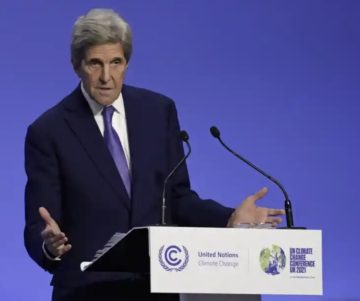 When it comes to climate finance, the gap between what is needed and what is on the table is dizzying. The talk at the conference was all about the annual $100bn (£75bn) that rich countries had promised to poorer nations back in 2009. The rich countries have now apologised for falling short. The new resolution is to make up the difference by 2022 and then negotiate a new framework. It is symbolically important and of some practical help. But, as everyone knows, it falls laughably short of what is necessary. John Kerry, America’s chief negotiator, said so himself in a speech to the CBI. It isn’t billions we need, it is trillions. Somewhere between $2.6tn and $4.6tn every year in funding for low-income countries to mitigate and adapt to the crisis. Those are figures, Kerry went on to say, no government in the world is going to match. Not America. Not China.
We should take the hint. There isn’t going to be a big green Marshall plan. Nor are Europe or Japan going to come up with trillions in government money either. The solution, if there is to be one, is not going to come from rich governments shouldering the global burden on national balance sheets.
So, how does Kerry propose to close the gap? As far as he is concerned, the solution is private business.
More here.