
by John Allen Paulos
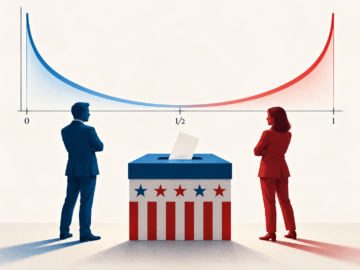
Election Day is just a week or so away and we can be sure that there will be many bogus claims that elections in this or that state or district were rigged. Of course, these claims generally depend on outright lies, not on the counterintuitive subtleties of probability theory, one of which is described here. Stated in terms of a long sequence of coin flips, the surprising bit of mathematics is called the Arcsine law. It focuses on the changing difference between the number of Heads up to a point in the sequence and the number of Tails up to that point.
What might we say about this changing difference? Assuming the coin is fair, we would naturally assume that the difference, the number of Heads minus the number of Tails, would change as the coin flips continue and would sometimes be positive and sometimes be negative. Furthermore we might expect that the difference between the number of Heads and the number of Tails would be positive about half the time and negative about half the time.
We might also conceive of flipping coins as counting the ballots between two evenly matched candidates, Harry and Terri. Since the candidates are, by assumption in a dead heat, we might expect in the ballot counting process that Harry at times will be ahead of Terri and Terri at times will be ahead of Harry. Furthermore, during the counting process we might expect each of the candidates to be ahead about half the time.
Whether expressed in terms of coin flips or votes, this intuition “about half the time” is not correct. What happens is that it’s considerably more likely that either Harry/Heads will be ahead during almost the entire counting/flipping process or that Terri/Tails will be ahead during almost the entire counting/flipping process than it is that Harry/Heads will be ahead about half the time and Terri/Tails about half the time.
During a random walk, after a while one or the other side will gain an advantage and it will generally persist and even grow a bit not because of biased coins or biased vote counters (who will be accused of ensuring their preferred candidate stays ahead), but because going from an advantage to a disadvantage or vice versa is probabilistically unlikely during any stretch of the counting/flipping process. Switching from a positive to a negative difference or vice versa is relatively rare. Of course, it remains the case that in the long run the difference will still be zero (50 /50) on average, but the fraction of time that one side, either Harry/Heads or Terri/Tails, leads is determined by the Arcsine law, which favors extremes.
A very important limiting proviso: this doesn’t usually hold even for equally matched candidates in real life since votes aren’t generally counted in a random order. The returns from certain atypical parts of a state or district are likely to be counted before those from other parts for a variety of reasons, such as urban vs rural areas.
Nevertheless, if two candidates are more or less tied and the counting is more or less random, the one ahead after a portion of the votes have been counted is considerably more likely to have his or her winning streak lead to victory.
***
John Allen Paulos is an emeritus Professor of Mathematics at Temple University and the author of Innumeracy and A Mathematician Reads the Newspaper. These and his other books are described and available here.
Enjoying the content on 3QD? Help keep us going by donating now.