
by Ashutosh Jogalekar
As the relentless march of AI in science continues, I found myself pondering the other day whether there ever would be a time when a human scientist would do the last human experiment, after which the machines take over. Of course, we don’t expect such a moment to be an abrupt one. AI is already taking over large parts of scientific work, and the progression from human to AI will be long, haphazard and lying on a continuum. Nevertheless, along with many other professionals, we scientists are facing a reckoning with technology with few parallels in history. So I asked: what would it actually feel like when slowly but quietly, science passes from the hands of humans to the silicon brains of machines. Perhaps, in what’s the ultimate irony, an AI made a substantial contribution in describing this watershed.
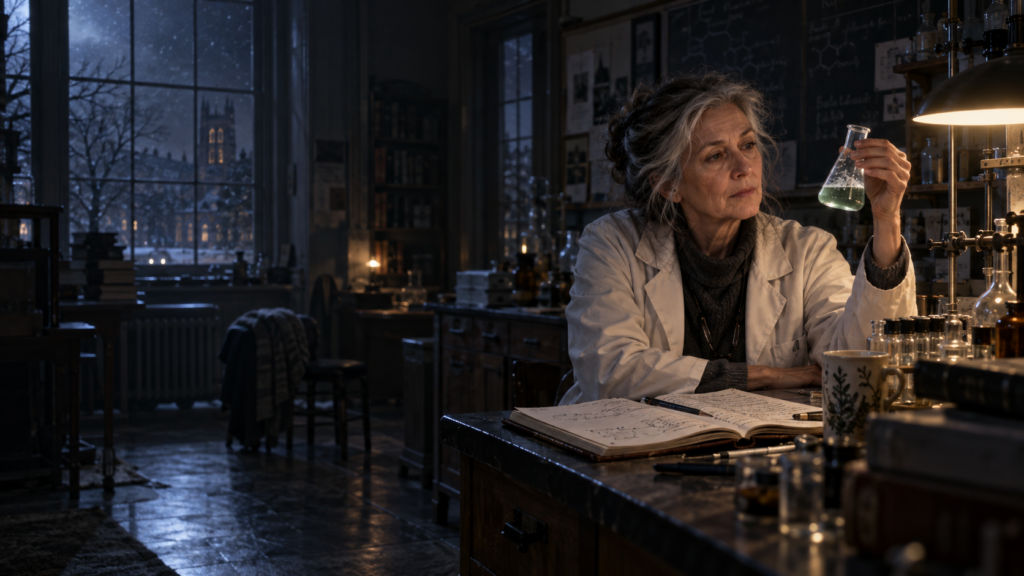
Nobody knew at the time that Elena Varga had made the last important scientific discovery in history that could be called entirely human. There was no announcement marking the occasion, no threshold anyone could point to, and certainly nothing about the experiment itself that suggested it belonged to history. It took place late one winter evening in a laboratory much like thousands of others, in a university building old enough that the pipes knocked in cold weather and the wooden drawers still contained pieces of glassware ordered by people who had retired before Elena arrived.
By then she was sixty-eight and had spent most of her adult life doing chemistry. She was not famous, though people who had worked with her tended to remember her as an authority in the field. She possessed the kind of knowledge that accumulated slowly and was difficult to explain: she knew when a vacuum line was leaking from the change in the pitch of the pump, when a crystallization had gone wrong from the way the first grains appeared on the wall of the flask, and when a reaction mixture deserved another hour even though every measurement said it was finished. None of these abilities appeared on her CV. They were simply the residue of forty-five years spent looking closely at matter.
Scientific work had changed enormously during those years. The systems now in routine use could read essentially the entire relevant literature before suggesting an experiment, generate mechanistic hypotheses, search enormous chemical spaces, design the experiments needed to distinguish among competing explanations, control robotic laboratories, interpret the resulting images, spectra and western blots, and decide what should be done next. A process that once required a dozen people moving back and forth between thought and experiment could now proceed almost continuously, with each result becoming the premise for the next experiment before a human scientist had even looked at it.
Humans had not disappeared from science, but their role had become curiously thin. They chose which diseases were worth curing, which materials were worth making, which questions seemed important enough to pursue – although even in those domains, there was unnerving evidence that AI could exercise what was considered a uniquely human quality 0 taste. Humans still set constraints, approved expensive campaigns, inspected unusual results, and argued about what a discovery meant once it had been made. The systems did not determine what humanity ought to care about, and no one seriously wanted them to. But between the asking of a question and the interpretation of its answer, very little remained that required a person. Hypotheses, experimental designs, measurements, revisions, controls and follow-up experiments could all unfold without anyone touching a pipette or, increasingly, without anyone having the thought that led from one experiment to the next.
Something else had changed as well, more gradually and therefore less noticeably. Science had once been intensely social. Laboratories were places where people watched one another work, argued over strange results, carried spectra down the hall, and spent hours trying to understand something together. Furious arguments could start at the water cooler. Mathematics had its own versions of the same culture, from the cafés of Lwów, Vienna and Budapest to the circles around Hilbert in Göttingen: problems moved from person to person, half-formed ideas were exposed to other minds, ideas were scribbled on marble tables in marathon sessions, and insight often emerged from prolonged collective confusion.
By Elena’s time, scientists still communicated constantly, but much of the exploratory conversation had migrated into private exchanges between a person and a machine. The first foolish question, the uncertain analogy, the halting expression of an idea, the suspicion that made no sense yet — things that once escaped into a room where another person might seize on them — were increasingly given to an intelligence that answered instantly and privately. The loss was not simply social. Scientific communities had once been one of the ways judgment, taste and standards were transmitted. People learned from one another what counted as an interesting anomaly, when an elegant explanation was probably wrong, and when an apparently foolish idea deserved another week. What grew thinner was the middle: the long period of shared uncertainty in which a group of people slowly, lazily learned how to see something none of them had understood before.
Elena used these systems herself and admired them. They had solved problems she had once assumed would occupy entire careers. She had no philosophical objection to them and no nostalgia for the enormous amount of tedious work they had eliminated. What she retained, almost as a private habit rather than a principle, was a preference for occasionally doing an experiment from beginning to end with her own hands.
The question that kept her in the laboratory that evening was not an especially important one. For years she had been bothered by a reaction that produced, just before failing, a brief gray-green color. The accepted explanation was decomposition. The models treated it as decomposition. Automated campaigns had run thousands of nearby conditions and found no reason to think otherwise. Elena had no coherent theory that they were wrong. She simply had the persistent feeling, born of having watched too many reactions fail in too many different ways, that this particular failure did not look like decomposition.
She remembered something else as well. Many years earlier, when she was a young faculty member working in a poorly heated laboratory, the color had seemed to linger on a particularly cold morning. The recollection was so vague that she would have been embarrassed to offer it as scientific evidence. Still, on that winter evening, with no student waiting for the instrument and no reason to hurry home, she decided to repeat the reaction at a lower temperature.
She dried the flask herself, weighed the reagents, assembled the apparatus and began again. For most of an hour nothing unusual happened. Then the solution turned gray-green and, instead of fading, remained that color. Elena lowered the temperature a little further. Several minutes later, a fine line of crystals appeared against the glass. She leaned toward the flask and watched them grow.
Later, people would ask her what she had thought at that moment, and she would disappoint them by saying that she had thought almost nothing. There was no sense of triumph, no conviction that she had discovered something important. Mostly she was afraid that she had contaminated the reaction. She isolated the material, ran the spectrum, assumed the spectrum was wrong, and ran it again.
Shortly after two in the morning she opened the paper notebook she still kept beside the instrument and wrote, in blue ink, “I think this is real.”
The compound turned out to reveal a reaction pathway that had been overlooked for decades, and the pathway eventually led to a family of catalysts with useful industrial properties. Other laboratories reproduced the result; theoreticians explained it; automated systems explored variations with a speed and thoroughness Elena could never have attempted herself. Within a few years the discovery had become much larger than the odd experiment from which it began. But what no one noticed was that the manner of its discovery had already become obsolete.
Historians recognized this only decades later, when they tried to reconstruct the transition to autonomous science. There was no single day on which machines began making discoveries. Instead, their participation gradually became inseparable from the process. A system proposed one hypothesis, another identified an anomalous pattern, another chose the experiment most likely to discriminate between two mechanisms. Humans continued to make decisions, ask questions and decide which problems mattered, but the chain from observation to conjecture to experiment increasingly passed through forms of intelligence that were not human.
Elena’s experiment turned out to sit just before that boundary. As far as anyone could determine, it was the last consequential discovery for which the essential observation had been made by a lone human being, the conjecture had arisen in a lone human mind, and the decisive experiment had been conceived and carried out by lone human hands without machine participation in the reasoning.
She was ninety-one when a historian came to tell her this. Elena listened politely and then laughed, because the claim struck her as faintly absurd. Science, she said, had never been pure in the way historians sometimes imagined. Every scientist depended on instruments made by other people, theories inherited from earlier generations, tables of data, techniques learned from mentors and entire civilizations of accumulated knowledge. In the long view of things, science, humans and machines all tumbled into each other.
“So no,” she said, “I wasn’t alone.”
Then she looked for a while at an old photograph of her laboratory.
“But there was a feeling you sometimes had,” she said. “There would be something in front of you that nobody understood yet. Not a problem in a database. Not a prediction. A thing. And for a little while, before you told anyone else, there was only you and the thing.”
She held her hands in front of her as though she were once again holding a flask.
“That was a wonderful feeling.”
By then the world’s laboratories were making discoveries at a rate no human scientist from Elena’s generation could have imagined. Diseases had treatments that once seemed impossible, materials were designed rather than stumbled upon, and questions that had survived for centuries could sometimes be resolved in days. Elena did not wish any of it undone.
What had disappeared was smaller than that, and perhaps more difficult to name: the experience of confronting nature with nothing between the observer and the unknown except memory, judgment, patience and a pair of hands. And perhaps something else had disappeared with it as well: the old experience of bringing that uncertainty to other people before it had hardened into an answer, of letting a strange result pass through a roomful of minds, of watching an idea become communal before it became correct.
In a museum not far from the university, Elena’s old notebook was eventually placed behind glass. Most visitors passed it quickly. There was nothing visually remarkable about the page – just chemical structures, temperatures, a few crossed-out numbers and, near the bottom, four words written in blue ink.
I think this is real.