
A collage essay by River Lerner

A dam and a corset share a certain poetry. The opposing forces along their walls grant function: not only to contain or boundary, but to harness difference. Pressure makes a thing what it is.
The work of the world is common as mud.1Piercy, Marge. “To Be of Use.” Circles on the Water: Selected Poems of Marge Piercy, Alfred A. Knopf, 1982.
Since being introduced to Marge Piercy’s poem “To Be of Use”, I have misread that line numerous times as: “The work of the world is covered in mud.”
The restraint of lace and the frustration of water sieve power. Separate the wheat from the chafe.
The work of a person is managing mud.
[I]nterventions need to be based on the waste hierarchy, 3R principles, and integrated solid waste management, including avoidance, reduction, source separation, collection, treatment, and final disposal.2Jayasinghe, R., Koliyabandara, P.A. and Vithanage, M. Waste in One Health. One Health, eds M. Vithanage and M.N.V. Prasad, 2023, doi:9781119867333.ch16.
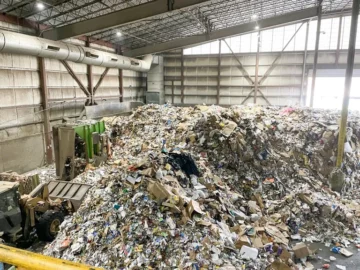
Let us sort our waste. Waste is not solely excess or squander. Waste is refuse: that which has been refused. It must be tidied, transmuted, incinerated, amputated, shaved, shed, concealed, obscured, omitted, deleted – disappeared in some sense – to purify, elevate, concentrate, crystallize the Thing Worth Keeping.
As much as self-creation is growth and modulation, it is subtraction. We shape ourselves as much by what we are not as by what we are. The sculpture implies all the stone missing from it.
What of the stone’s shavings strewn across the floor? Do they congeal into the statue across the hall staring down our unblemished alabaster? The detritus of the work we do in sculpting ourselves does not necessarily make our so-called shadow/antithesis. It could; but the shards on the ground are challenging in their own right.
Then there are our frictions we contain to cohere in society – the mistakes in rock we patch and do not speak of – to at least be admissible, if not assimilated.
That which is denied the light of day still requires tending.
Maintenance is a drag. It takes all the fucking time. Literally. The mind boggles and chafes at the boredom.3Ukeles, Mierle Laderman. Manifesto for Maintenance Art 1969! Proposal for an Exhibition “Care.” 1969. Ronald Feldman Gallery, feldmangallery.com/exhibition/manifesto-for-maintenance-art-1969.
Could we get up every morning and take showers and put on clothes and go to work?4Kaysen, Susanna. Girl, Interrupted. Turtle Bay Books, 1993.

The labor must remain unseen, of course. Otherwise it is embarrassing and cringe. It reveals more about the person than does whatever it protects. Your makeup must be no-makeup. Even if you’re sick, don’t be.
You can’t win. You can’t win. If you show your disability, I’ve had people say, “No one wants to hear about your pain. It’s so boring.” Oh, I’ve had people say that. Like, “It’s tedious and you’re always going to have it, so we don’t want to hear it. Just hide it. No one wants to see it.” So I get told that and then I hide it and they go, “Well, you’re clearly not that sick, what do you want from me?”5Cheung MMY, Lewis S, Raja R, et al. Disruption and Improvisation: Experiences of Loneliness for People With Chronic Illness. Qual Health Res. 2025;35(3):319-334. doi:10.1177/10497323241265329
So often we cannot give or receive what we want from each other. Thus we temper it with a thousand compromises – white lies and silences – until we become unrecognizable but palatable. Potentially lovable.
There is some responsibility we have to each other to maintain half of ourselves in shadow not only for our own comfort or social acceptance, but also for others’. It is out of consideration for those around us with low tolerance for proximity to suffering.
[H]e must lie low for the present and, by exercising patience and the utmost consideration, help the family to bear the inconvenience he was bound to cause them in his present condition.6Kafka, Franz. “The Metamorphosis.” The Complete Stories, edited by Nahum N. Glatzer, translated by Willa and Edwin Muir, Schocken Books, 1971.
Whether it’s because it hurts to watch us suffer (suffering by proxy), it socially associates them with our suffering (sufferer by proxy), or it yokes their avoidant gaze back toward their own potential to suffer.
There’s always a touch of fascination in revulsion: Could that happen to me? […] Are you still contagious?7S. Kaysen, Girl, Interrupted.
And I thought, I am thirty-seven and I just won the Lambda Award. I can’t tell people I want to kill myself. On my Facebook status update.8Piepzna-Samarasinha, Leah Lakshmi. Care Work: Dreaming Disability Justice. Arsenal Pulp Press, 2018.
Inpatient psychiatry, compared to outpatient, reassures through its emergency. The 2 AM walk-ins I meet in the emergency department have their knees and palms scraped by, and mouths full of, rock bottom. “Eat dirt,” circumstance taunts. But for the vast majority, this is as bad as it gets, and we can admit to each other how bad this is. They are held in a container—imperfect, institutionalized, but held nonetheless. If they’re seeing me, they have institutionally sanctioned access to medications, therapy, time, and space. They can access second-order, if not first-order, hope.
Conversely, psychiatric outpatients range from the doing-very-well to the barely-holding-on. “Functionality” sours from a marker of wellness into a demand of unrelenting capitalism. Whether inertial or willpowered, they grab groceries on their commutes, kiss their spouses, sit in pews and on the sidelines of playgrounds and soccer games, read boxed food nutrition facts, come see me for their appointments.

[Y]ou speak to a nice therapist in a pastel office for six sessions, and then you’re fixed, you marry your husband or get a girlfriend and have a kid, and it’s all pastel soft lighting fade out forever. You either do that or you’re fucked […] Most folks want to go for the Triumph of the Human Spirit one, if you get to pick.9L. L. Piepzna-Samarasinha, Care Work.
It is the art of compartmentalization, of isolation of affect. The compensation is so practiced it is elegant.
The longer I didn’t say anything about it, the farther away it got, until the me who had been in the hospital was a tiny blur and the me who didn’t talk about it was big and strong and busy.10S. Kaysen, Girl, Interrupted.
I sometimes don’t see them for months at a time. I wonder how they are doing. I sometimes worry how they are doing. Those…
[…] who pull like water buffalo, with massive patience,
who strain in the mud and the muck to move things forward,
who do what has to be done, again and again.11M. Piercy, “To Be of Use.”

Choose what must suffer to elevate the rest. Some works render the social contract and its sacrifice explicit: the child in Omelas, the white-clad adherents in Midsommar, Mrs. Hutchinson in The Lottery. Then there are works that compress the dichotomy and monstrosity into a single subject. This can be through vacillating between two forms (Beast, the Hulk, Jekyll/Hyde), or unidirectional, irrevocable metamorphosis (Seth Brundle in The Fly, Gregor Samsa in The Metamorphosis), or with a dependent, coexistent split (Quirinus Quirrell/Voldemort in The Philosopher’s Stone, Elisa/Sue in The Substance, Mark Scout in Severance).
Enough experienced or anticipated societal rejection becomes internalized and self-reinforcing. Self-sequestration becomes habit. Professor Quirrell wraps his head in a turban; Sue hides Elisa behind the bathroom wall; Gregor takes comfort in his bedroom. À la Pavlov and Stockholm, the system is rewarded when repressed.
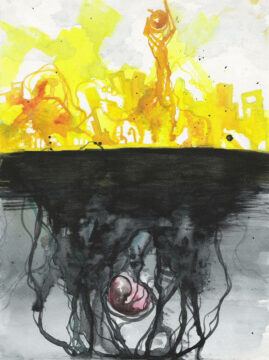
Neither the beautiful nor the ugly may gain too much hubris.
Respect the balance and there won’t be any more inconveniences.13The Substance. Directed by Coralie Fargeat, Working Title Films/MUBI, 2024.
When Sue is first born from Elisa, she understands this via biological imperative. The detrital self, the mother matrix, is repulsive. At the same time, for Sue to exist, the matrix cannot die.
Disposing of waste – out of sight, out of mind – is not an option anymore.14Jayasinghe et al., “Waste in One Health.”
The split requires a maintained intimate communication. Sue must stabilize herself through extracting cerebrospinal fluid from Elisa daily. The care she offers Elisa, albeit reluctantly and repulsed, is care nonetheless. Stitch by stitch, she sews closed the inverse spinal womb from whence she came, so it is healthy enough for further extraction. As they alternate unconscious periods, Sue and Elisa must trust that the other will feed them and switch on time. They do – for a while.
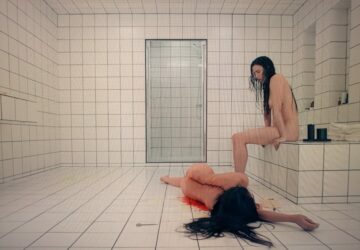
The story only exists so long as the split is maintained. The conjoining at the film’s conclusion kills both the duo and the film itself. The Substance is not titled “Elisabeth”, “Sue”, or even “Monstro Elisasue”. The Metamorphosis is not titled “Gregor Samsa” or “Gigantic Insect”. These titles, and the stories they enclose, require separation to drive plot. Integration heralds a peaceful, transcendent death.
I see three potential conflations between person and waste.
First, there is society’s relegation of certain undesirables as waste. They become a foil, a contrast, to the in-group and its workings. They are refused entry. This is the telos across targets of discrimination and marginalization, and is inherently intersectional, but allow me to speak briefly and artificially narrowly on disability and chronic illness:
Capitalism says that disabled, tired bodies that spend too much time in bed are useless […] crips are useless to capitalism.15L. L. Piepzna-Samarasinha, 2024.
Capitalism is obsessed with things going “perfectly”: optimization, automation, accumulation, progress, and speed. Deliverables. Chronic illness is often slow, spiraling, tedious, withering. Bodily vulnerability asks too much of capitalism, which works on the clock. If you wish to continue participating in the machine, you must put enormous effort into overcoming the hostile architecture of everyday life. Make phone calls to schedule and reschedule doctor’s appointments on lunch breaks. Pick up prescriptions in the edge hours of the pharmacy. Spend sleepless nights with your heating pad watching the window sky lose its black but not gain dawn, knowing you’ve run out of sick days.
Second, there are those who, in managing refuse, become associated with that refuse as its manager. They are waste by proxy, often overlooked and underpaid.
After the revolution, who’s going to pick up the garbage on Monday morning?16M. L. Ukeles, Manifesto.
They hold and metabolize an intimate societal wisdom.
What people have owned—and thrown away—can speak more eloquently, informatively, and truthfully about the lives they lead than they themselves ever may.17Rathje, William, and Cullen Murphy. Rubbish!: The Archaeology of Garbage. HarperCollins, 1992.
And third, in anticipation of – or in response to – being labeled waste, there are those who align with and/or reclaim its entrails. Think of the anarcho-punks, or the mad justice or crip justice movements. Writing about “refuse work” in Samuel R. Delaney’s Through the Valley of the Nest of Spiders, Jina B. Kim observes:
For the residents of the Dump and its nearby communities, waste and its management constitute key sites of pleasure and social connectivity, with much of civic life oriented around the abundant circulation of flesh and fluid. […] In Through the Valley, disability becomes key to imagining the multiplicity of ways different bodies might enjoy sexual and social contact, as well as foregrounding the high value the novel attributes to the labor of care and support. […] Delany’s novel explores waste and its management as a potent site for theorizing a crip-of-color politics and aesthetics.18Kim, Jina B. Refuse Work: Samuel Delany’s Crip-Queer Ethics and Erotics of Waste Management. Care at the End of the World: Dreaming of Infrastructure in Crip-of-Color Writing, Duke University Press, 2025.
Maintenance isn’t just a drag, it’s complex. What’s great about walking around with sanitation workers is that they have agency.19Toby Perl Freilich; Blazing Epiphany: Maintenance Art Manifesto 1969!: An Interview with Mierle Laderman Ukeles. Cultural Politics 1 March 2020; 16 (1): 14–23. doi:17432197-8017214.
The artist Mierle Laderman Ukeles was my age when she penned Manifesto! Maintenance Art – Proposal for An Exhibition: Care. She wrote it, in her words, in a cold fury.
If I am the boss of my freedom, then I name maintenance art.20M. L. Ukeles, Manifesto.
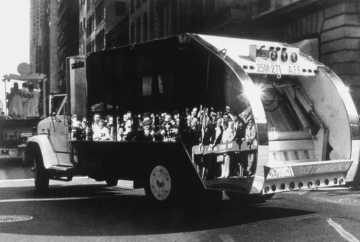
Typically in the night, city residents roll their detritus onto the sidewalk, close their doors, and sleep. In the early morning, rolling and belching and stinking, with their squealing mechanical arms, garbage trucks and their unfaltering operators care for the population. One of Ukeles’ projects as the Artist in Residence of the New York City Department of Sanitation, “The Social Mirror” (1983), plastered a garbage truck in mirror and toured it on the city streets. As the garbage truck visited each household, New Yorkers could no longer deny their reflection, and their contents, in it.
Every window on Alcatraz has a view of San Francisco.21S. Kaysen, Girl, Interrupted.
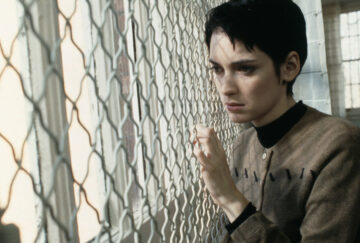
There are various forms of imprisonment: our shadow, our self-carving, our inefficiency, and our untenable hope for liberation. The dream to be free of the pain and bureaucracy of being just this. Cathedrals are built vertically not only to draw the gaze upward, but also to pull it away from what sits at ground level.
We can dream of salvation from unpacked boxes in the basement, skeletons in the closet. If they can’t decompose or disappear, we can at least shove them elsewhere, where they can’t accost us with their existence. If we choose not to tend to them, we just must remember not to open the door.
Lest the door stay locked for too long, things tend to blob, bubble, and gurgle out.
We leak, tear, run, bleed, excrete. Survival demands expression and release. Retained sewage is sepsis.
You can’t escape from yourself. […] Remember there is no “she” and “you”. You are one.22The Substance, 2024.
I awaken in a cold sweat, lost in who and where and when I am. You wake with me, wide-eyed. You tell me to run my hands over my chest, feel the textured crop of my hair. Absences are proof of presence: time has passed, and I am safe from the thing I was.
I take a pill bis in die to maintain this boundary.
Only in the liminal space of consciousness do I feel her hum under my skin, glimpse her flicker across my face. I surmise, bleary-eyed, that she is poised and ready to reclaim the life I wrested from her. To reciprocate the drowning.
Liminality occurs when individuals are suspended “betwixt and between”—an ambiguous, often transitory state of being neither here nor there, neither one thing nor the other […] the inability to return to “normal”.23Cheung MMY, Lewis S, Raja R, Willis K, Dubbin L, Rogers A, Moensted ML, Smith L. Disruption and Improvisation: Experiences of Loneliness for People With Chronic Illness. Qual Health Res. 2025 Mar;35(3):319-334. doi: 10.1177/10497323241265329. In-text citations removed.
Perhaps instead of revenge, she just wants to talk.
Gregor now stationed himself immediately before the living-room door, determined to persuade any hesitating visitor to come in or at least to discover who it might be; but the door was not opened again and he waited in vain.24F. Kafka, “The Metamorphosis.”
– All decisions are your decisions. You’re simply making them from different sides of yourself.
– Everything is getting all too Kafkaesque…
– Would you like to stop?25Fargeat, Coralie. The Substance. 2024. Script Slug, www.scriptslug.com/script/the-substance-2024. Screenplay. All-caps removed from the first line. Was the Kafka reference too on-the-nose to survive the film cut?
Elisabeth and Sue experience know the cost of overdrawing. Outpatients know it too, when I do end up meeting some of them at 2 AM in the emergency department.
They are sixteen or sixty-six. They overdrew on their tolerance of the everyday. They are – in clinical terms – well-dressed, kempt, and cooperative. You wouldn’t know unless you read the chart and kept in mind it is 2 AM on a Thursday that something is gravely wrong.
They explain rehearsed, methodically, with slight shrill, that this went too far, got out of hand, but is generally under control. They list protective factors like stats. They’ll make an appointment next week. Their loved one sits beside them. Silently, with pursed lips. They hold my eyes. Knit their brow.
This is not always the case, but sometimes you notice a loose thread. That’s one of the saddest jobs in psychiatry: you are tasked to unravel. With great care, you note the word that makes their voice catch. A pause in your question that their eyes dart away from facing.
And you tug. You tug and tug on the thread that corsets them into this inhaled, upright constriction; the thread that only allows “I’m fine” to be said. Find the hamartia and go for the jugular. We stop giving the defense grace, for what is it now protecting?
I write this with a white coat on, still crisp from hanging in my closet these past two years. I write as though mud is alien to me. I must keep it alien enough to wash my hands of it and treat the next patient. You can’t read progress notes smeared with mud.
A close friend describes how the smell of garbage is reminiscent of her hometown. It is comforting and safe.
The only thing more familiar than the back of my hand is my palm.
The first broadening of light in the world outside the window entered his consciousness once more.26F. Kafka, “The Metamorphosis.” As Gregor dies.
And there, we all laid still, we all watched the light change, and instead of magnifying the pain in my chest & in my stomach, it assuaged it.27@flashbulbstudio. “Places I Have Had to Lay Still & Watch the Light Change” [zine], 2018.
I thank the many authors and artists whose work I cite in this essay; my patients; Rev. Tara Deonauth for introducing me to Marge Piercy’s poem; and Dr. Ilya Vidrin for helping me sort through and value the ideas I too quickly discard.
Enjoying the content on 3QD? Help keep us going by donating now.
Footnotes
- 1Piercy, Marge. “To Be of Use.” Circles on the Water: Selected Poems of Marge Piercy, Alfred A. Knopf, 1982. ↩︎
- 2Jayasinghe, R., Koliyabandara, P.A. and Vithanage, M. Waste in One Health. One Health, eds M. Vithanage and M.N.V. Prasad, 2023, doi:9781119867333.ch16. ↩︎
- 3Ukeles, Mierle Laderman. Manifesto for Maintenance Art 1969! Proposal for an Exhibition “Care.” 1969. Ronald Feldman Gallery, feldmangallery.com/exhibition/manifesto-for-maintenance-art-1969. ↩︎
- 4Kaysen, Susanna. Girl, Interrupted. Turtle Bay Books, 1993. ↩︎
- 5Cheung MMY, Lewis S, Raja R, et al. Disruption and Improvisation: Experiences of Loneliness for People With Chronic Illness. Qual Health Res. 2025;35(3):319-334. doi:10.1177/10497323241265329 ↩︎
- 6Kafka, Franz. “The Metamorphosis.” The Complete Stories, edited by Nahum N. Glatzer, translated by Willa and Edwin Muir, Schocken Books, 1971. ↩︎
- 7S. Kaysen, Girl, Interrupted. ↩︎
- 8Piepzna-Samarasinha, Leah Lakshmi. Care Work: Dreaming Disability Justice. Arsenal Pulp Press, 2018. ↩︎
- 9L. L. Piepzna-Samarasinha, Care Work. ↩︎
- 10S. Kaysen, Girl, Interrupted. ↩︎
- 11M. Piercy, “To Be of Use.” ↩︎
- 12Le Guin, Ursula K. “The Ones Who Walk Away from Omelas.” The Wind’s Twelve Quarters, Harper & Row, 1975. ↩︎
- 13The Substance. Directed by Coralie Fargeat, Working Title Films/MUBI, 2024. ↩︎
- 14Jayasinghe et al., “Waste in One Health.” ↩︎
- 15L. L. Piepzna-Samarasinha, 2024. ↩︎
- 16M. L. Ukeles, Manifesto. ↩︎
- 17Rathje, William, and Cullen Murphy. Rubbish!: The Archaeology of Garbage. HarperCollins, 1992. ↩︎
- 18Kim, Jina B. Refuse Work: Samuel Delany’s Crip-Queer Ethics and Erotics of Waste Management. Care at the End of the World: Dreaming of Infrastructure in Crip-of-Color Writing, Duke University Press, 2025. ↩︎
- 19Toby Perl Freilich; Blazing Epiphany: Maintenance Art Manifesto 1969!: An Interview with Mierle Laderman Ukeles. Cultural Politics 1 March 2020; 16 (1): 14–23. doi:17432197-8017214. ↩︎
- 20M. L. Ukeles, Manifesto. ↩︎
- 21S. Kaysen, Girl, Interrupted. ↩︎
- 22The Substance, 2024. ↩︎
- 23Cheung MMY, Lewis S, Raja R, Willis K, Dubbin L, Rogers A, Moensted ML, Smith L. Disruption and Improvisation: Experiences of Loneliness for People With Chronic Illness. Qual Health Res. 2025 Mar;35(3):319-334. doi: 10.1177/10497323241265329. In-text citations removed. ↩︎
- 24F. Kafka, “The Metamorphosis.” ↩︎
- 25Fargeat, Coralie. The Substance. 2024. Script Slug, www.scriptslug.com/script/the-substance-2024. Screenplay. All-caps removed from the first line. Was the Kafka reference too on-the-nose to survive the film cut? ↩︎
- 26F. Kafka, “The Metamorphosis.” As Gregor dies. ↩︎
- 27@flashbulbstudio. “Places I Have Had to Lay Still & Watch the Light Change” [zine], 2018. ↩︎