
by Mark Harvey
Time gets compressed as you get older. When you’re a kid, a month waiting for summer break can seem like an eternity, whereas later in life, you marvel that just yesterday our forebears were crossing the mountains and steppes of the interior West in horse-drawn wagons. I long to know what it was really like trying to make it from, say, Ohio to California, or Iowa to Oregon in the 19th century. Most of the lore in fiction and the movies flattens the experience into hard men and bonneted women snarling at each other, fighting Indians, and eating grub around the campfire.
But there are a few surviving accounts from men and women who made the crossing and, despite long, long days on the trail, setting up camp, and tending to children and livestock, managed to jot down some of their thoughts and impressions along the way.
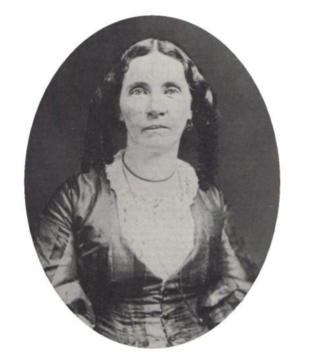
One of those women was Amelia Stewart Knight, who set off with her husband and seven children from Monroe County, Iowa, on April 9, 1853, for Oregon Territory. Her journal entries are terse and thus compress her interiority. But the hardships and disasters of the trip itself speak in themselves. And because they are so few, the entries when Amelia expresses hurt or despair are touching.
She begins her diary, “Started from home about 11 o’clock and traveled 8 miles and camped in an old house; night cold and frosty.”
I don’t know why Amelia, her husband, and her brood left Iowa, but Monroe County in 1853 had to have been almost impossible. Whites had barely settled it; malaria (known then as “the shakes”) and cholera were rampant, and massive storms and floods in 1851 had wiped out grain and lumber mills along the riverbanks. The floods and disease would have aggravated an already marginal existence.
And Oregon Fever was calling: thousands of people were on the move to realize the promise of free land and a temperate climate in the Pacific Northwest.
The first week into the journey, the skies let loose and poured rain on Amelia and her family. Their clothes and bedding got soaked, three horses ran away, and Amelia is already feeling homesick. She writes,
Bed clothes nearly spoiled. Cold and cloudy this morning, and every body out of humour. Seneca is half sick. Plutarch has broke his saddle girth. Husband is scolding and hurrying all hands (and the cook) and Almira says she wished she was home, and I say ditto. “Home, Sweet Home.” . . .
Amelia suffers headaches throughout the journey. The cause is unknown, but it could be related to carrying what would become her eighth child, as she is in the third trimester of another pregnancy.
Caring for their livestock and horses while traveling through rough country is costly and at times nearly impossible. With few towns or supplies along the trail, some days they feed their livestock flour and cornmeal. Amelia’s itemized lists of things bought during the trip: corn, river crossings, etc.—suggest tight finances.
About a month into the trip, after dealing with heavy rains and mud at the campsites, the family must have been near what is today Omaha, Nebraska. On May 6th, they encounter a family returning east after a tragedy on the Elkhorn River located about two days’ travel west. Amelia writes,
Here we passed a train of wagons on their way back, the head man had been drowned a few days before, in a river called Elkhorn, while getting some cattle across and his wife was lying in the wagon quite sick, and children were mourning for the father gone. With sadness and pity I passed those who perhaps a few days before had been well and happy as ourselves.
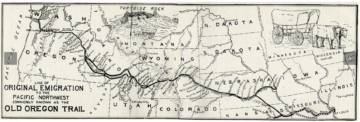
The sight of the returning family and the news of the drowning must have been scary for Amelia and her brood. They would have recently crossed the Missouri River, at the time considered the boundary between American civilization and the vast Western wilderness. The United States mail system in 1853 pretty much ended at the Missouri River, and any communication for the next several hundred miles would depend on handing a letter to strangers heading east, sometimes called East-Bounders. They could be mountain men, returning emigrants, or freight wagons. Many of the letters handed to strangers would somehow reach the recipient, but pioneers often wrote nearly duplicate letters days later to double their chances.
For many pioneers, the Missouri was a physical and psychological threshold between their old life and the unknown ahead. Luzena Walter, a woman traveling to California four years before Amelia wrote,
The day’s slow journey brought us to the Missouri River, over which we were ferried in the twilight, and our first campfire was lit in Indian territory. This spread in one unbroken, unnamed waste from the Missouri River to the borderline of California. This was the start of my terror.
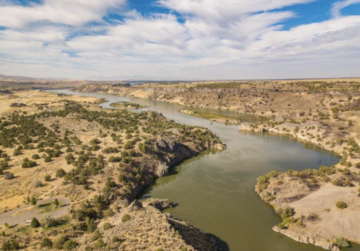
The Snake River Plain in southern Idaho was particularly hard on the pioneers and their livestock. To some overlanders, it was considered the most dangerous and difficult section of the Oregon Trail. The crossing was roughly 300 miles and began in what is now Pocatello, Idaho, and ended near today’s Huntington, Oregon, on the states’ border. Thousands of cattle died in that stretch and some said that you didn’t even need a map to follow the Snake River, you just followed the stench.
Cattle deaths were attributed to dehydration, starvation, toxic plants, and alkali water. The many emigrants with their herds had stripped the plains bare. The ecology of the Snake River Plain was primarily composed of bunch grass and sagebrush. The bluebunch wheatgrass, basin wildrye, Idaho Fescue, and other grasses of the region were much more delicate than the rhizomatous grasses of the Great Plains. It was difficult for the livestock to get enough nutrition, so they turned to eating toxic plants they normally would have avoided.
Amelia’s family lost three precious animals within a week on the Snake Plain: On July 24th a calf, on July 27th a “fine cow,” on August 1st one of their best milk cows. I have to assume losing a good milk cow would be a severe blow to a mother of seven children and one on the way. The milk and cream must have been a good source of fat on a lean diet. Milk cows were also routinely used to tow wagons if oxen died or failed. Finally, all the cattle were meant to be foundational capital once in Oregon.
Given the harsh conditions, the months of travel, and the constant loss of livestock, I would assume Amelia would be hardened to losing cattle along the way and would consider the losses only in terms of nutrition and economics. But she repeatedly remarks on the plight of her cattle and oxen, demonstrating a tenderness to the animals one might not expect. On August 12th, just a few days after losing that milk cow, one of her oxen dies. She writes,
Lost some of our oxen. We were traveling along slowly, when he dropped dead in the yoke. We unyoked and turned out the odd ox, and drove around the dead one, and so it is all along the road, we are continually driving around the dead cattle, and shame on the man who has no pity for the poor dumb brutes that have to travel and toil month after month on this desolate road. (I could hardly help shedding tears, when we drove round this poor ox who had helped us along thus far, and has given us his very last step.
I had always assumed that most overlanders on the Oregon Trail traveled by horse or in a wagon. Reading Amelia’s diary, it is evident that she walked a great deal of the 2,300-mile journey. The whole trip took about 160 days, which means they averaged close to 15 miles per day. Not only was she heavily pregnant, but when walking she had to carry her youngest child, Chadwick, in her arms.
There’s a term that was batted around in the mid 20th century among sociologists and historians that has been badly skewed: American exceptionalism. It was first used to describe the founding of our country as being truly different, and then bastardized to imply Americans as individuals were exceptional in character. Reading Amelia’s account, there’s one thing that is almost entirely missing: complaining. There are days when she records fatigue or headaches or sorrow at dead livestock. But next to the travails of going without water some days, getting soaked by rain, and the endless days of travel, her endurance is simply heroic. How she bore the 2,300 mile journey with seven children and carrying an eighth boggles the mind. The strength and stoicism of those pioneers is not just humbling but can give a person a sense of how absurdly easy most of us have it by comparison. Being American doesn’t make a person exceptional. But Amelia Knight was an exceptional American.
On September 1st, five months after leaving Iowa, the Knights are camped near the Deschutes River, in the final leg of the trip. Their suppers are occasionally made up from fish from the Pacific Ocean as they buy salmon from the local Indians. In that month at that place, it would likely have been Chinook or Coho. She also buys a few potatoes from the Indians and both the salmon and the potatoes are a “treat” for the family. Given the matter-of-fact diary, calling them “treats” means they must have been delicious. I believe it’s the only time Amelia describes a meal with any epicurean flourish.
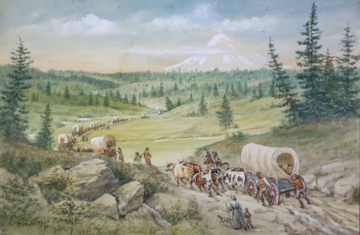
As they approach the mountains near Mount Hood and Laurel Hill, considered by some to be the most treacherous section of the Oregon Trail, Amelia begins jettisoning anything that is not absolutely necessary to lighten the load. The road approaching Laurel Hill was said to be strewn with wood stoves, family heirlooms, farm machinery, books, and anything else that could take weight off the emigrants’ wagons. Amelia’s entry describing Laurel Hill is the longest in her entire journal. In part, she writes,
It would be useless for me with my pencil to describe the awful road we have just passed over….It is something more than a half mile long very rocky all the way, quite steep, winding, sideling, deep down, slippery and muddy….and this road is cut down so deep that at times the cattle and wagons are almost out of sight….
A week later, Amelia gives birth to her eighth child and their long journey across the continent comes to an end. She writes,
Here husband traded two yoke of oxen for a half section of land with one half acre planted to potatoes and a small log cabin and lean-to with no windows. This is the journey’s end.
The Knights ultimately settled across the Columbia River near what is today Vancouver, Washington. Dr. Knight, always referred to as “Husband” throughout the journal, became a member of Washington Territory’s legislature. Amelia lived to be 81.