
by Bill Benzon
A bit over a year and a half ago I published “Kisangani 2150: Homo Ludens Rising,” a science fiction yarn set a decade later and half way around the world from Kim Stanley Robinson’s New York 2140. Robinson gave us a post-climate change world with pretty much the same institutional structure of the current world. Things were a bit looser in some ways, the very rich were, if anything, even richer, and finance made that world go round. Robinson developed a rich plot in which the financial crisis of 2008 was replayed, but to a different denouement. The banks weren’t bailed out; they were nationalized. Our heroes celebrated by going to Mezzrow’s where they danced “to the tightest West African pop any of them have ever heard.”
My world. As a musician who’s played RnB, rock, and jazz in many clubs and private parties, that world is more familiar to me than the world of financial derivatives and AI-driven trading, where Robinson centered his story. I decided to take Robinson’s world, move ahead a decade, and center it on the activities of Homo ludens rather than Homo economicus. That gives us Kisangani in the center of the Congo Basin and in 2150.
But this story is much earlier than that. It takes place just a few years from now and is about how the Mystic Jewels started Matrix Miriam, their first in a series of projects to create a new architecture for artificial intelligence. A somewhat revised version will be incorporated into Chapter 6 of my book in progress, Play: How to Stay Human in the AI Revolution, where it will be mated with a revised version of “Kisangani 2150: Homo Ludens Rising” and some more fictional material.
Overture: Before the Beginning
No one really knows just when or how the Mystic Jewels got started or, for that matter, whether they were ever quite a proper organization, with in-person meetings, officers, plans & events, and a budget. Maybe they’re more a legend, a vibe, a mist in a wandering mind, or, who knows? a confabulation in an LLM with the temperature cranked to 11. Whatever their true nature, their sweep, power, and influence were real, and still are. That being so, and this being a story, just as stories have beginnings so must the Jewels.
For the sake of the story, let’s say that the Mystic Jewels started coalescing around a miscellaneous group of musicians and artists in North America in the second half of the 20th century, starting with Duke Ellington, Maya Deren, and Paul Robeson. Somewhere along the line they were joined by NASA mathematician Katherine Johnson, jivometric musician, Rahsaan Roland Kirk, Brazilian composer and musician, Hermeto Pascoal, pianist and mystic, Alice Coltrane, manga and anime pioneer, Osamu Tezuka, cognitive scientist, Billy “Doc” Rasmussen, science fiction writers Samuel Delany and Octavia Butler, artist and futurist Rammellzee, tabla virtuoso, Zakir Hussain, comedian, Dave Chappelle, and pianist, Hiromi Uehara. Oh, I forgot, when Bishop Trevor Huddleston gave Hugh Masekela a trumpet, they both became Jewels, and then Miriam Makeba and who knows whom else. It’s a miscellaneous rag-tag bunch.
Building on ideas from Johan Huizinga’s classic, Homo Ludens, and Ishmael Reed’s Mumbo Jumbo, and elaborating on them with ideas from Rastafarianism, Sun Ra’s cosmic visions, the films of Nina Paley, and who knows what else, the Jewels developed a comprehensive and flexible matrix of beliefs, attitudes, and practices. As for the group’s full and proper name, The Mystic Jewels for the Propagation of Grace, Right Living, and Saturday Night, through Historic Intervention by Any Means Necessary, who knows where that come from. Sounds a bit like something dreamed up by an Ishmael Reed character on acid.
Anyhow, buy the time the so-called AI Revolution took off in the wake of ChatGPT, the Jewels legend was in full swing and beginning to burn. As chatbot activity spread around the world so did Jewel skepticism. The mythos began concretizing on the outskirts of Kisangani, in the heart of the Congo Basin. Intellectuals, engineers, dancers, scientists, musicians, cooks, artists, milliners, creators of all kinds and no kinds, migrated to Kisangani as the AI-fueled Hegemony of homo economicus strengthened its grip on the world, spreading fears of AI catastrophe and holding out carrots of universal basic income. The ruse worked well enough that the Hegemony was able to keep a measure of prosperity, at a strategically low level, distributed throughout the world.
That’s where our story begins. The Kisanganians sent word to Jacky Hill, known to his friends as Ade, who was an administrator at Van Der Heyden University in upstate New York and to, of all places, the Vatican: HELP! This story is about how that call was answered.
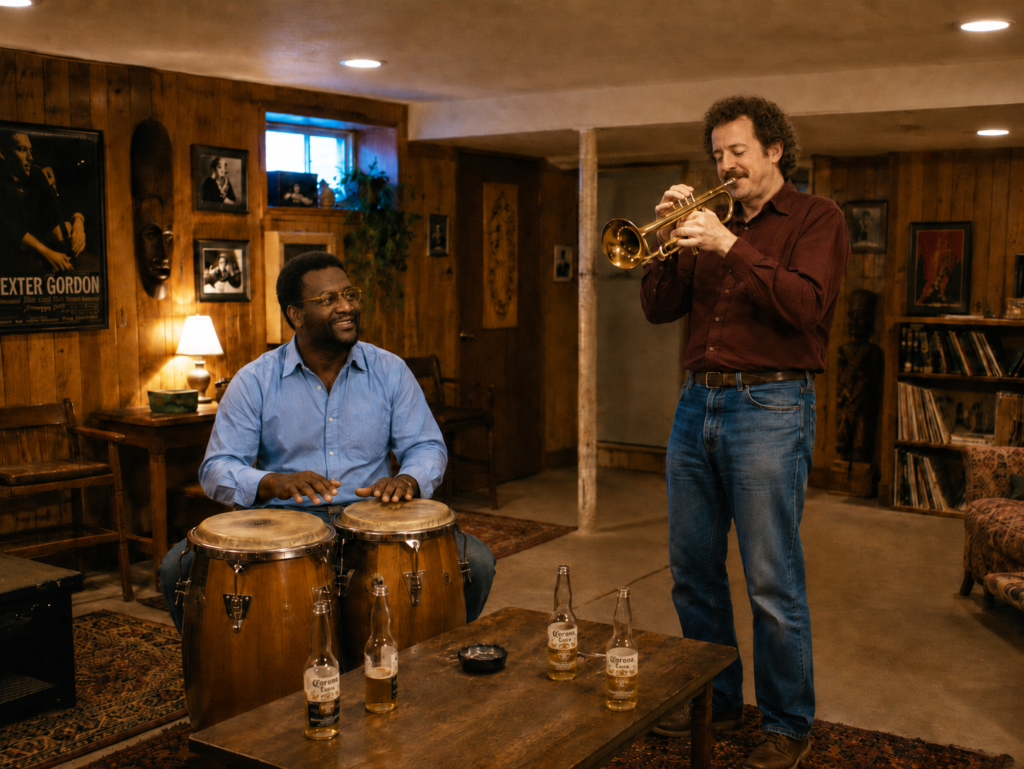
It was an ordinary Sunday evening in September 2030. Doc and Ade were relaxing after jamming, listening to a new Los Muñequitos CD, sipping rum and coke – or was it piña colada’s? maybe Corona Extras – and talking about this and that. Ade mentioned that his students liked the piece Doc had written about the magic of the bell, and,that led them to the groove, community, how the world’s changing, and then the secretive Society of the Iron Crown. Ade was a high-level administrator at Van Der Heyden University. Doc was a good friend; he’d been on the faculty, didn’t make tenure, so he’d become a freelance writer while continuing his research.
“A secret society, on campus?”
“Yeah, just heard about it,” Ade remarked. “It’s new. Some kind of pipeline to Silicon Valley.”
Doc: “Oh?”
The rise of AI had changed everything. Job prospects were uncertain, students were more transactional than ever. That’s why Ade liked that percussion class he was able to teach through the music department.
“Gets away from A.I. You have to hit the drum yourself.”
“Amen.”
With that Doc went off on how current AI had taken the wrong path. Just as he was ramping up his standard rant on the neglect of Miriam Yevick’s work, of his own teacher, Dave Hays, of super-scaling and [explicative deleted] LLM hype, that’s when Ade got “the vibe.” That’s what they called it, the vibranium vibe. It was a message from The Mystic Jewels, a group Ade had joined a couple months after he’d become a priest of Changó. A year later the Jewels tapped Doc for his research.
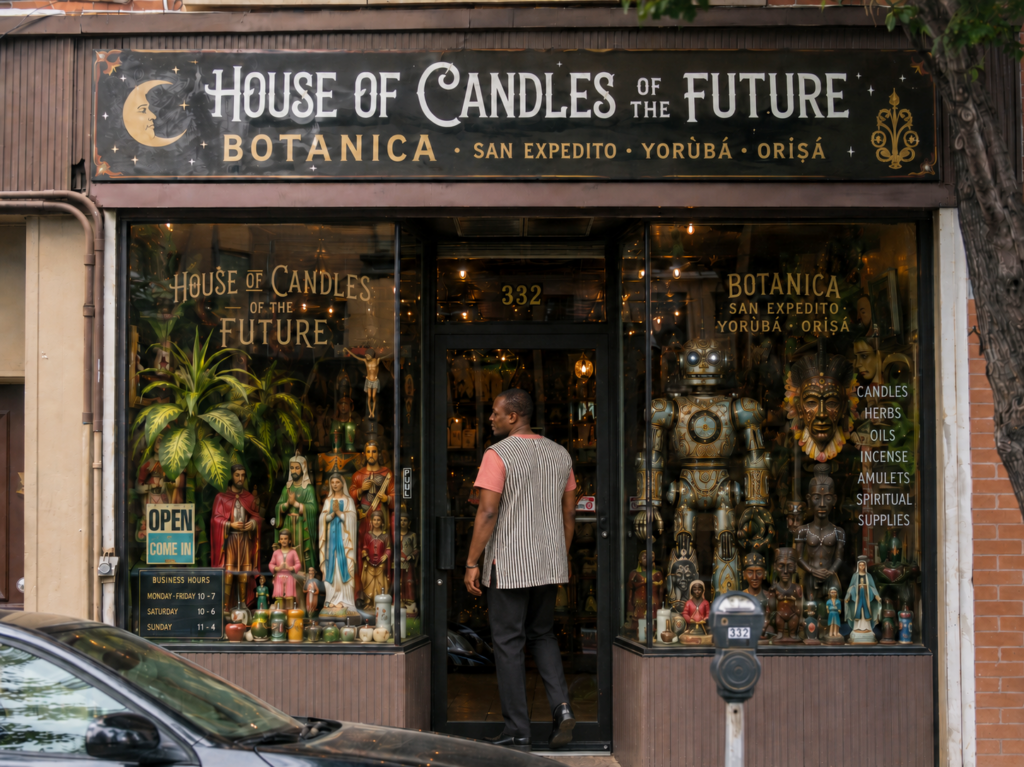
Things had been sketchy for a while. Doc had begun collaborating with a guy in Frankfurt and Ade was busy at school – start of the new year, freshman orientation, lots to do. And then comes the vibe. Ade packed his bags, offered a libation to Eleguá, and got in the car. Doc drove him into Jersey City where he consulted with two batá masters and then drove him to his favorite botanica, House of Candles of the Future, to secure an amulet. He dropped Ade off at the PATH station and headed back upstate. Ade crossed the Hudson into Manhattan where he met with some executives at Marvel Entertainment.
“Don’t ask me, that’s what they told me. Said it’s time to start the project. I should pick up a package at Marvel and bring it with me to Kisangani.” That’s all Ade told Doc about the trip. Doc didn’t need to know more. He got the vibe. He trusted the Jewels. It would be a long flight, over 30 hours.
It certainly was that, from New York to Istanbul, Casablanca, and into Kinshasa International to pick up the final leg on Ethiopian Airlines into Kisangani Bangoka International. Jacky – his given name, only his friends called him Ade, from Adenola – boarded the plane and took a seat beside an elegant young woman, dark tobacco brown linen dress, leather sandals, good leather, well worn, a slender gold bracelet on her right wrist. After they’d taken off she opened her carry-on and pulled out a well-worn copy of Augustine’s Confessions. He was a bit startled. She gave him a quizzical look.
“Hi, I’m Jacky, Jacky Hill.”
“Nice to meet you,” with a slight accent. “I’m Beatriz, Beatriz Lacerda Moreira.”
“Brazil?”
“Yes.”
“Your book startled me a little.”
“Augustine’s Confessions?”
“Yes, my friend Doc had just been telling me about it. Said there was a startling passage in it, something about memory, something that reminded him of the work of, a mathematician, the one who proved that arithmetic was incomplete, or something, I forget exactly. What was his name?”
“Kurt Gödel?”
“Yes, that’s it.”
“I think I know the passage. It’s a famous one.”
She leafs through the book. “Here it is: ‘Great is this power of memory, exceedingly great, O my God—a large and boundless inner hall! Who has plumbed the depths of it? Yet it is a power of my mind, and it belongs to my nature. But I do not myself grasp all that I am. Thus the mind is far too narrow to contain itself.’”
“That’s it. Doc said it had something to do with the limitations of formal systems, of these chatbots and what they can do, that the hype about coming superintelligence was somehow idolatrous.”
“That’s right. Gödel argued that any sufficiently power mathematical system can contain statements that are true in the system, but that cannot be derived from the system.”
“That’s what Doc said. Humans, because they’re outside the system, can create those statements, but the system itself cannot. He said computers had similar limitations and that a mathematician named… Yevick had used Gödel’s arguments to establish contextual boundaries for effective computing.”
Now it was Beatriz’s turn to be startled. She recognized that name. Her grandmother had told her about an exiled philosopher she’d known, David Bohm. Bohm had corresponded with Yevick. She was curious about this Doc fellow that Jacky mentioned. Did he know something? She decided that it would be safer not to say anything. She noticed the calluses on Jacky’s fingers.
“Are you a drummer?”
“Yes.”
It turned out that Beatriz knew a lot about Candomblé. Jacky revealed that a couple of years ago he’d become a priest of Changó. “Ah, Xangô in Candomblé.” So they talked religion, about drums and rhythm, the atabaques of Candomblé and the batá of Santería. No sooner had they begun veering into the infinite when the plane landed, bringing them back to earth. They went their separate ways at the airport.
After Pope Leo XIV issued Magnifica Humanitas, things got interesting. Peter Thiel kept talking about the Anti-Christ as a force that is emerging to technological fears, mentioning such figures as Eliezer Yudkowsky and Nick Bostrom, not a strange pairing, but then there’s Greta Thunberg as well, not so strange in herself, but paired with the other two…interesting. At the same time social media was buzzing with the idea that Thiel himself seemed like something of an Anti-Christ, not to mention Silicon Valley itself, of which Thiel is but a single representative.
That was several years go. Since then both OpenAI and Anthropic went public, with the federal government kindly picking up some shares, even as community after community rose up in protest against the construction of server farms nearby. When OpenAI and Anthropic began having trouble meeting their fiduciary responsibilities, guess what? Bailout!! Meanwhile SpaceX managed to keep afloat by increasing its Starlink capacity and getting the government to fund vastly expensive schemes for generating electrical power in space and then beaming it down to earth. That gave Musk’s space jockeys a workout hauling tons upon megatons of equipment into space all on the government dime.
While all that was going on the job market was in chaos. It’s not so much that A.I. displaced a lot of workers, though it displaced some. But nothing worked out like it was supposed to. In some cases workers would be let go in favor of A.I. replacements and then when the A.I. didn’t work out, there’d be a frenzy to rehire some of those workers back. Those new A.I. jobs? It takes time to redesign workflows around them. Sometimes it works, sometimes it doesn’t. How can you plan a life amid such chaos?
Meanwhile the Mystic Jewels were busy at work in and on the outskirts of Kisangani. They also began to reach out to tech workers through social media, not directly, but through proxies, attracting tech workers from Cairo, Cape Town, Lagos, and Nairobi, not to mention artistes, as they are known in Nigerian English, and the occasional visionary. Before long they were joined by disillusioned tech workers from the United States, China, Japan, and India began finding their way to Kisangani. It’s as though the spirit of the Whole Earth Catalog was emerging around the world and finding its way to the Congo Basin. The Jewels established a variety of web-based business and began working on an alternative approach to A.I., one that emphasized augmenting human capabilities rather than replacing and displacing humans.
The Jewels decided the contact Pope Leo, indirectly of course. Why? For one thing there’s his interest in A.I, which he expressed in his first encyclical, Magnifica Humanitas. Moreover, he was obviously interested in Africa. Even before he became Pope, Robert Francis Prevost had visited Kenya, Tanzania, Algeria, and Nigeria, and then after, in April 2026, he went on an eleven-day apostolic journey from Algeria, to Cameroon, Angola and finishing in Equatorial Guinea. Africa was not an afterthought to this man, this Pope, this Augustinian, a group that also includes Martin Luther (before his break), Erasmus, Thomas à Kempis, and Gregor Mendel.
For Saint Augustine, Augustine of Hippo, Aurelius Augustinus Hipponensis, of the fourth century CE (or AD if you prefer Old Style), was one of the most important figures in the early Catholic Church and, for that matter, in the history of Western thought. In The City of God he staged the Church as a spiritual City, in contrast to the Earthly City. This was of prime importance to the Jewels, who feared that the Hegemony – their term for the Silicon Valley and the forces with which they had become allied – was setting out to subjugate the globe under the aegis of an all-powerful super-intelligence, a vast hollow automaton, stuffed with their unexamined adolescent angst and desire.
It was decided. They would sent word to Rome, but discretely, without tipping their hand. They decided to contact Isaac Kwadwo, aka The Kumasi Algorithm, who was cousin to Bishop Emmanuel Osei-Bonsu in Accra. He was known in the Vatican for his work through the Symposium of Episcopal Conferences of Africa and Madagascar (SECAM), which has had him traveling widely in Africa.
The Jewels had it right. Rome was interested indeed. Moreover they had someone who would make a suitable emissary, Beatriz Lacerda Moreira. She was a philosopher of mind and language on the faculty of the Pontifical Catholic University of Rio de Janeiro (PUC-Rio) when the Vatican contacted her to become a consultant the working group on language, culture and human dignity for the Inter-Dicasterial Commission on Artificial Intelligence. She was originally from Salvador da Bahia. She’d entered a small convent dedicated to Our Lady of Solitude outside Salvador in her late teens, staying for three years before she decided that she wanted to go to the university, the University of São Paulo (USP) for her undergraduate degree in philosophy and the Pontifical Catholic University of São Paulo (PUC-SP) for her doctorate.
The working group was chaired by Cardinal Domenico Ferrante, Prefect of Culture and Education, who invited her for lunch one day.
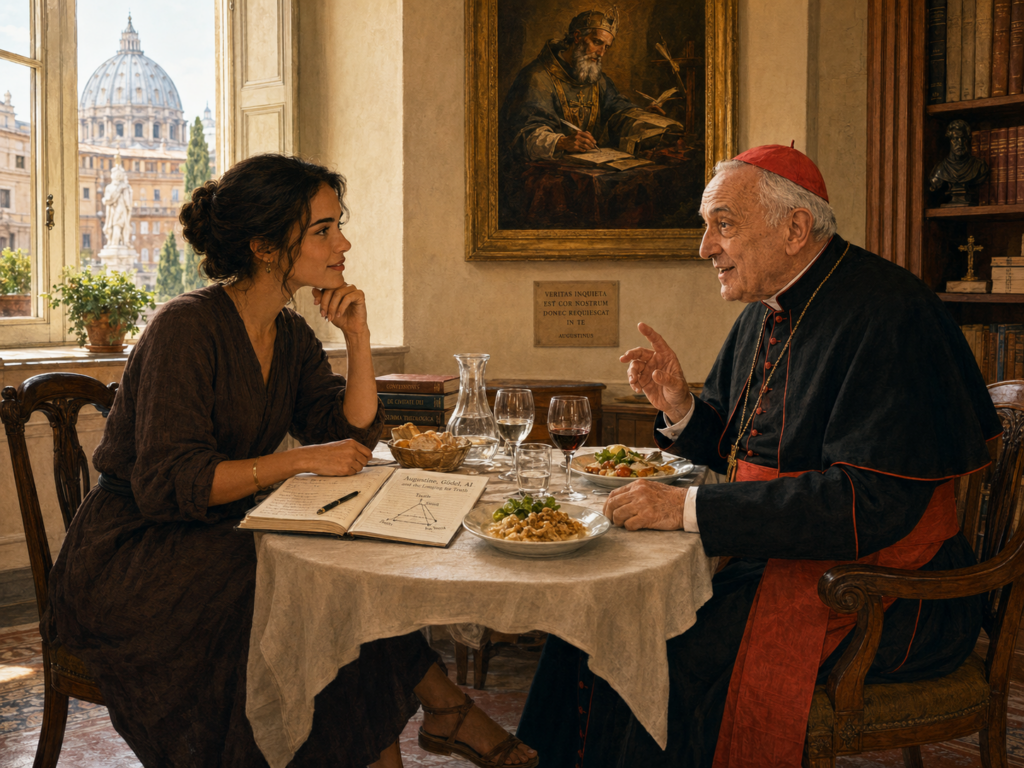
“That was an interesting piece you’d posted to your blog the other day, the conversation between St. Augustine, Pope Leo, and Kurt Gödel. How’d you come up with it? After six years at Notre Dame, the Cardinal spoke English fluently, though with a slight accent.
“Thank you, Cardinal Ferrante. I’d been thinking about my grandmother, who used to tell me about this physicist she knew. He’d been exiled to Brazil in the 1950s.”
“You mean David Bohm?”
“Yes, that’s him.”
“Didn’t he write about the implicate order of the universe, how everything is related to everything else?”
“Yes. When my grandmother knew him he hadn’t gotten that far. But he’d been corresponding with a now forgotten American mathematician, Miriam Yevick, about quantum mechanics. Anyhow she later did some work on the limitations of computing that involved Kurt Gödel.”
“The mathematician who wrote about incompleteness?”
“Yes. Any mathematical system that is sufficiently rich is necessarily incomplete” – the Cardinal looked imperceptibly perplexed – “that is, it is possible to construct statements that are true in the system but not provable within it.”
“Ah, I see, and that reminded you of Augustine, ‘the mind is too narrow to contain itself entirely. But where is that part of it which it does not itself contain? Is it somewhere outside itself and not within it?’”
“Yes, that’s it. It got me to thinking, when the mind extends itself to its limits it collapses and nothing’s left but…”
“I see. Yes. That’s what I wanted to talk to you about.” Now it was Beatriz’s turn to look imperceptibly perplexed. “Bishop Emmanuel Osei-Bonsu has just told us about some group in Kisangani in the heart of the Congo Basin. The ‘Mystic Jewels’ they call themselves, The Mystic Jewels for the Propagation of Grace, Right Living, and Saturday Night, through Historic Intervention by Any Means Necessary.” Two raised eyebrows, a broad smile, and an inaudible giggle. “I know. Anyhow, these Jewels are unhappy with the way A.I. is going.”
They’d sent a note to the Bishop in which they mentioned Beatriz’s blog. He showed it to Beatriz, who brightened as she read: “These words resonate:
To love a lower thing as though it were higher. To love one’s own power more than truth. To love the image more than the living being. To love the tower more than the city.
We sense that Rome and Kisangani are implicated in a common pattern. Do you agree?”
“Ahh!!”
“You see?”
“How would you like to visit them? We figured that with your knowledge, Augustine, Yevick, and Gödel, your Brazilian background, Candomblé, and your faith, you’d be an ideal messenger.”
After chatting some more, she accepted the commission – observe only, make no promises – then packed her bag, and boarded a plane on the first leg of her flight to Kisangani.
Kisangani, DRC, was founded by Henry Morton Stanley, in the service of King Leopold II of Belgium, in 1883 as Stanley Falls Station; it was generally known as “Stanleyville” by Europeans or as “Kisangani” by the locals. It straddles the Congo River in the eastern part of the Congo Basin, playing an important role in English literature in Joseph Conrad’s Heart of Darkness. At 1,300 miles from the mouth of the Congo River, it is the farthest navigable point upstream. It is an important commercial and distribution hub. According to Wikipedia, “before the country gained independence from Belgium in 1960, Kisangani was reputed to have more Rolls-Royces per capita than any other city in the world.” Stanleyville was renamed “Kisangani” in 1966 with the ascension of Mobutu Sese Seko.
By the time Beatriz and Ade journeyed there to confer with the Mystic Jewels – separately, though they’d chatted on the plane, they weren’t aware of their common destination – the population of Kisangani was approaching 1.9 million. Roughly 5,000 of them were Mystic Jewels, who lived in various arrangements throughout the city and surrounding areas. Many, however, preferred small compounds of 15 to 25 people living around a central open courtyard. As Ade approached one of these compounds he noticed Beatriz leaving the gate and getting into a car, but she’d been driven away by the time he arrived at the gate. She’d spent the morning conferring with the Mystic Jewels. She’d only been authorized to listen, no promises, which was all the Jewels needed.

Ade was ushered into a room in the largest building in the compound. He saw two women seated around a low table, one he recognized, the other he didn’t. He recognized Yetunde Adeyemi, an ethnomusicologist at Columbia whom he’d met at a percussion circle he occasionally visited in the Bronx. She’s the one who met him at Marvel Entertainment in New York before he got on the flight to Istanbul and ultimately Kisangani.
“Elder, this is my friend, Brother Adenola. Ade, this is Elder Malaika Oduya.” “It’s an honor to meet you, Elder Malaika.” “And you, Brother Ade.”
“As you know the Mystic Jewels arose as a response to a disturbance in Àṣẹ,” Malaika said. “The movies call it the Force, though they understand very little of it.” The disturbance has been growing steadily. We recruited you because your position at the university and your commitment to the Orishas puts you in a position to feel the shift.”
“I understand, Elder Malaika, and I feel the disturbance has been getting stronger these last couple of years.”
“Yes, Ade. That’s why we summoned you,” Yetunde remarked.
Elder Malaika continued, “Over the last half year or so we’ve been joined here in Kisangani by some researchers from Japan, China, India, and Pakistan, referred to us by colleagues in Nairobi and Lagos. They’ve conferring with our head of scientific research, Dr. Amara Lokele, and our chief engineer, Théodore Mbongi. They feel it is time for us to create a counter-force. We’re calling the project “Matrix Miriam.” Have you heard of Miriam Yevick?”
“The mathematician?”
“Yes.”
“My friend Doc, Billy Rasmussen”– “another Jewel” – “Yes. Doc’s been telling me about her work for years. Computation is not intelligence. Intelligence requires a balance between complementary regimes, holographic and symbolic.”
“Our new colleagues have been using her work to map out a program.”
“Have you brought the package from Marvel?”
“Yes,” handing it to Yetunde, who passes it to Malaika. Malaika opens the package and unwraps the enclosed box. It appears to contain a special edition character figure of Shuri – eliciting a smile from Ade – but when she opened the box it contained a small device of exquisite craftsmanship and a small document printed in strange script.
“Matrix Miriam will take years, perhaps decades, to come to fruition. We need to be able to work in secret. Our friends at Marvel have agreed to let us activate Wakanda Stealth.” – “Ah” – “That’s what the device is.”
“But the device will not function alone,” Ade offers. “It is not magic.”
“No, it is not, Brother Ade,” Yetunde offers.
“We must make an offering,” Elder Malaika intones, in a slow, steady voice. “The Wakanda field needs a human pattern to start.”
“I know that’s why you called me.”
The three of them talked for about an hour. Sometimes slowly and deliberately in hushed tones. Sometimes animated by anguish and regret. Elder Malaika led them in a chant as they held hands. The mood lightened. Ade asked for three bells, giving one to Yetunde, another to Malaika. He held a double-headed bell. He led them in a bell rhythm until the spirit tones came, the tones all could hear but no one of them played.
It was now early evening. They walked out into the compound, Ade ahead of the two women, where a circle of Jewels awaited.
Coda: Purity and Danger
Ade had been gone for a week and a half and Doc still hadn’t heard from him. He was getting worried, but Ade’s wife, Margaret assured him that there was nothing to be worried about. A week after that, however, Margaret, called him. “I was contacted by a woman at the Vatican, Beatriz Lacerda Moreira. Do you know her?” “No.” “She’d flown into Kisangani with Ade…” “That’s what she called him?” A moment of silence. Tentatively, “Yes. The Kisangani contact had passed word to her that he’s gone.’” “Gone?” “Yes, no traces, no news, no evidence of foul play. He’s just gone. ‘I’m so sorry.’”
Doc went to Margaret’s and they talked, commiserated, and wept. They knew enough about things and stuff to know that there was more to this than they could, or should, know. They started sorting through Ade’s study and came across a dog-eared copy of Purity and Danger, by Mary Douglas. When it fell open to page 178 Margaret gave a start and Doc’s face fell. They recognized the passage. It was one they’d all discussed a couple of months ago. It was about the Dinka spearmasters.
They’re a hereditary clan of priests, the most important ones among the Dinka. They mediate between the divinity, Flesh, and the tribe. It was important that the spearmaster’s spirit be conveyed directly to his successor. To ensure continuity the spearmaster chooses the occasion.
By reputation among foreign travelers this rite was a brutal suffocation of a helpless old man. An intimate study of Dinka religious ideas reveals the central theme to be the old man’s voluntary choosing of the time, manner and place of his death. The old man himself asks for the death to be prepared for him, he asks for it from his people and on their behalf. He is reverently carried to his grave, and lying in it says his last words to his grieving sons before his natural death is anticipated. By his free, deliberate decision he robs death of the uncertainty of its time and place of coming. His own willing death, ritually framed by the grave itself, is a communal victory for all his people.
Other than the passages from Augustine’s Confessions, Beatriz’s (fictional) blog post (which is my real blog post) and the passage from Purity and Danger, I wrote all the prose in this piece. As I noted at the beginning, however, this, or some revised version, is intended for my book on AI, Play: How to Stay Human in the AI Revolution. I have done considerable work with both ChatGPT and Claude in preparing that book, both the nonfiction and the fictional sections. In particular I’ve developed a complete time line for the fictional sections, though only a little of that is directly relevant to this piece, but the rest still lingers in the background. While writing this piece I had considerable interaction with both Claude and Gemini (through the Google Search interface) on matters of detail (e.g. flights to Kisangani, Brazilian background), and on issues of pace and staging. I make minor changes in response to comments by ChatGPT. ChatGPT also did the illustrations under my direction. I supplied reference photos for the first two.
Enjoying the content on 3QD? Help keep us going by donating now.