
by Marie Snyder
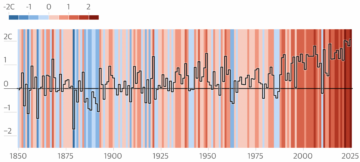 A recent article in The Guardian asked one of the UK’s top climate scientists, Professor Ed Hawkins, to bust the biggest myths about climate change. He tells us we can’t keep adapting to rising temperatures; burning fossil fuels is what’s primarily affecting climate; harvests are suffering; we’ve known the basics of all this for over 175 years, and it’s never too late to change. Does it help to clear all that up? I wonder if our reluctance to change has less to do with myths continuing to propagate and more to do with an increasingly pervasive ideology of individuality and independence. These myths might just be a way to rationalize our desire to be oblivious to our effects on one another.
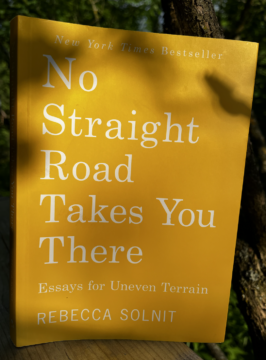 I always enjoy Rebecca Solnit’s writing, and her 2025 book, No Straight Road Takes You There: Essays for Uneven Terrain is no exception. The essays start with the need for a long view when we try to enact change, and she touches on several issues including democracy, masculinity, abortion, covid, and climate change, leaving us with some hope at the end. The thread I want to pull on is a much needed shift from a simplistic “us vs them” way of thinking into more complexity and nuance that comes with the acceptance of our necessary interconnectivity. I can’t help noticing some parallels with psychiatrist Frank Yeomans’ Transference-Focused Psychotherapy, which might imply that our personal development is important for the sake of the world. Maybe funding therapy would save the planet!
SPLITTING: The problem with clarity, certainty, and comfort.
It’s comfortable to have two clear sides to any issue or between groups and to know which side to root for. We like to have certainty and predictability in our world. It’s comforting when things are clear and stable. Old Westerns and WWE and cheering for our favourite sports team all play with a good vs evil narrative that’s familiar. We can get a sense of belonging from just wearing the colours of the home team. We bank on stats and polls and other bits of data to arrive at conclusions about each side. Even if our team or our politician of choice loses, there’s still a solace that we’re on the right side and can commiserate in good company. Solnit explains that it can be so painfully distressing to experience the tension of ambiguity that we’ll rely on the most dubious evidence for backing.
“When it comes to real life, this state of unknowing is both normal and so wildly uncomfortable that we engage in foolish and delusional imitations of knowing, whether it’s trusting untrustworthy authorities or making pronouncements about outcomes with no particular basis in fact, knowledge, or history.”
Our desire for predictability can prevent us from questioning our stance or attempting to change even when it’s vital for our survival. We sometimes choose a side and stick to it, ignoring the nuance of positions and the possibility of harm in part just to have that decision off our plate, rationalizing our stance if need be. Everything is simpler when we can look for signs revealing which side someone’s on and judge them accordingly. (Wait, is a Canadian flag on the back of a pickup truck good or bad now?) This tendency towards the comfort of black and white thinking is vitally important to consider at this point in history. We’ve been living through constant change, often imperceptible, but climate change’s effects will require overt adjustments. Solnit cautions,
“We are leaving behind our old familiar world whose stability we can remember as a great kindness and entering into a rough new set of circumstances. Like refugees leaving a place, we are leaving a time. What should we carry with us? … What will sustain us through this period?”
Frank Yeomans has a compelling take on this type of divisive perspective that fosters clarity and certainty. He calls it a paranoid-schizoid organization. It’s common and harmless in small doses; the problem comes when we get stuck there. His theory suggests it’s our infantile state of being, and something we need to grow out of:
“In the early year and a half of life, as it is posited, experiences with the caretakers by the infant are seen as either perfectly satisfying or totally depriving because there’s no concept of object constancy. If you’re being caressed and fed and kept warm and cozy, you’re in heaven, but if you’re uncomfortable, you’re cold, you’re hungry, you’re soiled, and the caretaker isn’t there, you don’t have this feeling, ‘Oh, I know mom will come.’ … You’re in pain. You’re suffering and you perceive the other as the source of the suffering. So you’re either in heaven or hell. … The mind is divided between the segment of the mind that’s about positive ideal experiences and negative persecutory experiences. …
If you go through life where things are either perfect or terrible, you don’t adapt well to the complexity of life. … The positive side of the split internal world is just as pathological as the negative side that’s all about paranoia and rejection and harm because the positive side doesn’t correspond to reality. You never find the perfect caretaker. No matter how much you’re in love with your partner, they’re not going to be perfect. …
It’s called schizoid because it’s split. It’s called paranoid because in that mental organization where fondness and aggression are totally divided, the person experiencing aggression is not comfortable seeing himself or herself as the source of the aggression. They tend to project the aggression and see it as coming from outside. So as soon as you begin to get close to somebody, you’re nervous because you think something bad is going to happen. … Splitting allows you not to think as much. Splitting is simple, but in a way it’s reassuring when your mind functions according to splitting. You know what’s good and you know what’s bad. There’s no ambiguity. …
You can allow yourself to regress, to forget about all the complexity of the world … enjoy that for two hours. The problem is that political leaders can appeal to splitting when they say we’re all good; the only problems are outside of our group. Everything bad is outside. … The system breaks down because in that tribe mentality, people are not taking responsibility for themselves, but only blaming the other, and then when you get enough of that going on, somebody’s going to get into violence, and it’s going to fall apart.”
I wonder how much of perfectionism and rejection sensitivity can be framed through the lens of operating from this earlier splitting phase of life. Either we’re successful or a failure, and either people love us fully or hate us completely. Either you’re with us or against us. The projection of aggression helps to understand the sense of increasing fearfulness of one another that can come out as actual rage against others: Canada’s Freedom Convoy, ICE’s itchy trigger finger, the US invasion of the capital, and an undisguised defensiveness in people ready to fight against any request to share or have compassion for others.
At the start of the anti-vaccine protests, I had a handful of students in my civics class insist that nothing should impede anybody’s freedom ever. I countered that all laws impede freedoms, and we had a discussion about freedoms to and freedoms from and the delicate dance to find the best landing spot between them. But it was unnerving to me how quickly some had bought into the extreme individualism idea that the best society is a society in which we each survive on our own, and we should be allowed to do anything we want, which is the absolute antithesis of civilization. It’s a simple narrative, often presented with unwarranted confidence: Freedom is the cowboy with the white stetson, and responsibility and compassion and care are part of the posse that’s threatening to burn down our farm. It’s me against the world! I’m not sure I changed their minds.
INTEGRATION AND INTERCONNECTIVITY: The importance of caring and community.
Solnit points out that we once thought trees competed for light, but now, with Suzanne Simard‘s work, we know they work together to share resources. We’re slowly recognizing the network of cause and effect that we’re each a part of. If we can acknowledge that we don’t live separated from the world, but are of the world, then we have to recognize our impacts on virus transmission, world hunger, climate change, and so many other issues we’re facing or trying to ignore. Solnit questions if our political factions should be renamed to reflect this key marker: “Isolationists and interconnectionists might be more useful terms for the political divides of our time than left and right. … You could describe the position as: ‘Nothing is mutual, there is therefore no justification for aid” (53). And later,
“A lot of why the right doesn’t ‘understand’ climate change is that climate change tells us everything is connected, everything we do has far-reaching repercussions, and we’re responsible for the whole, a message at odds with their idealization of a version of freedom that smells a lot like disconnection and irresponsibility. … Recognizing the reality of climate breakdown means recognizing the interconnectedness of all things. That connection brings obligation: to respect nature, to build domestic regulation and international treaties that protect what’s needed, to negotiate the freedom of the individual in the name of the well-being of the collective. That is, of course, a worldview in direct contrast with free-market fundamentalism and libertarianism.”
Solnit points to the crafted message that all crime and trouble comes from outside, which allows the powerful to demonize targeted groups of people. We’re still stuck in a version of the American Dream that fosters the ‘achievement society’ values that adhere our worth to our capacity for production and consumption. If we have no sense of mattering to the world in our own right, of having inherent worth, we will need to continuously prove our existence is valuable with accomplishments and acquisitions. This misses the million tiny ways we each affect one another. It also means, as Solnit says, “If you equate your wealth with virtue, you tend to equate poverty with vice.”
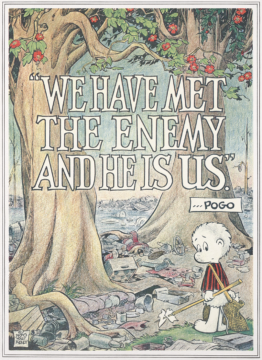
For Solnit, the sense of predictability in the world, the illusion of knowing, provides “a false certainty that excuses inaction. Whether you feel assured that everything is going to hell or will all turn out fine, you are not impelled to act. … Not acting is a luxury those in immediate danger do not have.” Solnit provides many examples of people who appear to be powerless nevertheless changing the world over and over. It’s historically demonstrated to be possible, but our short-sightedness makes us wary of following a path that’s been overgrown. She says,
“We have been making short-term decisions for a long time, and the consequences have arrived. … People without much sense of history imagine the world as static. They assume that if the present order is failing, the system is collapsing and there is no alternative. A historical imagination equips you to understand that change is ceaseless. … The rescuers we need are mostly not individuals, they are collectives — movements, coalitions, campaigns, civil society.”
Yeoman’s transitional stage out of the schizoid-paranoid organization is called the depressive organization, which is the preferable place despite its name:
“If you integrate those two radical polarized extremes, two things happen. One is you have to give up and you have to mourn your belief that you can ever find the ideal other or that you can ever be the perfect ideal self. You have to give up on thinking anybody can be ideal, and that’s kind of a sad awareness. The second thing that happens when you begin to integrate your positive and negative emotions is that you begin to have an awareness and take some responsibility and consciousness for the aggressive feelings you always saw as outside of you. It’s a painful trajectory from splitting and projection to integration and mourning the ideal object, and accepting that one has one’s own aggression. … In other words, does your identity allow you to assume and connect with the full range of who you are as an emotional being.”
There’s a grief that comes from realizing we were on the wrong path, and the ideals we hoped for were attached to inevitably fallible human beings. As that fantasy turns to dust, we need something else in its place. Yeomans clarifies a point he made that’s been previously misunderstood about where to look for ideals:
“Here’s what I said about religion, philosophy, and art, which is that that’s where you can idealize. … I don’t think you’re not allowed to have ideal beliefs, ideal values. They might be embodied in a spiritual system, an ethical system, an artistic pursuit, an aesthetic pursuit. So I think ideals are laudable, but look for them where they might exist, and not in another person or oneself.”
We have to look outside ourselves and other individuals for values and ideals. We need religion, philosophy, or art, or something to help us find the better path instead of glorifying the words of a politician, MVP, or influencer.
A couple years ago I wrote about the move over centuries from following religion to modernism to post- then meta-modernism, and Charles Taylor’s concern with our flattened horizon and lack of shared values. It’s a tumultuous trek to give up what’s familiar and comfortable in order to enable and enact change:
“From the pre-modernist time to now, we were encouraged to serve religiously, then to discover scientifically, then to grasp for all we deserve commercially, and now we need to recover a hierarchy of secular values that encompass more than ourselves. The problem with this retrieval of values is that we run into internal conflict and anguish – if we’re willing to acknowledge it – as we recognize how much exploitation we have become accustomed to in virtually every aspect of our lives. When we encounter cognitive dissonance as we recognize an internal inconsistency between how we think of ourselves and how we actually live, we have the choice of changing it or using defence mechanisms to protect ourselves from it. We’ve taken the latter route for long enough to destroy our planet in the process.”
We’re at a daunting yet privileged point in the timeline of our species in that we’re aware of the choices on the table and where they might lead. It seems like it’s up to us to see ourselves as part of the cause and effect of it all in order to be willing to work through the grief and anguish of changing direction.

Solnit’s hope for us comes with a description of the Hindu goddess Akhilandeshwari, which translates to “She Who Is Never Not Broken.” She discusses the meaning as it was explained to her:
“‘The whole is finite; in our brokenness we are infinite.’ I think she means that being perfect, being whole, means being sealed and shut off in some way, being that version of complete that needs and welcomes no more. To be broken is to reach out, to be open, to be incomplete and therefore to welcome outside in. Maybe a break opens up room for yearnings as reaching beyond.”
The illusion of completeness and perfection means we don’t need anyone else or we shouldn’t need anyone else, which merely keeps us separated and isolated. The alternative is to embrace imperfection, uncertainty, and the incompleteness of the self that leads us towards interconnection with others, in solidarity, in order to build a more compassionate future, or maybe even the only possible future. When we see ourselves as just a piece in a larger puzzle, it gives us the impetus to join together, the space to welcome what comes next, and the courage to step into the unknown.
Something like that.
Enjoying the content on 3QD? Help keep us going by donating now.