
by Eric Feigenbaum
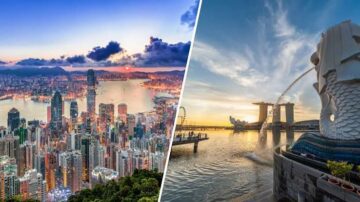
In a sense, you could say Sir Stamford Raffles not only came up with the idea for Singapore, but also for Hong Kong. In the early 19th Century, Raffles – the imperial strategist tasked with safeguarding British passage to and from China – realized the best way to fulfill his responsibilities was to eliminate the Dutch as a commercial and military rival along the passage from India to Malaysia.
During initial scouting missions, Raffles’ eye turned to Singapore as an ideal naval and commercial port, not only along the route from British India to Imperial China, but at a crossroads of international trade. In 1821, Raffles – with the persuasion of thinly veiled threats – signed a treaty with Malay leaders Sultan Hussein Shah and Temenggong Abdul Rahman giving a practically uninhabited Singapore island to the British Empire.
Taking the unprecedented step of making Singapore an Open Port – without tariffs or taxation – was the stroke of brilliance that truly launched the new colony and usurped the Dutch port of Malacca.
Raffles wasn’t personally involved in the British acquisition of Hong Kong Island following the First Opium War in 1841, but the Empire was taking the logical next step from the new playbook he introduced. A second island-based Crown Colony in the Far East secured Britain’s dominance not only over trade with China but over any other Western naval power with presence in Asia.
From that point, many observers loved to play “A Tale Of Two British Colonies” – usually drawing many parallels between Hong Kong and Singapore. At first glance, it seems obvious – two islands with predominantly if not exclusively Chinese populations, open ports, centers of both trade and naval power, free-market capitalism and most significantly, an organic synthesis of Eastern and Western cultures.
Hong Kong in particular, was the Wild West of the East when it came to capitalism. Britain placed fewer rules and controls on the crown colony allowing it to burgeon over time into a city arguably more modern and advanced than London. Certainly, Hong Kong became to Asia what London was the Europe and the Americas in banking and finance.
Singapore’s economy, on the other hand, stayed closer to its role as a port city with ship building and repair, shipping, trade and naval bases comprising most of its economy. It didn’t amass the kind of capital Hong Kong did.
That’s because, almost counterintuitively, China’s conservatism and xenophobic nature – both under the Qing Dynasty and later under the People’s Republic of China – gave Hong Kong the rare opportunity to play entrepot between a flourishing free-world and a closed, stagnating economy in a country with vast resources. Under the right circumstances, playing the middleman can be quite lucrative.
Once Singapore became independent in 1965, it could no longer rely on the economy the British has established there.
As Founding Prime Minister Lee Kuan Yew explained:
How was an independent Singapore to survive when it was no longer the center of the wider area that the British once governed as one unit? We needed to find some answers and soon, for unemployment was alarming at 14 per cent and rising. Furthermore, we had to make a living different from that under British rule. I used to see our godowns filled with rubber sheets, pepper, copra and rattan, and workers laboriously cleaning and grading them for export. There would be no more imports of such raw materials from Malaysia and Indonesia for processing and grading. We had to create a new kind of economy, try new methods and schemes ever tried before anywhere else in the world, because there was no other country like Singapore. Hong Kong was the one island most like us, but it was still governed by the British and it had China as its hinterland. Economically it was very much a part of China, acting as China’s contact with the capitalist world for trade with non-communist countries.
There was also the matter of talent – something Singapore’s early leaders frequently discussed. Singapore spent 144 years under British rule with a lax immigration policy, allowing migrants from a plethora of Chinese provinces and the Malay Peninsula to meet the colony’s ever-growing need for labor. Additionally, the British brought in a substantial population of Tamils from British India largely to work in government roles from administrators to law enforcement. These transplants were already educated in English and the Empire’s bureaucratic systems.
Thus, when Singapore gained its independence, its populace was largely poor with an average education. Many people only spoke their “mother tongue” – which for the Chinese ethnics frequently meant the regional dialect of their family, not Mandarin. Even among the Chinese, there was not a unifying language.
In Hong Kong, China’s tragedy had become the colony’s good fortune. Again, Lee explains eloquently:
When the communists “liberated” the mainland in 1949, with the influx of some 1–2 million refugees from China had come some of the best entrepreneurs, professionals and intellectuals from Shanghai and the provinces of Zhejiang, Jiangsu and Guangdong. They formed a thick layer of talent that was to transform Hong Kong into one of the most dynamic cities in the world, helped by the more enterprising and resourceful of the Chinese workers who had decided to leave China rather than live under communist rule.
To the world at large, Hong Kong and Singapore are two similar Chinese cities of approximately the same size. To me there were as many contrasts as similarities. Hong Kong has twice the land area and twice the population packed on the island, Kowloon peninsula and the New Territories. Hong Kong had a bleaker economic and political environment in 1949, totally dependent on the mainland’s restraint. China’s People’s Liberation Army could march in any time they were ordered to. But despite uncertainty and the fear of a disastrous tomorrow, or the day after, Hong Kong thrived.
Singapore did not then face such dire prospects. I was relieved we were not living so precariously under such intense pressures, as Hong Kong was. Even after Malaya became independent in 1957, Singapore was still linked economically and physically to the peninsula, with people and business to-ing and fro-ing. Only in 1965, after we were asked to leave Malaysia, did we face as bleak a future. But unlike Hong Kong we did not have a million and a half refugees from the mainland. Perhaps if we had, and with them had come some of the best entrepreneurs and the most industrious, resourceful and energetic people, we would have gained that extra cutting edge.
Eventually, Singapore did get its chance to gain some of that talent. In the wake of the 1997 handover of Hong Kong to China, Singapore made its move. Much of Hong Kong’s elite were shopping for a new, safer home and Singapore opened the doors for easy and expedited immigration for them.
Not all seeing the value of the strategy, many Singaporeans became nervous, prompting Lee to explain in an address:
The practice of immigrating foreign talent is for the sake of Singapore’s economy, society, and politics, and will not disadvantage any Singaporean climbing the social ladder… If we do not capture these talents, our neighbors will, or they will go to Canada, Australia, and the US, and we will miss a historic window to upgrade our entire economic matrix.
Over time, the Lee Kuan Yew’s original view of Hong Kong being different from Singapore because its “hinterland” of China has changed. Between China’s incredible economic and social changes and the erosion of Hong Kong’s special status, Singapore has played an increasing role as a connector between East and West. In particular, while Hong Kong’s legal system that was modeled after British Common Law and property rights deteriorates, Singapore remains a beacon of safety for investors and businesses around the world.
Moreover, the flow of physical goods through either country is far less significant than three generations ago. Finances and banking play larger roles – and more novelly, intellectual property and scientific research.
This has in turn given Singapore an edge that Lee could never have imagined in 1965.
As a result, Hong Kong and Singapore have increasingly been seen in rival roles – something Singapore now seeks to downplay in the interest of good relations with its many trade partners.
In a 2020 interview, then Prime Minister of Singapore (and eldest son of Lee Kuan Yew) Lee Hsien Loong said:
I have never looked at Singapore’s relationship with Hong Kong as an intense rivalry… Hong Kong has its advantages being on the doorstep of China. Singapore has a different set of advantages, being in the middle of Southeast Asia and with a broader footprint. On balance, I would say I’d much prefer Hong Kong doing well, and to have people looking for places to go out of Hong Kong.
Current Prime Minister Lawrence Wong took a slightly more acknowledging stance recently:
The media like to play up the rivalry between Hong Kong and Singapore… As global cities and financial hubs, Singapore and Hong Kong share many similarities and challenges… The occasional rivalry between Singapore and Hong Kong is a healthy one that ultimately benefits wider global trade.
Interestingly for Singapore, over time its independence– which put it in a significant bind at the beginning of its national history – has come to pay unexpected dividends. The generations that have built Singapore since independence didn’t do so with Hong Kong in mind. It wasn’t even considered an option to try to eclipse Hong Kong. But a well-designed, trustworthy system worked for Singapore.
In 1965, Hong Kong’s Per Capita GDP was 31 percent higher than Singapore’s. Today, Singapore’s Nominal Per Capita GDP is 80.6 percent higher than Hong Kong’s and PPP Per Capita GDP is 106 percent higher. Singapore ranks 4thglobally in Nominal Per Capital GDP and Hong Kong 28th.
From that perspective, there is no rivalry at all.
Enjoying the content on 3QD? Help keep us going by donating now.