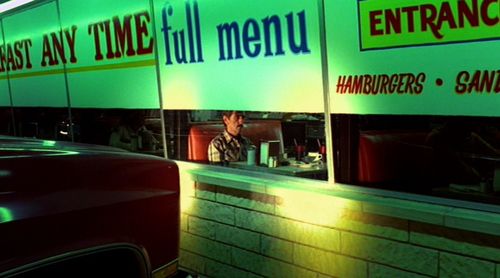
Many reviews of Paris, Texas open by describing of the condition and provenance of Travis, its wayward middle-aged protagonist. Though this isn't a review per se, I will uphold the proud tradition nonetheless: Travis shambles into the film from a barren, near-surrealistic desert landscape, allegedly on his way back an extended impromptu stay in Mexico. He's also a scruffy disaster, masked by a scraggly beard and battered baseball cap, walking on, more so than in, a pair of boots that no longer merit the name. He appears to understand little. He says even less.
Such a setup could be taken in hundreds of different tiresome directions. The story of a enigmatic outsider, perhaps, uninitiated in entrenched human mores, who, by way of his noble naïveté, inadvertently strips the ludicrous facade from the cesspool of hypocrisy and parochialism we have short-sightedly come to call civilization? How about a gimmicky yarn revolving around a taciturn Man With a Past, a tale whose teller manipulatively keeps the audience on an artificial drip-feed of detail, delaying as long as possible the exposure of this figure's preposterous, baroque backstory to the harsh light of day? Maybe a lazy odyssey of the bizarre, where the fellow continues to shamble silently through an interminable series of haphazard, dissociated words and images, leading viewers into an interpretational wild goose chase?
From the moment Travis breaks his isolation and crosses into some semblance of a built environment, the possible disastrous creative choices blossom, almost eclipsing from view the possible successful ones. By some miracle combination of calculated cinematic risk-taking and sheer bravado, Wenders and his collaborator, the redoubtable playwright Sam Shepard, pull the film through unscathed. Given that the final product contains both a precocious child actor and no fewer than two interstate road trips, Shepard and Wenders' indisputable victory over cliché looks even less probable, but it shines right there onscreen nonetheless.
 “Monster … not one with the blowing clover or the falling rain.” That's what Ralph Waldo Emerson says.