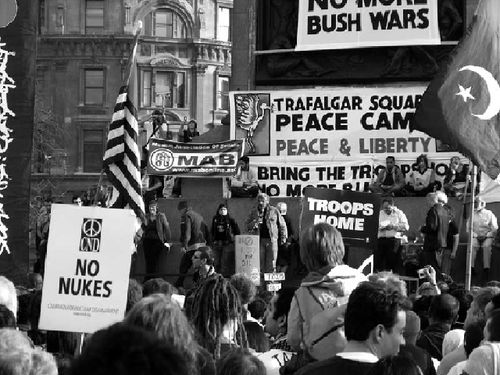
Maniza Naqvi: You have spent a lifetime leading political, anti war and socialist activism through demonstrations, protest marches; political articles, books, lectures, interviews, and speeches . You have spoken out in all sorts of forums ranging from university settings to the streets during anti war demonstrations. You are noted as the leader of the Left in Europe. You’ve been a hero and example for many of us. So, in all of this, where does writing novels fit in? You have now written five novels, two of which I absolutely loved reading: The Book of Saladin and Shadows of the Pomegranate Tree.
Tariq Ali: I started writing fiction in 1990. Why? I don't know. I felt like it but recently on a trip to Pakistan I came across a letter I'd written my mother in 1966 or '67, soon after leaving Oxford. I was quite surprised because I'd written that I was thinking about writing a novel. I have no memory of what I might have been thinking of…then 1968 happened and swept our generation away into the utopian wilds. It was the end of that period that started me thinking of fiction again. I had written plays and film scripts in the 80's and early 90s. So a full-scale novel was not such a huge leap forward.
Maniza Naqvi: What draws you to fiction? Can you place the role of fiction writing in your life?
Tariq Ali: Shadows of the Pomegranate Tree was begun in 1991 after the first Gulf War. I wanted to excavate the history of European Islam and went, naturally, to Spain. Here I saw the Great Mosque in Cordoba, went to Granada, wandered round Seville and imagined the ruins whispering to me…stories of their past and those who had built them. So I imbibed the atmosphere and wrote the first novel of the Quintet. Edward Said read it and liked it and said: 'Don't stop now. Tell the whole bloody story.' He meant the whole bloody story of the clash between Western Christendom and Islamic Arab civilization. So I did and it was Edward who first started referring to it as the Islam Quartet, which soon became a Quintet. Writing these historical novels became the centre of my intellectual life till 9/11 and the wars in Iraq and Afghanistan. Reality dragged me back to non-fiction which I had more or less given up. Now I do both, but to write fiction I have to cut myself off completely from everyday life which isn't easy. Had the US agreed to the bombing of Iran I might not have been able to finish the Quintet.