For those of us that write about the periodic table for a living, the gap at 117 was doubly galling. First, every element through 116 had already been discovered, as well as element 118. (To be accurate, the elements through 92 had been discovered, and the elements after that created, in a lab, since the days of getting your fingernails dirty looking for new elements in nature ended about 1930. The ultra-heavy elements never existed before people created them, unless in the labs of alien scientists somewhere distant.) Anyway, the gap at 117 violated a sense of order, since we like things to start at 1 and progress to N without skipping around. That for technical reasons it’s easier to create even-numbered elements like 116 and 118 couldn’t salve our aesthetic sense that something was somehow wrong with there being a gap for ununseptium.
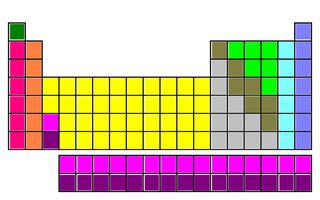
Second, the gap was galling because the periodic table was just one box short of completing its seventh row. Because of the way electrons stack themselves inside atoms, the table always has eighteen columns; but the number of rows changes, and grows fractionally longer with each new element. And it was frustrating (at least for some of us) to be sitting on 6.96875 rows (6 and 31/32) for years, so close to 7.00000. Ununseptium fulfills the table, squares off the bottom row. It just looks better now.
We can find even more satisfaction because the beauty here isn’t arbitrary human beauty. The tidiness doesn’t depend on our senses or our accidental circumstances on Earth. For example, it’s human convention to celebrate turns of millennia or 100th wedding anniversaries because we like to see zeroes. Really, that’s just an accident of our base-ten counting system, because numbers like 200 and 2,000 look good in that system—those pleasingly geometric circles (or at least ovals) stacked at the end, and the sense they give of having turned from one era to another. But if we had seven fingers, 100 would be written as (in base-seven counting) “202”; 1,000 would be “2626”. Had we thirteen fingers, they’d respectively be “79” and (because we’d need more digits than 0 to 9 in a 13-digit system) “5BC”. So there’s nothing inherently special about those numbers, just the numerals.
The beauty of the periodic table isn’t constrained by our metatarsals. Everywhere in the universe, the basic periodic system is exactly the same. Perhaps not jotted down in the castles-with-turrets shape we humans have come to favor, but in every civilization that ever discovered the periodicity of atomic structure, the spiral or chart or hologram or whatever would naturally pause after 118 elements, would rest as a cycle completes itself. No matter how someone counts or reckons, 118 is a special number among elements, a millennial anniversary built into nature, as universal as π.
 It's easy for a Westerner to get the impression that everything a North Korean citizen might see or read or hear, every piece of culture they might encounter — paintings, stories, sitcoms — is, in some way, propaganda. How true is that notion?