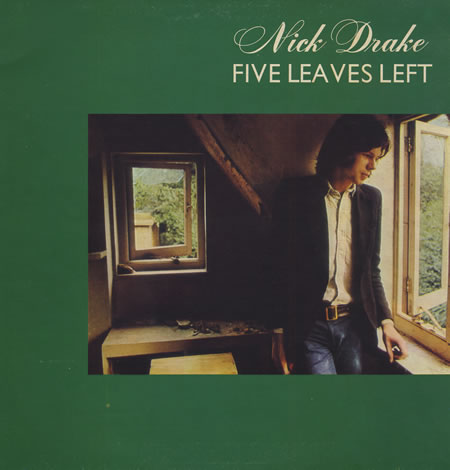
On September 1, 1969, the English singer-songwriter and guitarist Nick Drake made his recording debut as his album Five Leaves Left shipped to record stores. Released on producer Joe Boyd's Witchseason label with backing by members of Fairport Convention and string arrangements by Harry Robinson and Drake's Cambridge chum Robert Kirby, the album stands as a haunting, pastoral portrait of the 21-year-old artist as a very young but startlingly musically adept young man. In the four decades since, the record has enchanted new generations of listeners and made insatiable Nick Drake fans of many.
Colin Marshall originally conducted these conversations with Trevor Dann, Patrick Humphries and Peter Hogan, authors of the three books published about Nick Drake, to celebrate the 40th anniversary of Five Leaves Left's release on the public radio program and podcast The Marketplace of Ideas. [MP3] [iTunes link]
* * *
Writer, broadcaster and head of the UK Radio Academy Trevor Dann is Nick Drake's newest biographer, having released Darker than the Deepest Sea: The Search for Nick Drake in 2006.
Can you give us a little background of the musical context of September 1969, the musical world in England into which Five Leaves Left was released?
 I think that's a really good question, because people who write about the history of music tend to always concentrate on what was very popular at the time. They forget that there are always substantial undercurrents and smaller genres going on. 1969 people think of as being the year of the first Led Zeppelin album, the year of Woodstock and loud stuff, but aside from that there was a great fashion for rather bespoke, melancholy, quite, folk-y acoustic stuff.
In America, that was John Sebastian at Woodstock. In England, it was the folk revival of people like Cat Stevens. That's the genre into which Nick Drake's music fell, and it was a small market. It was not very popular. It became highly influential, but at the time, it was written about and talked about by the opinion-formers in music of the time.
Because so many of Nick Drake's current fans were, of course, not even around when his music was initially released, how different or similar was his music to that subgenre?
If you went back in time 40 years and switched the radio on, you would hear more music of the type you hear on Five Leaves Left than we now hear. I think that, although it's one of the great timeless records, it's nevertheless of its time more than historians think.
If you were listening to the John Peel show in England at the time, although you did hear what we would call rock music, even hard rock music, you also heard a lot of that kind of thing: John Martyn, even a rock band like Jethro Tull did a lot of acoustic-y kind of work. People were experimenting with what happened when you turned things down, after some years of experimenting with what happened to guitars and other instruments when you turned them up. Although it's become very timeless, I don't think it was as unique a sound as we now think.
I suppose this is the question Nick himself became obsessed with, but if it did fit into a genre, why didn't Five Leaves Left succeed as well as the average release in that genre?
Two simple reasons. One was, he didn't promote it. Even in those days, you had to make some kind of effort, even if your record wasn't being played much on the radio, even if you didn't have a single that could get you in the charts, you had to tour. And he hated touring. He tried it once or twice; he didn't like it. He was playing a kind of music that was very difficult to play in the student common room and at free festivals in those days, because amplification simply wasn't good enough.
He just didn't have the temperament, partly because he didn't have a very loud showbiz personality. Secondly, to be honest with you, he was rather arrogant about his music. I think he felt that it deserved to be listened to, and he didn't work hard enough to win an audience; he assumed that audience should be there for it.
The second reason is the number of problems the record had. It was promoted before it was available in the shops. The sleeve notes don't fit the track listing. The distribution wasn't very good. There were a lot of other technical reasons which meant, having committed everything he'd got to what he thought was this great work of art… it was like being Van Gogh. He'd given everything he could, and he wasn't popular. He hadn't made it. That was one of the reasons why he turned in on himself.
Read more »